Cómo la Temperatura de Color Afecta el Estado de Ánimo y la Productividad
Resumen ejecutivo: La temperatura de color (CCT) es más que una apariencia: es un control de rendimiento. La luz más cálida (≈2700–3000 K) favorece la relajación y la recuperación; la neutra (≈3500–4000 K) equilibra la colaboración; la más fría (≈4000–5000 K y superior) aumenta el estado de alerta y la precisión visual. Cuando combinas la CCT adecuada para la tarea con una iluminancia vertical en el ojo, robusta calidad de color (TM-30), y bajo parpadeo rendimiento del conductor (IEEE 1789; Pst LM/SVM), puede mejorar notablemente la comodidad, concentración y resultados en lugares de trabajo, comercios, educación, salud y producción.
Introducción
Si el trabajo se siente lento, las reuniones se arrastran y la creatividad se estanca, el problema podría no ser tu gente, sino tu luz. La iluminación no es solo estética; es diseño basado en evidencia que moldea cómo las personas sienten y se desempeñan. Este artículo conecta la ciencia de la temperatura del color con especificaciones prácticas y pasos de puesta en marcha que puedes usar de inmediato, completo con estándares y un estudio de caso del mundo real.
Lo que aprenderás
- Cómo la CCT influye en las vías visuales y no visuales del cerebro
- Qué bandas de CCT se ajustan a tareas e industrias comunes
- Cómo establecer objetivos medibles (EML/EDI melanópico, TM-30, Pst LM/SVM, UGR)
- Cómo implementar blanco ajustable escenas que se alinean con los ritmos humanos
Comprendiendo la Temperatura de Color
Temperatura de color correlacionada (CCT) describe la calidez o frescura percibida de una fuente de luz en Kelvin (K):
- Cálido: ≈2700–3000 K (sensación ámbar)
- Neutral: ≈3500–4000 K (equilibrado)
- Frío: ≈5000–6500 K (azulado, alerta)
CCT es un punto de partida, no toda la historia. Los efectos perceptivos y biológicos dependen de la distribución espectral de potencia (SPD) y reproducción de color características. Para calidad de color, vaya más allá del CRI y adopte TM-30 (fidelidad Rf y gama Rg) para predecir cómo se ven los colores en rostros, alimentos, telas y acabados (IES TM-30).
Dos lámparas a 4000 K pueden sentirse diferentes: un SPD con mayor contenido rojo se siente más cálido y favorecedor, mientras que un SPD enriquecido en azul se siente más nítido y alertante.
Guía rápida de selección
| Uso Destinado | CCT recomendada | Calidad del color | Notas |
|---|---|---|---|
| Sala de estar / Área de descanso | 2700–3000 K | TM-30 Rf ≥ 85, Rg ~ 100 | Relajación y recuperación |
| Oficina abierta | 3500–4000 K | TM-30 Rf ≥ 85 | Enfoque equilibrado, baja fatiga visual |
| Cabinas de Enfoque | 4000–5000 K | TM-30 Rf ≥ 85 | Más frío para atención sostenida |
| Laboratorios / Producción | 5000–6500 K | TM-30 Rf ≥ 85–90 | Alta agudeza y vigilancia |
| Venta Minorista de Ropa / Piel | 3000–3500 K | TM-30 Rf ≥ 90, Rg ≈100 | Color preciso y favorecedor |
Hábitos accionables
- Especificar Bandas de CCT, no puntos únicos (ej., 3500–4000 K), para dejar espacio para ajustes.
- Solicitar Gráficos SPD y TM-30 datos en presentaciones; no confíe únicamente en la CCT.
- Emparejar CCT con atenuación para gestionar el brillo y la percepción juntos.
La Ciencia: Luz y el Cerebro

La luz impulsa dos vías:
- Sistema visual (bastones y conos): agudeza y percepción del color.
- Sistema no visual (células ganglionares de la retina intrínsecamente fotosensibles con melanopsina): sincronización circadiana, melatonina, cortisol, estado de ánimo y alerta.
Espectros enriquecidos con azul por la mañana avanzar el estado de alerta; espectros más cálidos más tarde en el día preservar melatonina para proteger el sueño. Para cuantificar la luz biológicamente efectiva, use métricas melanópicas como Lux Melanópico Equivalente (EML) o EDI melanópico como se define por CIE S 026/E:2018 (CIE S 026) y dirigido en el Estándar de Construcción WELL v2 (Luz) (WELL v2—Luz).
Estímulo → respuesta (pistas de diseño)

| Estímulo | Respuesta cerebral | Conclusión de Diseño |
|---|---|---|
| Blue-enriched morning light | Increased alertness, suppressed melatonin | Use cooler CCT and higher vertical illuminance after start-of-day |
| Warm evening light | Relaxation, preserved melatonin | Transition toward 2700–3000 K late afternoon |
| Alta vertical illuminance | Stronger circadian cueing | Luz at the eye matters—design for vertical lux, not just desk lux |
| Low flicker (TLM) | Reduced stress, headache risk | Specify drivers meeting IEEE 1789 and verify Pst LM/SVM in scenes |
Practical rule of thumb: Provide cooler, higher melanopic stimulus in the first half of the workday and warmer, lower stimulus toward the end—tuned to tasks, age groups, and local daylight.
Psychological Effects by CCT

CCT gently nudges emotion and behavior:
- Warm (2700–3000 K): Social warmth, relaxation, hospitality tone
- Neutral (3500–4000 K): Balanced tempo for collaboration
- Cool (5000–6500 K): Vigilance, precision, and task orientation
Mood mapping
| Desired State | CCT | Complementary Controls | Risks |
|---|---|---|---|
| Calm / Decompress | 2700–3000 K | Lower brightness, soft contrasts | Under-stimulation if overused |
| Social / Collaborative | 3500–3800 K | Moderate brightness, color-rich SPD | “Flat” if SPD lacks red content |
| Focus / Deep Work | 4000–5000 K | Higher brightness, low glare | Fatigue if too cool for too long |
| Precision / QC | 5000–6500 K | High vertical illuminance | Sterile feel if overapplied |
Context matters: Age, culture, and task difficulty modulate preferences. Gather occupant feedback and correlate with actual performance metrics.
How Lighting Influences Productivity
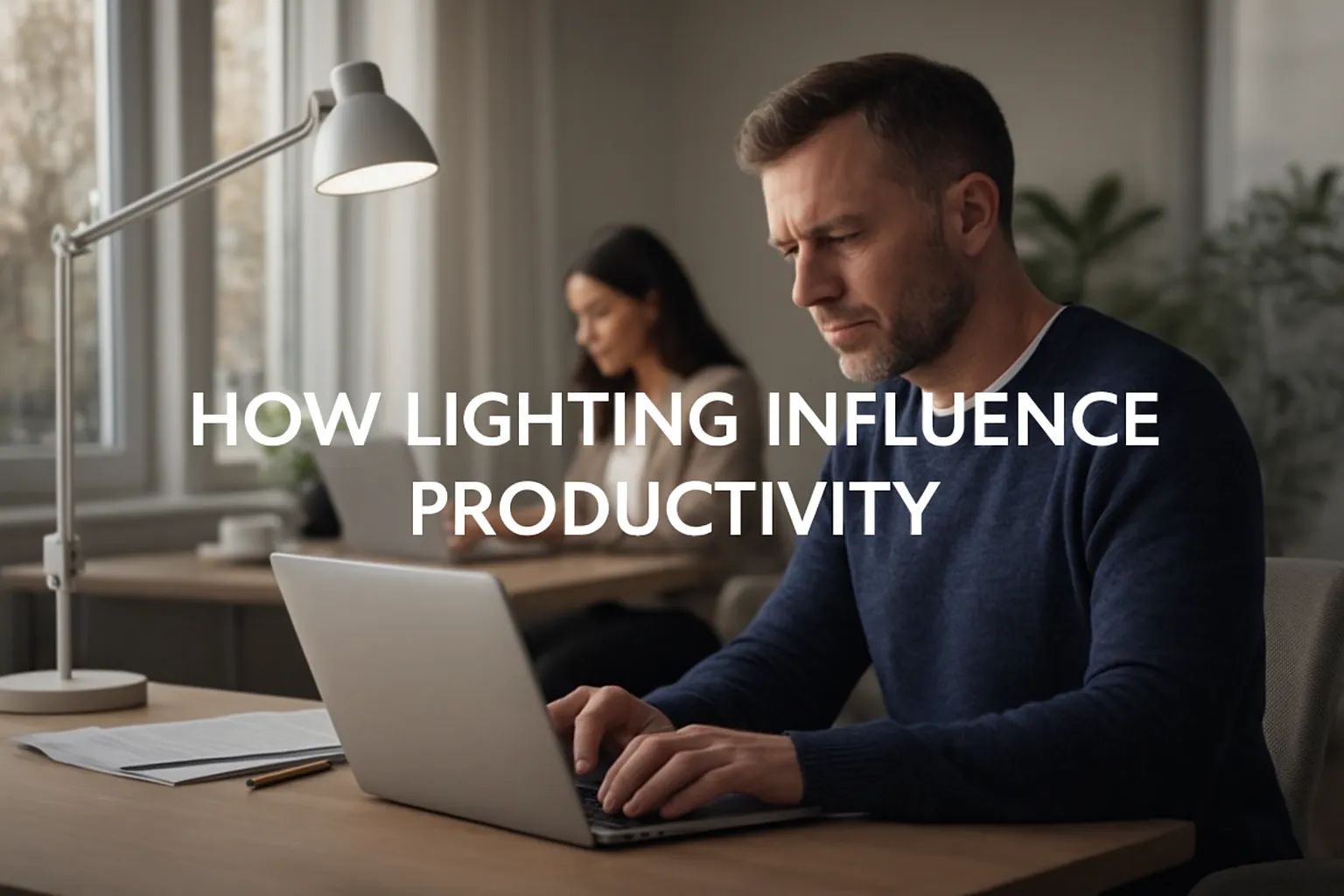
Performance improves when you combine appropriate spectrum, adequate vertical illuminance, y time-of-day scheduling.
Day-part framework for offices
| Time Block | Task Emphasis | CCT | Vertical Illuminance at Eye | Rationale |
|---|---|---|---|---|
| 8–11 AM | Deep work | 4000–5000 K | Higher (per WELL v2 targets) | Capitalize on prime focus window |
| 11–2 PM | Collaboration | 3500–4000 K | Moderado | Balance energy and social tone |
| 2–4 PM | Precision tasks | 4000–5000 K | Más alto | Counteract afternoon dip |
| 4–6 PM | Wrap-up | 3000–3500 K | Inferior | Reduce strain, prep for evening rest |
Techniques that work
- Layer task-ambient strategies (cooler task light with neutral ambient).
- Set scenes with both CCT y illuminance changes—perception depends on both.
- Track KPIs: task completion time, error rate, perceived fatigue, and satisfaction.
Applications by Industry
Each sector has unique visual and emotional demands. Tune CCT and scenes to real workflows and outcomes.
| Industry | Primary Goals | CCT Guidance | Notas |
|---|---|---|---|
| Cuidado de la Salud | Recovery + staff vigilance | Patient 2700–3500 K; Staff 4000–5000 K | Day-part scenes; protect sleep cycles |
| Education | Engagement + comprehension | 3500–4500 K | Glare control; cooler before tests |
| Manufacturing | Accuracy + safety | 5000–6500 K | High vertical illuminance; low flicker |
| Minorista | Desire + authenticity | 3000–4000 K | TM-30 Rf ≥ 90 for skin/fabric rendering |
| Hospitalidad | Comfort + brand tone | 2700–3200 K | Layered scenes; neutral in task zones |
Deep considerations
- Healthcare: Use warmer night scenes to reduce melatonin suppression in patient areas; keep staff areas alerting when needed.
- Retail: Choose SPDs that flatter skin and textiles; color is your merchandising tool.
- Manufacturing: Blue-enriched light improves vigilance—verify parpadeo under actual dim levels.
Integrating Tunable White
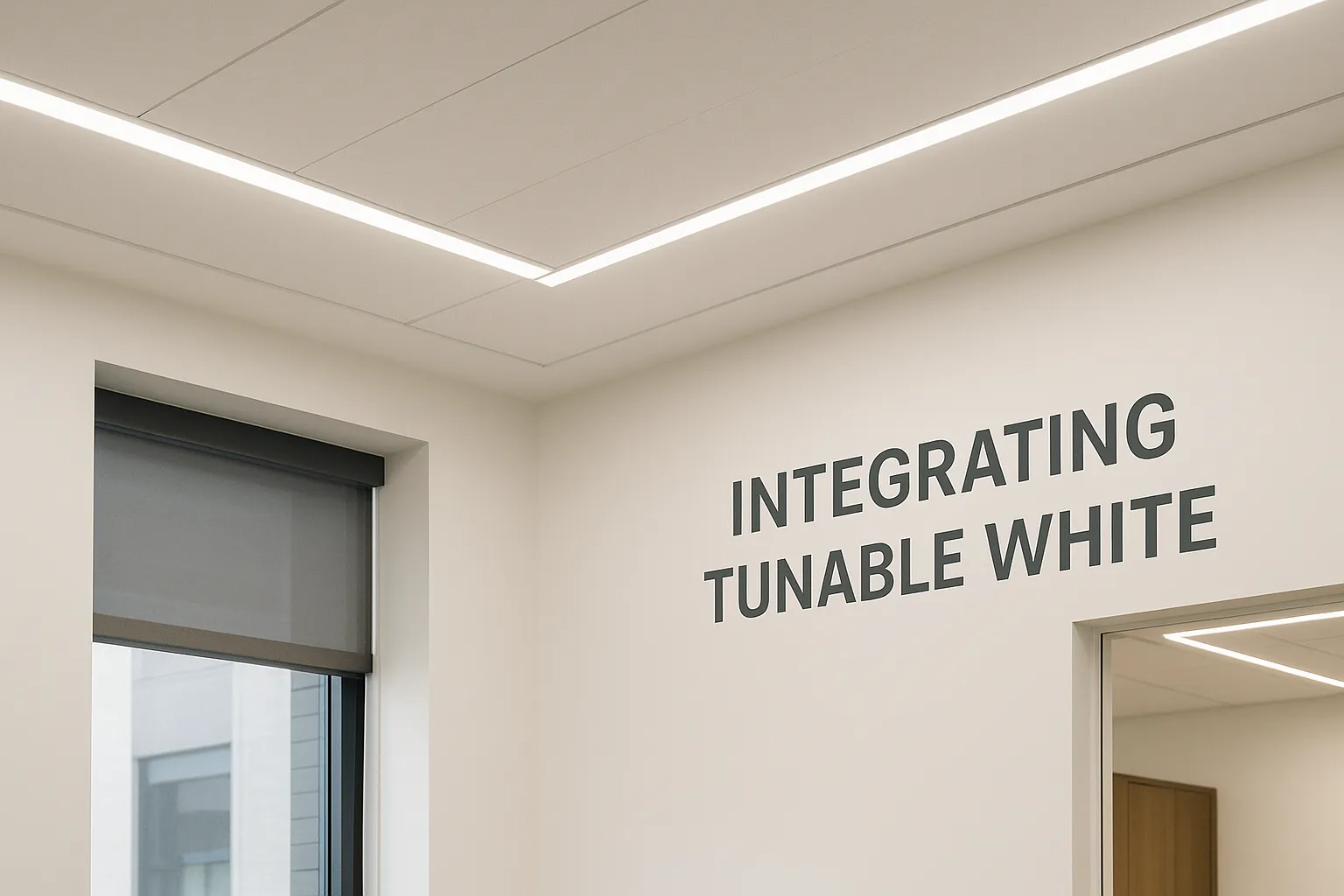
Static CCT forces compromises. Tunable white lets you align spectrum and brightness with time, task, and people—without changing hardware later.
System architecture
- Fixtures: Warm and cool LED channels, well-mixed optics.
- Drivers: Constant-current, hybrid dimming or high-frequency PWM to land in IEEE 1789’s low-risk region (IEEE 1789-2015).
- Controls: DALI-2 (DT8: Tc) or interoperable platforms for stable, repeatable scenes (DALI Alliance).
Commissioning that holds up in the field
- Define scenes: e.g., Focus AM (≈4200–4800 K, higher vertical), Collaborate Midday (≈3600–4000 K, moderate vertical), Wind-down (≈3000–3300 K, lower vertical).
- Measure & verify: CCT within ±150–200 K at task plane; vertical illuminance at eye meets WELL v2 targets; temporal light modulation compliant (Pst LM ≤ 1.0, SVM ≤ 0.9) under operating dim levels (not only full output). EU flicker metrics appear in the Single Lighting Regulation; verify using accepted methods (EU Ecodesign/Label portal, EU SLR references via Commission pages).
- Interoperability: Validate device lists (drivers, controllers, sensors) and ensure RF/wireless gateways are both thermally y CEM-isolated from power electronics.
Case Study: Workplace Redesign (Internal Pilot)

A 12,000 ft² office upgraded from static 3500 K to blanco ajustable with day-part scenes:
- Morning (Focus): 4200–4800 K with higher vertical illuminance
- Midday (Collab): 3600–4000 K, moderate vertical
- Late day (Wind-down): 3000–3300 K, reduced vertical
Outcomes (internal pilot report):
- Task completion: +18% speed in morning focus blocks
- Quality: −12% measured error rate in precision tasks
- Wellbeing: −22% self-reported afternoon fatigue
Notes: Results are specific to one site with supporting change management and glare control; your outcomes will vary with task type, cohort, and baseline lighting.
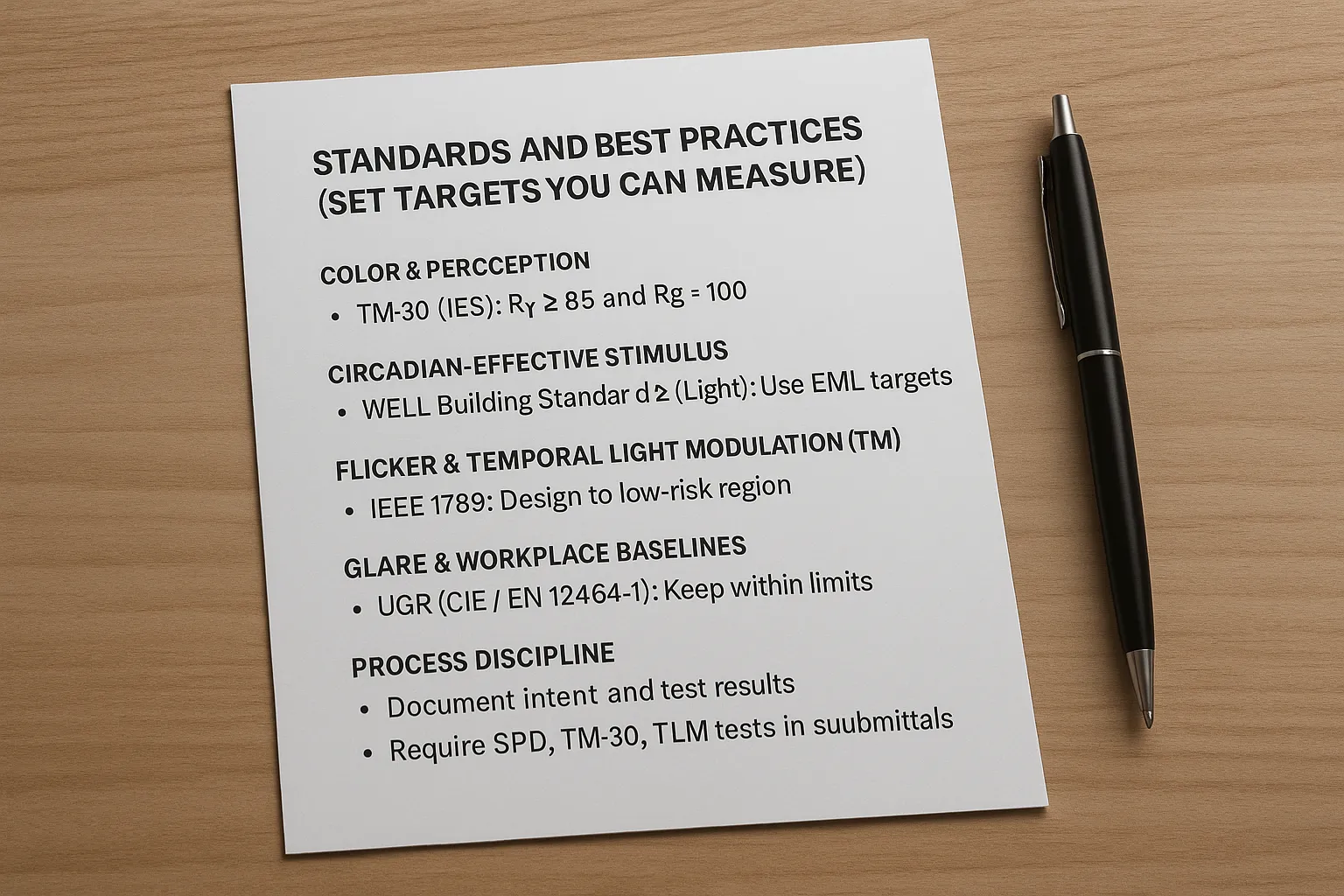
Standards and Best Practices (Set Targets You Can Measure)
Color & perception
- TM-30 (IES): Especificar Rf (fidelity) and Rg (gamut) targets by space type; Rf ≥ 85 and Rg ≈ 100 is a robust baseline for most offices and retail (IES TM-30).
Circadian-effective stimulus
- WELL Building Standard v2 (Light): Uso EML targets and measure iluminancia vertical en el ojo to commission scenes; apply task-appropriate values and daylight integration (WELL v2—Luz).
- CIE S 026: Consider EDI melanópico for more rigorous α-opic analysis (CIE S 026).
Flicker & temporal light modulation (TLM)
- IEEE 1789: Design to the low-risk region via hybrid dimming or sufficiently high PWM. Validate with instrumentation, not just driver datasheets (IEEE 1789-2015).
- EU Pst LM / SVM: In European projects, verify Pst LM ≤ 1.0 y SVM ≤ 0.9 at scene levels, consistent with Single Lighting Regulation test methods (see Commission guidance pages on Ecodesign/Label).
Glare & workplace baselines
- UGR (CIE / EN 12464-1): Keep glare within recommended limits for indoor workplaces; measure at representative viewer positions.
Process discipline
- Document intent, require SPD, TM-30, flicker/TLM tests in submittals, conduct mockups, y measure after installation. Treat scenes as performance specifications, not just settings.
Balancing Science and Aesthetics
Data guides performance; design carries emotion and brand. Use materials and color palettes to provide warmth so the CCT can remain functional for tasks. Co-design scenes with stakeholders, prototype in representative spaces, and iterate with feedback plus real metrics.
| Constraint | Scientific Need | Aesthetic Move | Resultado |
|---|---|---|---|
| Afternoon slump | Cooler spectrum, higher vertical | Warm materials & accents | Energized yet inviting |
| Color-critical tasks | High fidelity (high Rf) | Neutral backgrounds | Accurate perception |
| Recovery zones | Warm spectrum, low contrast | Textural comfort cues | Calm, restorative feel |
Conclusion & Next Steps
CCT steers mood; timing drives performance. Design scenes—not just specs—so spaces can shift from focus to collaboration to recovery as the day unfolds. Align CCT with human biology (WELL v2; CIE S 026), verify color quality (TM-30), control glare (UGR), and prove low flicker (IEEE 1789; Pst LM/SVM) at operating dim levels. That’s how lighting becomes a measurable lever for productivity and wellbeing.
Want help translating this into your project?
Teco Lighting’s engineering team can map tasks to CCT/EML, define tunable-white scenes, verify flicker and color metrics, and deliver commissioning documents aligned to WELL v2 and IEEE 1789.
👉 Book a 30-minute review: [email protected]