
Cómo la Temperatura de Color Afecta el Estado de Ánimo y la Productividad
Executive summary: Color temperature (CCT) is more than a look—it’s a performance control. Warmer light (≈2700–3000 K) supports relaxation and recovery; neutral (≈3500–4000 K) balances collaboration; cooler (≈4000–5000 K and above) elevates alertness and visual precision. When you pair task-appropriate CCT with adequate vertical illuminance at the eye, robust color quality (TM-30), and low-flicker driver performance (IEEE 1789; Pst LM/SVM), you can measurably improve comfort, focus, and outcomes across workplaces, retail, education, healthcare, and production.
Introducción
If work feels sluggish, meetings drag, and creativity stalls, the problem might not be your people—it might be your light. Lighting isn’t just aesthetics; it’s evidence-based design that shapes how people feel and perform. This article connects the science of color temperature to practical specifications and commissioning steps you can use right away—complete with standards and a real-world case study.
What you’ll learn
- How CCT influences the brain’s visual and non-visual pathways
- Which CCT bands fit common tasks and industries
- How to set measurable targets (EML/melanopic EDI, TM-30, Pst LM/SVM, UGR)
- How to deploy tunable white scenes that align with human rhythms
Understanding Color Temperature
Correlated color temperature (CCT) describes the perceived warmth or coolness of a light source in Kelvin (K):
- Warm: ≈2700–3000 K (amber feel)
- Neutral: ≈3500–4000 K (balanced)
- Cool: ≈5000–6500 K (bluish, alerting)
CCT is a starting point, not the whole story. Perceptual and biological effects depend on the light’s spectral power distribution (SPD) y color rendering characteristics. For color quality, move beyond CRI and adopt TM-30 (fidelity Rf and gamut Rg) to predict how colors look on faces, food, fabrics, and finishes (IES TM-30).
Two lamps at 4000 K can feel different: an SPD with stronger red content feels warmer and more flattering, while a blue-enriched SPD feels crisper and more alerting.
Quick selection guide
| Target Use | Recommended CCT | Color Quality | Notes |
|---|---|---|---|
| Lounge / Breakout | 2700–3000 K | TM-30 Rf ≥ 85, Rg ~ 100 | Relaxation & recovery |
| Open Office | 3500–4000 K | TM-30 Rf ≥ 85 | Balanced focus, low eye strain |
| Focus Booths | 4000–5000 K | TM-30 Rf ≥ 85 | Cooler for sustained attention |
| Labs / Production | 5000–6500 K | TM-30 Rf ≥ 85–90 | High acuity & vigilance |
| Retail Apparel / Skin | 3000–3500 K | TM-30 Rf ≥ 90, Rg ≈100 | Accurate, flattering color |
Actionable habits
- Specify CCT bands, not single points (e.g., 3500–4000 K), to leave room for tuning.
- Solicitar SPD plots y TM-30 data in submittals; don’t rely on CCT alone.
- Pair CCT with dimming to manage brightness and perception together.
The Science: Light and the Brain

Light drives two pathways:
- Visual system (rods and cones): acuity and color perception.
- Non-visual system (intrinsically photosensitive retinal ganglion cells with melanopsin): circadian timing, melatonin, cortisol, mood, and alertness.
Blue-enriched spectra in the morning advance alertness; warmer spectra later in the day preserve melatonin to protect sleep. To quantify biologically effective light, use melanopic metrics such as Equivalent Melanopic Lux (EML) or melanopic EDI as defined by CIE S 026/E:2018 (CIE S 026) and targeted in the WELL Building Standard v2 (Light) (WELL v2—Light).
Stimulus → response (design cues)

| Stimulus | Brain Response | Design Takeaway |
|---|---|---|
| Blue-enriched morning light | Increased alertness, suppressed melatonin | Use cooler CCT and higher vertical illuminance after start-of-day |
| Warm evening light | Relaxation, preserved melatonin | Transition toward 2700–3000 K late afternoon |
| Alta vertical illuminance | Stronger circadian cueing | Luz at the eye matters—design for vertical lux, not just desk lux |
| Low flicker (TLM) | Reduced stress, headache risk | Specify drivers meeting IEEE 1789 and verify Pst LM/SVM in scenes |
Practical rule of thumb: Provide cooler, higher melanopic stimulus in the first half of the workday and warmer, lower stimulus toward the end—tuned to tasks, age groups, and local daylight.
Psychological Effects by CCT

CCT gently nudges emotion and behavior:
- Warm (2700–3000 K): Social warmth, relaxation, hospitality tone
- Neutral (3500–4000 K): Balanced tempo for collaboration
- Cool (5000–6500 K): Vigilance, precision, and task orientation
Mood mapping
| Desired State | CCT | Complementary Controls | Risks |
|---|---|---|---|
| Calm / Decompress | 2700–3000 K | Lower brightness, soft contrasts | Under-stimulation if overused |
| Social / Collaborative | 3500–3800 K | Moderate brightness, color-rich SPD | “Flat” if SPD lacks red content |
| Focus / Deep Work | 4000–5000 K | Higher brightness, low glare | Fatigue if too cool for too long |
| Precision / QC | 5000–6500 K | High vertical illuminance | Sterile feel if overapplied |
Context matters: Age, culture, and task difficulty modulate preferences. Gather occupant feedback and correlate with actual performance metrics.
How Lighting Influences Productivity
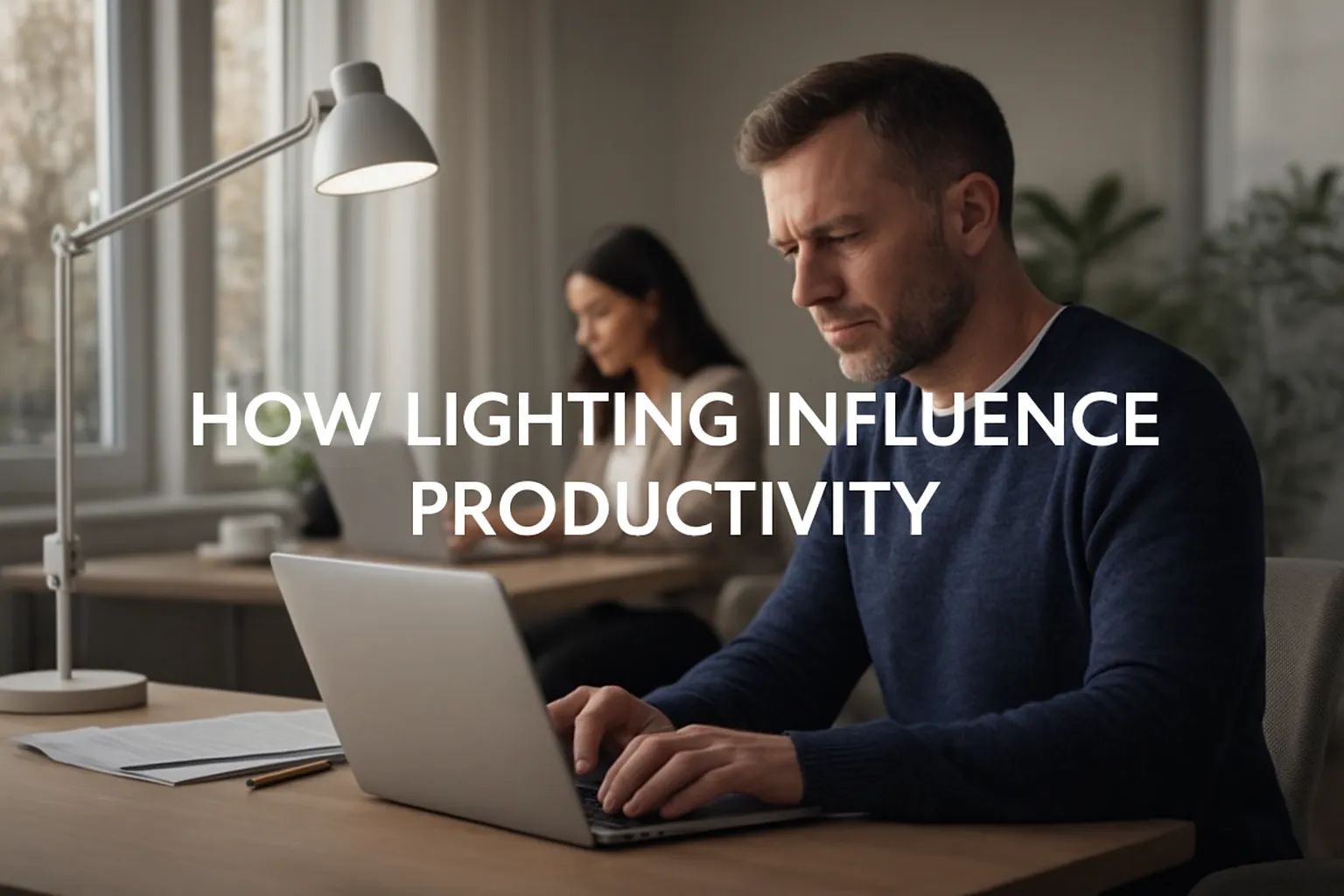
Performance improves when you combine appropriate spectrum, adequate vertical illuminance, y time-of-day scheduling.
Day-part framework for offices
| Time Block | Task Emphasis | CCT | Vertical Illuminance at Eye | Rationale |
|---|---|---|---|---|
| 8–11 AM | Deep work | 4000–5000 K | Higher (per WELL v2 targets) | Capitalize on prime focus window |
| 11–2 PM | Collaboration | 3500–4000 K | Moderado | Balance energy and social tone |
| 2–4 PM | Precision tasks | 4000–5000 K | Más alto | Counteract afternoon dip |
| 4–6 PM | Wrap-up | 3000–3500 K | Inferior | Reduce strain, prep for evening rest |
Techniques that work
- Layer task-ambient strategies (cooler task light with neutral ambient).
- Set scenes with both CCT y illuminance changes—perception depends on both.
- Track KPIs: task completion time, error rate, perceived fatigue, and satisfaction.
Applications by Industry
Each sector has unique visual and emotional demands. Tune CCT and scenes to real workflows and outcomes.
| Industry | Primary Goals | CCT Guidance | Notes |
|---|---|---|---|
| Cuidado de la Salud | Recovery + staff vigilance | Patient 2700–3500 K; Staff 4000–5000 K | Day-part scenes; protect sleep cycles |
| Education | Engagement + comprehension | 3500–4500 K | Glare control; cooler before tests |
| Manufacturing | Accuracy + safety | 5000–6500 K | High vertical illuminance; low flicker |
| Minorista | Desire + authenticity | 3000–4000 K | TM-30 Rf ≥ 90 for skin/fabric rendering |
| Hospitalidad | Comfort + brand tone | 2700–3200 K | Layered scenes; neutral in task zones |
Deep considerations
- Healthcare: Use warmer night scenes to reduce melatonin suppression in patient areas; keep staff areas alerting when needed.
- Retail: Choose SPDs that flatter skin and textiles; color is your merchandising tool.
- Manufacturing: Blue-enriched light improves vigilance—verify parpadeo under actual dim levels.
Integrating Tunable White
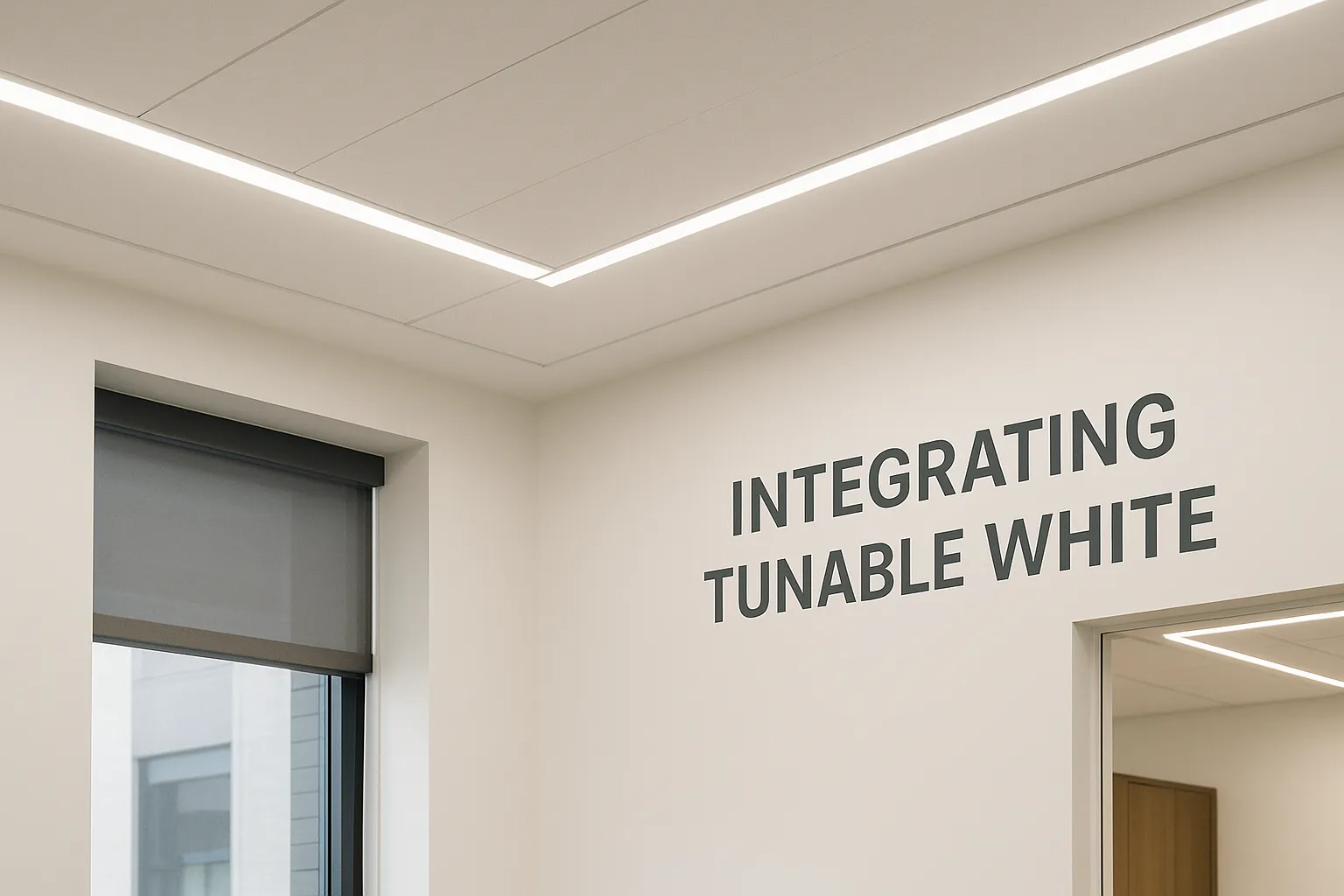
Static CCT forces compromises. Tunable white lets you align spectrum and brightness with time, task, and people—without changing hardware later.
System architecture
- Fixtures: Warm and cool LED channels, well-mixed optics.
- Drivers: Constant-current, hybrid dimming or high-frequency PWM to land in IEEE 1789’s low-risk region (IEEE 1789-2015).
- Controls: DALI-2 (DT8: Tc) or interoperable platforms for stable, repeatable scenes (DALI Alliance).
Commissioning that holds up in the field
- Define scenes: e.g., Focus AM (≈4200–4800 K, higher vertical), Collaborate Midday (≈3600–4000 K, moderate vertical), Wind-down (≈3000–3300 K, lower vertical).
- Measure & verify: CCT within ±150–200 K at task plane; vertical illuminance at eye meets WELL v2 targets; temporal light modulation compliant (Pst LM ≤ 1.0, SVM ≤ 0.9) under operating dim levels (not only full output). EU flicker metrics appear in the Single Lighting Regulation; verify using accepted methods (EU Ecodesign/Label portal, EU SLR references via Commission pages).
- Interoperability: Validate device lists (drivers, controllers, sensors) and ensure RF/wireless gateways are both thermally y CEM-isolated from power electronics.
Case Study: Workplace Redesign (Internal Pilot)

A 12,000 ft² office upgraded from static 3500 K to tunable white with day-part scenes:
- Morning (Focus): 4200–4800 K with higher vertical illuminance
- Midday (Collab): 3600–4000 K, moderate vertical
- Late day (Wind-down): 3000–3300 K, reduced vertical
Outcomes (internal pilot report):
- Task completion: +18% speed in morning focus blocks
- Quality: −12% measured error rate in precision tasks
- Wellbeing: −22% self-reported afternoon fatigue
Notes: Results are specific to one site with supporting change management and glare control; your outcomes will vary with task type, cohort, and baseline lighting.
Standards and Best Practices (Set Targets You Can Measure)
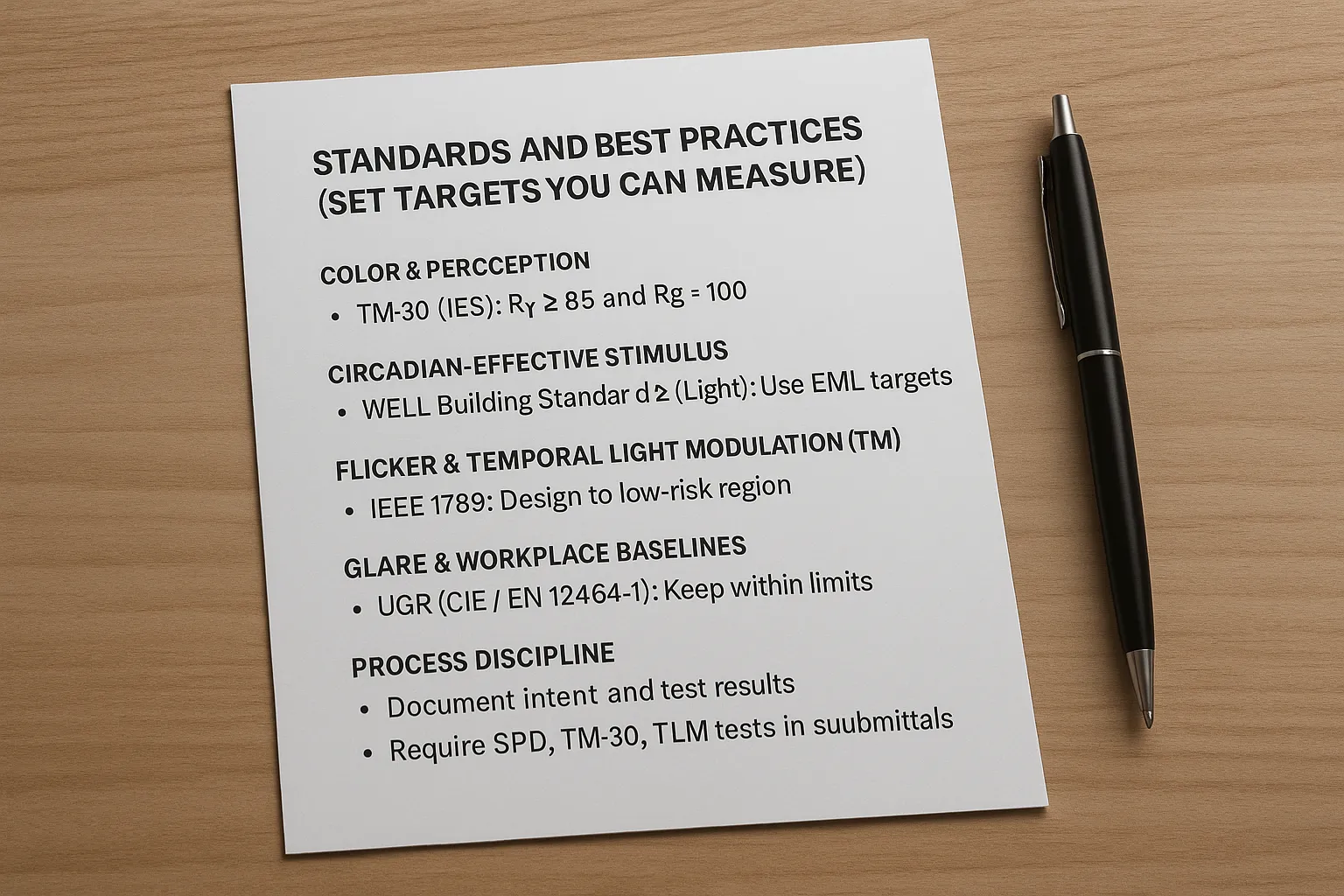
Color & perception
- TM-30 (IES): Specify Rf (fidelity) and Rg (gamut) targets by space type; Rf ≥ 85 and Rg ≈ 100 is a robust baseline for most offices and retail (IES TM-30).
Circadian-effective stimulus
- WELL Building Standard v2 (Light): Uso EML targets and measure vertical illuminance at the eye to commission scenes; apply task-appropriate values and daylight integration (WELL v2—Light).
- CIE S 026: Consider melanopic EDI for more rigorous α-opic analysis (CIE S 026).
Flicker & temporal light modulation (TLM)
- IEEE 1789: Design to the low-risk region via hybrid dimming or sufficiently high PWM. Validate with instrumentation, not just driver datasheets (IEEE 1789-2015).
- EU Pst LM / SVM: In European projects, verify Pst LM ≤ 1.0 y SVM ≤ 0.9 at scene levels, consistent with Single Lighting Regulation test methods (see Commission guidance pages on Ecodesign/Label).
Glare & workplace baselines
- UGR (CIE / EN 12464-1): Keep glare within recommended limits for indoor workplaces; measure at representative viewer positions.
Process discipline
- Document intent, require SPD, TM-30, flicker/TLM tests in submittals, conduct mockups, y measure after installation. Treat scenes as performance specifications, not just settings.
Balancing Science and Aesthetics
Data guides performance; design carries emotion and brand. Use materials and color palettes to provide warmth so the CCT can remain functional for tasks. Co-design scenes with stakeholders, prototype in representative spaces, and iterate with feedback plus real metrics.
| Constraint | Scientific Need | Aesthetic Move | Resultado |
|---|---|---|---|
| Afternoon slump | Cooler spectrum, higher vertical | Warm materials & accents | Energized yet inviting |
| Color-critical tasks | High fidelity (high Rf) | Neutral backgrounds | Accurate perception |
| Recovery zones | Warm spectrum, low contrast | Textural comfort cues | Calm, restorative feel |
Conclusion & Next Steps
CCT steers mood; timing drives performance. Design scenes—not just specs—so spaces can shift from focus to collaboration to recovery as the day unfolds. Align CCT with human biology (WELL v2; CIE S 026), verify color quality (TM-30), control glare (UGR), and prove low flicker (IEEE 1789; Pst LM/SVM) at operating dim levels. That’s how lighting becomes a measurable lever for productivity and wellbeing.
Want help translating this into your project?
Teco Lighting’s engineering team can map tasks to CCT/EML, define tunable-white scenes, verify flicker and color metrics, and deliver commissioning documents aligned to WELL v2 and IEEE 1789.
👉 Book a 30-minute review: [email protected]
 English
 French
 German
 Italian
 Spanish
 Portuguese
 Arabic
 Russian
 Japanese
 Chinese