MR16 LED Atenuación Explicada: Compatibilidad, Transformadores y Selección de Atenuadores
Última actualización: 9 de marzo de 2026
Las bombillas LED MR16 se utilizan ampliamente en iluminación empotrada, iluminación de acento, exhibiciones minoristas, proyectos de hostelería e instalaciones residenciales. En comparación con las lámparas halógenas MR16 tradicionales, los reemplazos LED ofrecen una eficiencia energética significativamente mayor, reducción de calor y una vida operativa más larga.
Sin embargo, La atenuación LED MR16 sigue siendo una de las causas más comunes de inestabilidad en sistemas de iluminación, lo que a menudo resulta en problemas como:
- salida de luz parpadeante
- zumbido de los transformadores
- rango de atenuación limitado
- brillo inestable de bajo nivel
- apagado inesperado de la lámpara
Muchos instaladores asumen que el problema está en la lámpara misma. En realidad, la mayoría de las fallas ocurren porque La regulación de LED MR16 depende de la compatibilidad del sistema en lugar de un solo componente.
El malentendido clave es simple:
“Regulable” no significa “universalmente compatible”.”
Esta guía explica cómo funciona el atenuado de LED MR16, por qué ocurren problemas de compatibilidad y cómo compradores, instaladores y especificadores de iluminación pueden seleccionar sistemas de LED MR16 atenuables confiables.
¿Qué es una bombilla LED MR16?
MR16 describe un formato de lámpara, no una especificación eléctrica.
La designación proviene de dos características:
- MR = Reflector Multifacético
- 16 = 16 octavos de pulgada (aproximadamente 50 mm de diámetro)
Este estándar define el tamaño físico y óptica reflectora de la lámpara, que se utilizan comúnmente en aplicaciones de iluminación direccional como:
- iluminación de exhibición minorista
- iluminación para museos
- iluminación de restaurantes
- iluminación de acento arquitectónico
Sin embargo, el el comportamiento eléctrico de una lámpara LED MR16 está determinado por el tipo de base, el sistema de voltaje y la electrónica del driver, lo cual afecta directamente el rendimiento del atenuado.
Tipos de Base MR16 y Sistemas de Voltaje
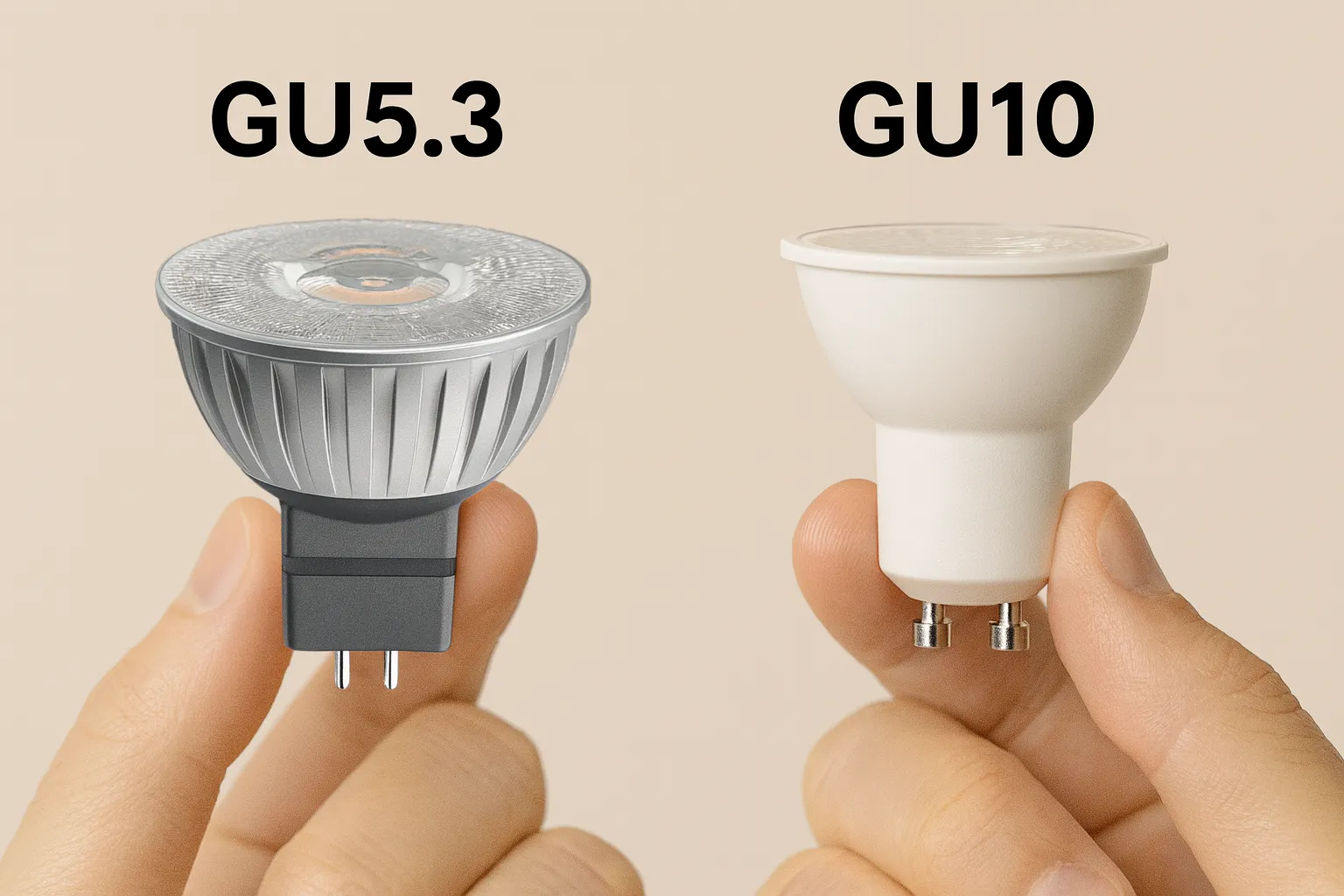
Las lámparas en formato MR16 se utilizan normalmente con dos sistemas de base diferentes.
Estos sistemas se comportan de manera muy diferente cuando se trata de regulación.
GU5.3 — Bajo Voltaje MR16
Características:
- base de dos pines
- opera a 12V CA o CC
- requiere un transformador externo o driver LED
- comúnmente utilizado en instalaciones de retrofit de halógeno
Debido a que el transformador es externo, la compatibilidad del sistema se vuelve crítica para el rendimiento de atenuación.
GU10 — Sistema de Tensión de Línea
Características:
- base de bloqueo por giro
- opera a 120V o 230V CA
- El driver LED está integrado dentro de la lámpara
Este diseño simplifica la instalación porque se involucran menos componentes externos.
Aclaración importante
Mucha gente supone:
MR16 = GU10Esto es incorrecto.
MR16 se refiere a tamaño de la lámpara, mientras que GU10 se refiere a tipo de base y sistema de voltaje.
El comportamiento de regulación está determinado principalmente por electrónica del driver y compatibilidad del sistema, no diámetro del reflector.
Por qué la regulación de MR16 LED es más compleja que la de halógeno

Las lámparas halógenas tradicionales se regulan suavemente porque se comportan como cargas eléctricas puramente resistivas.
Los sistemas LED se comportan de manera muy diferente.
Una instalación de MR16 LED regulable típicamente incluye tres componentes:
Atenuador → Transformador / Driver → Lámpara LEDCada elemento afecta la estabilidad del sistema.
Si un componente es incompatible, pueden aparecer problemas de regulación.
Los desafíos técnicos comunes incluyen:
- requisitos de carga mínima del transformador
- compatibilidad con reguladores de fase
- inestabilidad del driver en niveles bajos de corriente
- alta corriente de irrupción del LED al arranque
- Variaciones de salida CA vs CC
Debido a estos factores, a menudo aparecen problemas de regulación en MR16 LED después de la instalación, incluso cuando los componentes individuales funcionan correctamente durante las pruebas.
¿Son todas las bombillas LED MR16 regulables?
No.
No todas las lámparas LED MR16 admiten regulación.
Algunas bombillas LED:
- son no regulables
- parpadeo al atenuar
- apagado por debajo de ciertos niveles de brillo
- se comportan de manera diferente según la entrada de CA o CC
Para que una lámpara funcione correctamente en sistemas de regulación, debe ser:
- diseñado explícitamente para atenuación
- probado con transformadores compatibles
- validado con tipos específicos de reguladores
Incluso cuando están etiquetados “regulable”, la compatibilidad con transformadores y reguladores aún debe verificarse.
Factores clave al elegir una bombilla LED MR16 regulable

Seleccionar la lámpara LED MR16 adecuada requiere evaluar varios parámetros técnicos.
1. Compatibilidad de voltaje de entrada
Las lámparas MR16 de bajo voltaje pueden admitir:
- Solo entrada CA
- solo entrada de CC
- funcionamiento universal CA/CC
Some lamps operate perfectly on DC but flicker on AC electronic transformers.
Always verify the supported voltage type.
2. Transformer Type
Two common transformer categories exist:
Magnetic Transformers
Características:
- stable output waveform
- high compatibility with LED loads
- heavier and less energy efficient
Electronic Transformers
Características:
- compact and efficient
- designed for halogen loads
- may require minimum load levels
A common failure scenario occurs when the LED load is below the transformer’s minimum load requirement, causing flicker or shutdown.
3. Dimmer Load Rating
LED lamps consume low steady-state power but generate high inrush current during startup.
Ejemplo:
10 × 7W MR16 LEDs = 70W running loadHowever, startup current may exceed the tolerance of a small dimmer.
Best practice is to select dimmers rated 2–3 times higher than the calculated LED load.
4. Dimmer Technology
Two primary phase-cut dimmer types exist.
Leading-Edge (Forward Phase)
Características:
- older technology
- higher electrical stress
- greater risk of buzzing
Trailing-Edge (Fase inversa)
Características:
- smoother dimming waveform
- better compatibility with electronic LED drivers
- lower noise levels
Trailing-edge dimmers are generally preferred for LED lighting.
However, compatibility must still be verified with the transformer.
5. Dimming Range
Professional MR16 LED lamps should provide:
- smooth dimming from 100% down to 5–10% brightness
- stable light output at low levels
- no visible flicker
- no sudden shutdown
Low-quality LEDs often become unstable below 20–30%.
6. Flicker Performance
Lighting flicker is not only a visual issue.
Research published in IEEE Std 1789 indicates that excessive LED flicker can contribute to visual discomfort and neurological stress.
Professional lighting systems should therefore provide documented flicker performance data.
Common MR16 LED Dimming Problems
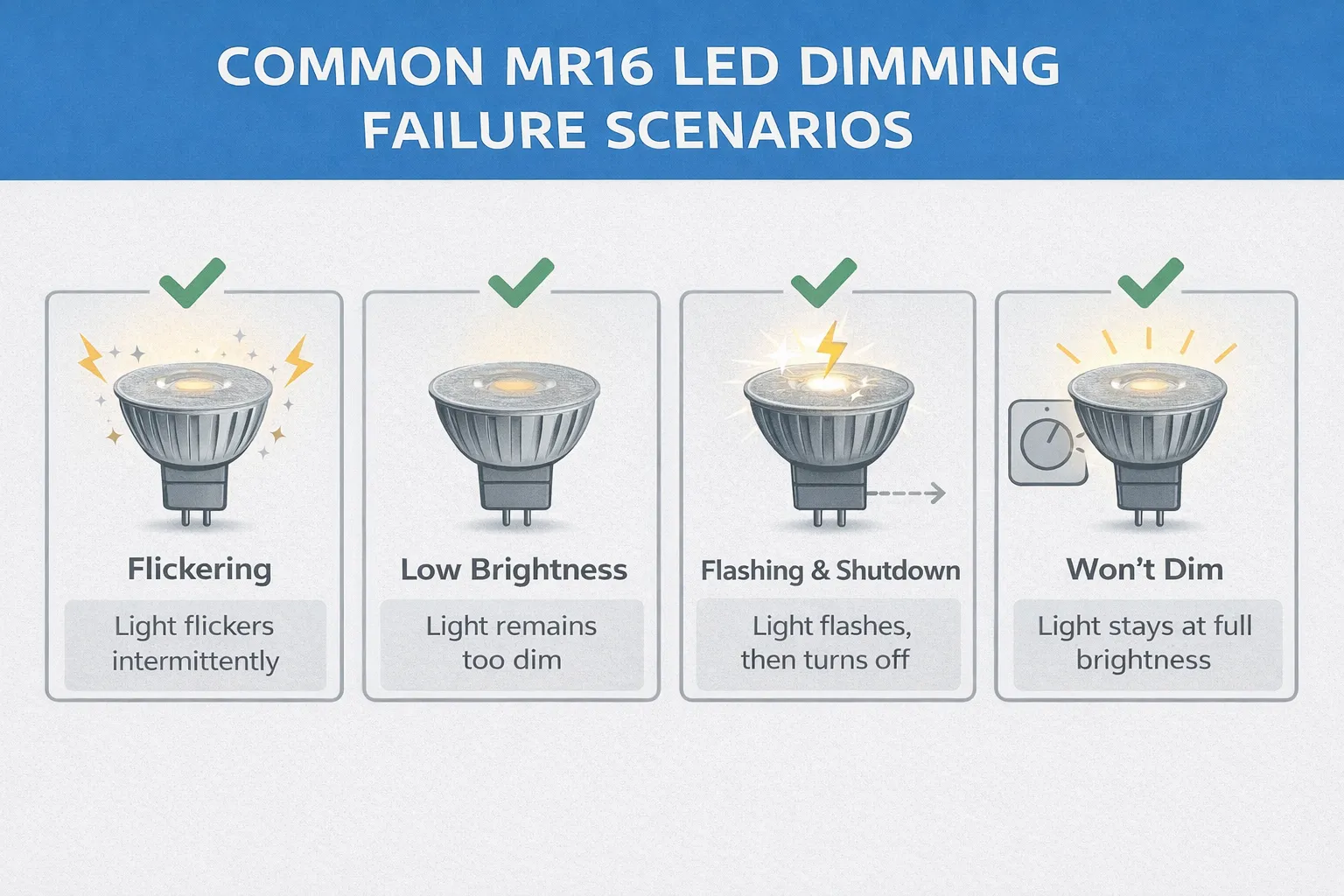
Typical installation problems include:
- reusing halogen-era transformers with LED loads
- mixing different MR16 LED models on one circuit
- ignoring transformer minimum load requirements
- selecting under-rated dimmers
- assuming dimming compatibility without testing
In most cases, these are system failures rather than lamp defects.
MR16 LED vs Halogen Dimming
| Característica | Halogen MR16 | MR16 LED |
|---|---|---|
| Electrical behavior | Resistive load | Electronic driver |
| Compatibilidad de regulación | Nearly universal | System dependent |
| Eficiencia energética | Bajo | Alta |
| Salida de calor | Alta | Bajo |
| Vida útil | 2,000 hours | 25,000–40,000 hours |
This comparison explains why LED dimming requires greater attention to compatibility.
Pre-Installation Compatibility Checklist
Before approving a dimmable MR16 LED installation, verify the following:
- lamp explicitly rated as dimmable
- supported AC/DC voltage clearly specified
- transformer type confirmed
- transformer minimum load verified
- dimmer type confirmed
- dimmer load rating sufficient
- low-level dimming tested
- flicker performance documented
If these factors are unclear, installation problems are likely.
Conclusión
MR16 LED bulbs can deliver reliable dimming performance — but only when the entire electrical system is designed and verified as a whole.
Successful MR16 LED dimming depends on:
- LED driver behavior
- transformer compatibility
- dimmer waveform characteristics
Understanding these interactions allows installers and buyers to avoid common compatibility issues and achieve stable, flicker-free lighting installations.
In MR16 LED dimming systems, system design matters more than lamp selection alone.