
MR16 LED Dimming Explained: Compatibility, Transformers & Dimmer Selection
Last updated on March 9, 2026
MR16 LED bulbs are widely used in recessed lighting, accent lighting, retail displays, hospitality projects, and residential installations. Compared with traditional halogen MR16 lamps, LED replacements deliver significantly higher energy efficiency, reduced heat output, and longer operational lifespan.
However, MR16 LED dimming remains one of the most common causes of lighting system instability, often resulting in issues such as:
- flickering light output
- buzzing noise from transformers
- limited dimming range
- unstable low-level brightness
- unexpected lamp shutdown
Many installers assume the problem lies with the lamp itself. In reality, most failures occur because MR16 LED dimming depends on system compatibility rather than a single component.
The key misunderstanding is simple:
“Dimmable” does not mean “universally compatible.”
This guide explains how MR16 LED dimming works, why compatibility problems occur, and how buyers, installers, and lighting specifiers can select reliable dimmable MR16 LED systems.
What Is an MR16 LED Bulb?
MR16 describes a lamp format, not an electrical specification.
The designation comes from two characteristics:
- MR = Multifaceted Reflector
- 16 = 16 eighths of an inch (approximately 50 mm diameter)
This standard defines the physical size and reflector optics of the lamp, which are commonly used in directional lighting applications such as:
- retail display lighting
- museum lighting
- restaurant lighting
- architectural accent lighting
However, the electrical behavior of an MR16 LED lamp is determined by the base type, voltage system, and driver electronics, which directly affect dimming performance.
MR16 Base Types and Voltage Systems
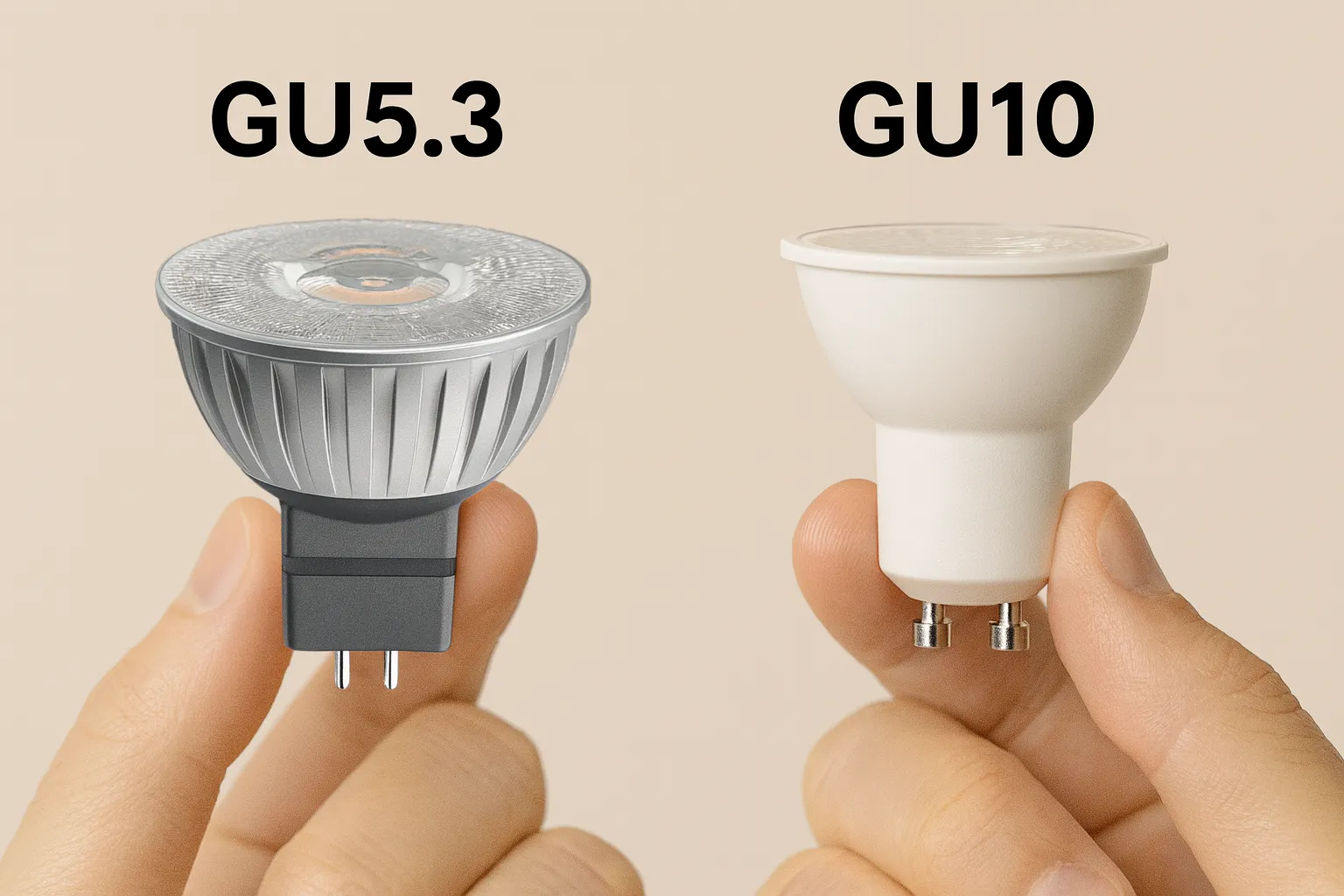
MR16-format lamps are typically used with two different base systems.
These systems behave very differently when dimming is involved.
GU5.3 — Low Voltage MR16
Characteristics:
- two-pin base
- operates at 12V AC or DC
- requires an external transformer or LED driver
- commonly used in halogen retrofit installations
Because the transformer is external, system compatibility becomes critical for dimming performance.
GU10 — Line Voltage System
Characteristics:
- twist-lock base
- operates at 120V or 230V AC
- LED driver is integrated inside the lamp
This design simplifies installation because fewer external components are involved.
Important clarification
Many people assume:
MR16 = GU10This is incorrect.
MR16 refers to lamp size, while GU10 refers to base type and voltage system.
Dimming behavior is determined primarily by driver electronics and system compatibility, not reflector diameter.
Why MR16 LED Dimming Is More Complex Than Halogen

Traditional halogen lamps dim smoothly because they behave as purely resistive electrical loads.
LED systems behave very differently.
A dimmable MR16 LED installation typically includes three components:
Dimmer → Transformer / Driver → LED LampEach element affects system stability.
If one component is incompatible, dimming problems may appear.
Common technical challenges include:
- transformer minimum load requirements
- phase-cut dimmer compatibility
- driver instability at low current levels
- high LED inrush current at startup
- AC vs DC output variations
Because of these factors, MR16 LED dimming issues often appear after installation, even when individual components function correctly during testing.
Are All MR16 LED Bulbs Dimmable?
N°.
Not every MR16 LED lamp supports dimming.
Some LED bulbs:
- are non-dimmable
- flicker when dimmed
- shut off below certain brightness levels
- behave differently depending on AC or DC input
For a lamp to operate correctly in dimming systems, it must be:
- explicitly designed for dimming
- tested with compatible transformers
- validated with specific dimmer types
Even when labeled “ gradable ”, compatibility with transformers and dimmers must still be verified.
Key Factors When Choosing a Dimmable MR16 LED Bulb

Selecting the right MR16 LED lamp requires evaluating several technical parameters.
1. Input Voltage Compatibility
Low-voltage MR16 lamps may support:
- AC input only
- DC input only
- universal AC/DC operation
Some lamps operate perfectly on DC but flicker on AC electronic transformers.
Always verify the supported voltage type.
2. Transformer Type
Two common transformer categories exist:
Magnetic Transformers
Characteristics:
- stable output waveform
- high compatibility with LED loads
- heavier and less energy efficient
Electronic Transformers
Characteristics:
- compact and efficient
- designed for halogen loads
- may require minimum load levels
A common failure scenario occurs when the LED load is below the transformer’s minimum load requirement, causing flicker or shutdown.
3. Dimmer Load Rating
LED lamps consume low steady-state power but generate high inrush current during startup.
Exemple :
10 × 7W MR16 LEDs = 70W running loadHowever, startup current may exceed the tolerance of a small dimmer.
Best practice is to select dimmers rated 2–3 times higher than the calculated LED load.
4. Dimmer Technology
Two primary phase-cut dimmer types exist.
Leading-Edge (Forward Phase)
Characteristics:
- older technology
- higher electrical stress
- greater risk of buzzing
Trailing-Edge (Reverse Phase)
Characteristics:
- smoother dimming waveform
- better compatibility with electronic LED drivers
- lower noise levels
Trailing-edge dimmers are generally preferred for LED lighting.
However, compatibility must still be verified with the transformer.
5. Dimming Range
Professional MR16 LED lamps should provide:
- smooth dimming from 100% down to 5–10% brightness
- stable light output at low levels
- no visible flicker
- no sudden shutdown
Low-quality LEDs often become unstable below 20–30%.
6. Flicker Performance
Lighting flicker is not only a visual issue.
Research published in IEEE Std 1789 indicates that excessive LED flicker can contribute to visual discomfort and neurological stress.
Professional lighting systems should therefore provide documented flicker performance data.
Common MR16 LED Dimming Problems
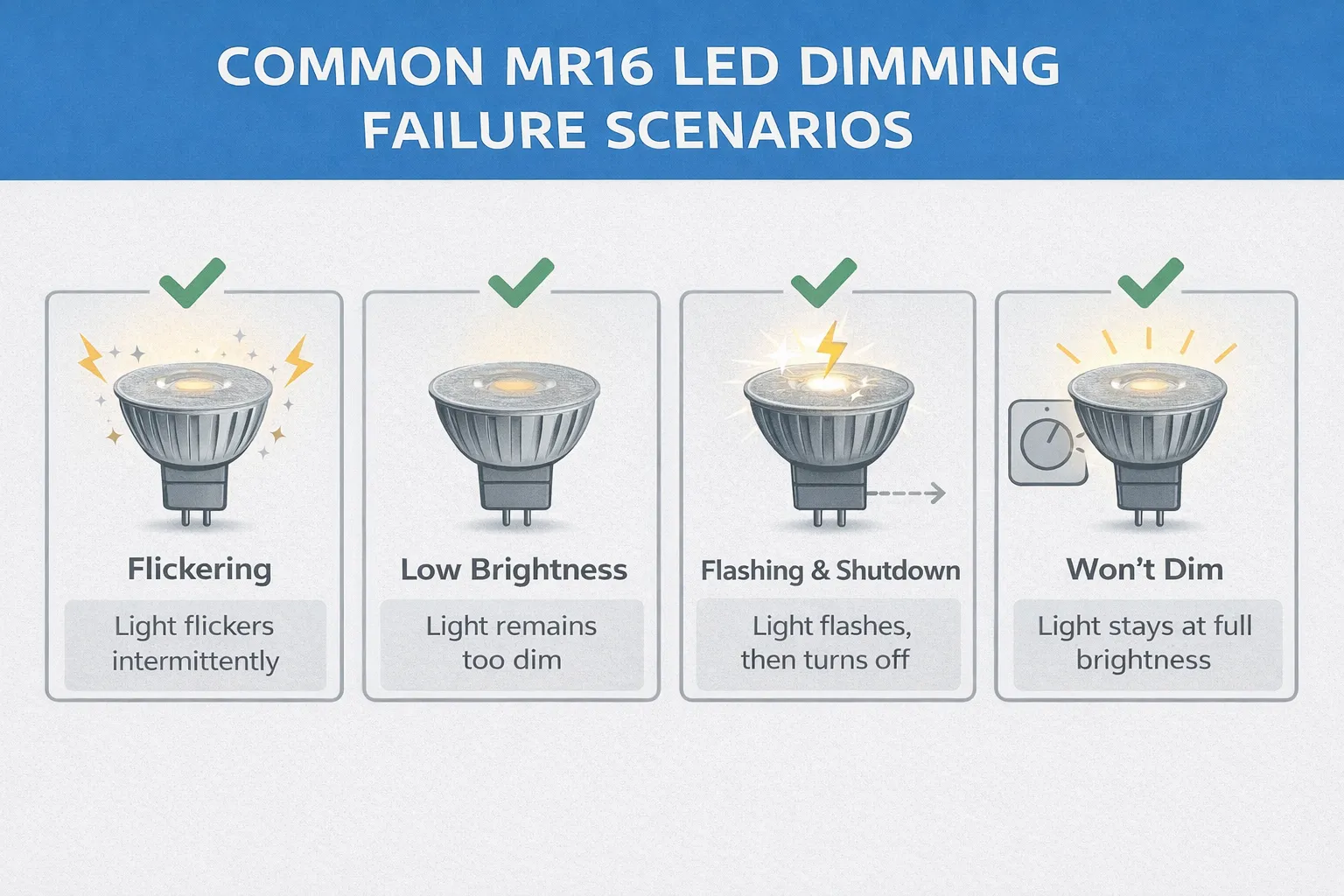
Typical installation problems include:
- reusing halogen-era transformers with LED loads
- mixing different MR16 LED models on one circuit
- ignoring transformer minimum load requirements
- selecting under-rated dimmers
- assuming dimming compatibility without testing
In most cases, these are system failures rather than lamp defects.
MR16 LED vs Halogen Dimming
| Fonctionnalité | Halogen MR16 | MR16 LED |
|---|---|---|
| Electrical behavior | Resistive load | Electronic driver |
| Compatibilité avec la gradation | Nearly universal | System dependent |
| Efficacité énergétique | Faible | Haut |
| Heat output | Haut | Faible |
| Durée de vie | 2,000 hours | 25,000–40,000 hours |
This comparison explains why LED dimming requires greater attention to compatibility.
Pre-Installation Compatibility Checklist
Before approving a dimmable MR16 LED installation, verify the following:
- lamp explicitly rated as dimmable
- supported AC/DC voltage clearly specified
- transformer type confirmed
- transformer minimum load verified
- dimmer type confirmed
- dimmer load rating sufficient
- low-level dimming tested
- flicker performance documented
If these factors are unclear, installation problems are likely.
Conclusion
MR16 LED bulbs can deliver reliable dimming performance — but only when the entire electrical system is designed and verified as a whole.
Successful MR16 LED dimming depends on:
- LED driver behavior
- transformer compatibility
- dimmer waveform characteristics
Understanding these interactions allows installers and buyers to avoid common compatibility issues and achieve stable, flicker-free lighting installations.
In MR16 LED dimming systems, system design matters more than lamp selection alone.

 English
 French
 German
 Italian
 Spanish
 Portuguese
 Arabic
 Russian
 Japanese
 Chinese