Ampoules à détecteur de mouvement micro-ondes GU10 : Fonctionnement et applications
Corridors, stairways, entrances, garages, and service zones often have the same lighting problem: the lamps stay on for hours even when nobody is using the space. Replacing the complete luminaire with a sensor fitting can solve the issue, but it may require rewiring, ceiling work, fixture approval, and a larger retrofit budget.
A GU10 microwave motion sensor bulb offers a more compact route. Instead of adding an external sensor or replacing the full fixture, the sensor is integrated inside the lamp itself. When the existing GU10 holder and fixture are suitable, the project team can add automatic switching by replacing the bulb.
That does not mean every GU10 fixture should use a sensor bulb. Microwave detection can be sensitive, fixture materials can affect sensor behavior, and the lamp is usually designed for automatic on/off control rather than dimming or scene control. For B2B buyers, the real question is not only "Does it turn on?" but "Will the detection range, delay time, beam spread, fixture position, and false-trigger behavior work in the actual building?"
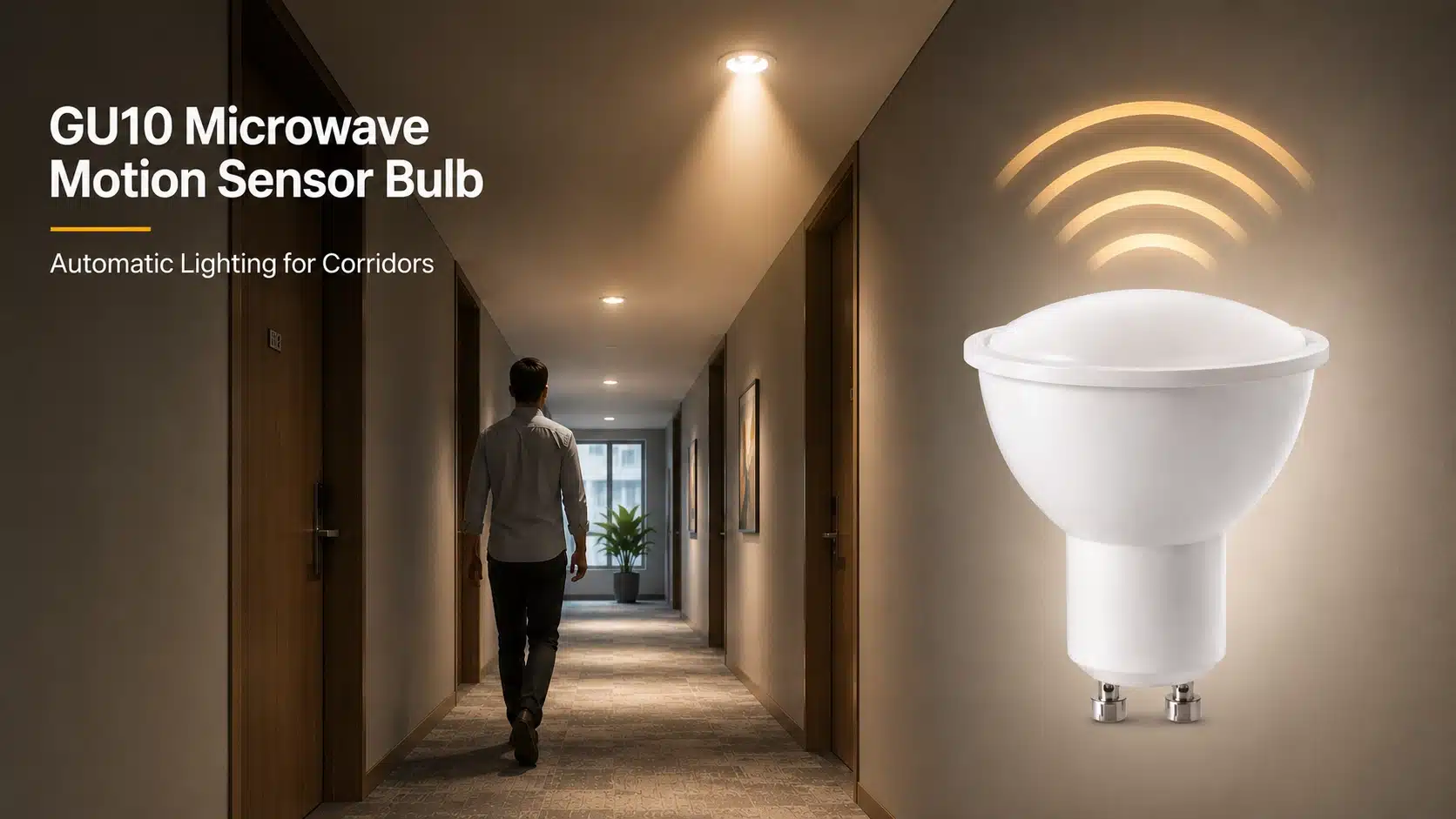
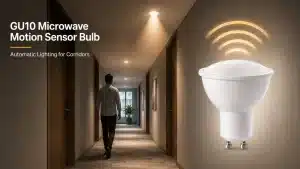
GU10 microwave motion sensor bulb for corridor retrofit lighting
What Is a GU10 Microwave Motion Sensor Bulb?
A GU10 microwave motion sensor bulb is still a GU10 LED lamp. It uses the standard twist-and-lock GU10 base and is installed into a compatible mains-voltage GU10 socket. The difference is that the lamp also contains a microwave motion sensor, driver, and control circuit.
When movement is detected, the lamp switches on automatically. After the last detected movement, the lamp stays on for a defined delay period and then switches off. Some sensor bulbs also include daylight detection, so the lamp does not turn on unnecessarily when the surrounding space is already bright enough.
TECO’s Essential Plastic GU10 microwave motion sensor bulb is a 7W, non-dimmable GU10 lamp with a 120 degree beam angle, 100-240Vac input, flicker-free operation, and listed lumen options of 640lm, 740lm, and 800lm depending on CCT. The product page lists 2700K, 3000K, and 4000K options, CRI80, 50 x 53 mm dimensions, and customizable sensing distance, delay time, and light-intensity detection for project requirements.1
| Component | Function in the Sensor Bulb |
|---|---|
| GU10 base | Connects to the existing mains-voltage holder |
| LED light source | Provides the actual illumination |
| Microwave sensor | Detects motion through reflected microwave signal changes |
| Driver and control circuit | Powers the LED and manages automatic switching |
| Daylight detection | Helps prevent unnecessary activation in bright conditions |
| Delay setting | Controls how long the lamp remains on after motion |
This product should not be treated as a voice-control lamp, a PIR lamp, a dimmable spotlight, or an emergency light. It is best understood as a GU10 LED bulb with built-in automatic motion switching.
How Microwave Motion Detection Works
Microwave sensing is an active detection method. The sensor emits a low-power microwave signal and monitors the reflected signal. When a person, vehicle, door, or object moves within the detection area, the reflected signal changes. The control circuit interprets that change as motion and switches the lamp on.
PIR detection works differently. PIR sensors are passive infrared devices that respond to changes in infrared radiation in their field of view. Microwave sensors actively send and receive signals, while PIR sensors detect changes in thermal radiation patterns. This difference is why microwave sensors can sometimes detect smaller movements or movement through certain non-metallic materials, while PIR sensors usually need a clearer line of sight to the moving warm body.
For lighting buyers, the practical meaning is simple:
- microwave sensors detect movement, not sound
- they do not depend only on body heat
- they may respond to small movement more readily than PIR
- they may detect motion beyond the intended visible area in some installations
- metal, deep fixtures, and surrounding construction can change the detection result
The U.S. Department of Energy’s sensor reliability report notes that occupancy-sensor performance is commonly evaluated through field of view, detection distance, and repeatable test methods, and that NEMA protocols cover PIR as well as active sensing technologies such as ultrasonic and microwave devices.2 This matters because sensor performance is not only a datasheet number. It is strongly connected to installation geometry.
Can Microwave Sensor Bulbs Detect Through Walls or Doors?
Sometimes, but this must be handled carefully. Microwave signals may pass through or be affected by some glass, plastic, thin wood, or light non-metallic covers. Metal usually reflects or shields the signal. Wall thickness, material, sensor sensitivity, mounting direction, and fixture design all affect the result.
This can be an advantage in certain enclosed luminaires where the sensor is hidden behind a plastic or glass cover. It can also become a problem if the lamp detects movement behind a thin partition, outside a door, or in an adjacent corridor.
The correct wording is not "microwave sensors can see through walls." A better project statement is: microwave detection may extend beyond the visible fixture opening depending on material and installation conditions, so sample testing is required before bulk installation.
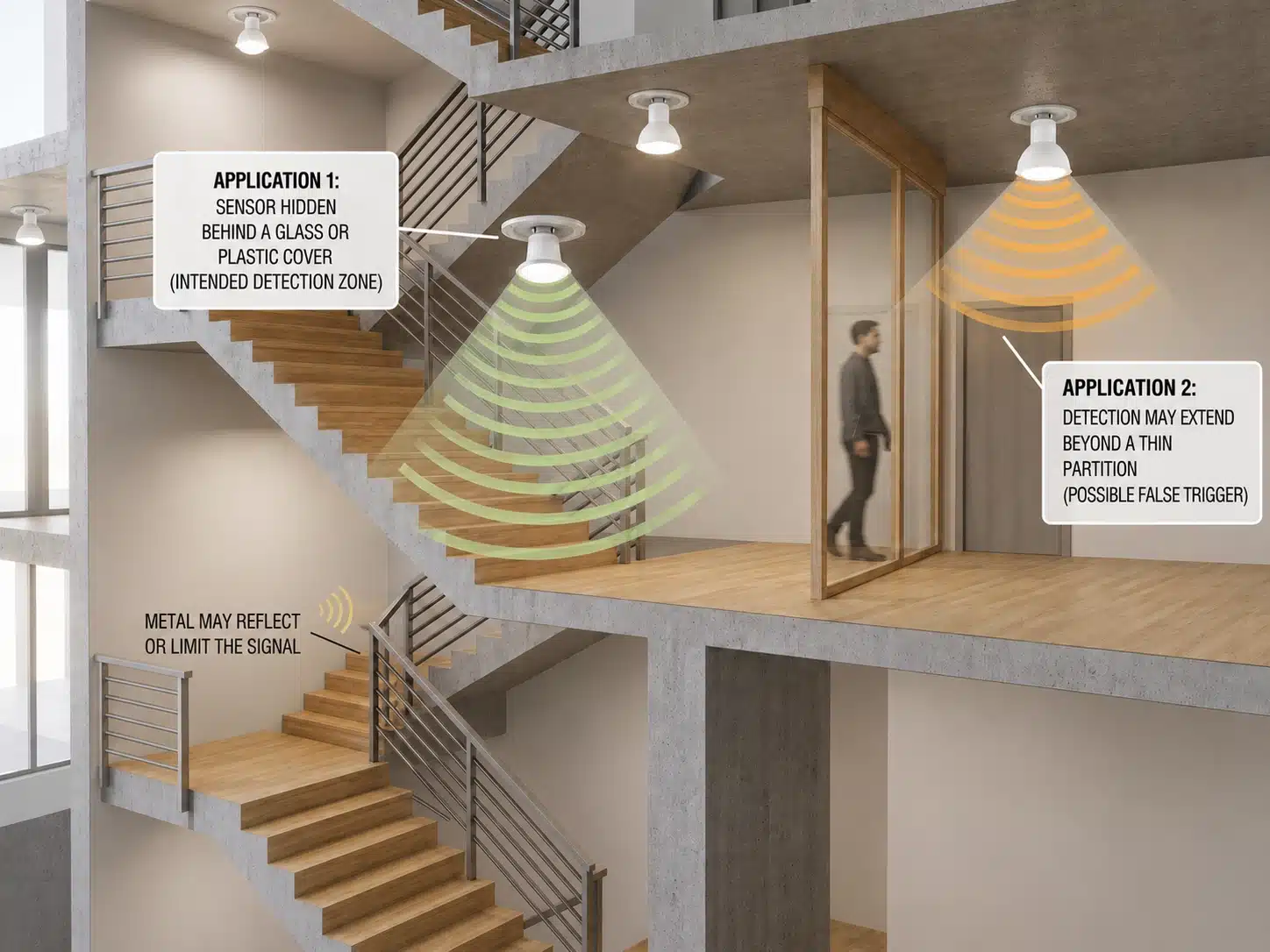
Microwave sensor GU10 bulb detection in corridor and stairway lighting
Microwave Sensor vs PIR Sensor: What Is the Difference?
Microwave and PIR sensors are not simply "better" or "worse." They solve different project problems. A microwave sensor can be useful when fine movement detection, concealed installation, or detection through some non-metallic covers is important. PIR can be better when the project needs a more clearly limited detection zone with less risk of triggering from adjacent areas.
| Facteur | Microwave Sensor | PIR Sensor |
|---|---|---|
| Detection principle | Sends and receives microwave signals | Detects infrared radiation changes |
| Sensor type | Active | Passive |
| Fine movement detection | Often sensitive to small movement | Usually needs clearer body movement |
| Temperature influence | Less dependent on body-to-air temperature difference | More affected by thermal contrast |
| Through-cover behavior | May work through some glass or plastic | Usually needs clearer field of view |
| False-trigger risk | May detect beyond intended zone | Usually more limited by line of sight |
| Power use | Typically higher than PIR sensing | Typically lower |
| Common use | Corridors, stairways, enclosed fixtures, service zones | Rooms, entries, outdoor security fittings |
For a single small corridor, stair landing, or service-room retrofit, a GU10 microwave sensor bulb can be a practical solution. For a large office, hotel floor, warehouse aisle, or coordinated building-control zone, an external sensor or networked control system may be more appropriate.
NEMA describes lighting controls as a broad category including photocells, sensors, dimmers, timers, relays, and systems used to reduce energy use, improve safety, and increase flexibility across indoor and outdoor spaces.3 A sensor bulb belongs to that wider control family, but it is still a localized product, not a full lighting control system.
Where GU10 Microwave Sensor Bulbs Work Best
The strongest use case is a localized retrofit where automatic lighting is helpful, the existing GU10 holder remains usable, and replacing the full fixture would be unnecessary. This is why sensor GU10 bulbs are often more valuable in circulation and support spaces than in decorative accent lighting.
Good applications include:
| Application | Why It Can Work Well |
|---|---|
| Corridors | Short occupancy periods and repeated passing traffic |
| Escaliers | Hands-free switching improves convenience and safety |
| Entrances | Automatic lighting when people arrive or leave |
| Garages | Intermittent use and practical wide-area visibility |
| Service rooms | Staff may enter briefly and forget to switch lights off |
| Storage rooms | Lighting is needed only during access periods |
| Apartment common areas | Retrofit-friendly automatic lighting without full fixture replacement |
| Hotel back-of-house areas | Practical lighting for service passages and utility zones |
TECO’s model uses a 120 degree beam, which is different from a narrow GU10 spotlight. A standard GU10 used for accent lighting may have a 24 degree, 36 degree, or 60 degree beam. A 120 degree beam is broader and more suitable for passage lighting, stair zones, entries, and utility spaces where people need general visibility rather than a tight spotlight effect.
| Beam Type | Typical Effect | Better Use |
|---|---|---|
| 24 degree | Narrow, concentrated spot | Product accent lighting |
| 36 degree | Controlled spotlight | Retail or recessed accent lighting |
| 60 degree | Wider spotlight | Small spaces and broader accents |
| 120 degree | Broad flood coverage | Corridors, stairs, garages, entrances |
This means the lamp should not be specified as a premium display spotlight or decorative beam-control product. It is a functional automatic lighting bulb for movement-based switching and broad coverage.
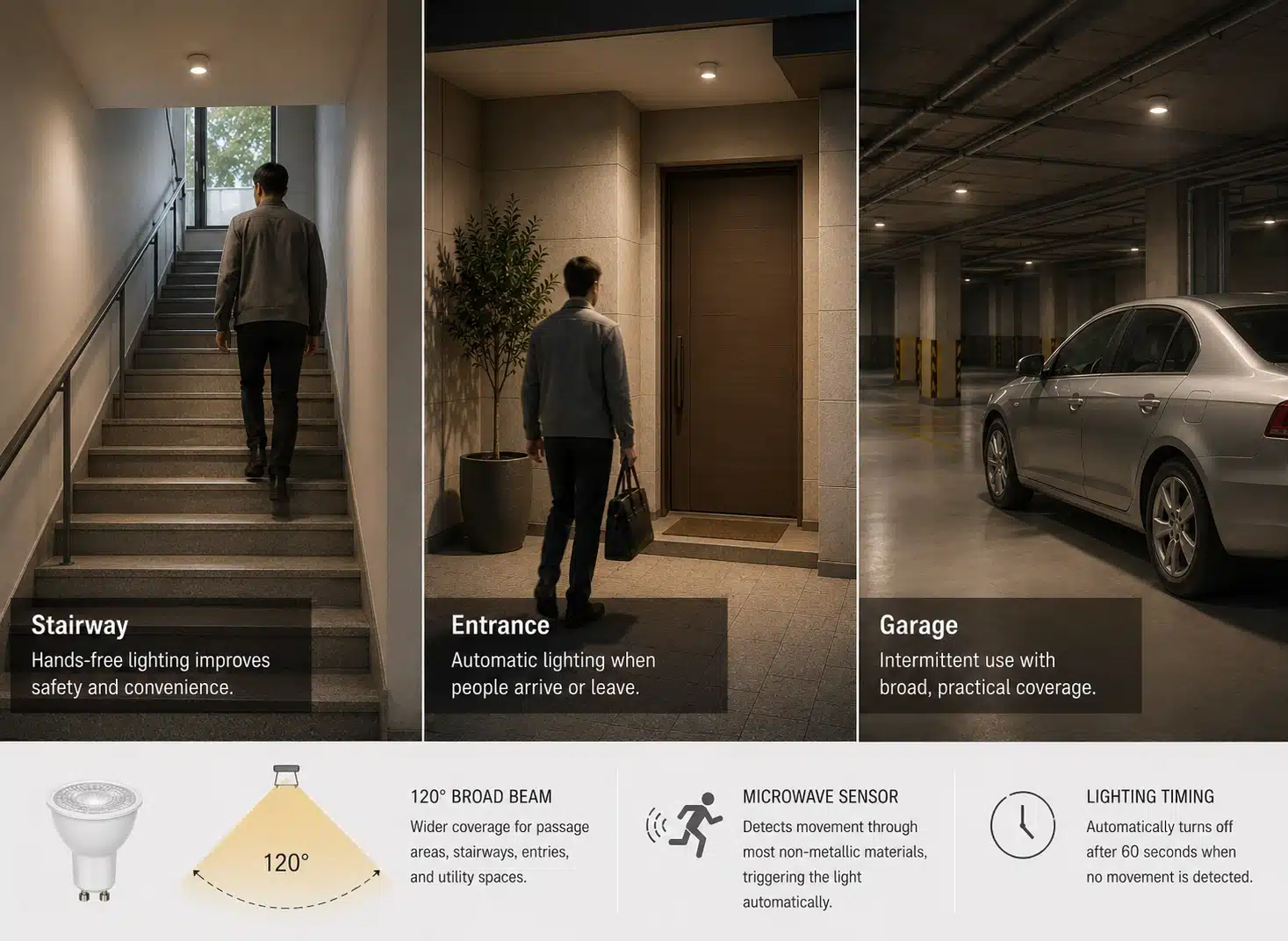
GU10 microwave sensor bulb for stairway entrance and garage lighting
Where You Should Not Use a Microwave Sensor GU10 Bulb
The most professional advice is sometimes to say no. A motion sensor bulb is useful only when automatic switching matches the space behavior.
Avoid using this type of lamp in:
- areas that need continuous stable lighting, such as workstations or desks
- spaces that need dimming, scene setting, or ambience control
- restaurants, hotel rooms, lounges, or retail displays where lighting mood matters
- narrow areas where the sensor may detect movement through a wall or door
- locations with moving fans, machines, vehicles, or doors that may create false triggers
- fully metal-enclosed luminaires that may block or distort microwave sensing
- damp, outdoor, or wet areas unless the full product and fixture have suitable ratings
- emergency lighting, exit lighting, or life-safety systems
- multi-lamp zones where every lamp must switch on and off in a coordinated way
TECO’s product is explicitly listed as non-dimmable.1 It should not be connected to a standard Triac dimmer or used where dimming compatibility is required. If the front end already has an external motion sensor, timer, smart relay, or building-control system, the project team should check whether adding a second sensor inside each bulb creates control conflict.
A good rule is this: use a sensor bulb for simple localized automatic switching; use a proper control system when the building needs coordinated zones, dimming, schedules, overrides, or central management.
The Sensor Parameters Buyers Must Confirm
For bulk orders, sensor behavior matters as much as wattage and lumens. Two bulbs with the same GU10 base can create very different user experiences if their delay time, detection distance, daylight threshold, or re-trigger behavior differs.
| Paramètre | Why It Matters in Projects |
|---|---|
| Detection distance | Too short creates dark entry moments; too long may detect adjacent areas |
| Delay / hold time | Too short causes repeated off/on; too long reduces energy savings |
| Daylight threshold | Prevents the lamp from switching on in bright conditions |
| Installation height | Changes real detection coverage and response behavior |
| Fixture material | Metal, glass, or plastic may change microwave transmission |
| Fixture depth | A deeply recessed GU10 may limit sensor performance |
| Re-trigger behavior | Determines whether timing resets when movement continues |
| Multi-lamp sequence | Prevents awkward staggered switching in corridors |
| Ambient movement | Fans, doors, vehicles, and machinery may trigger the sensor |
One overlooked issue is re-trigger logic. In a corridor, the lamp should normally remain on if movement continues. If the delay time expires while the person is still nearby, the user may see uncomfortable repeated switching. For stairways, both upward and downward movement should be tested because detection may differ by approach direction.
Daylight threshold also deserves attention. If it is too high, the lamp may switch on during the day and waste energy. If it is too low, it may fail to activate at dusk or in a dim interior. For buildings with skylights, glass doors, or mixed daylight, one setting may not behave the same throughout the day.
Fixture Compatibility Is More Than the GU10 Base
Being able to twist the bulb into a GU10 holder does not guarantee sensor performance. The lamp, fixture, and space must work together.
Buyers should check four compatibility layers:
| Compatibility Layer | What to Check |
|---|---|
| Mechanical fit | 50 x 53 mm lamp body, holder depth, trim clearance |
| Electrical input | 100-240Vac supply, non-dimmable circuit, stable connection |
| Sensor transmission | Fixture material, metal shielding, glass or plastic covers |
| Thermal condition | Heat buildup around the LED, driver, and sensor electronics |
Deep recessed fittings can hide the lamp body and change the detection area. Metal housings may reflect or block microwave signals. Thick covers may reduce sensitivity. Very open fixtures may allow the sensor to detect too broadly. These effects are not always visible from the product photo.
For retrofit projects, the safest method is to install samples in the real fixture and test the real walking path. A sample tested on an open desk does not prove that it will behave correctly inside a ceiling fitting, garage fixture, or stairwell luminaire.
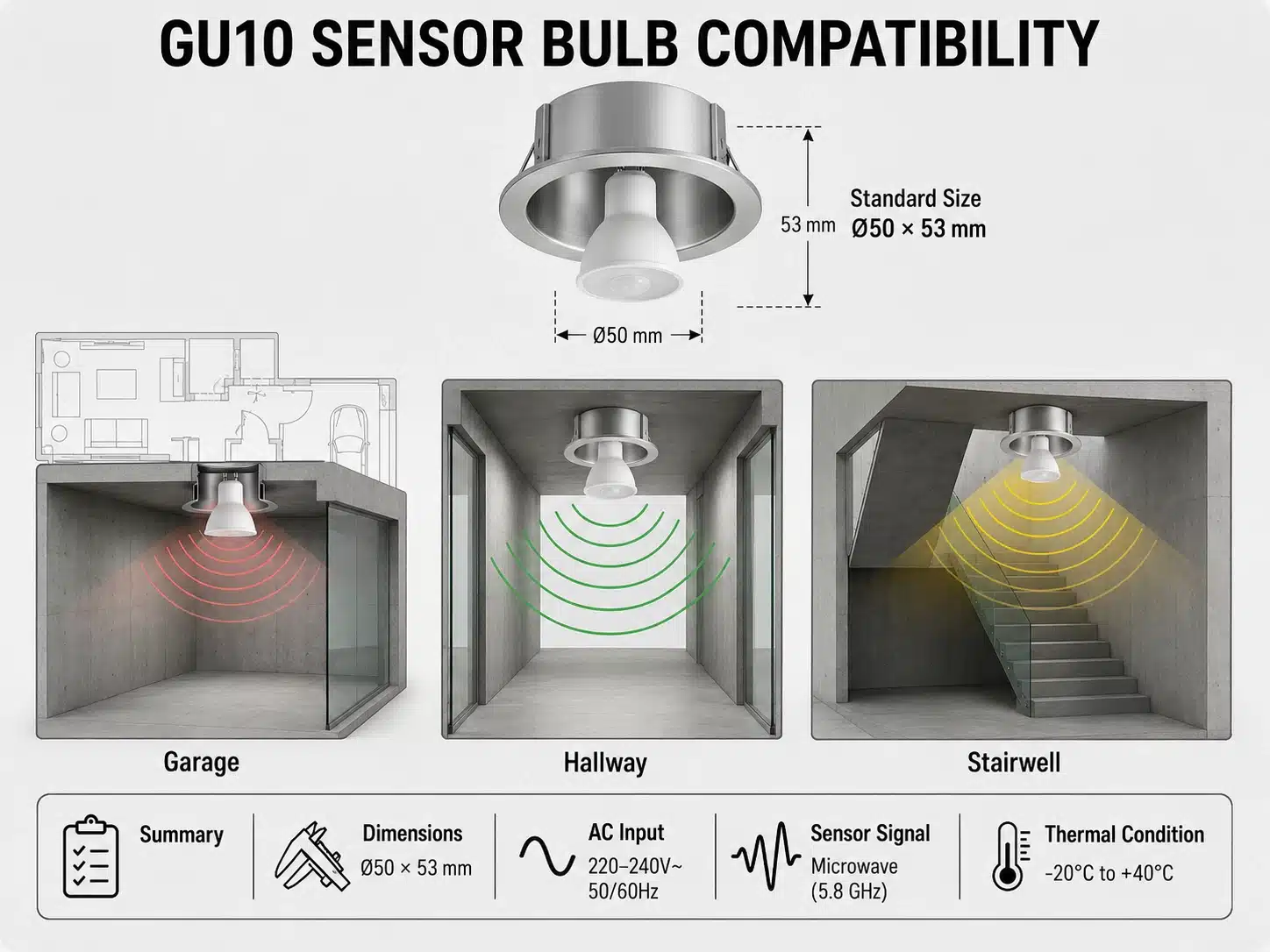
GU10 microwave motion sensor bulb fixture compatibility and installation testing
Common Installation Problems and False Triggers
Most complaints about sensor bulbs come from installation mismatch rather than a simple lamp defect. The lamp may work exactly as designed, but the sensing zone does not match the space.
Common problems include:
| Problem | Possible Cause | Project Fix |
|---|---|---|
| Lamp stays on too long | Delay time too long or continuous movement nearby | Adjust delay or change location |
| Lamp turns on through a door | Microwave detection extends beyond target zone | Reduce range, relocate lamp, or use different control method |
| Lamp does not turn on quickly | Sensor shielded by fixture or installed in poor direction | Test fixture material and position |
| Lamp triggers from fans or vehicles | Moving objects inside detection range | Change sensing distance or application |
| Multiple bulbs switch unevenly | Each bulb detects independently | Use fewer sensor bulbs or external zone control |
| Lamp flickers on dimmer | Product is non-dimmable | Remove dimmer or use a suitable non-dim circuit |
For hotel corridors or apartment common areas, staggered switching can look unprofessional if each bulb activates independently. In a short passage, this may be acceptable. In a long corridor, an external sensor controlling multiple standard GU10 lamps may create a smoother result.
For garages, vehicles may trigger the light before a person enters. That can be useful, but it may also keep the light active longer than expected. For service rooms, moving equipment or ventilation can sometimes create unexpected activation. This is why a site mockup is more valuable than arguing from a detection-distance number alone.
Integrated Sensor Bulb vs External Motion Sensor
An integrated GU10 sensor bulb is attractive because it keeps the retrofit simple. But it is not always the best engineering answer.
| Facteur | Integrated GU10 Sensor Bulb | External Sensor + Standard GU10 |
|---|---|---|
| Retrofit complexity | Usually lower | May require rewiring |
| Control zone | Each bulb usually works independently | One sensor can control several lamps |
| Visual appearance | No obvious external sensor | External sensor may be visible |
| Commissioning flexibility | Limited by bulb design | Usually more adjustable |
| Maintenance | Sensor and lamp replaced together | Sensor and lamp serviced separately |
| Large project suitability | Good for simple localized retrofits | Better for coordinated zones |
For small zones, individual sensor bulbs can be very convenient. For long corridors, hotel floors, office common areas, or multi-lamp stairwells, a dedicated external sensor may provide better zone control. The right solution depends on whether the buyer wants simple lamp-level automation or a coordinated building-control result.
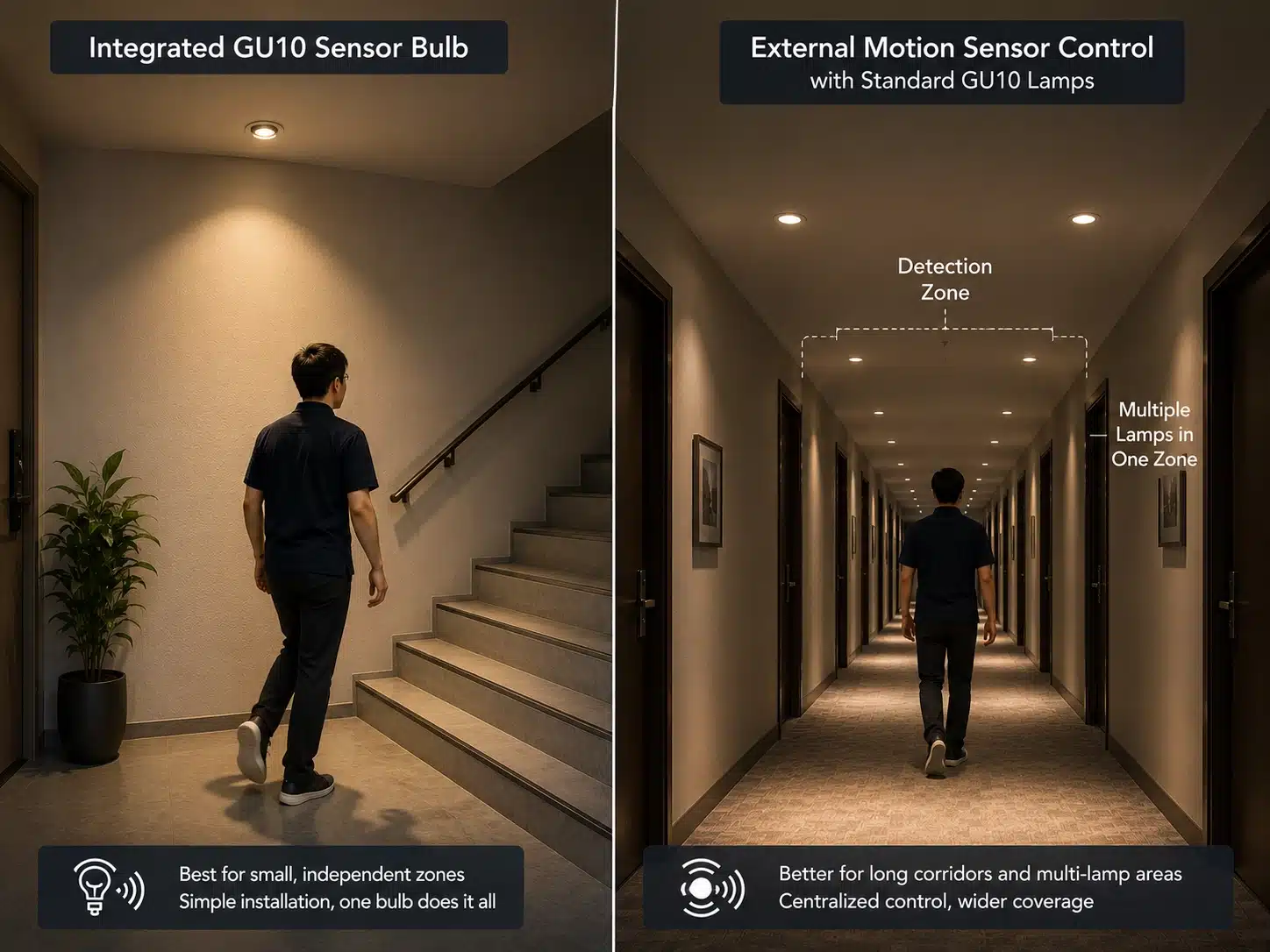
Integrated GU10 sensor bulb versus external motion sensor lighting control
What B2B Buyers Should Test Before Bulk Orders
Before ordering sensor GU10 bulbs in quantity, buyers should test the product as a system: lamp, fixture, building material, mounting height, walking path, daylight condition, and electrical circuit.
| Test Item | What to Confirm |
|---|---|
| GU10 fit | Lamp fits the holder, trim, and fixture depth |
| Detection range | No missed detection or adjacent-area triggering |
| Hold time | Matches real walking and occupancy pattern |
| Daylight threshold | Does not switch on unnecessarily during daytime |
| Fixture material | Metal, glass, or plastic does not create unexpected behavior |
| Installation height | Detection works at the real ceiling or wall position |
| Multiple lamps | Activation sequence looks acceptable |
| Heat | Lamp remains stable in the intended fixture |
| Tension | Stable operation on the target market supply |
| Beam coverage | 120 degree beam covers the required floor or passage area |
| Batch consistency | Sensor behavior remains consistent across production |
| Certification | Meets destination-market requirements |
For a serious inquiry, buyers should send TECO the fixture photo, installation height, corridor or room dimensions, number of lamps per area, target sensing distance, preferred delay time, daylight requirement, voltage market, and estimated order quantity. This gives the team enough information to recommend a sample configuration and avoid treating the product as a generic GU10 replacement.
Conclusion
GU10 microwave motion sensor bulbs are most useful in localized retrofit projects where automatic lighting is needed without replacing the complete fixture. They can work well in corridors, stairways, entrances, garages, service rooms, apartment common areas, and hotel back-of-house zones.
The key is to specify them as sensor-control products, not as ordinary GU10 spotlights. Detection range, delay time, daylight threshold, fixture material, installation height, beam coverage, false-trigger risk, and multi-lamp behavior must all be checked before bulk installation.
For TECO project buyers, the best next step is not only to ask for price. Send the fixture type, installation position, sensing requirement, delay-time preference, daylight condition, and estimated quantity so the right GU10 microwave sensor bulb sample can be tested before production.
Notes de bas de page
Product specifications are based on TECO’s product page for the Essential Plastic GU10 Microwave Motion Sensor Light Bulb, including 7W power, 100-240Vac input, 120 degree beam angle, non-dimmable operation, 640lm / 740lm / 800lm flux options, and customizable sensing settings. See TECO GU10 Microwave Motion Sensor Spotlight 7W 120D. ↩ ↩
The U.S. Department of Energy report on occupancy sensor reliability discusses field of view, detection distance, repeatable test methods, and the use of NEMA protocol for PIR and active sensors such as ultrasonic and microwave devices. See DOE Evaluation of the Reliability of PIR Occupancy Sensors. ↩
NEMA describes lighting controls as devices and systems including sensors, photocells, dimmers, timers, relays, and other controls used to reduce energy consumption, improve safety, and increase flexibility. See NEMA Lighting Controls. ↩