Лампы GU10 с микроволновым датчиком движения: принцип работы и сферы применения
Коридоры, лестницы, входы, гаражи и служебные зоны часто имеют одну и ту же проблему с освещением: лампы остаются включенными часами, даже когда в помещении никого нет. Замена всего светильника на модель с датчиком может решить проблему, но это может потребовать перемонтажа проводки, работ с потолком, согласования светильника и более крупного бюджета на модернизацию.
Микроволновая лампа с датчиком движения GU10 предлагает более компактное решение. Вместо добавления внешнего датчика или замены всего светильника, датчик интегрирован в саму лампу. Если существующий патрон GU10 и светильник подходят, проектная команда может добавить автоматическое переключение, просто заменив лампу.
Это не означает, что каждый светильник с цоколем GU10 должен использовать лампу с датчиком. Микроволновое обнаружение может быть чувствительным, материалы светильника могут влиять на работу датчика, и лампа обычно предназначена для автоматического включения/выключения, а не для диммирования или управления сценами. Для B2B-покупателей реальный вопрос не только в том, "включается ли она?", но и в том, "будут ли дальность обнаружения, время задержки, ширина луча, положение светильника и вероятность ложных срабатываний работать в реальном здании?"
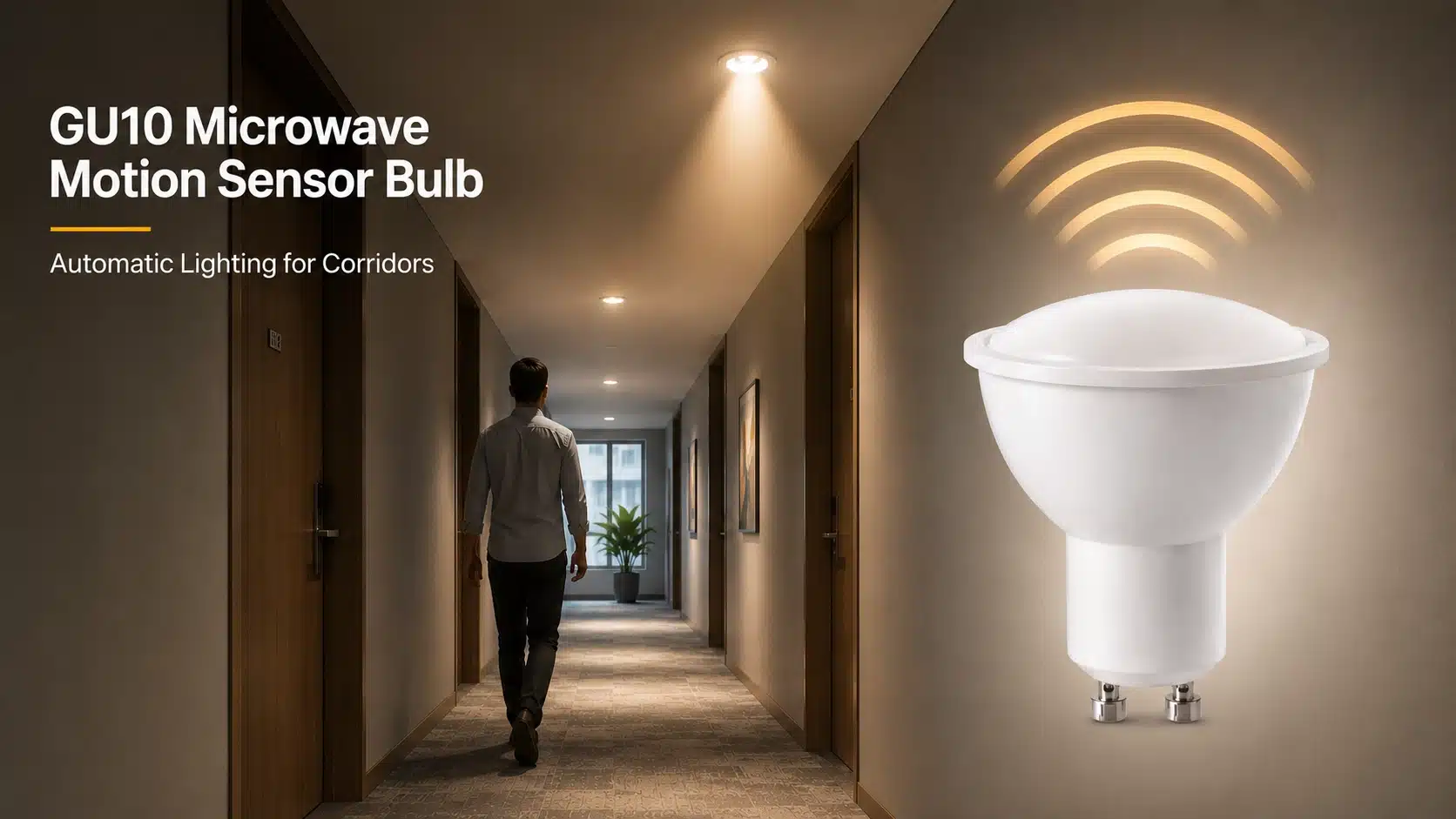
Микроволновая лампа с датчиком движения GU10 для модернизации освещения в коридорах
Что такое микроволновая лампа с датчиком движения GU10?
Микроволновая лампа с датчиком движения GU10 — это все та же светодиодная лампа GU10. Она использует стандартный поворотно-фиксирующий цоколь GU10 и устанавливается в совместимую розетку GU10 сетевого напряжения. Разница в том, что лампа также содержит микроволновый датчик движения, драйвер и управляющую схему.
При обнаружении движения лампа автоматически включается. После последнего обнаруженного движения лампа остается включенной в течение заданного периода задержки, а затем выключается. Некоторые датчики ламп также включают обнаружение дневного света, поэтому лампа не включается без необходимости, когда окружающее пространство уже достаточно яркое.
Микроволновая лампа с датчиком движения TECO Essential Plastic GU10 — это 7-ваттная нерегулируемая лампа GU10 с углом рассеивания 120 градусов, входным напряжением 100-240 В переменного тока, без мерцания, и вариантами светового потока 640 лм, 740 лм и 800 лм в зависимости от CCT. На странице продукта указаны варианты 2700K, 3000K и 4000K, CRI80, размеры 50 x 53 мм, а также настраиваемая дистанция обнаружения, время задержки и порог освещенности для требований проекта.1
| Компонент | Функция в лампе с датчиком |
|---|---|
| Цоколь GU10 | Подключается к существующему патрону сетевого напряжения |
| Светодиодный источник света | Обеспечивает фактическое освещение |
| Микроволновый датчик | Обнаруживает движение по изменениям в отраженном микроволновом сигнале |
| Драйвер и управляющая схема | Питает светодиоды и управляет автоматическим переключением |
| Детекция дневного света | Помогает предотвратить ненужное срабатывание в ярких условиях |
| Настройка задержки | Определяет, как долго лампа остается включенной после обнаружения движения |
Этот продукт не следует рассматривать как голосовую лампу, PIR-лампу, регулируемый прожектор или аварийный свет. Лучше всего его понимать как светодиодную лампу GU10 со встроенным автоматическим переключением по движению.
Как работает микроволновое обнаружение движения
Микроволновое обнаружение — это активный метод детекции. Датчик излучает маломощный микроволновый сигнал и отслеживает отраженный сигнал. Когда человек, транспортное средство, дверь или объект движется в зоне обнаружения, отраженный сигнал изменяется. Управляющая схема интерпретирует это изменение как движение и включает лампу.
Обнаружение PIR работает иначе. PIR датчики — это пассивные инфракрасные устройства, которые реагируют на изменения инфракрасного излучения в их поле зрения. Микроволновые датчики активно отправляют и принимают сигналы, в то время как PIR датчики обнаруживают изменения в тепловых излучающих паттернах. Из-за этой разницы микроволновые датчики иногда могут обнаруживать более мелкие движения или движение сквозь определенные неметаллические материалы, в то время как PIR датчикам обычно требуется более четкая прямая видимость движущегося теплого объекта.
Для покупателей осветительного оборудования практический смысл прост:
- микроволновые датчики обнаруживают движение, а не звук
- они зависят не только от тепла тела
- они могут реагировать на мелкие движения быстрее, чем PIR
- в некоторых установках они могут обнаруживать движение за пределами предполагаемой видимой зоны
- металл, глубокие светильники и окружающая конструкция могут изменить результат обнаружения
Отчет Министерства энергетики США о надежности датчиков отмечает, что производительность датчиков присутствия обычно оценивается по полю обзора, дальности обнаружения и повторяемым методам тестирования, а также что протоколы NEMA охватывают PIR, а также активные технологии обнаружения, такие как ультразвуковые и микроволновые устройства.2 Это важно, потому что производительность датчика — это не просто цифра из технического описания. Она тесно связана с геометрией установки.
Могут ли микроволновые датчики ламп обнаруживать движение сквозь стены или двери?
Иногда, но это требует осторожного подхода. Микроволновые сигналы могут проходить сквозь некоторые виды стекла, пластика, тонкой древесины или легких неметаллических покрытий или подвергаться их влиянию. Металл обычно отражает или экранирует сигнал. Толщина и материал стены, чувствительность датчика, направление установки и конструкция светильника — все это влияет на результат.
Это может быть преимуществом в некоторых закрытых светильниках, где датчик скрыт за пластиковой или стеклянной крышкой. Это также может стать проблемой, если лампа обнаруживает движение за тонкой перегородкой, за дверью или в соседнем коридоре.
Правильная формулировка — не "микроволновые датчики могут видеть сквозь стены". Более точное описание проекта: микроволновое обнаружение может распространяться за пределы видимого отверстия светильника в зависимости от материала и условий установки, поэтому перед массовым монтажом требуется тестирование на образцах.
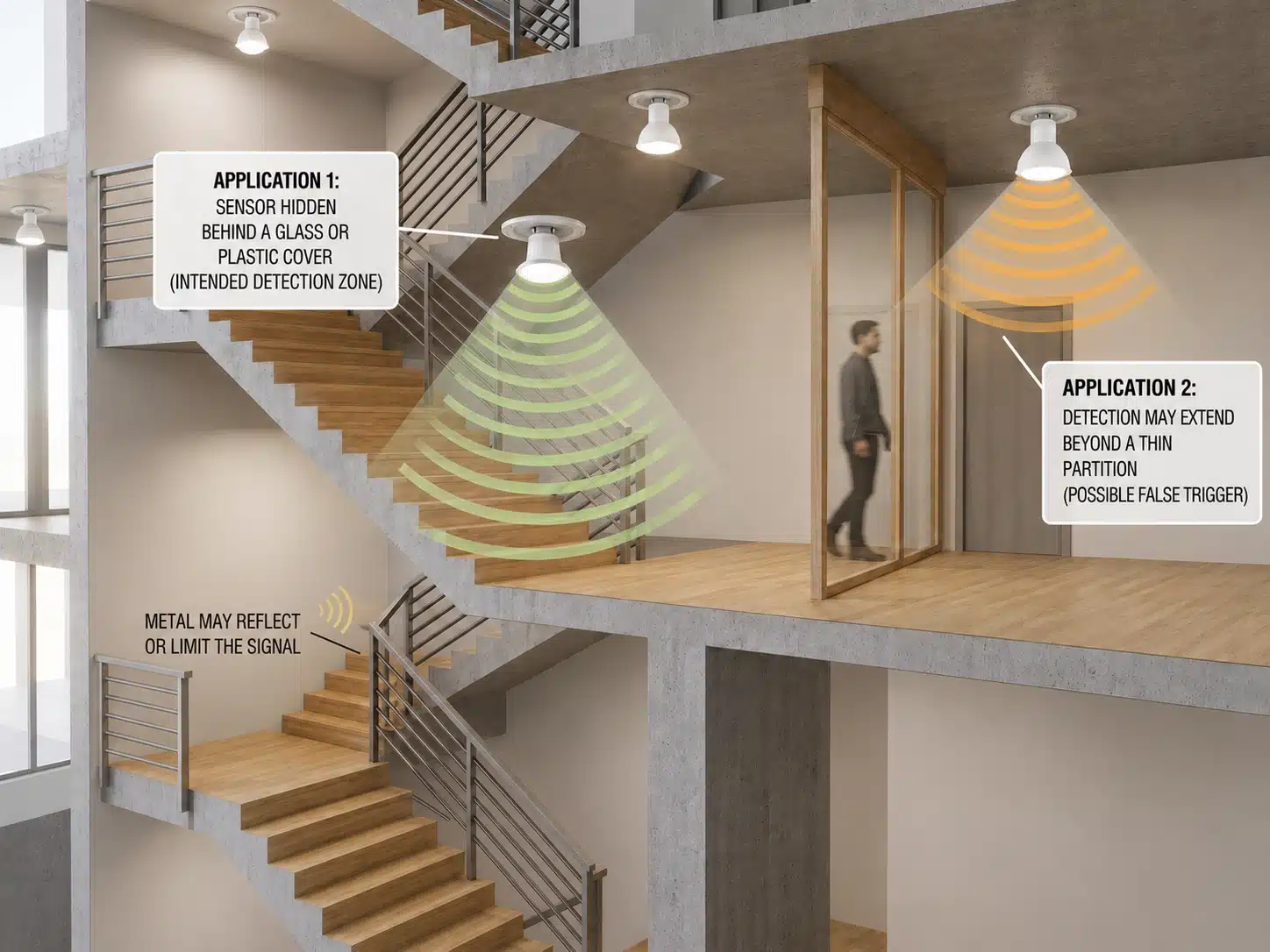
Обнаружение микроволновой лампой GU10 в освещении коридоров и лестничных пролетов
Микроволновый датчик против PIR датчика: в чем разница?
Микроволновые и PIR датчики нельзя просто назвать "лучше" или "хуже". Они решают разные проектные задачи. Микроволновый датчик может быть полезен, когда важны обнаружение малейших движений, скрытая установка или обнаружение сквозь некоторые неметаллические покрытия. PIR может быть лучше, когда проекту требуется более четко ограниченная зона обнаружения с меньшим риском срабатывания от смежных областей.
| Фактор | Микроволновый датчик | PIR-датчик |
|---|---|---|
| Принцип обнаружения | Отправляет и принимает микроволновые сигналы | Обнаруживает изменения инфракрасного излучения |
| Тип датчика | Активен | Passive |
| Fine movement detection | Often sensitive to small movement | Usually needs clearer body movement |
| Temperature influence | Less dependent on body-to-air temperature difference | More affected by thermal contrast |
| Through-cover behavior | May work through some glass or plastic | Usually needs clearer field of view |
| False-trigger risk | May detect beyond intended zone | Usually more limited by line of sight |
| Power use | Typically higher than PIR sensing | Typically lower |
| Common use | Corridors, stairways, enclosed fixtures, service zones | Rooms, entries, outdoor security fittings |
For a single small corridor, stair landing, or service-room retrofit, a GU10 microwave sensor bulb can be a practical solution. For a large office, hotel floor, warehouse aisle, or coordinated building-control zone, an external sensor or networked control system may be more appropriate.
NEMA describes lighting controls as a broad category including photocells, sensors, dimmers, timers, relays, and systems used to reduce energy use, improve safety, and increase flexibility across indoor and outdoor spaces.3 A sensor bulb belongs to that wider control family, but it is still a localized product, not a full lighting control system.
Where GU10 Microwave Sensor Bulbs Work Best
The strongest use case is a localized retrofit where automatic lighting is helpful, the existing GU10 holder remains usable, and replacing the full fixture would be unnecessary. This is why sensor GU10 bulbs are often more valuable in circulation and support spaces than in decorative accent lighting.
Good applications include:
| Приложение | Why It Can Work Well |
|---|---|
| Corridors | Short occupancy periods and repeated passing traffic |
| Stairways | Hands-free switching improves convenience and safety |
| Entrances | Automatic lighting when people arrive or leave |
| Гаражи | Intermittent use and practical wide-area visibility |
| Service rooms | Staff may enter briefly and forget to switch lights off |
| Storage rooms | Lighting is needed only during access periods |
| Apartment common areas | Retrofit-friendly automatic lighting without full fixture replacement |
| Hotel back-of-house areas | Practical lighting for service passages and utility zones |
TECO’s model uses a 120 degree beam, which is different from a narrow GU10 spotlight. A standard GU10 used for accent lighting may have a 24 degree, 36 degree, or 60 degree beam. A 120 degree beam is broader and more suitable for passage lighting, stair zones, entries, and utility spaces where people need general visibility rather than a tight spotlight effect.
| Beam Type | Typical Effect | Better Use |
|---|---|---|
| 24 degree | Narrow, concentrated spot | Product accent lighting |
| 36 degree | Controlled spotlight | Retail or recessed accent lighting |
| 60 degree | Wider spotlight | Small spaces and broader accents |
| 120 degree | Broad flood coverage | Corridors, stairs, garages, entrances |
This means the lamp should not be specified as a premium display spotlight or decorative beam-control product. It is a functional automatic lighting bulb for movement-based switching and broad coverage.
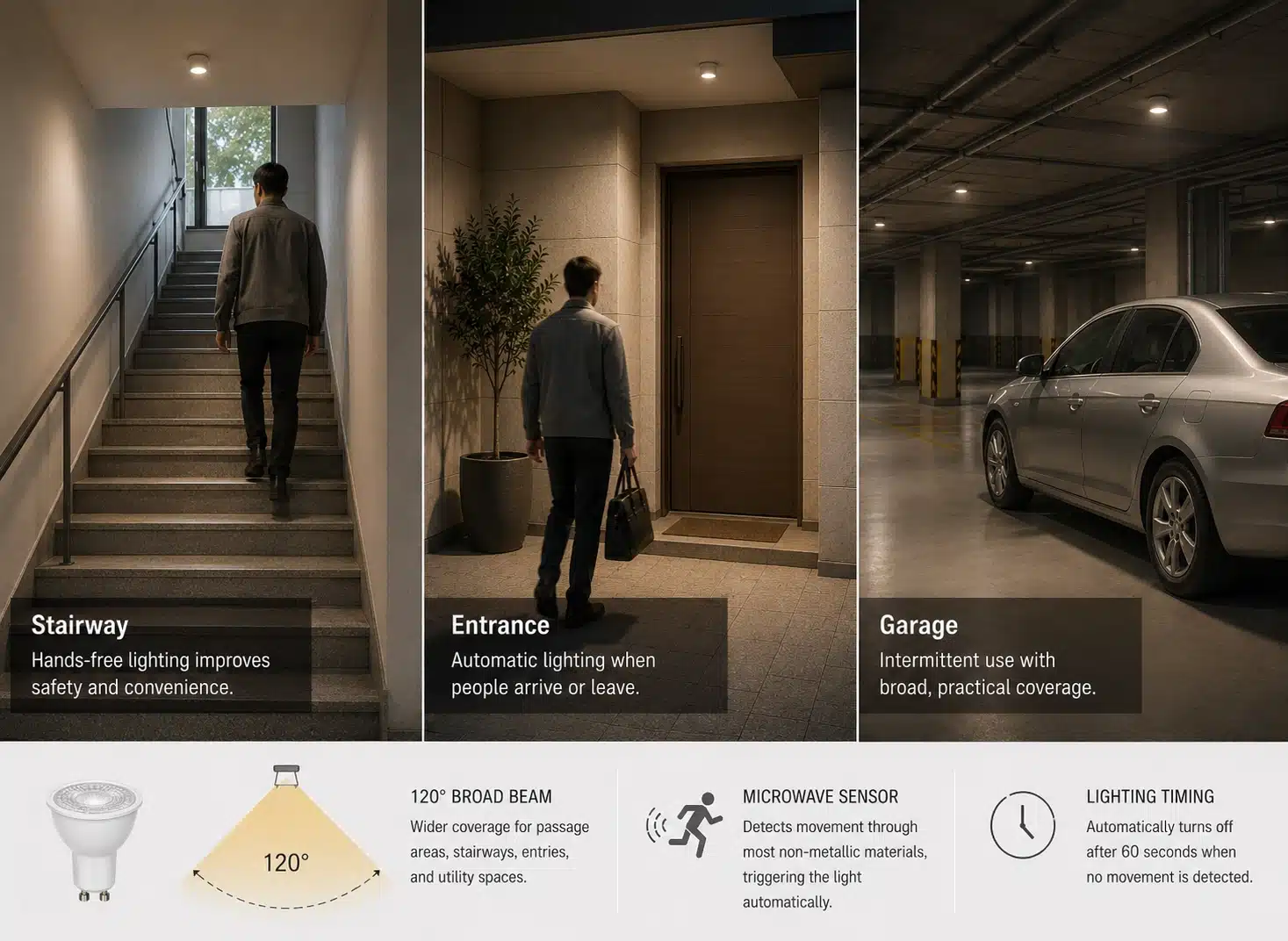
GU10 microwave sensor bulb for stairway entrance and garage lighting
Where You Should Not Use a Microwave Sensor GU10 Bulb
The most professional advice is sometimes to say no. A motion sensor bulb is useful only when automatic switching matches the space behavior.
Avoid using this type of lamp in:
- areas that need continuous stable lighting, such as workstations or desks
- spaces that need dimming, scene setting, or ambience control
- restaurants, hotel rooms, lounges, or retail displays where lighting mood matters
- narrow areas where the sensor may detect movement through a wall or door
- locations with moving fans, machines, vehicles, or doors that may create false triggers
- fully metal-enclosed luminaires that may block or distort microwave sensing
- damp, outdoor, or wet areas unless the full product and fixture have suitable ratings
- emergency lighting, exit lighting, or life-safety systems
- multi-lamp zones where every lamp must switch on and off in a coordinated way
TECO’s product is explicitly listed as non-dimmable.1 It should not be connected to a standard Triac dimmer or used where dimming compatibility is required. If the front end already has an external motion sensor, timer, smart relay, or building-control system, the project team should check whether adding a second sensor inside each bulb creates control conflict.
A good rule is this: use a sensor bulb for simple localized automatic switching; use a proper control system when the building needs coordinated zones, dimming, schedules, overrides, or central management.
The Sensor Parameters Buyers Must Confirm
For bulk orders, sensor behavior matters as much as wattage and lumens. Two bulbs with the same GU10 base can create very different user experiences if their delay time, detection distance, daylight threshold, or re-trigger behavior differs.
| Параметр | Why It Matters in Projects |
|---|---|
| Detection distance | Too short creates dark entry moments; too long may detect adjacent areas |
| Delay / hold time | Too short causes repeated off/on; too long reduces energy savings |
| Daylight threshold | Prevents the lamp from switching on in bright conditions |
| Installation height | Changes real detection coverage and response behavior |
| Fixture material | Metal, glass, or plastic may change microwave transmission |
| Fixture depth | A deeply recessed GU10 may limit sensor performance |
| Re-trigger behavior | Determines whether timing resets when movement continues |
| Multi-lamp sequence | Prevents awkward staggered switching in corridors |
| Ambient movement | Fans, doors, vehicles, and machinery may trigger the sensor |
One overlooked issue is re-trigger logic. In a corridor, the lamp should normally remain on if movement continues. If the delay time expires while the person is still nearby, the user may see uncomfortable repeated switching. For stairways, both upward and downward movement should be tested because detection may differ by approach direction.
Daylight threshold also deserves attention. If it is too high, the lamp may switch on during the day and waste energy. If it is too low, it may fail to activate at dusk or in a dim interior. For buildings with skylights, glass doors, or mixed daylight, one setting may not behave the same throughout the day.
Fixture Compatibility Is More Than the GU10 Base
Being able to twist the bulb into a GU10 holder does not guarantee sensor performance. The lamp, fixture, and space must work together.
Buyers should check four compatibility layers:
| Compatibility Layer | What to Check |
|---|---|
| Mechanical fit | 50 x 53 mm lamp body, holder depth, trim clearance |
| Electrical input | 100-240Vac supply, non-dimmable circuit, stable connection |
| Sensor transmission | Fixture material, metal shielding, glass or plastic covers |
| Thermal condition | Heat buildup around the LED, driver, and sensor electronics |
Deep recessed fittings can hide the lamp body and change the detection area. Metal housings may reflect or block microwave signals. Thick covers may reduce sensitivity. Very open fixtures may allow the sensor to detect too broadly. These effects are not always visible from the product photo.
For retrofit projects, the safest method is to install samples in the real fixture and test the real walking path. A sample tested on an open desk does not prove that it will behave correctly inside a ceiling fitting, garage fixture, or stairwell luminaire.
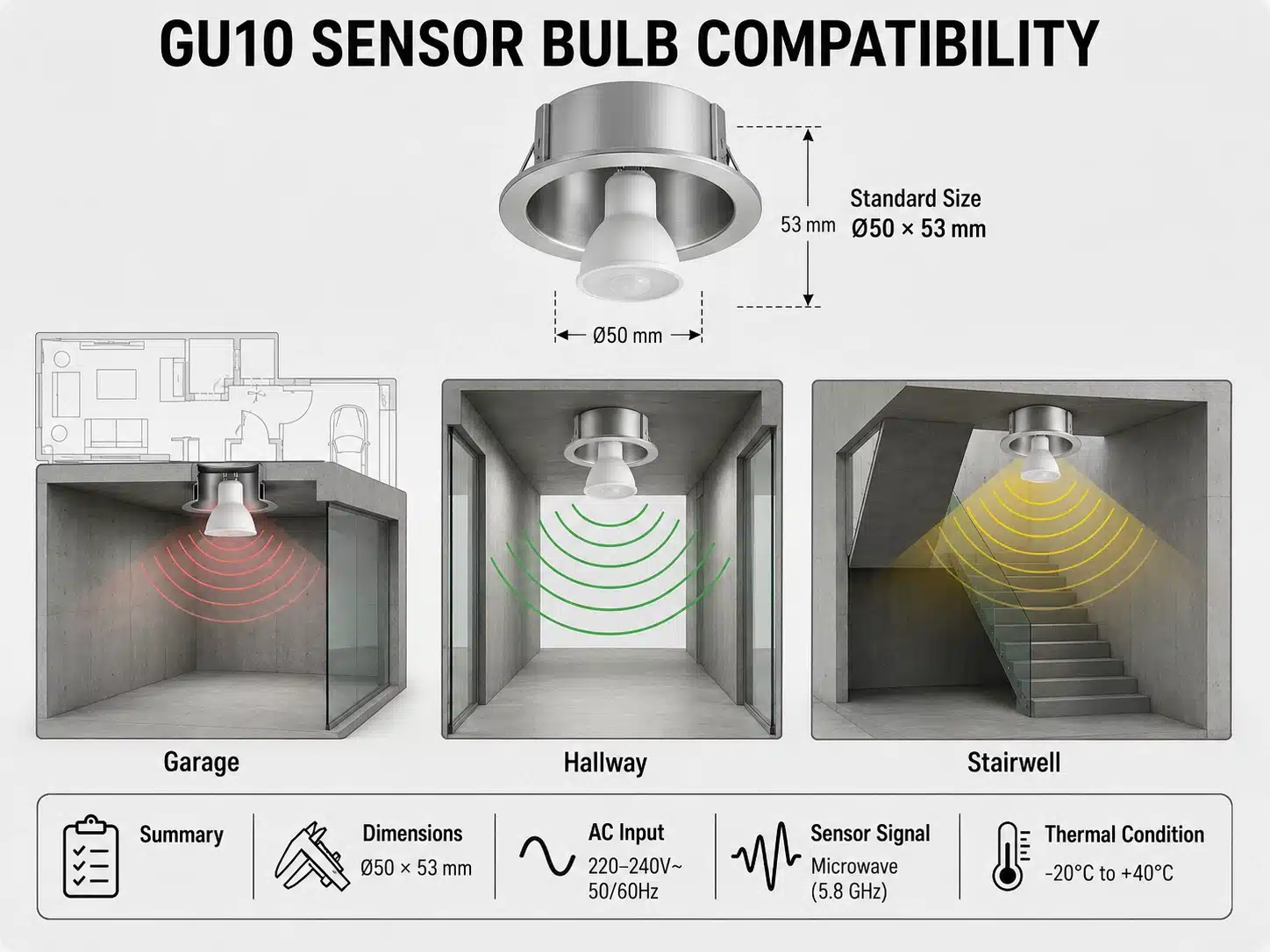
GU10 microwave motion sensor bulb fixture compatibility and installation testing
Common Installation Problems and False Triggers
Most complaints about sensor bulbs come from installation mismatch rather than a simple lamp defect. The lamp may work exactly as designed, but the sensing zone does not match the space.
Common problems include:
| Проблема | Possible Cause | Project Fix |
|---|---|---|
| Lamp stays on too long | Delay time too long or continuous movement nearby | Adjust delay or change location |
| Lamp turns on through a door | Microwave detection extends beyond target zone | Reduce range, relocate lamp, or use different control method |
| Lamp does not turn on quickly | Sensor shielded by fixture or installed in poor direction | Test fixture material and position |
| Lamp triggers from fans or vehicles | Moving objects inside detection range | Change sensing distance or application |
| Multiple bulbs switch unevenly | Each bulb detects independently | Use fewer sensor bulbs or external zone control |
| Lamp flickers on dimmer | Product is non-dimmable | Remove dimmer or use a suitable non-dim circuit |
For hotel corridors or apartment common areas, staggered switching can look unprofessional if each bulb activates independently. In a short passage, this may be acceptable. In a long corridor, an external sensor controlling multiple standard GU10 lamps may create a smoother result.
For garages, vehicles may trigger the light before a person enters. That can be useful, but it may also keep the light active longer than expected. For service rooms, moving equipment or ventilation can sometimes create unexpected activation. This is why a site mockup is more valuable than arguing from a detection-distance number alone.
Integrated Sensor Bulb vs External Motion Sensor
An integrated GU10 sensor bulb is attractive because it keeps the retrofit simple. But it is not always the best engineering answer.
| Фактор | Integrated GU10 Sensor Bulb | External Sensor + Standard GU10 |
|---|---|---|
| Retrofit complexity | Usually lower | May require rewiring |
| Control zone | Each bulb usually works independently | One sensor can control several lamps |
| Visual appearance | No obvious external sensor | External sensor may be visible |
| Commissioning flexibility | Limited by bulb design | Usually more adjustable |
| Maintenance | Sensor and lamp replaced together | Sensor and lamp serviced separately |
| Large project suitability | Good for simple localized retrofits | Better for coordinated zones |
For small zones, individual sensor bulbs can be very convenient. For long corridors, hotel floors, office common areas, or multi-lamp stairwells, a dedicated external sensor may provide better zone control. The right solution depends on whether the buyer wants simple lamp-level automation or a coordinated building-control result.
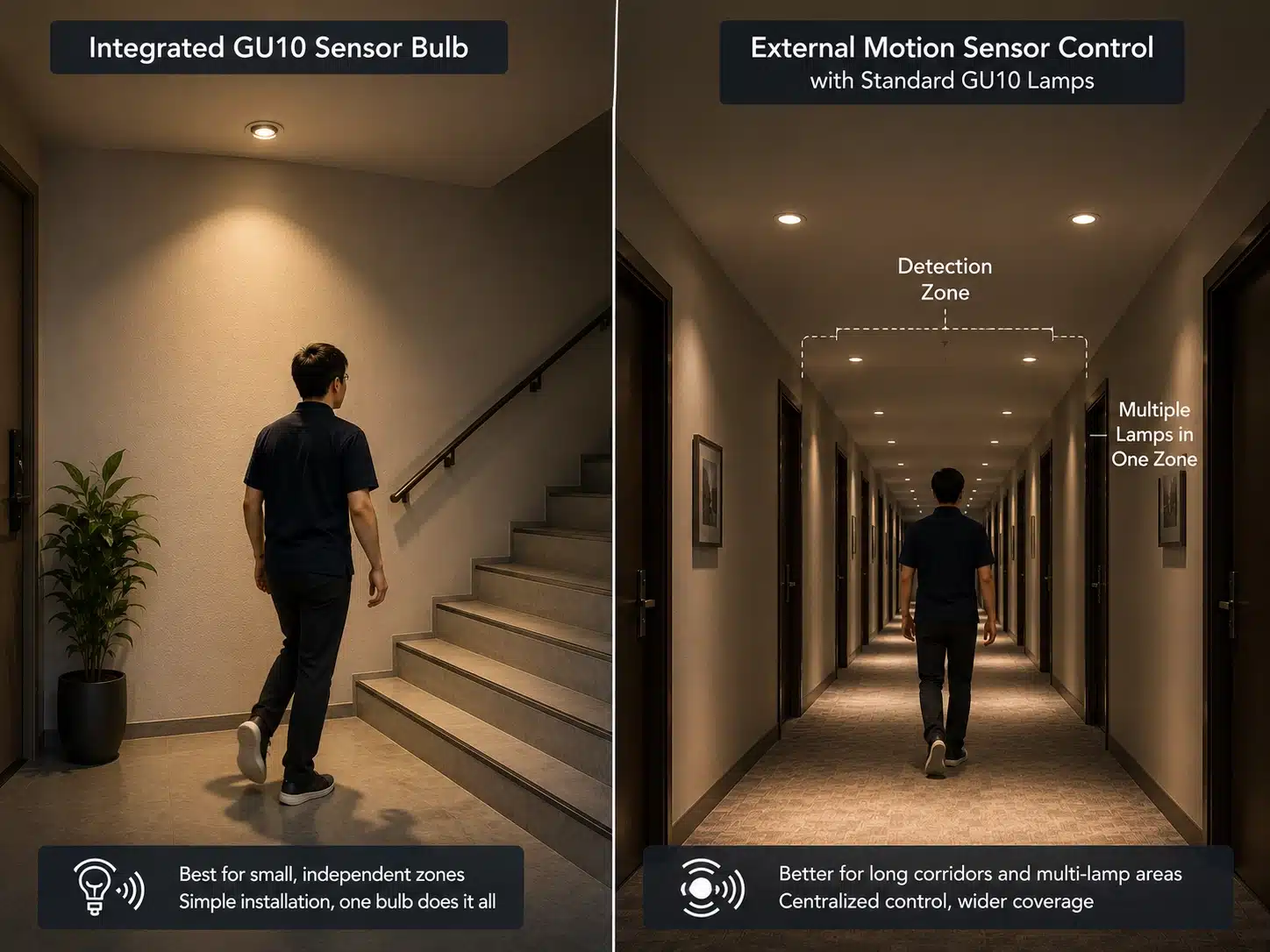
Integrated GU10 sensor bulb versus external motion sensor lighting control
What B2B Buyers Should Test Before Bulk Orders
Before ordering sensor GU10 bulbs in quantity, buyers should test the product as a system: lamp, fixture, building material, mounting height, walking path, daylight condition, and electrical circuit.
| Test Item | What to Confirm |
|---|---|
| GU10 fit | Lamp fits the holder, trim, and fixture depth |
| Дальность обнаружения | No missed detection or adjacent-area triggering |
| Hold time | Matches real walking and occupancy pattern |
| Daylight threshold | Does not switch on unnecessarily during daytime |
| Fixture material | Metal, glass, or plastic does not create unexpected behavior |
| Installation height | Detection works at the real ceiling or wall position |
| Multiple lamps | Activation sequence looks acceptable |
| Heat | Lamp remains stable in the intended fixture |
| Напряжение | Stable operation on the target market supply |
| Beam coverage | 120 degree beam covers the required floor or passage area |
| Batch consistency | Sensor behavior remains consistent across production |
| Сертификация | Meets destination-market requirements |
For a serious inquiry, buyers should send TECO the fixture photo, installation height, corridor or room dimensions, number of lamps per area, target sensing distance, preferred delay time, daylight requirement, voltage market, and estimated order quantity. This gives the team enough information to recommend a sample configuration and avoid treating the product as a generic GU10 replacement.
Заключение
GU10 microwave motion sensor bulbs are most useful in localized retrofit projects where automatic lighting is needed without replacing the complete fixture. They can work well in corridors, stairways, entrances, garages, service rooms, apartment common areas, and hotel back-of-house zones.
The key is to specify them as sensor-control products, not as ordinary GU10 spotlights. Detection range, delay time, daylight threshold, fixture material, installation height, beam coverage, false-trigger risk, and multi-lamp behavior must all be checked before bulk installation.
For TECO project buyers, the best next step is not only to ask for price. Send the fixture type, installation position, sensing requirement, delay-time preference, daylight condition, and estimated quantity so the right GU10 microwave sensor bulb sample can be tested before production.
Сноски
Product specifications are based on TECO’s product page for the Essential Plastic GU10 Microwave Motion Sensor Light Bulb, including 7W power, 100-240Vac input, 120 degree beam angle, non-dimmable operation, 640lm / 740lm / 800lm flux options, and customizable sensing settings. See TECO GU10 Microwave Motion Sensor Spotlight 7W 120D. ↩ ↩
The U.S. Department of Energy report on occupancy sensor reliability discusses field of view, detection distance, repeatable test methods, and the use of NEMA protocol for PIR and active sensors such as ultrasonic and microwave devices. See DOE Evaluation of the Reliability of PIR Occupancy Sensors. ↩
NEMA describes lighting controls as devices and systems including sensors, photocells, dimmers, timers, relays, and other controls used to reduce energy consumption, improve safety, and increase flexibility. See NEMA Lighting Controls. ↩