TM-30 vs CRI Rendimiento de Color: Comprendiendo las Métricas Modernas para una Evaluación Precisa de la Iluminación
Introducción
Color rendering is not a cosmetic specification. In commercial and hospitality lighting, it directly affects how merchandise, finishes, food, fabrics, and branded interiors are perceived on site. When the selected metric does not reflect actual visual performance, the result can be mock-up rejection, re-aiming, luminaire replacement, and disputes during commissioning.
This is where many projects run into trouble. CRI1 is still the most commonly quoted color metric in datasheets and tender documents, but it does not always describe how LED light sources render a full range of colors in real applications. TM-302 was developed to address that gap with a broader and more practical evaluation framework.
For importers, specifiers, and project contractors, the issue is not academic. It affects approval speed, visual consistency between batches, and the risk of post-installation complaints in retail stores, museums, hotel public areas, and architectural spaces.
Resumen Ejecutivo
CRI remains useful for basic specification, but TM-30 provides a more complete evaluation of LED color quality through fidelity and gamut analysis. For projects where color appearance affects brand presentation or visual comfort, TM-30 is the more reliable engineering reference.
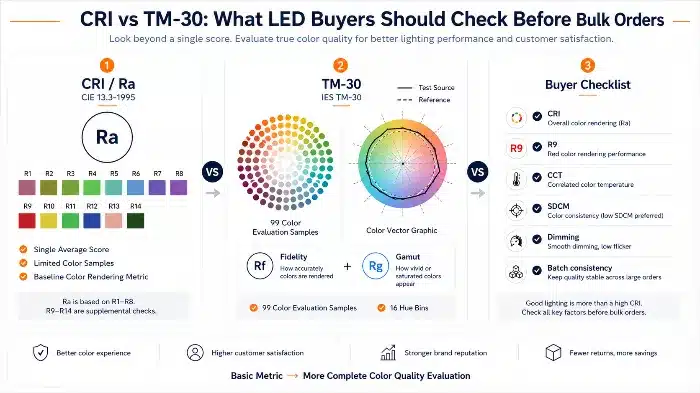
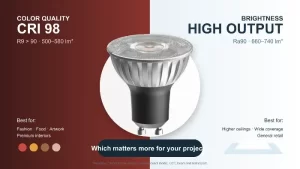
TM-30 vs CRI color rendering metrics for lighting evaluation
Why Color Rendering Matters in Lighting Design
Realidad en el sitio / comercial
In lighting design, poor color rendering often appears only after installation, when materials are viewed under the actual luminaires rather than in a lab report. A retail display may look flat, skin tones in a hospitality lobby may appear dull, or premium finishes may lose depth. At that stage, correcting the problem usually means changing lamps or fixtures, rechecking beam layouts, and repeating client approval.
For contractors and distributors, this creates direct cost through labor, access equipment, and project delay. In high-ceiling spaces such as ballrooms, atriums, and galleries, even a minor color performance issue can become expensive to rectify.
Análisis Profundo y Solución de Ingeniería
Color rendering describes how accurately a light source reveals object colors compared with a reference source. In practical terms, it helps determine whether illuminated materials appear natural, vivid, muted, or distorted.
Historically, CRI became the standard method for this evaluation. It is still widely used because it is simple and familiar. However, modern LED spectra are more complex than legacy incandescent or fluorescent sources, and a single score is often insufficient to describe their visual effect.
TM-30 expands the analysis by examining how a light source renders a much larger set of color samples and by separating two different characteristics:
- Fidelity, expressed as Rf, which indicates how closely colors match a reference
- Gamut, expressed as Rg, which indicates whether colors appear more saturated or less saturated overall
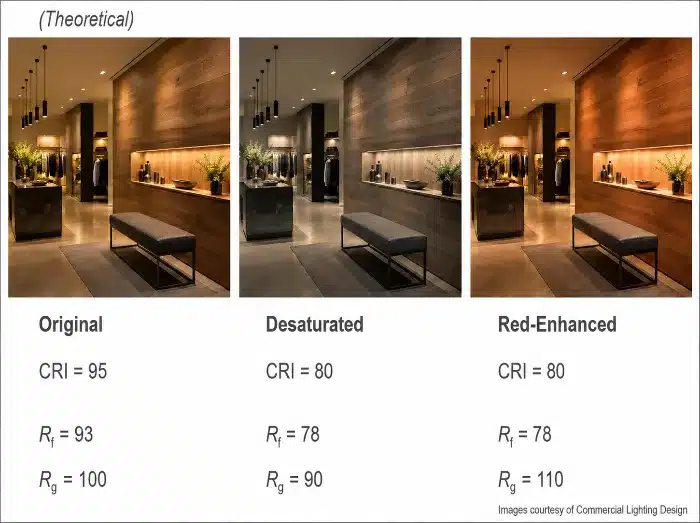
This distinction is important in specification work. Two light sources can have similar CRI values but produce noticeably different visual results in a store, museum, or premium interior.
Nota de Fábrica
From a manufacturing perspective, color rendering should never be treated as an isolated catalog number. It must be reviewed together with CCT3, chromaticity tolerance4, optical design, and batch consistency. A high nominal score is of limited value if one delivery lot does not visually match the approved sample.
¿Qué es el CRI (Índice de Reproducción Cromática)?
Realidad en el sitio / comercial
CRI is still the default requirement in many procurement documents because it is easy to understand and compare. A project may simply state CRI 80 or CRI 90 as a minimum threshold. That helps with fast vendor screening, but it can also create false confidence if no further color quality analysis is requested.
This becomes a problem when the site expectation is not just “acceptable color,” but accurate merchandise presentation, flattering skin tones, or faithful rendering of artwork and interior materials.
Análisis Profundo y Solución de Ingeniería
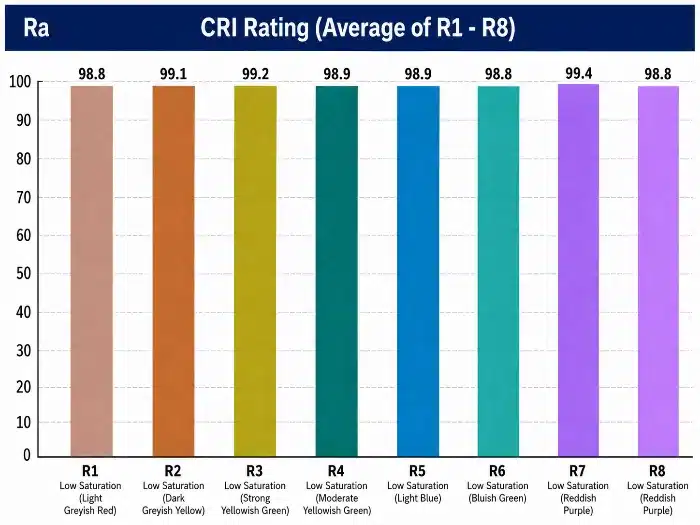
CRI, or Color Rendering Index, measures how well a light source reproduces colors compared with a reference illuminant of the same correlated color temperature. The general CRI value, Ra, is calculated from a limited set of test color samples.
Because of its long history, CRI remains useful as a baseline metric. It works reasonably well for broad comparisons and for minimum compliance requirements in standard commercial applications.
However, CRI simplifies color rendering into a single averaged value. That means it does not clearly show whether a source tends to oversaturate colors, desaturate them, or distort certain hues more than others. It also relies on a relatively small sample set, which limits its ability to describe the behavior of modern LED spectra in detail.
Nota de Fábrica
During project review, CRI is often the first filter, not the final decision metric. In applications where visual merchandising or material appearance matters, relying only on Ra can lead to approval issues after installation, especially when the client compares multiple luminaires side by side.
CRI color rendering index in LED lighting specification
Limitations of the Traditional CRI Metric
Realidad en el sitio / comercial
The practical issue with CRI appears when two luminaires both meet the same CRI target on paper but produce different visual impressions on site. One may make food displays look fresh and appealing, while another makes the same products look muted. If the tender specification only asked for CRI 90, both may technically comply.
For project teams, that mismatch can trigger sample resubmission, mock-up repetition, and claims that the installed lighting does not match the design intent.
Análisis Profundo y Solución de Ingeniería
The main limitations of CRI are related to how it is calculated:
- It uses a limited number of test color samples
- It reports an average score rather than a fuller color profile
- It does not adequately describe saturation shift
- It can miss differences in strong red rendering and other critical hues
- It was not developed around the spectral behavior of modern LED sources
Research on solid-state lighting has raised similar concerns. NIST researchers have noted that the traditional CRI method uses only eight low- to medium-saturation reflective samples and may not adequately represent normal object colors or the peaked spectral distributions often found in LED sources.5
As a result, CRI may not capture the full visual effect of a light source in real environments. This is particularly relevant in applications such as fashion retail, museums, restaurants, and architectural accent lighting, where specific colors and textures need to appear controlled and intentional.
A common example is R9, which describes saturated red rendering. In many LED specifications, R9 is reviewed separately because strong red performance can be critical for skin tones, food, wood, fabrics, cosmetics, and artwork. A product may have a high Ra value while still performing weakly in saturated red rendering.
A source with a high CRI can still produce color rendering that feels visually unbalanced if gamut behavior is not well managed. It also does not necessarily mean the spectral power distribution is smooth or complete. Two LED sources with similar Ra values may still show different spectral peaks, valleys, or missing wavelength regions, which can become visible when they are compared on real merchandise, artwork, wood, stone, fabric, or food surfaces.
Nota de Fábrica
In large hospitality projects, color complaints rarely begin with the phrase “the CRI is wrong.” They usually come as comments such as “the marble looks cold,” “the food looks dull,” or “the wood finish has lost warmth.” That is why more advanced color metrics are increasingly important during pre-approval.
What Is TM-30 Color Rendering?
Realidad en el sitio / comercial
TM-30 is especially useful when the project requires a more predictable visual result before full rollout. In chain retail, museum upgrades, or hotel brand standards, sample approval often depends on subtle color appearance rather than just meeting a minimum compliance value.
Using TM-30 in evaluation reduces the chance that a “passing” light source still disappoints during mock-up review.
Análisis Profundo y Solución de Ingeniería
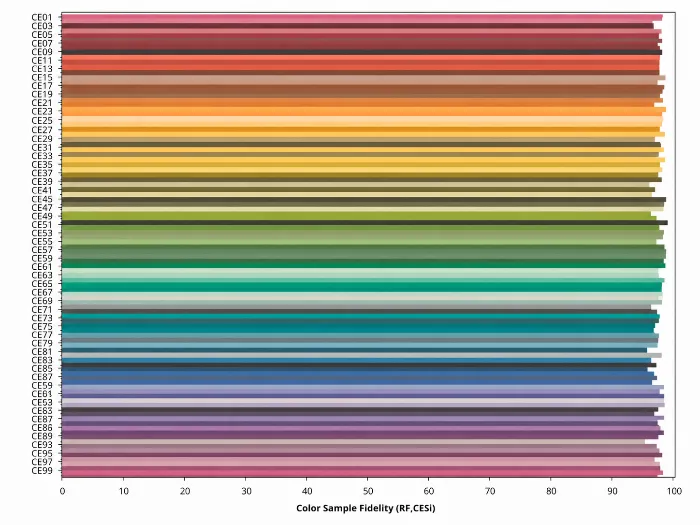
TM-30 is a modern method for evaluating color rendering developed to provide a more complete picture than CRI. Instead of relying on a small number of test samples and a single averaged score, TM-30 evaluates 99 color evaluation samples and reports multiple metrics.
Lighting research literature describes TM-30 as a broader framework for communicating color fidelity, gamut area, gamut shape, and related visual effects rather than reducing color quality to one average number.6
Its two most referenced outputs are:
- Rf, the Fidelity Index, which indicates how closely colors are rendered relative to a reference source
- Rg, the Gamut Index, which indicates the average increase or decrease in color saturation
This is the key improvement. TM-30 does not only ask whether colors are rendered accurately. It also shows whether the source tends to make colors look more vivid or more muted overall.
In professional lighting decisions, this matters because not every application wants the same result. A museum may prioritize faithful reproduction, while retail may accept moderate saturation enhancement if it supports product presentation without looking unnatural.
Nota de Fábrica
From a manufacturing perspective, TM-30 is more aligned with how LED products should be evaluated today. It helps engineering teams distinguish between sources that look similar in a basic datasheet but behave differently in real spaces. That improves sample selection before tooling allocation or mass production scheduling.
Key Components of TM-30 Metrics
Realidad en el sitio / comercial
When a project team requests TM-30 data, they are usually trying to avoid visual surprises after installation. This is common in premium retail, galleries, food and beverage spaces, and front-of-house hospitality zones where light quality is part of the customer experience.
The practical value is that TM-30 makes evaluation more specific, which reduces ambiguity during approval.
Análisis Profundo y Solución de Ingeniería
The two core TM-30 metrics are Rf and Rg:
- Rf measures fidelity. Higher Rf indicates that colors appear closer to the reference source.
- Rg measures gamut. An Rg above 100 generally indicates increased saturation, while an Rg below 100 indicates reduced saturation.
These metrics work together. A source can have high fidelity but neutral or reduced saturation, or it can have moderate fidelity with slightly enhanced saturation. The preferred balance depends on the application.
A simplified comparison is shown below:
| Característica | CRI (Ra) | TM-30 (Rf / Rg) | Project Risk / Approval Impact |
|---|---|---|---|
| Evaluation method | Single average score | Multi-metric analysis | Better preselection reduces respecification risk |
| Color sample set | Limitado | Expanded | Lower chance of visual mismatch after install |
| Saturation analysis | Not explicit | Included through Rg | Fewer complaints about dull or exaggerated colors |
| LED suitability | Basic | Stronger for modern LED assessment | Better mock-up accuracy and approval efficiency |
| Application guidance | General | More design-specific | Improved fit for retail, museum, and hospitality use |
TM-30 can also include graphic representation of hue shift and saturation behavior across color regions, which gives specifiers a more practical understanding of how a source will perform beyond a single number.
Nota de Fábrica
During hotel commissioning, areas such as reception, bar counters, pastry displays, and decorative wall finishes often reveal the difference between acceptable color rendering and well-controlled color rendering. TM-30 data is useful because it supports those decisions before site installation begins.
Rf and Rg TM-30 metrics explained for lighting design
TM-30 vs CRI: Key Differences
Realidad en el sitio / comercial
Many procurement teams still ask for CRI because it is familiar, while designers increasingly ask for TM-30 when visual quality is critical. If these two groups are not aligned early, the project can end up with technically compliant products that fail design review.
That gap often leads to avoidable re-submission cycles and slow approval.
Análisis Profundo y Solución de Ingeniería
The key difference is not that one metric replaces the other in all cases, but that they operate at different levels of detail.
CRI provides a simple, established benchmark. TM-30 provides a more comprehensive analysis of color quality.
| Característica | CRI | TM-30 | Project Risk / Approval Impact |
|---|---|---|---|
| Main output | Ra | Rf and Rg | Una especificación más precisa reduce el riesgo de reemplazo |
| Familiaridad con la industria | Muy alta | Creciendo rápidamente | CRI permite un cribado rápido; TM-30 permite una validación final |
| Nivel de detalle | Limitado | Alta | Mejor predicción del rendimiento visual real |
| Información de saturación | No | Sí | Menor riesgo de apariencia inesperada en el sitio |
| Mejor uso | Cumplimiento básico | Evaluación detallada del diseño | Mayor control del resultado del proyecto |
En la práctica técnica, el CRI sigue siendo útil para establecer estándares mínimos. El TM-30 es más efectivo cuando el proyecto requiere una comprensión matizada de la fidelidad y saturación del color.
Nota de Fábrica
Desde una perspectiva de fabricación, el error más común es tratar CRI y TM-30 como intercambiables. No lo son. CRI es un indicador simplificado. TM-30 es una herramienta de diagnóstico más amplia. Para el suministro de proyectos de ingeniería, ambos pueden usarse, pero sirven para diferentes etapas de decisión.
Comparación TM-30 vs CRI para proyectos de iluminación comercial
Cuándo usar CRI vs TM-30 en el diseño de iluminación
Realidad en el sitio / comercial
No todos los proyectos requieren un análisis completo de TM-30. Para áreas estándar de servicio, utilidad o circulación, el CRI puede ser suficiente si las exigencias visuales son modestas. Pero cuando la iluminación forma parte de la marca o la experiencia del usuario, las métricas básicas de cumplimiento a menudo no son suficientes.
Seleccionar el método de evaluación incorrecto puede complicar en exceso la adquisición o subcontrolar el resultado visual final.
Análisis Profundo y Solución de Ingeniería
Un enfoque práctico es:
- Utilice CRI para especificaciones comerciales estándar donde el objetivo principal sea el rendimiento mínimo aceptable del color
- Utilice TM-30 para espacios donde la apariencia del color afecte directamente a las ventas, presentación, experiencia del huésped o integridad de artefactos
- Utilice ambos cuando el proyecto requiera un punto de referencia de cumplimiento familiar además de una revisión técnica más profunda
Orientación típica:
| Tipo de aplicación | Enfoque métrico recomendado | Razón | Project Risk / Approval Impact |
|---|---|---|---|
| Oficinas, pasillos, zonas de servicios | Línea base CRI | Iluminación funcional con sensibilidad visual moderada | Adquisición más sencilla |
| Expositores comerciales | TM-30 + CRI | El color del producto afecta a la presentación de ventas | Menos quejas sobre la exhibición después de la instalación |
| Museos y galerías | Prioridad TM-30 | La reproducción precisa de las obras de arte es crítica | Reducción de reiluminación y ajuste de exposiciones |
| Áreas públicas de hostelería | TM-30 + CRI | El tono de piel, los acabados y la atmósfera importan | Mejor consistencia orientada al cliente |
| Iluminación arquitectónica de realce | Prioridad TM-30 | La respuesta del material y la superficie debe controlarse | Menor riesgo de revisión del diseño |
Aplicaciones de la iluminación de alto rendimiento de color
Realidad en el sitio / comercial
La iluminación de alto rendimiento de color generalmente se especifica donde el sujeto iluminado tiene valor comercial, estético o funcional. En estos entornos, la calidad visual está vinculada a los ingresos, la percepción de la marca o los estándares curatoriales. Si el resultado instalado es visualmente débil, el costo no se limita al mantenimiento; también puede afectar la conversión de ventas o la satisfacción del cliente.
Análisis Profundo y Solución de Ingeniería
Las aplicaciones típicas incluyen:
- Iluminación minorista, donde la ropa, cosméticos, alimentos y artículos de lujo deben parecer atractivos y consistentes
- Museos y galerías, donde las obras de arte necesitan una presentación fiel del color
- Interiores de hostelería, donde el confort del huésped depende de la reproducción natural del tono de piel y la apariencia equilibrada de los materiales
- Iluminación arquitectónica, donde la piedra, la madera, el metal y los acabados decorativos deben mantener el carácter visual previsto
- Premium commercial spaces, where presentation standards exceed basic functional lighting criteria
In these cases, high CRI alone may not guarantee the desired result. TM-30 helps determine whether the source supports the visual goal through the right balance of fidelity and saturation.
Nota de Fábrica
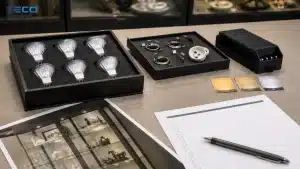
During sample review for retail and hospitality projects, it is common to compare luminaires on actual materials rather than rely only on reports. Fabric swatches, wood veneer panels, stone samples, and food presentation surfaces will often reveal differences that a single CRI value does not fully explain.
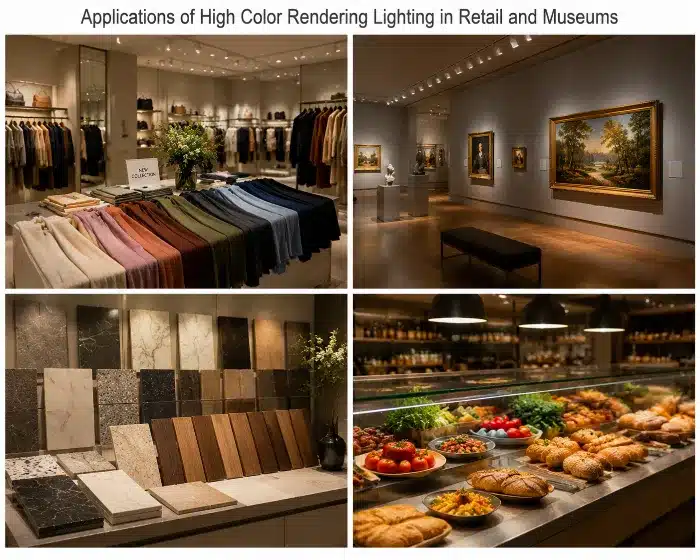
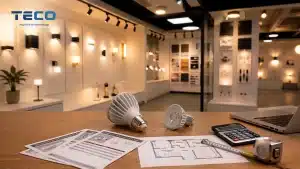
applications of high color rendering lighting in retail and museums
Future Trends in Color Rendering Evaluation
Realidad en el sitio / comercial
As LED systems become more application-specific, basic specification by wattage, CCT, and CRI alone is becoming less reliable for premium projects. Designers and buyers increasingly want data that predicts visual performance more accurately before installation.
That shift affects how products are sampled, approved, and standardized across multi-site rollouts.
Análisis Profundo y Solución de Ingeniería
In professional lighting specification, the direction is moving toward:
- Greater use of TM-30 for professional specification
- Increased emphasis on application-based color evaluation rather than single-score compliance
- Stronger integration of spectral data into luminaire engineering
- More detailed review of visual consistency across batches and product families
For manufacturers and specifiers, this means color rendering evaluation is moving toward a more complete system view. The question is no longer only whether the light source passes a minimum threshold, but whether it produces the intended visual result consistently across the project.
For manufacturing and project supply, the future requirement is not just better color metrics, but tighter production control around those metrics. That includes LED source selection, incoming verification, integrating sphere measurement, aging validation, and batch release discipline to maintain visual consistency from approval sample to final shipment.
Conclusion: Choosing the Right Color Rendering Metric
Realidad en el sitio / comercial
Choosing between CRI and TM-30 is really about choosing the right level of control for the project. If the application is visually sensitive, relying only on a traditional metric can create unnecessary approval risk and costly correction after installation.
Análisis Profundo y Solución de Ingeniería
CRI remains a practical and widely accepted baseline metric for general lighting specification. TM-30 offers a more complete framework for evaluating modern LED color quality, especially through Rf and Rg. For retail, museums, hospitality, and architectural lighting, TM-30 provides stronger guidance on how a source will actually perform.
Using both metrics in the right way improves specification clarity and reduces the gap between datasheet compliance and real visual outcome.
During project supply, the most effective approach is to match the metric to the application rather than rely on legacy habits. Basic areas may only need CRI. High-visibility spaces benefit from TM-30-based review before sample approval and mass deployment.
Conclusion: Business Value
For B2B lighting projects, the correct color rendering metric helps prevent approval delays, installation rework, and visual inconsistency across sites. CRI is still useful for baseline specification, but TM-30 provides stronger control where color appearance directly affects commercial value.
A better evaluation method supports:
- Higher reliability in project outcomes
- Reduced maintenance and replacement effort
- Lower lifetime system cost through fewer visual disputes and re-installation cycles
B2B Engineering Recommendation
For projects where color appearance affects approval, buyers should request CRI, R9 where relevant, TM-30 Rf / Rg data, spectral power distribution information, DUV or chromaticity data, CCT tolerance, sample test results, and batch consistency controls before mass production. The TECO engineering team can support project teams with color rendering review, sample comparison, and specification checks for retail, hospitality, museum, and architectural lighting applications.
Notas al pie
CRI (Color Rendering Index) is a traditional metric for measuring and specifying color rendering properties of light sources, commonly expressed as Ra. See CIE 13.3-1995 y NIST Color Rendering of Light Sources. ↩
TM-30 is a modern color rendering evaluation method published by the Illuminating Engineering Society, using broader color sample analysis and metrics such as Rf and Rg. See IES Position on TM-30 y DOE TM-30 Frequently Asked Questions. ↩
CCT (Correlated Color Temperature) describes whether white light appears warmer or cooler, typically measured in kelvin. ↩
Chromaticity tolerance refers to the allowable variation in color point between LED light sources, often controlled to maintain visual consistency across batches. ↩
Davis, W. and Ohno, Y. discuss CRI limitations for LED evaluation in Toward an Improved Color Rendering Metric, Proceedings of SPIE, Fifth International Conference on Solid State Lighting, 2005. See also Ohno, Y., Color Rendering, Proceedings of the CIE 26th Session, 2007. ↩
Royer, M. P., Tutorial: Background and Guidance for Using the ANSI/IES TM-30 Method for Evaluating Light Source Color Rendition, LEUKOS, 18:2, 191-231, 2022, DOI: 10.1080/15502724.2020.1860771. ↩