TM-30対CRI演色性:正確な照明評価のための最新指標を理解する
はじめに
演色性は表面的な仕様ではない。商業施設やホスピタリティ照明では、現場で商品、仕上げ材、食品、ファブリック、ブランド内装がどのように知覚されるかに直接影響する。選択された指標が実際の視覚的性能を反映しない場合、モックアップの却否、再調整、照明器具の交換、試運転時の紛争が生じる可能性がある。.
ここで多くのプロジェクトが問題に直面する。CRI1 は依然としてデータシートや入札文書で最も一般的に引用される色の指標だが、実際のアプリケーションでLED光源がフルレンジの色をどのように再現するかを常に説明するわけではない。TM-302 は、より広範で実用的な評価フレームワークでそのギャップに対処するために開発された。.
輸入業者、設計者、プロジェクト請負業者にとって、この問題は理論的なものではない。小売店、博物館、ホテルの公共エリア、建築空間における承認速度、ロット間の視覚的一貫性、設置後の苦情リスクに影響する。.
エグゼクティブサマリー
CRIは基本的な仕様として有用であるが、TM-30は忠実度と色域分析を通じてLEDの色品質をより完全に評価する。色の見え方がブランド表現や視覚的快適性に影響するプロジェクトでは、TM-30がより信頼性の高い技術的参照基準となる。.
照明評価のためのTM-30対CRI色彩再現指標
照明デザインにおいて色彩再現性が重要な理由
現場 / 商業的現実
照明デザインにおいて、色彩再現性の悪さは、多くの場合、実際の照明器具の下で材料が確認される設置後の段階で初めて明らかになる。ラボレポートではなく、実際の照明器具の下で材料を見たときに、小売ディスプレイが平坦に見えたり、ホスピタリティロビーの肌色がくすんで見えたり、高級仕上げが深みを失ったりする可能性がある。その段階で問題を修正するには、通常、ランプや器具の交換、ビームレイアウトの再確認、クライアント承認の再取得が必要となる。.
これは請負業者や販売代理店にとって、労働力、アクセス設備、プロジェクト遅延を通じて直接的なコストを生み出す。宴会場、アトリウム、ギャラリーなどの天井の高い空間では、わずかな色彩性能の問題でも修正に多額の費用がかかる可能性がある。.
詳細分析とエンジニアリングソリューション
演色性とは、基準光源と比較して光源が物体の色をどれだけ正確に再現するかを記述します。実際的には、照明された素材が自然に見えるか、鮮やかか、くすんでいるか、歪んでいるかを判断するのに役立ちます。.
歴史的に、CRIはこの評価の標準手法となった。シンプルで馴染み深いため、現在も広く使用されている。しかし、現代のLEDスペクトルは従来の白熱灯や蛍光灯よりも複雑であり、単一のスコアでは視覚効果を十分に説明できないことが多い。.
TM-30は、光源がはるかに多くの色サンプルをどのように再現するかを調べ、2つの異なる特性を分離することで分析を拡張する:
- 忠実度(Rfで表記)は、色が基準にどれだけ近いかを示す
- 色域(Rgで表記)は、色全体がより鮮やかに見えるか、あるいはよりくすんで見えるかを示す
この区別は仕様書作成において重要である。2つの光源が類似したCRI値を持っていても、店舗、博物館、高級インテリアでは明らかに異なる視覚的結果を生み出すことがある。.
工場注記
製造の観点からは、演色性を単独のカタログ番号として扱うべきではない。CCT3, 、色度許容差4, 、光学設計、ロット間の一貫性。承認済みサンプルと視覚的に一致しない納品ロットがある場合、高い公称スコアは限定的な価値しか持たない。.
CRI(演色評価数)とは何か?
現場 / 商業的現実
CRIは、理解しやすく比較しやすいため、多くの調達文書で依然としてデフォルト要件となっている。プロジェクトでは単にCRI80またはCRI90を最低基準として規定することがある。これはベンダーの迅速な選定には役立つが、それ以上の色品質分析が要求されない場合、誤った安心感を生む可能性もある。.
これは、現場の期待が単なる「許容できる色」ではなく、正確な商品表現、肌色の美化、美術品や内装材の忠実な再現である場合に問題となる。.
詳細分析とエンジニアリングソリューション
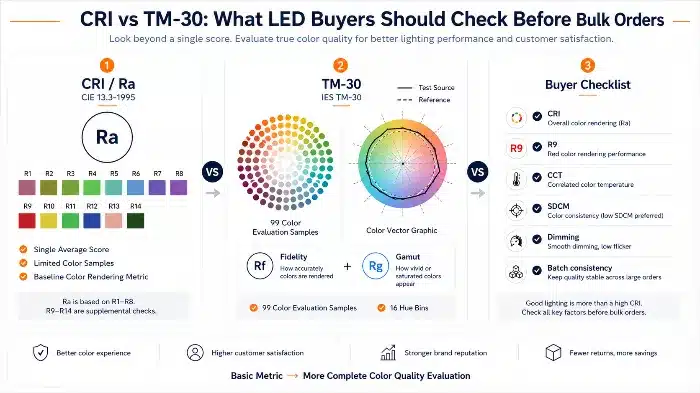
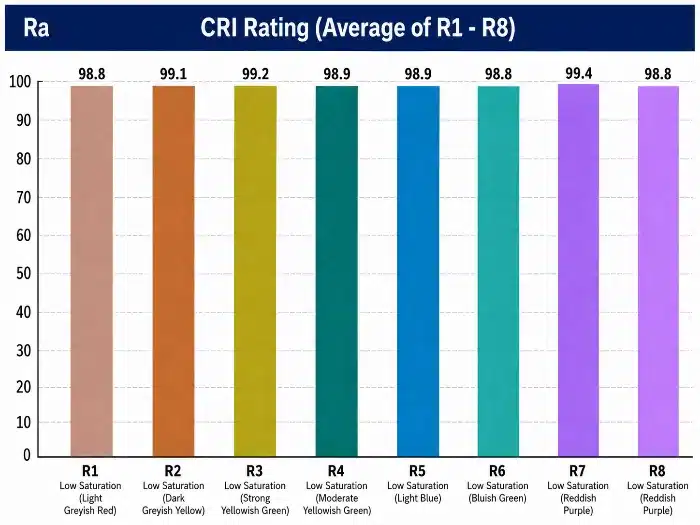
CRI(色彩再現指数)は、光源が同じ相関色温度の基準光源と比較して、色をどの程度忠実に再現するかを測定する。一般的なCRI値であるRaは、限られたテスト色サンプルのセットから計算される。.
長い歴史を持つため、CRIは基準となる指標として有用です。広範な比較や、標準的な商業用途における最小限の適合要件に対しては、合理的に機能します。.
しかし、CRIは演色性を単一の平均値に単純化している。つまり、光源が色を過飽和させたり、彩度を低下させたり、特定の色相を歪めたりする傾向があるかどうかを明確に示さない。また、比較的少ないサンプルセットに依存しているため、現代のLEDスペクトルの挙動を詳細に記述する能力が制限される。.
工場注記
プロジェクトレビューでは、CRIはしばしば最初のフィルターであり、最終的な決定指標ではない。視覚的な商品販売や素材の見た目が重要な用途では、Raのみに依存すると、設置後の承認問題につながる可能性があり、特にクライアントが複数の照明器具を並べて比較する場合に顕著である。.
LED照明仕様におけるCRI演色評価数
従来のCRI指標の限界
現場 / 商業的現実
CRIの実践的な問題は、2つの照明器具が書面上では同じCRI目標を満たしているにもかかわらず、現場では異なる視覚的印象を与える場合に発生する。一方は食品ディスプレイを新鮮で魅力的に見せ、他方は同じ商品をくすんで見せることがある。入札仕様書がCRI90のみを要求していた場合、両方とも技術的には適合している可能性がある。.
プロジェクトチームにとって、この不一致はサンプルの再提出、モックアップの繰り返し、設置された照明が設計意図と一致しないという主張を引き起こす可能性がある。.
詳細分析とエンジニアリングソリューション
CRIの主な制限は、その計算方法に関連しています:
- 限られた数の試験色サンプルを使用する
- これは完全なカラープロファイルではなく平均スコアを報告する
- 彩度シフトを適切に説明できない
- 強い赤色再現性やその他の重要な色相の違いを見逃す可能性がある
- 現代のLED光源のスペクトル特性を考慮して開発されたものではない
固体照明に関する研究でも同様の懸念が提起されている。NISTの研究者は、従来のCRI手法が中低彩度の反射サンプル8種類のみを使用しており、通常の物体色やLED光源によく見られるピークのあるスペクトル分布を適切に表現できない可能性があると指摘している。.5
その結果、CRIは実環境における光源の完全な視覚効果を捉えられない場合がある。これは特に、特定の色や質感が制御され意図的に見える必要があるファッション小売、博物館、レストラン、建築アクセント照明などの用途で関連性が高い。.
一般的な例は、飽和赤の再現性を表すR9である。多くのLED仕様では、強い赤色性能が肌色、食品、木材、布地、化粧品、芸術作品にとって重要であるため、R9は別途レビューされる。製品が高いRa値を持っていても、飽和赤の再現性では弱い性能しか発揮しない場合がある。.
高いCRIを持つ光源でも、色域の挙動が適切に管理されていない場合、視覚的にバランスが悪いと感じられる演色性を生じることがあります。また、必ずしもスペクトルパワー分布が滑らかで完全であることを意味しません。Ra値が類似した2つのLED光源でも、実際の商品、美術品、木材、石材、布地、または食品の表面で比較した際に、異なるスペクトルのピーク、谷、または欠落した波長領域が可視化される可能性があります。.
工場注記
大規模なホスピタリティプロジェクトでは、色に関する苦情が「CRIが間違っている」という表現で始まることは稀である。通常、「大理石が冷たく見える」「食品がくすんで見える」「木目仕上げの温かみが失われた」などのコメントとして現れる。そのため、事前承認段階ではより高度な色の指標がますます重要になっている。.
TM-30色彩再現性とは何か?
現場 / 商業的現実
TM-30は、特にプロジェクトが本格展開前に予測可能な視覚的結果を必要とする場合に有用です。チェーン小売、博物館の改修、またはホテルのブランド基準において、サンプル承認はしばしば最小限の適合値の達成だけでなく、微妙な色の見え方に依存します。.
評価にTM-30を使用することで、「合格」光源がモックアップレビュー中に依然として期待外れとなる可能性を減らす。.
詳細分析とエンジニアリングソリューション
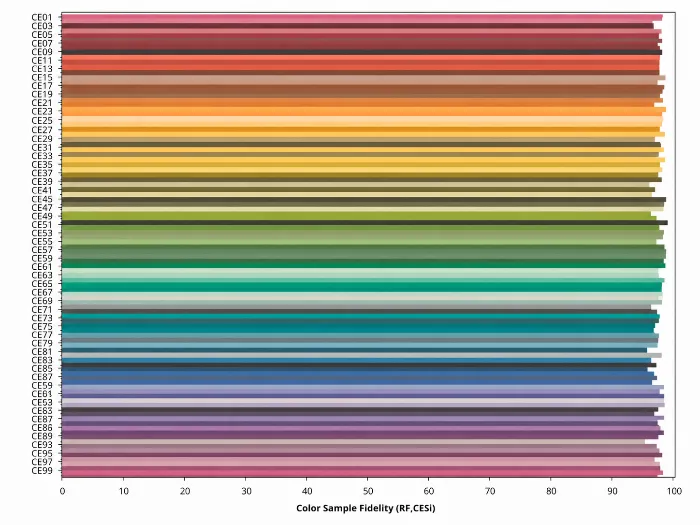
TM-30 is a modern method for evaluating color rendering developed to provide a more complete picture than CRI. Instead of relying on a small number of test samples and a single averaged score, TM-30 evaluates 99 color evaluation samples and reports multiple metrics.
Lighting research literature describes TM-30 as a broader framework for communicating color fidelity, gamut area, gamut shape, and related visual effects rather than reducing color quality to one average number.6
Its two most referenced outputs are:
- Rf, the Fidelity Index, which indicates how closely colors are rendered relative to a reference source
- Rg, the Gamut Index, which indicates the average increase or decrease in color saturation
This is the key improvement. TM-30 does not only ask whether colors are rendered accurately. It also shows whether the source tends to make colors look more vivid or more muted overall.
In professional lighting decisions, this matters because not every application wants the same result. A museum may prioritize faithful reproduction, while retail may accept moderate saturation enhancement if it supports product presentation without looking unnatural.
工場注記
From a manufacturing perspective, TM-30 is more aligned with how LED products should be evaluated today. It helps engineering teams distinguish between sources that look similar in a basic datasheet but behave differently in real spaces. That improves sample selection before tooling allocation or mass production scheduling.
Key Components of TM-30 Metrics
現場 / 商業的現実
When a project team requests TM-30 data, they are usually trying to avoid visual surprises after installation. This is common in premium retail, galleries, food and beverage spaces, and front-of-house hospitality zones where light quality is part of the customer experience.
The practical value is that TM-30 makes evaluation more specific, which reduces ambiguity during approval.
詳細分析とエンジニアリングソリューション
The two core TM-30 metrics are Rf and Rg:
- Rf measures fidelity. Higher Rf indicates that colors appear closer to the reference source.
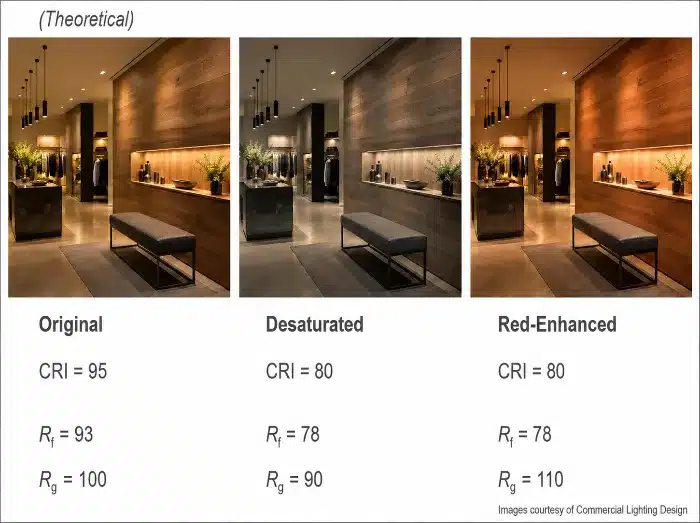
- Rg measures gamut. An Rg above 100 generally indicates increased saturation, while an Rg below 100 indicates reduced saturation.
These metrics work together. A source can have high fidelity but neutral or reduced saturation, or it can have moderate fidelity with slightly enhanced saturation. The preferred balance depends on the application.
A simplified comparison is shown below:
| 特徴 | CRI (Ra) | TM-30 (Rf / Rg) | Project Risk / Approval Impact |
|---|---|---|---|
| Evaluation method | Single average score | Multi-metric analysis | Better preselection reduces respecification risk |
| Color sample set | 限定的 | Expanded | Lower chance of visual mismatch after install |
| Saturation analysis | Not explicit | Included through Rg | Fewer complaints about dull or exaggerated colors |
| LED suitability | Basic | Stronger for modern LED assessment | Better mock-up accuracy and approval efficiency |
| Application guidance | General | More design-specific | Improved fit for retail, museum, and hospitality use |
TM-30 can also include graphic representation of hue shift and saturation behavior across color regions, which gives specifiers a more practical understanding of how a source will perform beyond a single number.
工場注記
During hotel commissioning, areas such as reception, bar counters, pastry displays, and decorative wall finishes often reveal the difference between acceptable color rendering and well-controlled color rendering. TM-30 data is useful because it supports those decisions before site installation begins.
Rf and Rg TM-30 metrics explained for lighting design
TM-30 vs CRI: Key Differences
現場 / 商業的現実
Many procurement teams still ask for CRI because it is familiar, while designers increasingly ask for TM-30 when visual quality is critical. If these two groups are not aligned early, the project can end up with technically compliant products that fail design review.
That gap often leads to avoidable re-submission cycles and slow approval.
詳細分析とエンジニアリングソリューション
The key difference is not that one metric replaces the other in all cases, but that they operate at different levels of detail.
CRI provides a simple, established benchmark. TM-30 provides a more comprehensive analysis of color quality.
| 特徴 | CRI | TM-30 | Project Risk / Approval Impact |
|---|---|---|---|
| Main output | Ra | Rf and Rg | More precise specification reduces replacement risk |
| Industry familiarity | 非常に高い | Growing rapidly | CRI supports quick screening; TM-30 supports final validation |
| Detail level | 限定的 | 高い | Better prediction of real visual performance |
| Saturation information | いいえ | はい | Lower risk of unexpected appearance on site |
| 最適用途 | Basic compliance | Detailed design evaluation | Stronger control of project outcome |
In technical practice, CRI is still useful for setting minimum standards. TM-30 is more effective when the project requires a nuanced understanding of color fidelity and saturation.
工場注記
From a manufacturing perspective, the most common mistake is treating CRI and TM-30 as interchangeable. They are not. CRI is a simplified indicator. TM-30 is a broader diagnostic tool. For engineered project supply, both can be used, but they serve different decision stages.
TM-30 vs CRI comparison for commercial lighting projects
When to Use CRI vs TM-30 in Lighting Design
現場 / 商業的現実
Not every project requires full TM-30 analysis. For standard back-of-house, utility, or circulation areas, CRI may be sufficient if the visual demands are modest. But where the lighting is part of the brand or user experience, basic compliance metrics are often not enough.
Selecting the wrong evaluation method can either overcomplicate procurement or under-control the final visual result.
詳細分析とエンジニアリングソリューション
A practical approach is:
- Use CRI for standard commercial specifications where minimum acceptable color rendering is the main objective
- Use TM-30 for spaces where color appearance directly affects sales, presentation, guest experience, or artifact integrity
- Use both when the project requires a familiar compliance benchmark plus a deeper technical review
Typical guidance:
| Application Type | Recommended Metric Focus | Reason | Project Risk / Approval Impact |
|---|---|---|---|
| Offices, corridors, utility zones | CRI baseline | Functional lighting with moderate visual sensitivity | Simpler procurement |
| Retail displays | TM-30 + CRI | Product color affects sales presentation | Fewer post-install display complaints |
| Museums and galleries | TM-30 priority | Accurate artwork rendering is critical | Reduced relighting and exhibit adjustment |
| Hospitality public areas | TM-30 + CRI | Skin tone, finishes, and ambience matter | Better guest-facing consistency |
| Architectural feature lighting | TM-30 priority | Material and surface response must be controlled | Lower design revision risk |
Applications of High Color Rendering Lighting
現場 / 商業的現実
High color rendering lighting is usually specified where the illuminated subject has commercial, aesthetic, or functional value. In these environments, visual quality is tied to revenue, brand perception, or curatorial standards. If the installed result is visually weak, the cost is not limited to maintenance; it can also affect sales conversion or client satisfaction.
詳細分析とエンジニアリングソリューション
典型的な用途には以下が含まれます:
- Retail lighting, where apparel, cosmetics, food, and luxury goods must appear attractive and consistent
- Museums and galleries, where artwork needs faithful color presentation
- Hospitality interiors, where guest comfort depends on natural skin tone rendering and balanced material appearance
- Architectural lighting, where stone, wood, metal, and decorative finishes must maintain intended visual character
- Premium commercial spaces, where presentation standards exceed basic functional lighting criteria
In these cases, high CRI alone may not guarantee the desired result. TM-30 helps determine whether the source supports the visual goal through the right balance of fidelity and saturation.
工場注記
During sample review for retail and hospitality projects, it is common to compare luminaires on actual materials rather than rely only on reports. Fabric swatches, wood veneer panels, stone samples, and food presentation surfaces will often reveal differences that a single CRI value does not fully explain.

applications of high color rendering lighting in retail and museums
Future Trends in Color Rendering Evaluation
現場 / 商業的現実
As LED systems become more application-specific, basic specification by wattage, CCT, and CRI alone is becoming less reliable for premium projects. Designers and buyers increasingly want data that predicts visual performance more accurately before installation.
That shift affects how products are sampled, approved, and standardized across multi-site rollouts.
詳細分析とエンジニアリングソリューション
In professional lighting specification, the direction is moving toward:
- Greater use of TM-30 for professional specification
- Increased emphasis on application-based color evaluation rather than single-score compliance
- Stronger integration of spectral data into luminaire engineering
- More detailed review of visual consistency across batches and product families
For manufacturers and specifiers, this means color rendering evaluation is moving toward a more complete system view. The question is no longer only whether the light source passes a minimum threshold, but whether it produces the intended visual result consistently across the project.
For manufacturing and project supply, the future requirement is not just better color metrics, but tighter production control around those metrics. That includes LED source selection, incoming verification, integrating sphere measurement, aging validation, and batch release discipline to maintain visual consistency from approval sample to final shipment.
Conclusion: Choosing the Right Color Rendering Metric
現場 / 商業的現実
Choosing between CRI and TM-30 is really about choosing the right level of control for the project. If the application is visually sensitive, relying only on a traditional metric can create unnecessary approval risk and costly correction after installation.
詳細分析とエンジニアリングソリューション
CRI remains a practical and widely accepted baseline metric for general lighting specification. TM-30 offers a more complete framework for evaluating modern LED color quality, especially through Rf and Rg. For retail, museums, hospitality, and architectural lighting, TM-30 provides stronger guidance on how a source will actually perform.
Using both metrics in the right way improves specification clarity and reduces the gap between datasheet compliance and real visual outcome.
During project supply, the most effective approach is to match the metric to the application rather than rely on legacy habits. Basic areas may only need CRI. High-visibility spaces benefit from TM-30-based review before sample approval and mass deployment.
Conclusion: Business Value
For B2B lighting projects, the correct color rendering metric helps prevent approval delays, installation rework, and visual inconsistency across sites. CRI is still useful for baseline specification, but TM-30 provides stronger control where color appearance directly affects commercial value.
A better evaluation method supports:
- Higher reliability in project outcomes
- Reduced maintenance and replacement effort
- Lower lifetime system cost through fewer visual disputes and re-installation cycles
B2B Engineering Recommendation
For projects where color appearance affects approval, buyers should request CRI, R9 where relevant, TM-30 Rf / Rg data, spectral power distribution information, DUV or chromaticity data, CCT tolerance, sample test results, and batch consistency controls before mass production. The TECO engineering team can support project teams with color rendering review, sample comparison, and specification checks for retail, hospitality, museum, and architectural lighting applications.
脚注
CRI (Color Rendering Index) is a traditional metric for measuring and specifying color rendering properties of light sources, commonly expressed as Ra. See CIE 13.3-1995 そして NIST Color Rendering of Light Sources. ↩
TM-30 is a modern color rendering evaluation method published by the Illuminating Engineering Society, using broader color sample analysis and metrics such as Rf and Rg. See IES Position on TM-30 そして DOE TM-30 Frequently Asked Questions. ↩
CCT (Correlated Color Temperature) describes whether white light appears warmer or cooler, typically measured in kelvin. ↩
Chromaticity tolerance refers to the allowable variation in color point between LED light sources, often controlled to maintain visual consistency across batches. ↩
Davis, W. and Ohno, Y. discuss CRI limitations for LED evaluation in Toward an Improved Color Rendering Metric, Proceedings of SPIE, Fifth International Conference on Solid State Lighting, 2005. See also Ohno, Y., Color Rendering, Proceedings of the CIE 26th Session, 2007. ↩
Royer, M. P., Tutorial: Background and Guidance for Using the ANSI/IES TM-30 Method for Evaluating Light Source Color Rendition, LEUKOS, 18:2, 191-231, 2022, DOI: 10.1080/15502724.2020.1860771. ↩