Introduction : Pourquoi les problèmes de gradation des LED deviennent des risques pour le projet
Dans les hôtels, bureaux et rénovations commerciales, les problèmes de gradation LED apparaissent rarement lors de la sélection des produits. Ils surviennent pendant mise en service, réception ou début d'exploitation—lorsque les calendriers sont serrés et les modifications coûteuses.
Le scintillement, une gradation instable ou des arrêts soudains ne sont pas seulement des désagréments techniques. Ils conduisent souvent à :
- remise de projet retardée
- visites répétées sur site et dépassements de main-d'œuvre
- inspections rejetées ou plaintes des clients
- augmentation des retours sous garantie et des litiges
La plupart de ces défaillances ne sont pas causées par une mauvaise qualité des LED, mais par des erreurs liées aux gradateurs commises tôt dans le projet.
Cet article explique les erreurs de gradation LED les plus courantes observées dans les projets commerciaux, pourquoi elles se produisent et comment les acheteurs professionnels et les entrepreneurs peuvent les éviter avant qu'elles ne deviennent des risques financiers et de réputation.
Erreur 1 : Choisir des gradateurs LED incompatibles
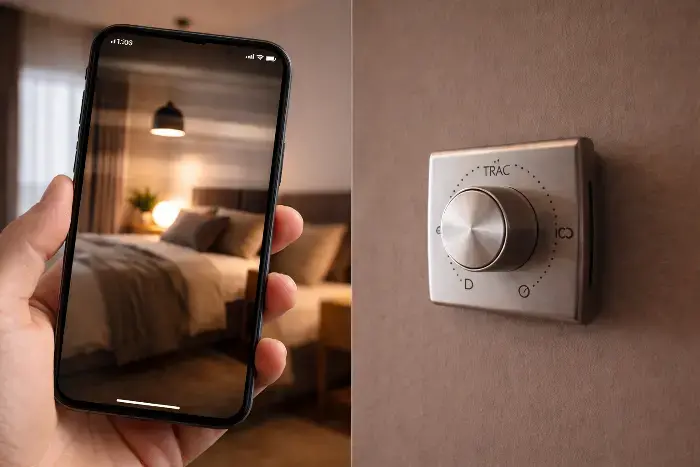
Ce qui se passe mal sur les projets réels
Lors des rénovations de salles de bal d'hôtel ou de salles de conférence, des gradateurs incompatibles provoquent souvent un comportement de gradation erratique ou une panne complète du système. Le dépannage intervient généralement après la fermeture des plafonds, le retrait des échafaudages et la fixation des plannings.
Ce qui devrait être une étape simple de mise en service se transforme en jours d'investigation et de retouche.
Pourquoi cela se produit (réalité technique)
Les gradateurs traditionnels étaient conçus pour charges halogènes résistives. Les alimentations LED, cependant, présentent comportement électrique non linéaire, y compris un faible facteur de puissance et un courant d'appel.
- Gradateurs à front montant (basés sur TRIAC) peuvent introduire des pointes de tension
- Les gradateurs à front descendant (à base d'IGBT) offrent un contrôle plus fluide pour les pilotes LED
Lorsque la forme d'onde de sortie du gradateur ne correspond pas à la conception d'entrée de l'alimentation, une instabilité apparaît sur toute la plage de gradation.
Impact commercial
Le choix d'un gradateur incompatible est l'une des principales causes de retards lors de la mise en service sur site.
Dans les grands projets hôteliers, cela se traduit souvent par des accès répétés au plafond, une augmentation des coûts de main-d'œuvre et un remplacement tardif des produits.
Comment l'éviter
- Confirmer le protocole de gradation pris en charge par l'alimentation LED
- Privilégier les gradateurs à front descendant ou universels vérifiés
- Demander listes de compatibilité gradateur–lampe testées des fournisseurs
- Pour les charges mixtes, nécessitent une capacité de réglage de fin de course ajustable
Erreur 2 : Erreurs d'installation provoquant un scintillement
Ce que les entrepreneurs rencontrent sur site
Le scintillement apparaît fréquemment lors des tests de réception des couloirs ou des chambres. Même lorsque les lampes et les gradateurs sont techniquement compatibles, une sortie lumineuse instable entraîne des échecs d'inspection et un rejet par le client.
Dans les bâtiments en exploitation, cela conduit souvent à des réparations nocturnes et des plaintes des clients.
Pourquoi cela se produit (réalité technique)
Les causes courantes incluent :
- fil neutre manquant à l'emplacement du gradateur
- mise à la terre incorrecte
- interférences électromagnétiques provenant de systèmes voisins
- incompatibilité entre le signal du gradateur et le comportement PWM du pilote
Sans une tension de référence stable, les pilotes LED répondent de manière incohérente, en particulier aux faibles niveaux de gradation.
Impact commercial
Les rappels liés au scintillement augmentent généralement le coût de la main-d'œuvre électrique de 20–30% dans les projets de rénovation et créent une exposition continue à la maintenance.
Comment l'éviter
- Verify neutral wire availability during rough-in
- Avoid sharing circuits with high-interference equipment
- Use dimmers with built-in filtering for dense installations
- In large zones, consider 0–10V or centralized control systems
Mistake 3: Ignoring LED Dimmer Wattage Limits

What Happens During Commissioning
Overloaded dimmers may appear functional during initial testing, then shut down under sustained operation. Thermal trips often occur after hours or days, forcing circuit redesign after installation.
Pourquoi cela se produit (réalité technique)
Dimmer wattage ratings reflect thermal dissipation limits, not just nominal load.
LED projects must account for:
- driver inrush current
- continuous operation derating
- heat accumulation in wall boxes
Exceeding safe limits—even by 15–20%—significantly shortens dimmer lifespan.
Impact commercial
Thermal overload issues frequently lead to full circuit redesigns, stranded labor, and delayed approvals—especially costly in multi-floor commercial buildings.
Comment l'éviter
- Calculate connected load with a 0.8 derating factor
- Distribute fixtures across multiple dimmers
- Select dimmers with thermal protection and capacity headroom
- Oversize dimmers where access is difficult
Why These Mistakes Keep Repeating in Commercial Projects

Most dimmer problems are not caused by negligence. They occur because:
- dimmers are treated as accessories, not system components
- LED drivers vary widely across suppliers
- compatibility testing is skipped under schedule pressure
LED dimming is a system-level issue, not a product-level one.
Projects that succeed treat dimmers, drivers, and lamps as a verified combination, not interchangeable parts.
A Practical Checklist Before Finalizing LED Dimming Systems
Before locking specifications or releasing purchase orders, professional buyers should confirm:
- Has the dimmer been tested with the selected LED driver?
- Is the minimum and maximum load clearly defined?
- Is a neutral wire available at every dimmer point?
- Has thermal derating been considered?
- Who carries responsibility if flicker appears after handover?
If these questions cannot be answered clearly, the project carries avoidable risk.
Conclusion: Dimmer Mistakes Are Preventable — and Expensive When Ignored
LED dimming failures rarely come from one dramatic error. They result from small compatibility assumptions compounded across dozens or hundreds of fixtures.
Projects that address dimmer selection early experience:
- smoother commissioning
- fewer RMAs
- lower lifetime maintenance cost
- better client satisfaction
The difference is not better products—it is better system thinking.
Teco supports B2B buyers, contractors, and project teams by validating LED lamp and dimmer compatibility before mass deployment.
We help with:
- dimmer–driver compatibility verification
- load calculation and derating support
- pre-production simulation for hospitality and commercial projects
- reducing on-site risk and post-installation callbacks
Email : [email protected]
Site Web : www.tecolite.com
If you are planning a dimmable LED project and want to avoid late-stage failures, share your fixture list and dimming method.
We will help you confirm what works—before it becomes a site problem.