Comment Choisir des Ampoules LED MR11 GU4 pour Vitrines d'Exposition
An MR11 bulb may fit the GU4 holder but still perform poorly inside a display cabinet because of glare, transformer incompatibility, uneven beams, trapped heat, or weak color rendering. Display cabinet lighting is different from general ceiling lighting: the space is smaller, the fixture is closer to the product, and the customer may be looking through glass, acrylic, polished metal, glossy packaging, or a shallow open shelf.
This is where MR11 GU4 LED bulbs are useful. MR11 is a compact reflector spotlight format, typically around 35 mm in diameter, and GU4 refers to the small two-pin base often used with low-voltage MR11 lamps. Compared with MR16, MR11 is smaller and better suited to compact fixtures, small cabinets, boutique shelves, and decorative accent points where space is limited.
For retailers, shopfitters, lighting distributors, and fixture manufacturers, the key question is not only whether the bulb turns on. The real question is whether the MR11 lamp creates the right beam, color, heat behavior, and maintenance result inside the actual display environment, whether that is a glass case, cosmetics wall shelf, hotel minibar niche, or compact decorative fixture.
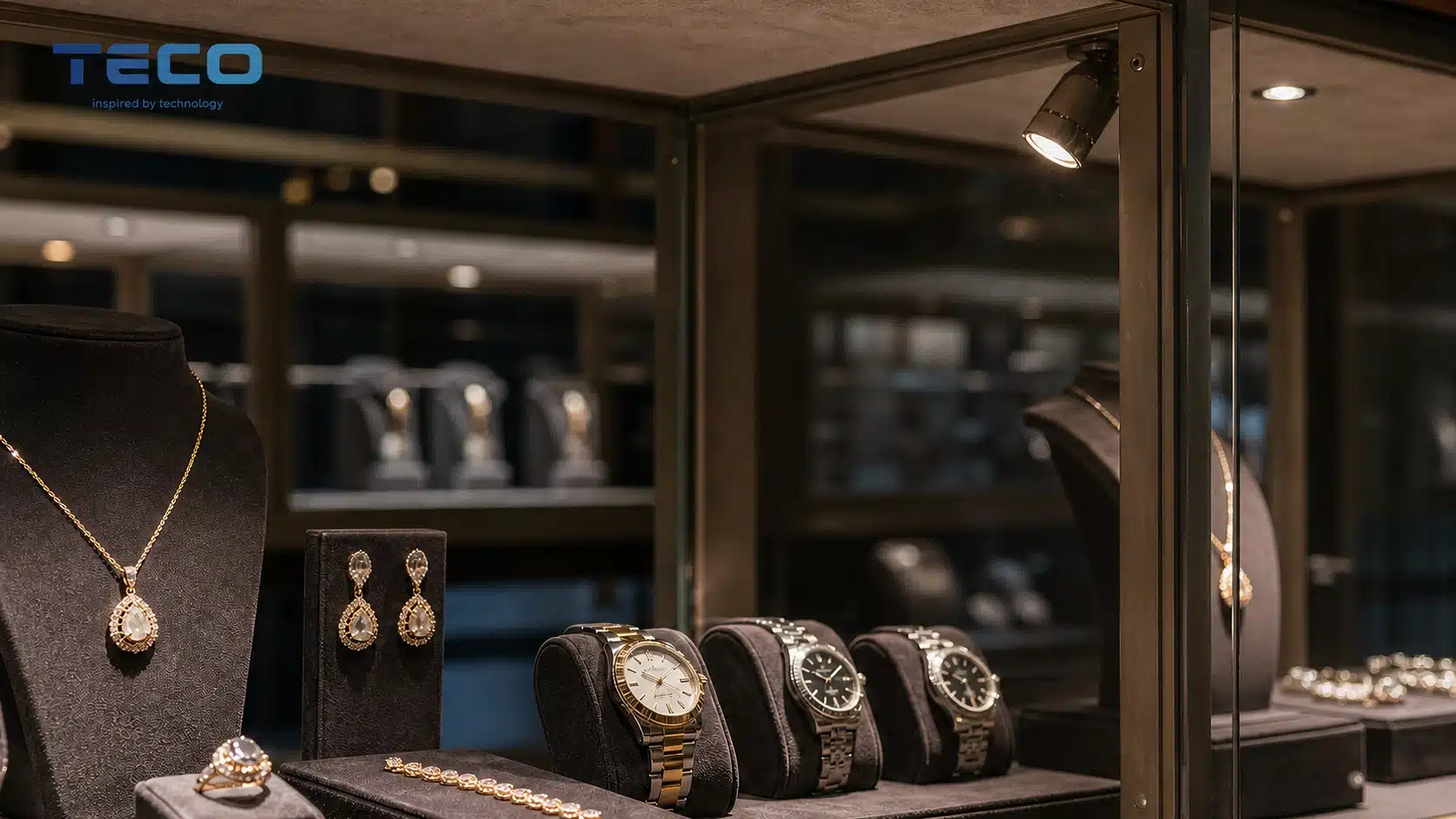
MR11 GU4 LED bulbs for retail display cabinet lighting
Why MR11 GU4 LEDs Fit Compact Displays and Small Fixtures
MR11 LED bulbs are often selected when the fixture space is too small for MR16 or GU10 lamps. Their compact size allows them to fit into miniature recessed fixtures, small adjustable spotlights, cabinet lighting heads, and decorative display fittings.
In compact display lighting, this smaller size can be useful for:
- jewelry trays and watch displays
- cosmetics counters
- perfume shelves
- museum shop displays
- wine and specialty food cabinets
- boutique accessory shelves
- hotel minibar or decorative display niches
The advantage is not only size. MR11 can create a focused beam from a small fixture position, helping the designer highlight one product area without flooding the whole cabinet, shelf, or niche.
However, MR11 is not a universal solution. Because it is small, it usually has lower output than MR16. It should be used for focused accent lighting, not for wide-area general illumination.
For buyers, the basic specification should be checked first:
| Fonctionnalité | Typical MR11 GU4 LED Bulb |
|---|---|
| Lamp format | Compact reflector spotlight |
| Diamètre | Around 35 mm |
| Base | GU4 bi-pin |
| Tension | Commonly 12V low voltage |
| Typical role | Mini accent and display lighting |
The TECO MR11 product category includes compact GU4 spotlight options for accent lighting, display lighting, track lighting systems, and decorative fixtures. Current MR11 examples include 12V GU4 models around 3W to 3.5W, compact 35 mm bodies, CRI 90+ color rendering, 24 degree or 36 degree beam options depending on model, and CCT choices for warm, neutral, or dim-to-warm display effects.1 Product details should always be matched to the actual fixture and project requirement.
Beam Angle and Product Visibility in Small Cabinets and Shelves
Beam angle is one of the most important choices for MR11 cabinet and shelf lighting. In a small display cabinet, a narrow beam may make one item stand out, while a wider beam may create softer coverage across a shelf. Buyers should review product size, shelf depth, fixture distance, and viewing angle together.
| Angle du faisceau | Best Use in Compact Displays |
|---|---|
| 15 degrees / narrow beam | Small jewelry, watches, single feature products |
| 24 degrees | Focused cabinet lighting and compact shelves |
| 36 degrees | General display lighting with softer coverage |
| 60 degrees or wide beam | Broader shelf coverage where contrast is less important |
Typical market beam options may include 15 degrees, 24 degrees, 36 degrees, and wider distributions depending on the lamp and optical design. Available beam angles vary by model, so current TECO MR11 options should be confirmed before sampling.
For jewelry and watches, a narrow beam can create contrast and stronger highlights. But if the beam is too tight, it may create a bright center and dark surrounding area. For cosmetics and boxed goods, 24 degrees or 36 degrees is often easier to manage because the display usually needs more even product visibility.
One common mistake is using the same beam angle for every shelf. A shallow glass shelf, a tall display case, and a narrow product niche may need different beam spreads. The same 24 degree beam creates a much smaller light spot at 150 mm than at 500 mm, so beam angle should never be selected without checking the lamp-to-product distance. Beam angle should also be reviewed together with glare: a good MR11 cabinet setup should show the merchandise first, not the lamp.
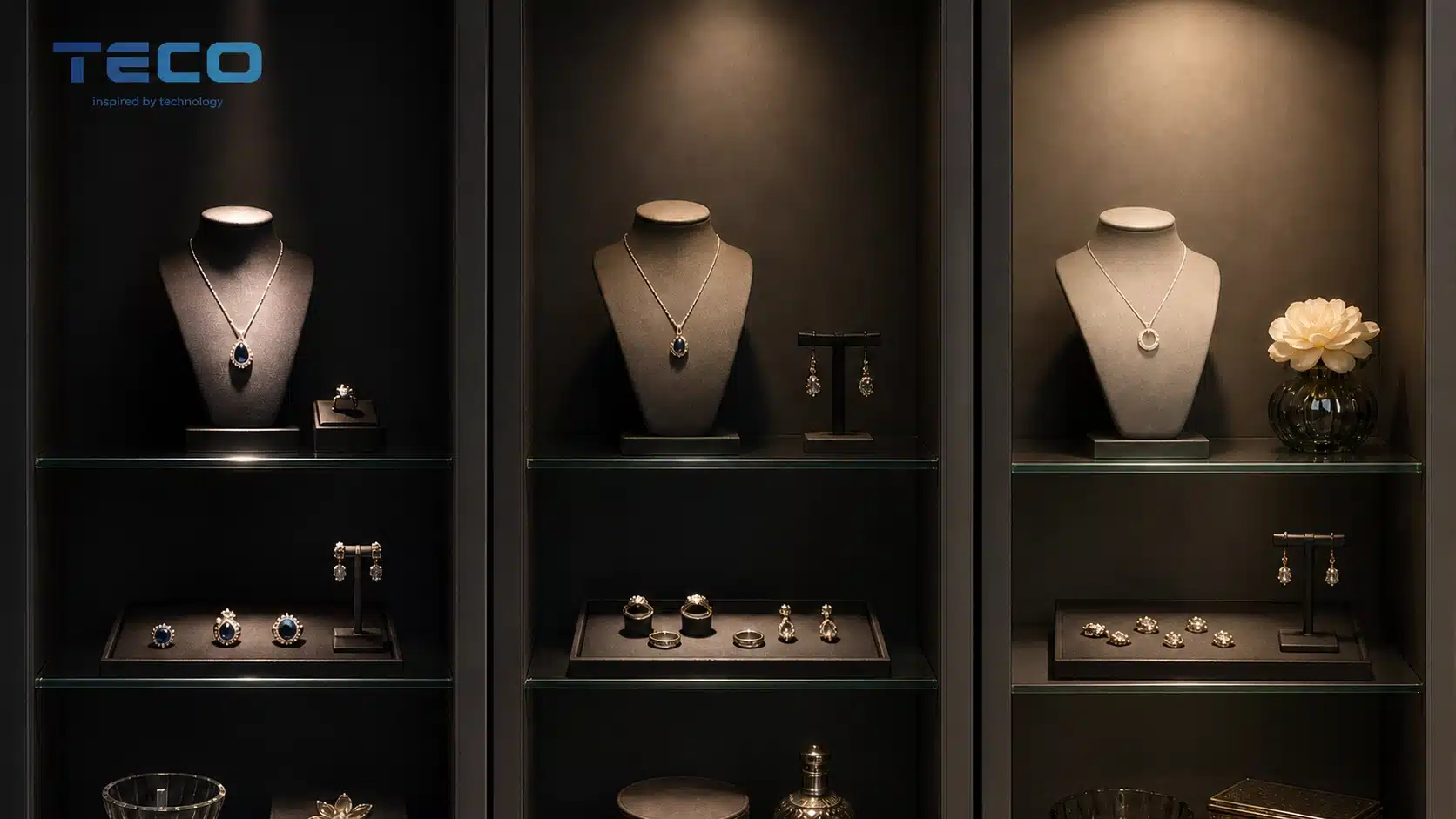
MR11 spotlight beam angle for jewelry and showcase lighting
CRI, CCT and Material Color in Retail Displays
Color quality is critical in compact display lighting because the customer is often judging small visual details. The wrong light can make a gemstone look dull, a cosmetic shade look different, a wine label look flat, or a leather accessory lose depth.
CRI is a useful starting point. CRI90 is a practical baseline for most retail display applications. For jewelry, cosmetics, fashion accessories, artwork, and premium retail, buyers should also review R9, CCT consistency, and the visual result on real products. TECO’s MR11 GU4 options include high CRI 90+ display-lighting models, with listed CCT choices such as 2700K, 3000K, and 4000K on selected 12V models, plus dim-to-warm versions that shift from about 3000K down to 2200K when dimmed.1
CCT should follow the merchandise and brand atmosphere:
| TDC | Display Use |
|---|---|
| 2700K | Warm luxury, wood, leather, hospitality displays |
| 3000K | Jewelry, boutique retail, cosmetics with warm ambience |
| 4000K | Cleaner cosmetics counters, galleries, neutral product displays |
| 5000K | Cooler technical displays where crispness is preferred |
For a fast project review, buyers can start with this selection framework and then confirm the final result in a cabinet, shelf, or niche mockup:
| Display Type | Recommended Beam | Suggested CCT | Color Rendering Focus |
|---|---|---|---|
| Jewelry and watches | 15-24 degrees | 3000K-4000K | CRI 90+, good R9, and visual sparkle testing |
| Cosmetics | 24-36 degrees | 3000K-4000K | Skin-tone and packaging color accuracy |
| Wine, leather, wood | 24-36 degrees | 2700K-3000K | Warm material depth and label readability |
| General retail shelves | 36-60 degrees | 3000K-4000K | Even shelf visibility and batch consistency |
For premium displays, R9 and color consistency also matter. Red tones, skin-tone cosmetics, warm labels, and leather products can shift under weak red rendering. A high CRI number is helpful, but buyers should still test the lamp on the real products being sold. CIE has also noted that general CRI/Ra has limitations for evaluating some solid-state lighting sources, so visual mockup testing remains important.2
Batch consistency is another B2B issue. If one cabinet uses a slightly warmer batch and another uses a cooler batch, the same product may look different across the store. For retail chains, CCT binning and production consistency should be discussed before bulk orders.
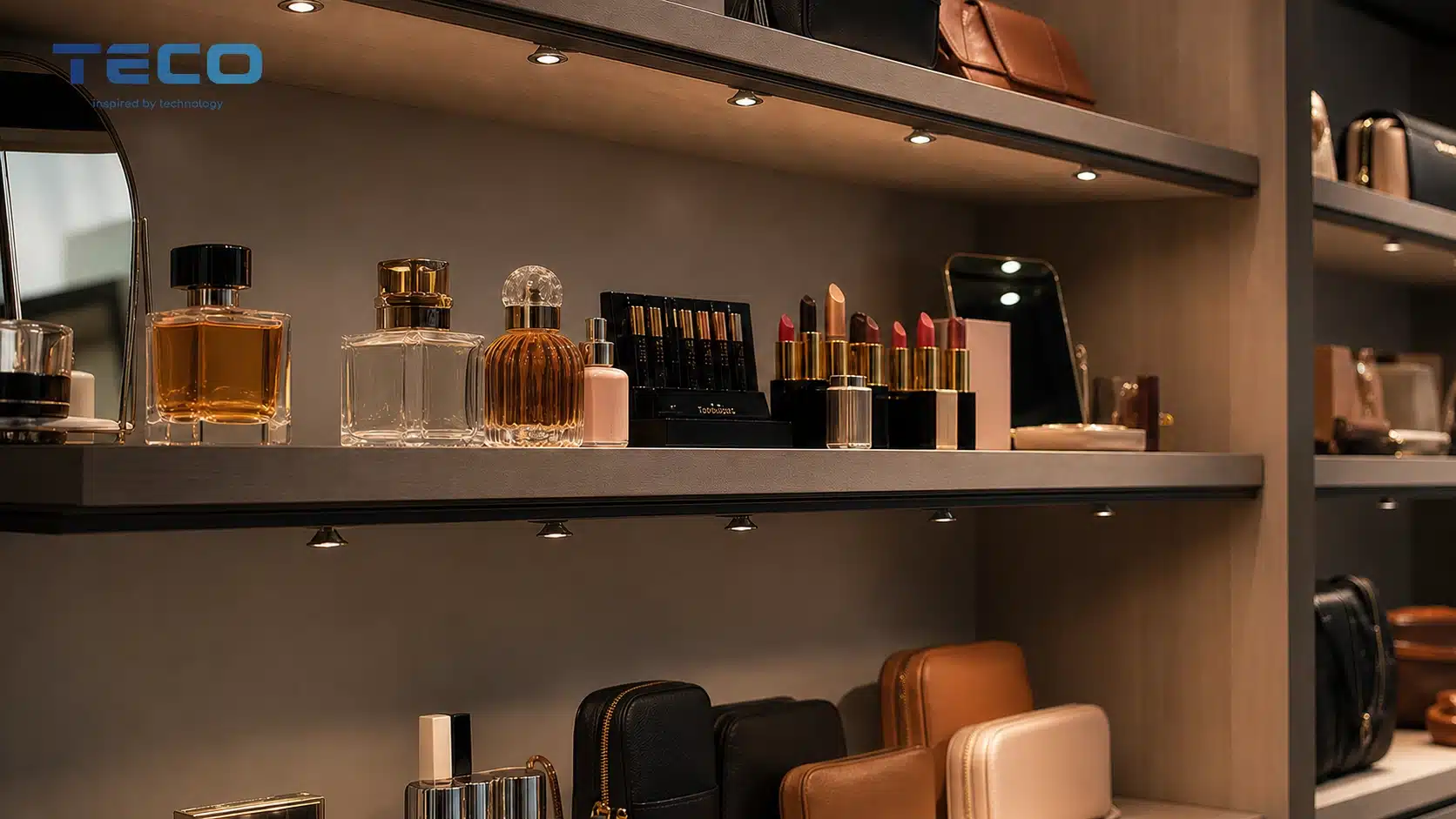
High CRI MR11 LED lighting for cosmetics and boutique open shelf display
Heat, Glare and Glass Reflection Risks
MR11 LED bulbs produce much less heat than halogen MR11 lamps, but compact display lighting can still create heat problems. The fixture is often small, the lamp may be close to the product, and airflow may be limited by glass, shelves, back panels, minibar joinery, or decorative trim.
Heat affects more than comfort. It can influence LED driver life, optical materials, product packaging, and the customer’s perception of quality. In a closed or semi-enclosed cabinet, even efficient LED lamps should be checked under real operating conditions. The U.S. Department of Energy notes that enclosed fixtures can trap heat and increase operating temperatures, which may affect LED performance and life expectancy.3
Glare is the second major risk. Glass doors, mirrored backs, polished metal, watch faces, jewelry trays, and glossy cosmetics packaging can reflect light directly toward the customer. If the MR11 is placed too close to the glass, the reflection may become more visible than the product.
Good display cabinet lighting usually requires:
- lamp position that avoids direct eye-level glare
- enough setback from glass and reflective surfaces
- suitable beam angle for shelf depth
- fixture shielding or trim where needed
- thermal space around the lamp
- sample testing with real merchandise
If a cabinet, shelf, or hotel display niche feels visually harsh, increasing lumen output is rarely the best answer. Better aiming, better shielding, and a more suitable beam angle often improve the display more effectively.
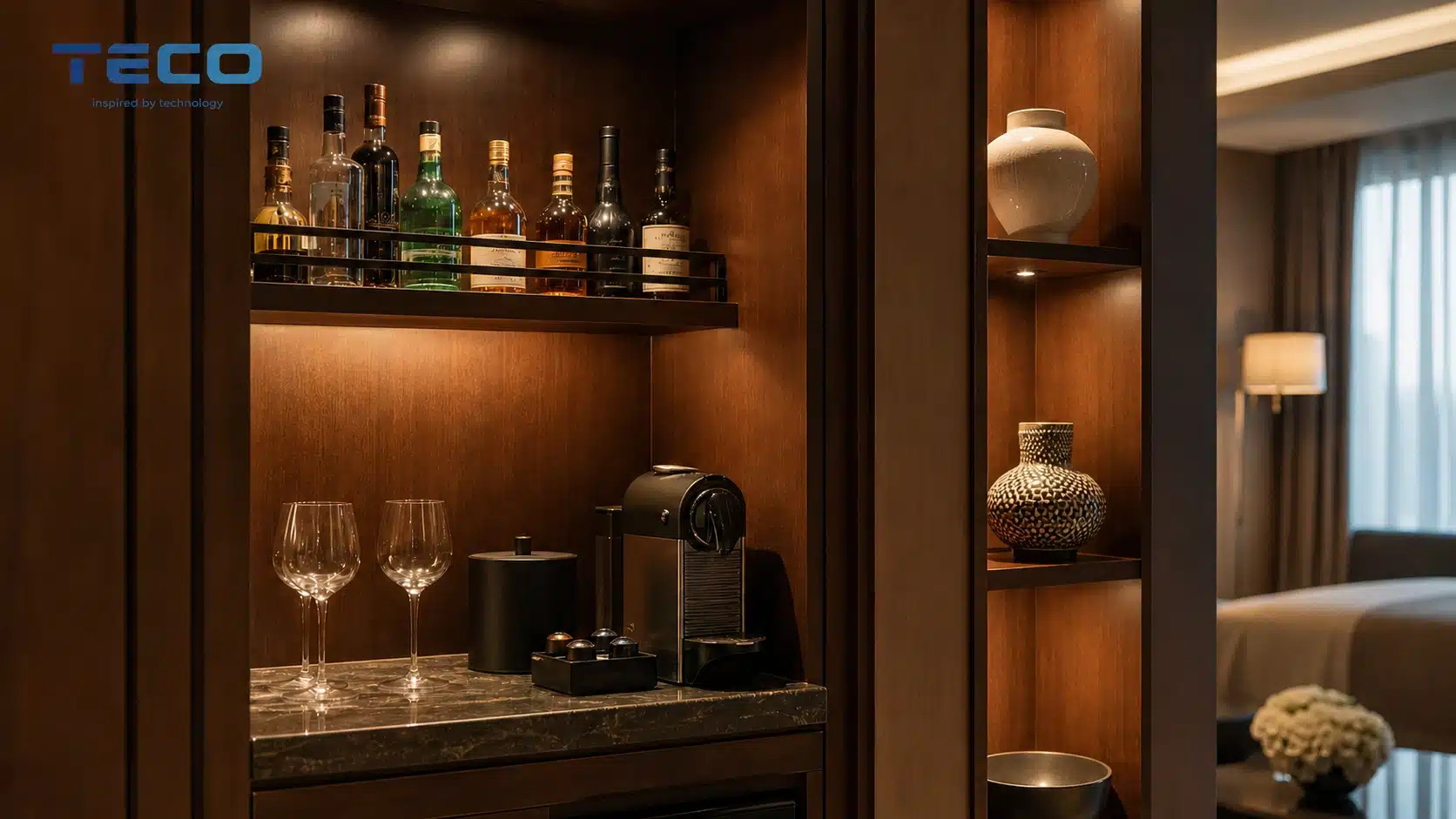
MR11 LED lighting for hotel minibar and decorative display niche
Dimming, Transformer and Fixture Compatibility
Many MR11 GU4 LED bulbs are low-voltage lamps, so the transformer or driver matters. Buyers should confirm whether the lamp is designed for 12V AC, 12V DC, or both. They should also check whether the existing transformer is suitable for the lower LED load.
This is especially important in retrofit display cabinets that originally used halogen MR11 lamps. A halogen transformer may have a minimum load requirement. If the LED load is too low, the lamp may flicker, fail to start, or behave unpredictably.
Dimming should also be checked carefully. A dimmable MR11 label does not guarantee compatibility with every transformer or dimmer. If the project requires dimming, buyers should test the complete system: lamp, transformer, dimmer, wiring, fixture, and load quantity.
For buyers comparing MR11 and MR16, MR11 is usually better for compact spaces, while MR16 often offers more output and broader fixture options. TECO already has a dedicated article on MR11 vs MR16 bulbs for buyers who need a direct comparison.
What B2B Buyers Should Test Before Bulk Orders
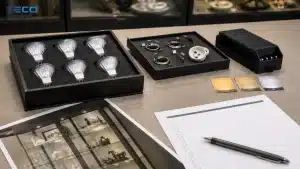
Compact display lighting should be approved in a mockup, not only from a datasheet. The lamp may look acceptable on a desk but behave differently inside a cabinet with glass, an open shelf with glossy packaging, a hotel niche with wood panels, mirrors, dark shelves, or limited ventilation.
Before placing bulk orders, buyers should check:
| Checkpoint | What to Confirm |
|---|---|
| Base and voltage | GU4 holder and 12V system compatibility |
| Transformer | Minimum load and AC/DC output suitability |
| Angle du faisceau | Correct spread for shelf depth and product size |
| TDC | Matches brand atmosphere and merchandise type |
| CRI / R9 | Product colors look accurate under real display conditions |
| Heat | Fixture does not trap excessive heat |
| Éblouissement | No harsh reflection from glass or glossy surfaces |
| Gradation | Tested with actual transformer, dimmer, and load |
| Batch consistency | CCT, beam, and driver remain stable in bulk production |
| Certification | Matches target market requirements |
For retail chains, shopfitters, display cabinet manufacturers, and lighting distributors, this testing process reduces rework. It also helps avoid after-sales complaints caused by color mismatch, flicker, glare, or early failure.
TECO can support MR11 sample review, CCT selection, beam angle discussion, dimming checks, and bulk production communication for retail cabinet, open shelf, and compact niche lighting projects. Buyers can share the fixture type, cabinet or shelf depth, transformer model, dimming requirement, product category, and order quantity before sample approval.
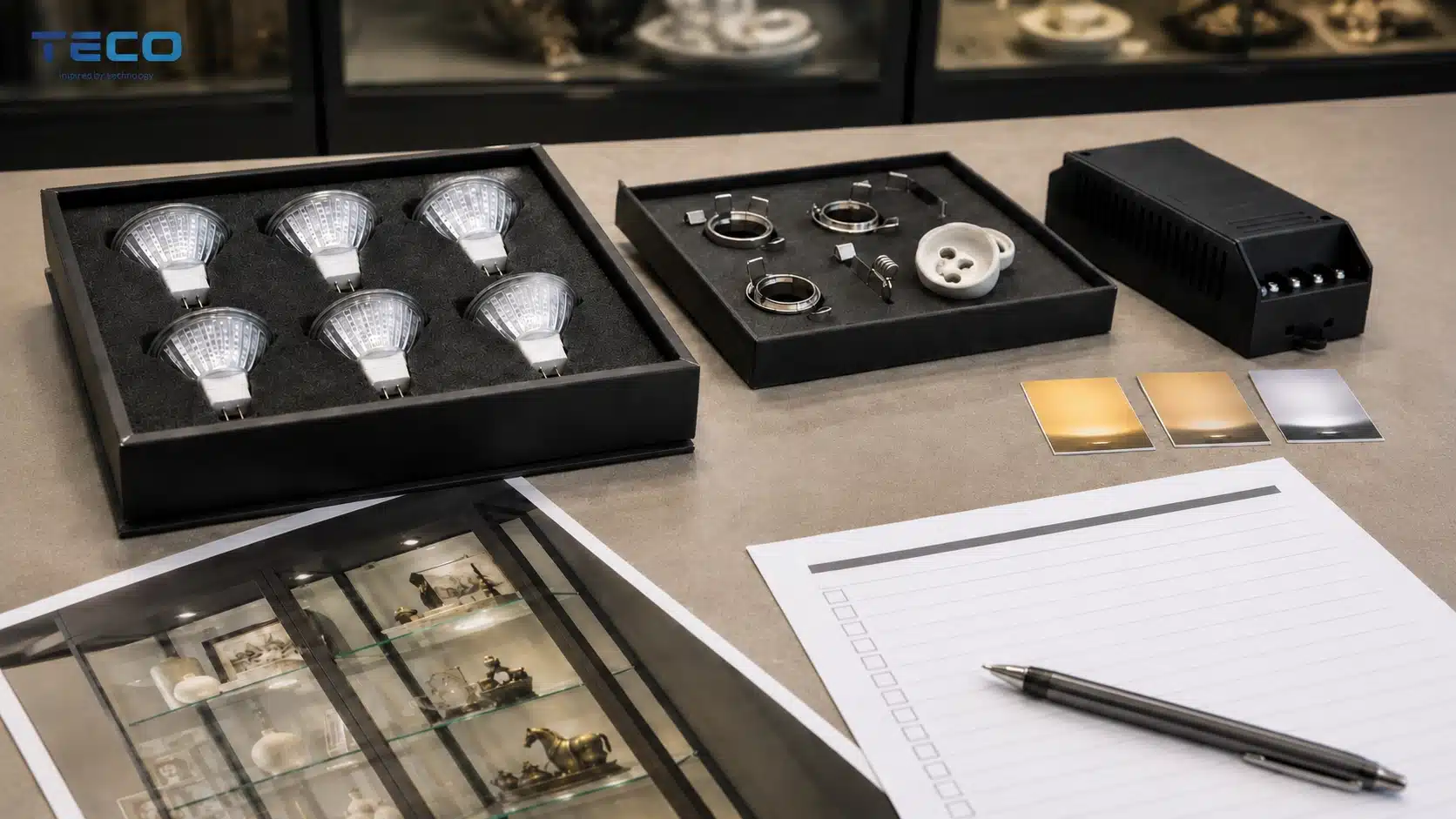
MR11 GU4 LED bulb sample testing for display cabinet projects
Conclusion
MR11 GU4 LED bulbs are useful when retail display lighting needs a compact, focused, low-voltage spotlight. They are especially relevant for display cabinets, jewelry cases, cosmetics counters, boutique shelves, hotel minibar niches, and small accent fixtures where MR16 or GU10 lamps may be too large.
The right MR11 choice depends on more than size. Buyers should check beam angle, CCT, CRI, R9, heat, glare, transformer compatibility, dimming behavior, and batch consistency before bulk orders.
For professional projects, the safest approach is to test the MR11 lamp inside the real display fixture with real merchandise. Send TECO the cabinet dimensions, fixture type, GU4 holder details, transformer model, target beam angle, preferred CCT, dimming requirement, and estimated order quantity. This allows the engineering and sales team to recommend a realistic MR11 GU4 sample configuration before bulk production.
Notes de bas de page
Product data is based on TECO’s MR11 category and product pages, including 12V GU4 MR11 dimmable and dim-to-warm spotlight options. See TECO MR11 GU4 LED bulbs, TECO 3W MR11 GU4 12V Dimmable LED Spotlightet Ampoule LED Dim-to-Warm MR11 12V GU4 Premium TECO. ↩ ↩
CIE notes that the CIE Colour Rendering Index, especially general Ra, has known limitations for evaluating some solid-state lighting sources. See CIE Colour Fidelity Index for accurate scientific use. ↩
The U.S. Department of Energy notes that fully enclosed fixtures can trap heat and increase operating temperatures, which may affect LED product performance and life expectancy. See DOE Purchasing Energy-Efficient Light Bulbs. ↩