Conception d'éclairage anti-éblouissement : principes techniques pour le confort visuel et le contrôle de l'UGR
Introduction
Les plaintes concernant l'éblouissement dans les projets commerciaux et d'hôtellerie affectent plus que le confort. Une luminosité excessive des sources, un placement médiocre des luminaires et des réflexions non contrôlées peuvent causer une fatigue au poste de travail, une insatisfaction des utilisateurs et des ajustements coûteux après l'installation. Un luminaire qui semble acceptable sur une fiche produit peut toujours mal fonctionner une fois que la hauteur sous plafond, la direction de vue, la réflectance des surfaces et l'espacement sont pris en compte.
Pour les spécificateurs, les entrepreneurs et les distributeurs d'éclairage, la conception d'éclairage anti-éblouissement est donc une tâche au niveau du système combinant conception optique, discipline de disposition, coordination des surfaces et Indice d'Éblouissement Unifié (UGR)1 évaluation dès le stade de conception initial.
Résumé Exécutif
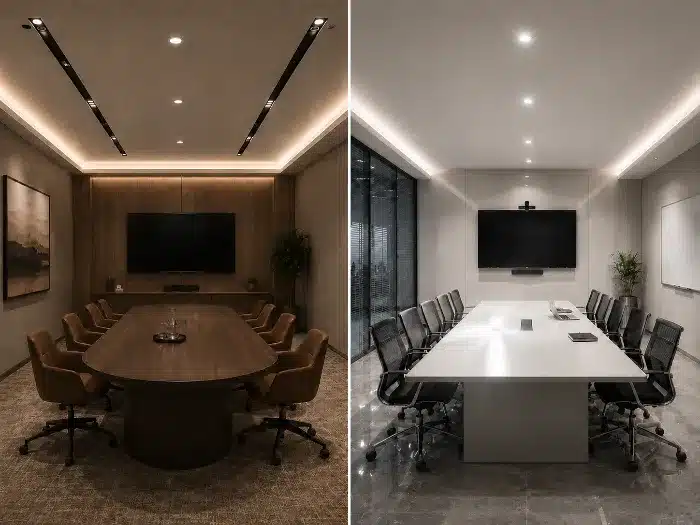
La conception de l'éclairage anti-éblouissement dépend du contrôle de la luminance2, direction du faisceau, position du luminaire et réflexion de la pièce tout en vérifiant les performances avec l'UGR. Les résultats à faible éblouissement ne peuvent être obtenus par la seule sélection des luminaires ; ils nécessitent une conception optique coordonnée, une simulation de disposition et une ingénierie spécifique à l'application.
conception d'éclairage anti-éblouissement et contrôle de l'UGR
Comprendre l'éblouissement dans la conception d'éclairage
Réalité sur site / commerciale
L'éblouissement devient un problème de projet lorsque les occupants remarquent des luminaires brillants directement dans leur champ de vision ou voient une luminosité réfléchie sur les bureaux, écrans, sols polis et finitions murales. Dans les bureaux, cela entraîne une fatigue visuelle et des plaintes. Dans les espaces de vente et les intérieurs publics, cela peut réduire le confort spatial et la qualité perçue. Une fois qu'un site est occupé, modifier les angles de vision ou déplacer les appareils est généralement laborieux et perturbant.
Plongée approfondie & Solution d'ingénierie
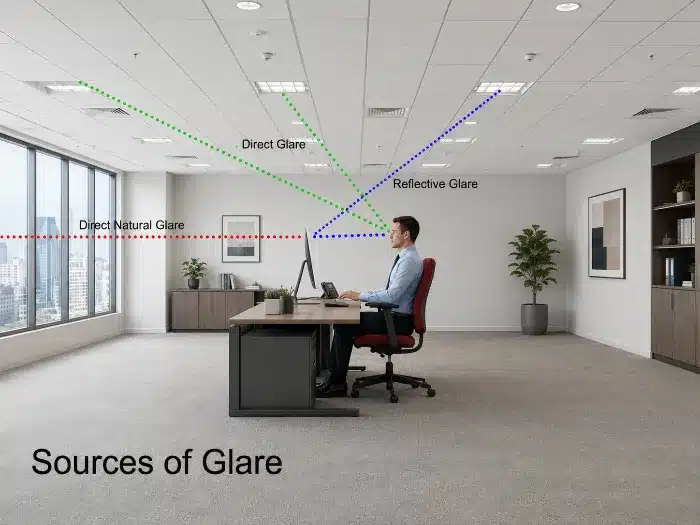
L'éblouissement peut être classé de deux manières différentes. Par effet visuel, on distingue généralement l'éblouissement d'inconfort, qui provoque une gêne sans nécessairement réduire la performance visuelle, et l'éblouissement d'incapacité, qui altère la capacité à voir les objets. Par chemin lumineux, un projet peut impliquer un éblouissement direct provenant des luminaires ou un éblouissement réfléchi par des surfaces brillantes et semi-spéculaires.3
La perception de l'éblouissement n'est pas déterminée uniquement par la puissance. Elle dépend de la luminance du luminaire, de la taille apparente, de la luminance de fond, de la position de l'observateur, de la direction de vision et de la géométrie de la pièce. C'est pourquoi une source LED compacte à haut rendement peut sembler plus agressive qu'un luminaire plus grand et mieux protégé à la même illumination.4.
Une approche de conception anti-éblouissement pratique comprend :
- Réduction de la luminance de pointe à la source
- Augmentation de la protection optique
- Contrôler l'étalement du faisceau pour éviter que la lumière n'atteigne les angles de vision critiques
- Gérer la réflectance de la salle pour limiter l'éblouissement secondaire
- Évaluation de l'installation en tant que système de salle complet, et non comme des produits isolés
| Fonctionnalité | Éclairage mal contrôlé | Éclairage anti-éblouissement conçu | Impact sur le projet / la maintenance |
|---|---|---|---|
| Apparence de la source | Image LED visible et lumineuse | Ouverture lumineuse blindée ou diffusée | Moins de réclamations et moins d'ajustements post-installation |
| Réflexions | Forte sur les bureaux, les sols, les écrans | Contrôlé par la conception du faisceau et de la disposition | Risque réduit de retouche dans les espaces finis |
| Confort visuel | Incohérent selon la position assise | Plus stable sous les angles de vision courants | Meilleure acceptation dans les projets de bureaux et publics |
| Résultat de la mise en service | Nécessite une réduction de l'intensité pour compenser | Fournit l'éclairement cible avec confort | Meilleure lumière utilisable et coût de compromis réduit |
Note d'Usine
D'un point de vue manufacturier, le contrôle de l'éblouissement commence par la géométrie de la source et le contrôle de la tolérance optique. Un appareil peut atteindre les objectifs de rendement en laboratoire, mais si le positionnement des LED, la finition du réflecteur, la texture du diffuseur ou l'alignement des lames varient entre les lots, le confort visuel peut changer sensiblement sur site. C'est pourquoi la cohérence optique au niveau du lot est aussi importante que le flux lumineux nominal.
comprendre l'éblouissement dans la conception de l'éclairage
Pourquoi l'éclairage anti-éblouissement est essentiel pour les intérieurs modernes
Réalité sur site / commerciale
Les intérieurs modernes utilisent plus d'écrans, des hauteurs de cloison plus basses, des lignes de plafond plus épurées et des matériaux plus réfléchissants que les espaces plus anciens. Cela augmente la probabilité que les occupants voient directement des ouvertures lumineuses ou des images réfléchies des luminaires. Dans les bureaux haut de gamme, les hôtels et les environnements commerciaux de marque, l'éblouissement est souvent interprété comme un échec de conception, même lorsque les niveaux d'éclairement sont techniquement adéquats.
Plongée approfondie & Solution d'ingénierie
La technologie LED a amélioré l'efficacité et la contrôlabilité, mais elle a également introduit de nouveaux risques d'éblouissement car la lumière provient souvent de surfaces d'émission compactes et à haute luminosité. Si ces sources sont exposées ou insuffisamment protégées, le contraste résultant peut être inconfortable même à des niveaux moyens d'éclairement en lux.5
L'éclairage anti-éblouissement est important car le confort visuel peut influencer :
- Concentration au travail et utilisabilité des écrans
- Qualité perçue des halls, couloirs et zones de vente
- L'expérience visuelle des clients dans les environnements commerciaux
- Acceptation des systèmes d'éclairage dans les intérieurs haut de gamme
- Satisfaction à long terme des utilisateurs sans réduire les niveaux d'éclairage en dessous de l'intention de conception
L'objectif technique n'est pas de rendre l'éclairage faible ou plat. Il s'agit de fournir l'éclairement requis et une hiérarchie visuelle sans créer de contrastes de luminance excessifs. Une bonne conception anti-éblouissement permet à la lumière de fonctionner efficacement tout en gardant la source visuellement discrète.
UGR Standard: The Key Metric for Glare Control
Réalité sur site / commerciale
Many projects specify “low glare” without defining what that means. This creates risk during procurement and approval because different suppliers may use the term inconsistently. Without a measurable metric, contractors and distributors can end up comparing products that are not evaluated under the same room conditions.
Plongée approfondie & Solution d'ingénierie
UGR, or Unified Glare Rating, is a standardized method widely used to assess discomfort glare from indoor electric lighting. It considers the average luminance of visible luminaires, their apparent size, their position relative to the observer, and the background luminance of the room.
In simplified terms, UGR increases when:
- Luminaires are brighter
- More luminaires fall into the observer’s field of view
- Fixtures are positioned closer to critical viewing directions
- The background is darker, making the luminaires appear more intense
This is why UGR is a system metric, not just a product attribute. A luminaire may achieve a favorable UGR value in one room geometry and fail in another.
Common reference values used in practice include:6
| Application | Typical Recommended UGR | Impact sur le projet / la maintenance |
|---|---|---|
| Offices and screen-based work areas | ≤ 19 | Common reference limit for office activities |
| Technical drawing | ≤ 16 | More restrictive reference for a demanding visual task |
| Reception counters | ≤ 22 | Less restrictive reference for a simpler visual task |
| Other commercial and public areas | Verify the exact task and locally adopted standard | Avoids applying office values to unrelated spaces |
UGR should be verified through lighting calculation software using actual room dimensions, reflectance assumptions, mounting heights, and observer positions. It should never be accepted as a standalone catalog claim without context.
The label “UGR < 19” does not automatically guarantee a compliant room. Published values normally depend on defined room indices7, reflectance assumptions, luminaire spacing, and viewing geometry. The tabular method is most meaningful for regular grid arrangements using one luminaire type; other layouts require project-specific numerical calculation.8
UGR also has defined limits. It primarily evaluates direct discomfort glare from luminaires and does not evaluate reflected glare from room surfaces. The method is principally applicable to mainly direct-distribution luminaires. In addition, conventional UGR based on average source luminance can underestimate discomfort from highly non-uniform LED emitting surfaces; such products require more detailed luminance assessment in line with CIE 232:2019.5 Project approval should therefore combine calculation with a review of materials, viewing directions, luminaire luminance distribution, and, where practical, a representative mock-up.
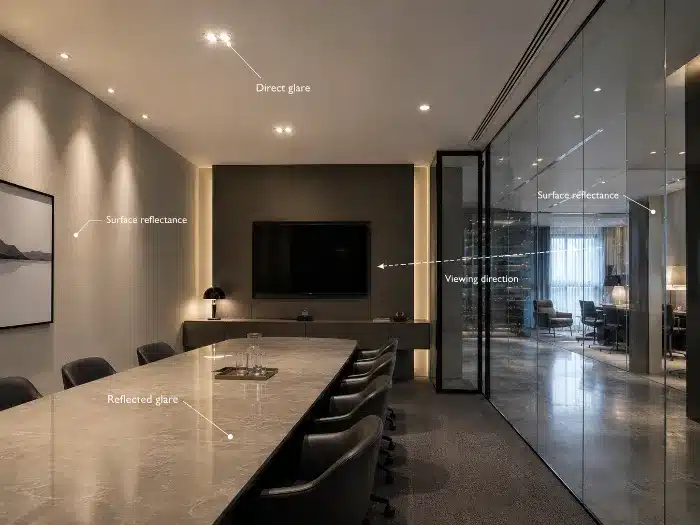
UGR limitations and real project glare review
Key Factors That Cause Lighting Glare
Réalité sur site / commerciale
Glare problems usually appear after furniture, screens, polished finishes, and actual viewing positions are in place. At that stage, changing one variable often affects several others. A contractor may lower output to reduce discomfort, only to find the lux level now falls below target. Identifying the root causes early prevents this trade-off.
Plongée approfondie & Solution d'ingénierie
The main variables influencing glare perception are closely linked:
1. Luminaire Brightness
High luminance from the emitting surface is one of the most direct causes of discomfort glare. Compact LEDs with insufficient shielding can create intense visual hotspots even when total lumens are modest.
2. Beam Angle
Narrow beams can create high-intensity zones and strong contrast, while overly wide beams may expose the source to more viewing directions or create reflective glare on room surfaces. Beam angle selection must therefore match mounting height, task plane, and observer movement.
3. Surface Reflectance
Walls, ceilings, floors, desktops, and display materials all influence glare. Moderate and balanced reflectance can support comfortable brightness distribution, while glossy or highly reflective finishes can produce reflected glare. Very dark interiors can also worsen discomfort by increasing contrast between luminaires and the background.
4. Fixture Placement
A well-designed luminaire can still cause glare if placed directly in common sightlines. Placement relative to desks, circulation paths, reception counters, and seating positions is critical.
| Facteur | If Poorly Controlled | If Properly Controlled | Impact sur le projet / la maintenance |
|---|---|---|---|
| Luminaire luminance | Source appears harsh and distracting | Brightness is shielded or spread | Can reduce complaint-driven replacement |
| Angle du faisceau | Hotspots or reflective discomfort | Balanced task and ambient distribution | Minimizes on-site aiming corrections |
| Surface reflectance | Unwanted reflections or excessive contrast | More stable visual environment | Less need for post-handover adjustment |
| Fixture position | Direct view into bright source | Better cut-off and viewing comfort | Lower labor cost during commissioning |
Note d'Usine
From a manufacturing perspective, anti-glare performance is not created by a single component. It is the combined result of LED package selection, optic depth, shielding angle, diffuser transmission, reflector finish, and installation geometry. When one of these is changed to reduce cost, the glare outcome often shifts first.
Luminaire Design for Anti-Glare Lighting
Réalité sur site / commerciale
When a project is already value-engineered, anti-glare performance often gets reduced unintentionally. A deeper optic may be replaced by a shallow housing, or a controlled louver may be replaced by a simple diffuser. These substitutions can save material cost but increase user complaints and force output reduction after handover.
Plongée approfondie & Solution d'ingénierie
Effective anti-glare luminaire design focuses on reducing direct view of high-brightness LED surfaces while maintaining useful light delivery.
Common design strategies include:
- Recessed light source geometry to increase shielding angle
- Dark-light reflectors that hide the source from normal viewing positions
- Microprismatic diffusers that spread light while limiting harsh source visibility
- Louvers that improve cut-off and directional control
- Larger luminous apertures to reduce luminance concentration
- Optical mixing chambers to soften LED point images
No optical method is universally best. The correct choice depends on ceiling depth, target efficiency, cleaning requirements, and application type. Deep recesses, louvers, diffusers, and dark-light reflectors can reduce source visibility, but none of these features guarantees a particular UGR result without photometric data and a room-level assessment.
| Fonctionnalité | Diffuser-Based Approach | Louver / Deep Optic Approach | Impact sur le projet / la maintenance |
|---|---|---|---|
| Source visibility | Lower visible pixelation | Stronger shielding at angle | Better comfort if correctly matched to use case |
| Efficacité | May reduce output due to diffusion loss | Can maintain higher directional efficiency | Affects fixture count and system power |
| Visual appearance | Softer luminous surface | More technical appearance | Influences architectural acceptance |
| Maintenance | Diffusers may yellow or collect dust | Louvers may require careful cleaning | Important for long-term performance |
A luminaire intended for anti-glare use should be evaluated for luminance control, optical consistency, and real installation depth rather than only lumen package and CCT.
Note d'Usine
From a manufacturing perspective, anti-glare optics require tighter quality control than many buyers expect. Microprismatic structures, reflector coatings, and shielding parts must remain consistent across production lots. Small deviations in texture, coating reflectivity, or assembly alignment can create visible differences between rooms or batches, especially in open-office ceilings.
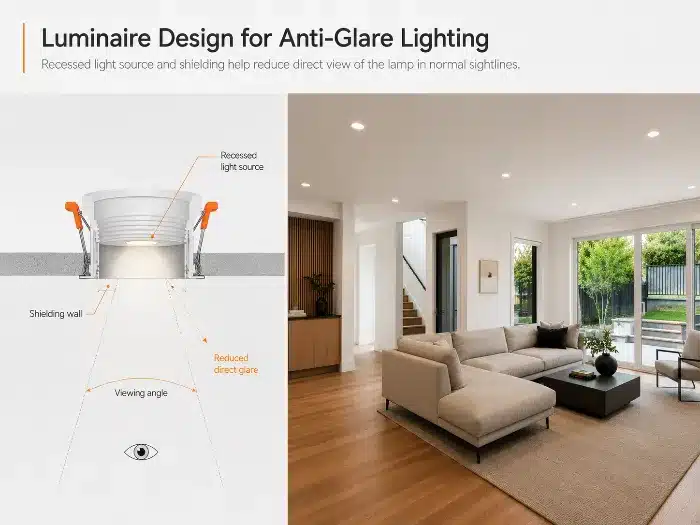
luminaire design for anti-glare lighting
Lighting Layout Strategies to Reduce Glare
Réalité sur site / commerciale
Many glare issues are caused less by the fixture itself than by layout decisions. Even a low-glare luminaire can become uncomfortable if spacing, mounting height, or orientation are not coordinated with task positions. Correcting layout after ceiling completion is one of the most expensive forms of lighting rework.
Plongée approfondie & Solution d'ingénierie
Layout strategy should be treated as part of glare control from the beginning. Key methods include:
- Keep luminaires out of primary sightlines where people spend long periods seated or standing
- Avoid placing downlights directly above screen-facing workstations
- Use indirect or semi-indirect lighting where uniform visual comfort is a priority
- Coordinate spacing and mounting height to avoid excessive brightness contrast
- Use wallwashing carefully to avoid reflected discomfort on glossy finishes
- Simulate multiple observer positions, not only center-of-room viewpoints
In many interiors, the best result comes from layering light: controlled ambient lighting, targeted task lighting, and accent lighting with carefully selected beam angles.
| Stratégie | Poor Practice | Better Practice | Impact sur le projet / la maintenance |
|---|---|---|---|
| Workstation alignment | Fixtures directly in screen sightlines | Rows coordinated with desk orientation | Can reduce complaints and relocation requests |
| Mounting height | Low mounting with exposed source | Height matched to shielding geometry | Better comfort without reducing lux |
| Spacing | Over-spaced bright points | Balanced distribution with lower contrast | Supports better visual uniformity |
| Lighting layers | One fixture type does everything | Ambient, task, and accent roles separated | Better energy and comfort control |
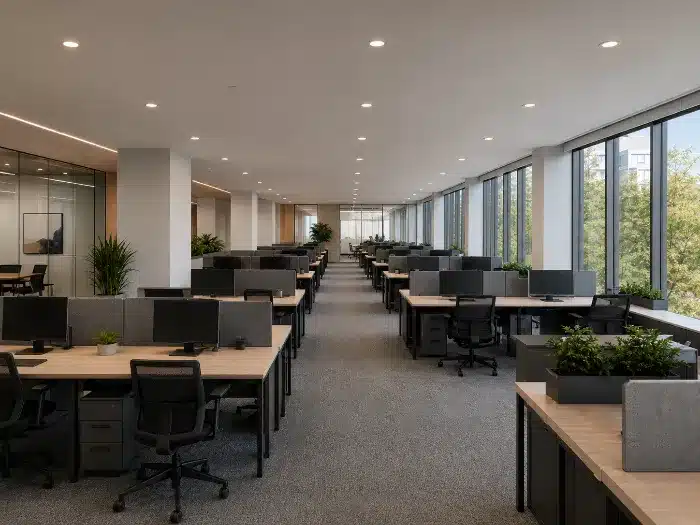
lighting layout strategies to reduce glare
Anti-Glare Lighting in Workplace Environments
Offices are among the most glare-sensitive applications because occupants spend long periods in fixed positions, often looking at screens. If glare is not controlled, users may complain about eye strain, reflected images, and excessive brightness contrast. These issues can lead to local modifications, desk relocation, or non-standard dimming requests after occupancy.
For workplaces, anti-glare design should support both visual comfort and task visibility. Typical engineering priorities include:
- UGR values aligned with the applicable workplace requirement, commonly ≤ 19 for office activities
- Luminaires with controlled luminance at common viewing angles
- Balanced vertical and horizontal illuminance to reduce contrast fatigue
- Careful orientation relative to monitor positions
- Surface reflectance planning for ceilings, walls, and desks
Suspended direct-indirect systems, recessed low-luminance panels, and controlled linear optics are commonly used where screen comfort is critical. The goal is not only to meet lux values on the desk but to maintain a visually stable environment across the workday.
Note d'Usine
In large office fit-outs, products are often selected based on appearance and efficacy first, with glare reviewed too late. Once workstation layouts are fixed, any mismatch between luminaire distribution and desk orientation becomes costly. Early coordination with furniture plans is one of the simplest ways to reduce project risk.
Anti-Glare Lighting in Commercial and Public Spaces
Retail stores, lobbies, corridors, reception areas, and public buildings have more varied sightlines than offices. People are moving, looking upward, approaching displays, and viewing reflective finishes from different angles. This makes glare control more dynamic and often more difficult to predict without simulation and mock-up review.
In commercial and public spaces, anti-glare lighting must balance comfort with architecture and visual emphasis. The design approach usually includes:
- Lower apparent brightness in circulation paths
- Controlled accent lighting to avoid direct line-of-sight discomfort
- Careful treatment of polished stone, glass, metal, and glossy displays
- Reduced source visibility at reception counters and waiting areas
- Layered lighting for hierarchy without excessive contrast
For retail, some degree of sparkle and emphasis may be desirable, but discomfort glare should still be controlled in browsing zones and cashier areas. In hospitality, visual comfort is tied directly to perceived luxury and calmness, especially in lobbies, guest corridors, and dining spaces.
Note d'Usine
In large hospitality projects, glare from reflected surfaces is often underestimated. Marble floors, polished metal trims, lacquered joinery, and decorative glass can amplify discomfort even when the fixture optics are well designed. Material schedules should be reviewed together with the lighting plan, not separately.
Common Mistakes in Anti-Glare Lighting Design
Most glare failures are not caused by a complete lack of technical knowledge. They come from partial decisions made in isolation: procurement focuses on price, design focuses on appearance, and installation follows ceiling constraints. The resulting system may satisfy none of the original comfort targets.
Common mistakes include:
Relying only on a catalog UGR claim
UGR values depend on room conditions. A product label alone is not enough.Selecting low-glare fixtures but ignoring layout
Good optics cannot compensate for poor positioning.Focusing only on horizontal illuminance
Lux targets do not guarantee visual comfort.Ignoring surface reflectance and finish changes
Interior material substitutions can significantly alter glare conditions.Overdriving compact luminaires
Higher lumen output from small apertures often increases discomfort.Using one luminaire type for every task
Ambient, task, and accent roles should be differentiated.
| Mistake | Typical Result | Better Engineering Approach | Impact sur le projet / la maintenance |
|---|---|---|---|
| Single-product UGR assumption | Unexpected glare after installation | Verify room-based simulation | Can reduce dispute risk |
| No furniture coordination | Complaints at desks or counters | Align layout with actual task zones | Fewer post-handover changes |
| Ignoring materials | Reflected glare on glossy finishes | Review reflectance and finish schedule | Less aesthetic and comfort rework |
| Overemphasis on output | Harsh appearance despite adequate lux | Control luminance, not only lumens | Better long-term acceptance |
Note d'Usine
From a manufacturing perspective, another common mistake is approving a sample under one installation condition and mass ordering for another. A recessed prototype reviewed in a mock-up ceiling can behave very differently when installed shallow, tilted, or in a different trim color. Installation detail must be frozen before final sign-off.
Emerging Technologies for Lighting Glare Control
As projects demand thinner ceilings, higher efficacy, and better visual comfort at the same time, conventional optical solutions are being pushed to their limits. New glare-control technologies can help, but they also require careful validation before being adopted across large batches.
Several developments are improving anti-glare performance in current lighting systems:
- Microprismatic optical films for more precise light redirection
- Advanced dark-light reflector geometries for better shielding at shallow depths
- Optical-grade diffusers with improved balance between transmission and luminance control
- Miniaturized lens arrays that distribute light more uniformly
- Tunable and sensor-based controls that reduce brightness when full output is unnecessary
- Hybrid direct-indirect systems that support lower contrast environments
Smart control also contributes indirectly to glare reduction. If lighting is dimmed according to daylight availability or occupancy patterns, luminance levels remain closer to what the visual environment requires instead of staying unnecessarily high all day.
However, newer optics should be checked for aging behavior, yellowing resistance, thermal stability, and batch repeatability before project deployment.
Note d'Usine
From a manufacturing perspective, not every new optical material is suitable for long production runs. Some films and diffusers look promising in early samples but show visible variation, heat-related deformation, or color shift after extended aging. For commercial projects, glare control technology must be validated not only for optics but for production stability.
Business Value of Anti-Glare Lighting Design
Anti-glare lighting design is a reliability decision affecting user acceptance, commissioning efficiency, and maintenance cost. Coordinating luminance control, beam management, surface reflectance, fixture placement, and UGR verification can improve visual comfort and reduce the risk of site corrections.
For B2B lighting supply, the business value is clear:
- More reliable project outcomes
- Fewer post-install complaints and adjustments
- Better consistency between design intent and site performance
- Potentially lower lifetime system cost through less rework and fewer complaint-driven adjustments
Recommandation d'ingénierie B2B
For anti-glare lighting projects, project teams should review the lighting layout, luminaire photometric files, mounting height, room geometry, surface-reflectance assumptions, furniture positions, and critical viewing directions before final approval. When the project moves from calculation to product selection, buyers can review the TECO LED product range and then contact the TECO engineering team with the relevant drawings and performance requirements. This allows fixture options, optical data, samples, and installation conditions to be assessed before mass production.
Notes de bas de page
Unified Glare Rating (UGR) is a standardized method for evaluating discomfort glare from electric lighting in interior installations. Sources: CIE 117:1995, https://cie.co.at/publications/discomfort-glare-interior-lighting; ERCO Lighting Knowledge, https://www.erco.com/en_us/designing-with-light/lighting-knowledge/lighting-design/ugr-method-7488/. ↩
Luminance describes luminous intensity per projected area in a specified direction and is expressed in candela per square meter (cd/m²). Source: CIE S 017:2020 International Lighting Vocabulary (e-ILV), term 17-21-050, https://cie.co.at/eilvterm/17-21-050. ↩
The CIE defines glare as a condition that causes discomfort or reduces the ability to see because of unsuitable luminance distribution or extreme contrast. It separately defines disability glare as glare that impairs vision without necessarily causing discomfort. Sources: CIE S 017:2020 International Lighting Vocabulary, https://cie.co.at/eilvterm/17-22-098 et https://cie.co.at/eilvterm/17-22-103. ERCO also distinguishes the direct glare evaluated by UGR from reflected glare: https://www.erco.com/en_us/designing-with-light/lighting-knowledge/lighting-design/ugr-method-7488/. ↩
Illuminance is the luminous flux incident on a surface per unit area and is expressed in lux. Source: CIE S 017:2020 International Lighting Vocabulary (e-ILV), term 17-21-060, https://cie.co.at/eilvterm/17-21-060. ↩
CIE 232:2019 addresses discomfort glare from luminaires with non-uniform source luminance, including conditions relevant to compact LED arrays and other visibly non-uniform emitting surfaces. Source: https://cie.co.at/publications/discomfort-caused-glare-luminaires-non-uniform-source-luminance. ↩ ↩
Indoor workplace glare requirements and application limits should be checked against the standard adopted for the project location and the exact visual task. Current international framework: ISO/CIE 8995-1:2025, https://www.iso.org/standard/76342.html. The office reference of UGR ≤ 19, technical-drawing reference of UGR ≤ 16, and reception-desk reference of UGR ≤ 22 appear in this EN 12464-1 guidance summary: https://www.performanceinlighting.com/ww/en/en-12464-1. ↩
Room index is a dimensionless value used in lighting calculations to describe room proportions relative to luminaire mounting height. The standardized UGR tabular method uses defined room geometry and reference conditions. Sources: CIE 117:1995, https://cie.co.at/publications/discomfort-glare-interior-lighting; ERCO Lighting Knowledge, https://www.erco.com/en_us/designing-with-light/lighting-knowledge/lighting-design/ugr-method-7488/. ↩
The standardized tabular UGR method is based on reference room conditions and regular arrangements. ERCO explains that individual calculation is required when different luminaire types are used or the arrangement differs from the regular grid: https://www.erco.com/en_us/designing-with-light/lighting-knowledge/lighting-design/ugr-method-7488/. Core method: CIE 117:1995, https://cie.co.at/publications/discomfort-glare-interior-lighting. ↩