Conception d'éclairage sur rail de bureau : solutions d'éclairage flexibles pour les espaces de travail modernes
Introduction
Les défaillances de l'éclairage de bureau proviennent rarement uniquement du rendement des luminaires. Dans la plupart des projets, le vrai problème est que le système d'éclairage ne peut pas s'adapter aux changements d'agencement, aux déplacements des postes de travail, aux mises à jour des cloisons et aux zones polyvalentes après la réception. Pour les entrepreneurs, les concepteurs et les gestionnaires d'installations, cela crée une chaîne de problèmes prévisible : bureaux sombres, plaintes d'éblouissement, ajustements répétés de l'orientation, retouches du plafond et appels de maintenance inutiles.
La conception de l'éclairage sur rail de bureau aborde cela comme une solution au niveau du système plutôt qu'un choix décoratif. Lorsqu'elle est correctement planifiée, elle offre aux espaces commerciaux la flexibilité nécessaire pour supporter les bureaux en open space, les zones de travail concentrées, les salles de réunion, les circulations et les espaces collaboratifs sans avoir à reconstruire le plafond à chaque changement d'agencement. Cette flexibilité réduit directement les perturbations sur site, préserve la qualité de l'éclairage et diminue les coûts opérationnels à long terme.
Ce guide est rédigé pour les entrepreneurs, les acheteurs de projets, les distributeurs d'éclairage, les gestionnaires d'installations et les équipes d'aménagement de bureaux évaluant les systèmes d'éclairage LED sur rail pour les bureaux ouverts, les salles de réunion, les zones d'accueil et les espaces de travail commerciaux flexibles.
Résumé Exécutif
L'éclairage sur rail de bureau améliore la flexibilité, accompagne l'évolution des agencements des espaces de travail et simplifie les futurs ajustements d'éclairage. Lorsque l'angle du faisceau, l'éclairement1, l'espacement des luminaires, l'orientation, la compatibilité des rails, la charge électrique et le zonage de contrôle sont correctement conçus, les systèmes sur rail réduisent les retouches, améliorent le confort visuel et offrent une plateforme d'éclairage plus facile à entretenir pour les bureaux modernes.
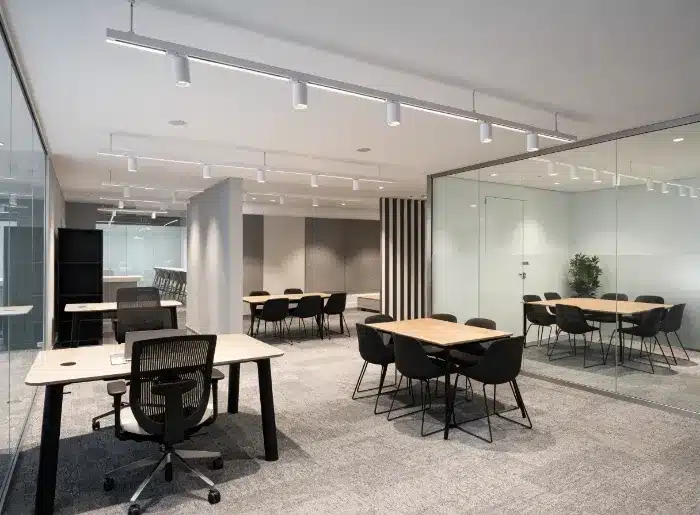
conception d'éclairage sur rail pour bureau adaptée à la flexibilité des espaces de travail modernes
Pourquoi l'éclairage sur rail est populaire dans la conception de bureaux modernes
Réalité sur site / commerciale
Les bureaux modernes ne fonctionnent plus selon des agencements fixes. Les espaces de travail ouverts deviennent des zones d'équipe, les salles calmes se transforment en cabines d'appel vidéo, et les espaces de collaboration sont reconfigurés après l'occupation. Avec les agencements encastrés conventionnels, chaque changement peut entraîner une distribution de lumière inégale, des luminaires supplémentaires, des réparations de plafond ou des problèmes de coordination apparents avec la CVC et les services incendie. Cela augmente les coûts de main-d'œuvre et prolonge le temps d'accès, en particulier dans les bureaux occupés où des travaux en dehors des heures normales sont nécessaires.
Plongée approfondie & Solution d'ingénierie
L'éclairage sur rail est populaire car il sépare le chemin d'alimentation électrique de la position finale de visée du luminaire2. Au lieu de fixer le flux lumineux à un point permanent du plafond, le système permet aux luminaires d'être repositionnés, ajoutés, retirés ou réorientés le long du rail.
Pour les bureaux, cela est précieux de plusieurs manières pratiques :
- les agencements de rails en bureau ouvert peuvent être ajustés lorsque les regroupements de bureaux changent
- Les projecteurs orientables peuvent être repositionnés pour s'adapter à la densité des postes de travail
- l'éclairage de tâche peut être renforcé au-dessus des zones de travail concentrées
- l'éclairage d'accentuation peut être dirigé vers les tables de réunion, les zones de détente et les murs de présentation
Cela rend l'éclairage sur rail LED particulièrement adapté aux bureaux qui évoluent dans le temps. Le système prend en charge une stratégie d'éclairage en couches plutôt qu'une grille uniforme unique. L'éclairage général peut provenir de projecteurs sur rail à faisceau large, tandis que des luminaires plus étroits et réglables peuvent soutenir les tâches visuelles ou mettre en valeur les zones de collaboration.
| Fonctionnalité | Agencement encastré fixe | Système d'éclairage sur rail LED | Impact sur la maintenance / ROI |
|---|---|---|---|
| Ajustement post-installation | Très limité | Haut | Coût de retouche inférieur |
| Adaptabilité aux changements d'agencement | Médiocre | Forte | Meilleure flexibilité à long terme |
| Remplacement ou déplacement du luminaire | Intervention au plafond souvent nécessaire | Habituellement, seul un ajustement sur rail est possible | Perturbation de maintenance réduite |
| Adaptabilité de zonage | Modéré | Haut | Meilleure utilisation des infrastructures installées |
Note d'Usine
D'un point de vue manufacturier, la valeur de l'éclairage sur rail dans les bureaux ne réside pas seulement dans la flexibilité esthétique. L'avantage réel est de préserver la compatibilité entre l'infrastructure électrique installée et l'évolution des besoins en éclairage. Dans les projets commerciaux, cela se traduit généralement par moins de modifications du plafond sur la durée de l'aménagement.
Principaux avantages des systèmes d'éclairage sur rail pour bureaux
Réalité sur site / commerciale
Dans les aménagements de bureaux, les erreurs d'éclairage les plus coûteuses apparaissent souvent après la réception des travaux. Les équipes s'installent, le mobilier change, les zones de réunion sont redéfinies, et soudain, l'éclairage d'origine ne correspond plus à l'utilisation réelle de l'espace. Si le système ne peut pas s'adapter, les équipes de maintenance sont contraintes de recourir à des solutions temporaires ou à des remplacements partiels.
Plongée approfondie & Solution d'ingénierie
Les principaux avantages des systèmes d'éclairage sur rail de bureau sont la flexibilité, le contrôle de zonage, la facilité de maintenance et l'éclairage ciblé.
Les principaux avantages techniques incluent :
- Positionnement ajustable des luminaires pour les agencements de bureau évolutifs
- Contrôle directionnel pour les postes de travail, les voies de circulation et les zones de collaboration
- Adaptation simplifiée sans ouvrir les plafonds
- Meilleur support pour l'éclairage de tâche où la performance visuelle sur le bureau est critique
- Éclairage d'accentuation amélioré pour les zones d'accueil, les points de rencontre informels et les murs d'ambiance
- Intégration efficace avec les sources LED pour une charge connectée réduite
Un système sur rail bien conçu aide également à éviter la sur-illumination. Au lieu d'utiliser une grille uniforme dense pour couvrir chaque agencement possible, les luminaires peuvent être orientés là où la lumière est réellement nécessaire. Cela améliore l'efficacité d'utilisation et peut réduire la puissance excédentaire.
| Fonctionnalité | Grille de downlights conventionnelle | Système d'éclairage sur rail | Impact sur la maintenance / ROI |
|---|---|---|---|
| Flexibilité de l'éclairage | Faible | Haut | Durée de vie utile plus longue du système installé |
| Visée spécifique à la tâche | Limitée | Forte | Meilleure performance des postes de travail |
| Effort de reconfiguration | Haut | Low to moderate | Lower labor cost |
| Adaptation to mixed-use areas | Poor to moderate | Forte | Reduced need for additional fittings |
In commercial office fit-outs, flexibility matters most when it preserves operational continuity. If one lighting rail can support several future workstation arrangements without ceiling reconstruction, the project gains a measurable maintenance advantage. That flexibility still depends on track loading, circuit zoning, adapter compatibility, and the availability of matching replacement heads.
Types of Track Lighting Used in Offices
Réalité sur site / commerciale
Selecting the wrong track head type creates commissioning issues quickly. A narrow spotlight used for general office lighting leads to patchy illumination. A flood beam used over presentation surfaces may cause spill light and reduced contrast. Once installed in quantity, correction means re-aiming, replacing optics, or changing fixture types.
Plongée approfondie & Solution d'ingénierie
Office track lighting typically uses several fixture categories, each serving a different function:
Adjustable spotlights
Used for task lighting, highlighting work areas, or accenting presentation walls and collaborative zones.Wide-beam flood track heads
Suitable for general lighting in open office spaces where broader distribution is required.Linear track luminaires
Used where more uniform illumination is needed over desks, circulation paths, or shared work tables.Wall-wash track fixtures
Applied in offices with vertical display surfaces, branding walls, or visual presentation areas.
The most effective office systems usually combine more than one type. Open work areas may use linear or wide-beam heads for ambient lighting, while adjustable spotlights provide emphasis in lounges, touchdown spaces, or meeting corners.
The track system itself also requires careful selection. Commercial offices may use single-circuit or multi-circuit mains-voltage track, recessed or surface-mounted track, suspended track, or low-voltage magnetic systems. These categories should not be treated as interchangeable. Track dimensions, conductor arrangement, earthing, adapter geometry, circuit selection, control method, and permitted load vary by system and market.
Before specification, confirm whether future replacement heads must remain within one manufacturer’s system. A lamp or fitting that appears physically similar may not be electrically or mechanically compatible with another track. The number of heads that can be added is also limited by the track, feed connector, circuit protection, driver inrush current, and control-device rating.
| Fonctionnalité | Spotlight Track Head | Linear Track Luminaire | Impact sur la maintenance / ROI |
|---|---|---|---|
| Meilleure utilisation | Task or accent lighting | Éclairage de bureau général | Correct selection reduces retrofit risk |
| Contrôle du faisceau | Haut | Moderate to broad | Better application matching |
| Visual uniformity | Lower unless carefully planned | Plus élevé | Fewer user complaints |
| Re-aiming flexibility | Forte | Limitée | Useful in changing zones |
Note d'Usine
From a manufacturing perspective, office projects benefit when optical distribution is standardized early. Mixing too many beam types without a layout logic often creates site-level confusion, especially when replacement heads are ordered later and beam identification is no longer clear.
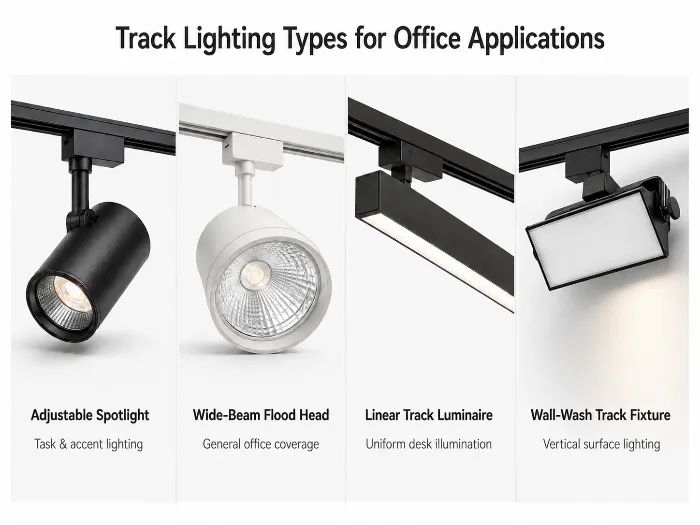
types of office track lighting spotlights linear track and flood beams
Office Track Lighting Buyer Checklist
For procurement, a track-lighting schedule should define the system and application requirements clearly enough to compare compatible products rather than wattage alone.
| Vérifier l'article | What to Confirm | Pourquoi c'est important |
|---|---|---|
| Track system | Circuit type, voltage, earthing, dimensions, adapter standard, and mounting method | Prevents mechanical or electrical incompatibility |
| Electrical loading | Track, feed, connector, breaker, control-device, and driver inrush limits | Prevents overload and unstable switching |
| Fixture role | Ambient, task, accent, wall-wash, or vertical lighting | Avoids using narrow accent heads as general office lighting |
| Beam and photometric data | Beam angle, field distribution, IES or LDT file, spacing, and aiming | Supports desk uniformity and glare review |
| Confort visuel | Shielding, source visibility, screen reflections, and applicable glare criteria | Reduces complaints in screen-based work areas |
| Color quality | CCT, CRI, color consistency, and replacement-batch tolerance | Maintains a consistent office appearance |
| Driver performance | Flicker, dimming method, minimum load, control compatibility, and power quality | Prevents visible instability and commissioning problems |
| Replacement planning | Availability of compatible heads, optics, adapters, and drivers | Protects the long-term flexibility promised by the system |
| Sample verification | Full-size test using the intended track, control gear, ceiling height, and furniture layout | Reduces risk before bulk ordering |
TECO’s product range includes selected track-light fittings and replaceable LED spotlights for compatible office and commercial applications. Examples include the TECO Track Lighting Fixture for PAR30 Spot Light and a compatible PAR30 E27 dimmable LED spotlight published with 20° / 30° beam options. Suitability for an office project still depends on the required illuminance, glare control, track compatibility, mounting height, electrical loading, and control scheme.
Office Track Lighting Layout Strategies
Réalité sur site / commerciale
Poor layout planning leads to glare, uneven desk lighting, dark circulation paths, and fixture conflict with ceiling services. In office fit-outs, these problems become more difficult after occupancy because access equipment, working-hour restrictions, and tenant coordination all increase correction cost.
Plongée approfondie & Solution d'ingénierie
Office track lighting layout should begin with how the space functions, not with fixture count alone.
Practical layout strategies include:
- running track lines parallel to workstation rows in open offices
- using adjustable heads to fine-tune lighting over desk clusters
- placing dedicated task lighting where focused visual work is expected
- adding accent lighting in collaborative areas to improve spatial identity
- separating circulation lighting from desk lighting where possible
- coordinating track positions with ceiling modules, HVAC diffusers, sprinklers, and acoustic elements
For open offices, continuous or segmented track lines usually work better than scattered short sections. This provides a stable electrical backbone while keeping flexibility for future repositioning.
A layered strategy is usually more effective than uniform aiming:
- ambient lighting for overall visibility
- task lighting for desks and focused work
- accent lighting for meeting points, lounges, and shared zones
During office commissioning, alignment and aiming errors often appear as inconsistent desk brightness, reflected glare on screens, or direct source visibility from normal seated positions. Good layout discipline before installation prevents a long sequence of after-hours aiming adjustments later.
Choosing the Right Beam Angle for Office Track Lighting
Réalité sur site / commerciale
Beam angle selection is one of the most common causes of dissatisfaction in office track lighting. If the beam is too narrow, desks receive bright hotspots with poor uniformity. If too wide, light spills into screens, circulation areas, or adjacent zones, reducing contrast and wasting output.
Plongée approfondie & Solution d'ingénierie
Angle du faisceau3 should match mounting height, task size, spacing, and the purpose of the zone.
General guidance:
- Narrow beam: suitable for highlighting specific points, displays, or small collaboration features
- Medium beam: useful for task lighting over desks or compact tables
- Wide beam: preferred for broader ambient coverage in open office zones
The correct choice depends on:
- ceiling height
- distance from fixture to task plane
- required illuminance
- spacing between luminaires
- desired overlap for uniformity4
For office use, broader beams often perform better for ambient lighting, while medium beams are practical for workstation emphasis. Narrow beams should be used selectively, not as the main source for general office illumination.
In screen-based offices, beam angle and aiming direction must be checked together. A technically sufficient lux level can still generate complaints if a track head is visible within the normal viewing direction or produces reflected glare on monitors, glass partitions, or glossy desks. UGR can support glare assessment, but it should not be treated as a complete prediction for every real track-lighting arrangement, particularly where small LED sources have high or non-uniform luminance.5
| Fonctionnalité | Narrow Beam | Wide Beam | Impact sur la maintenance / ROI |
|---|---|---|---|
| Light concentration | Haut | Inférieur | Wrong choice increases complaints |
| Uniformity over desks | Inférieur | Plus élevé | Better comfort reduces adjustment calls |
| Spill light control | Meilleur | Réduit | Must match application |
| Best office use | Accent or focal points | Éclairage ambiant | Improved application fit lowers rework |
Note d'Usine
From a manufacturing perspective, beam angle decisions should never be made from appearance alone. In office projects, two visually similar track heads can behave very differently on the task plane. Verified photometric data6 is far more reliable than relying on nominal wattage or visual impressions during mock-up.
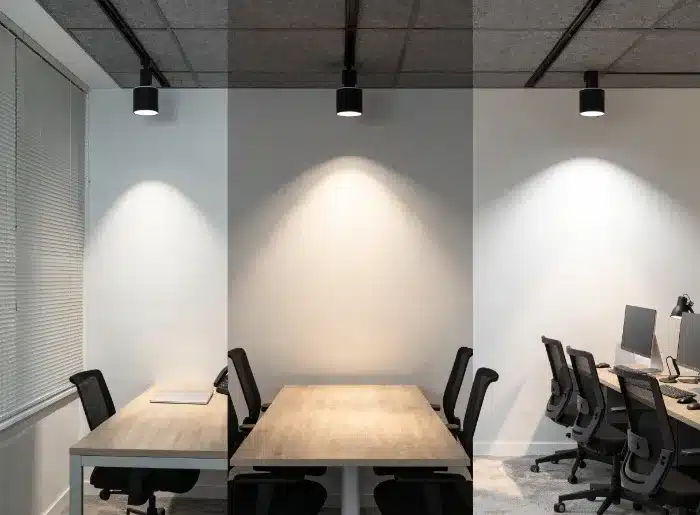
office track lighting beam angle selection for desks and collaboration areas
Recommended Brightness Levels for Office Lighting
Under-lighting leads to visual fatigue and complaint-driven adjustments. Over-lighting increases connected load, creates glare risk, and often forces dimming or re-aiming after occupancy. Both outcomes mean extra labor and dissatisfaction.
Recommended office brightness should be based on task requirement, not a single blanket lux value across all zones. Workstations, meeting areas, corridors, reception points, and breakout areas have different visual demands.
As a general approach:
- desk-based work areas need stable and comfortable task-plane illuminance
- collaborative areas benefit from balanced ambient light with some focal emphasis
- circulation spaces can operate at lower levels than active work zones
- presentation or display surfaces may require vertical illumination, not just horizontal brightness
Track lighting helps because the output can be distributed selectively. Instead of pushing the whole office to a high average brightness, the designer can reinforce workstations and reduce unnecessary output elsewhere.
The values below are preliminary maintained-illuminance references, not universal compliance limits. Final targets should be confirmed against the current workplace-lighting standard adopted in the project location, the visual task, occupant needs, daylight contribution, control strategy, uniformity, and glare requirements. ISO/CIE 8995-1:2025 is the current international standard covering the quantity and quality of illumination for indoor workplaces.7
| Office Area / Task | Common Preliminary Reference | Design Note |
|---|---|---|
| General desk work, writing, typing, and reading | 300–500 lux on the task plane | Many specifications use 500 lux for regular office tasks; confirm local requirements and task difficulty |
| Meeting and conference tables | 300–500 lux | Provide dimming or scene control where presentations are common |
| Reception and waiting areas | 200–300 lux | Combine functional light with vertical and accent illumination |
| Corridors and internal circulation | 100–200 lux | Avoid excessive contrast at transitions into work areas |
| Breakout and informal collaboration zones | 150–300 lux | A softer level may be suitable if visual tasks are limited |
| Presentation walls and whiteboards | Project-specific vertical illuminance | Check visibility, contrast, reflections, and video-camera use |
Illuminance alone does not establish office-lighting quality. The design should also check task-area uniformity, surrounding-area brightness, direct and reflected glare, color quality, flicker, daylight interaction, and the visibility of track heads from seated positions.
In commercial office projects, excessive brightness is often mistaken for better lighting quality. In practice, offices perform better when maintained illuminance is matched to the task, glare is controlled, and beam distribution is properly overlapped. That approach is more stable for long-term user acceptance.
Office Track Lighting Design Example
Without a design logic tied to actual use, office track lighting becomes a collection of movable fixtures without performance consistency. This often causes late-stage site changes and repeated aiming visits.
Consider a mid-sized open office with:
- primary desk clusters in the central area
- collaborative seating near the perimeter
- circulation routes between departments
- a small presentation wall and reception corner
A practical track lighting design could use:
- linear or wide-beam track luminaires over the main desk area for ambient coverage
- adjustable medium-beam heads aimed at high-use workstation zones
- accent spotlights for collaboration areas to create visual hierarchy
- dedicated track heads for vertical illumination at the presentation wall
- separate switching or dimming groups for work zones and shared zones
This arrangement allows the office to evolve. If workstation density changes, fixture heads can be repositioned along the track without major infrastructure changes. If a collaborative corner becomes a focused work area, beam distribution can be adjusted rather than replacing the entire ceiling layout.
During tenant fit-out and post-occupancy adjustment, zones often change function after furniture and teams move in. A design example only works in practice if the track system allows operational changes without exceeding circuit loads, losing control zoning, or introducing new glare.
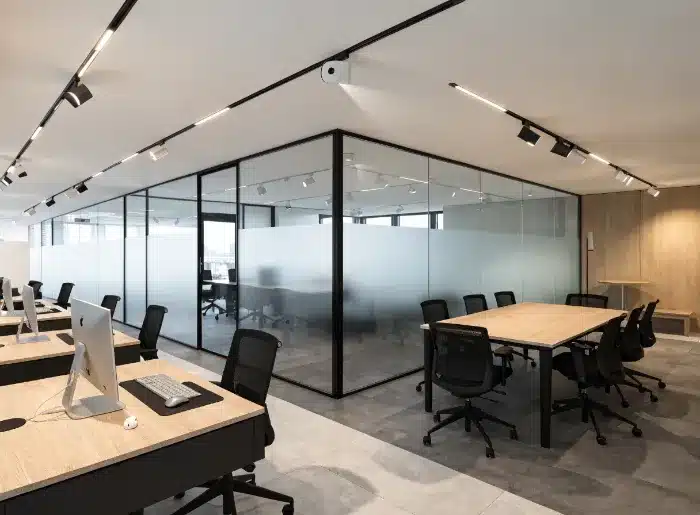
office track lighting design example for open plan workspace and collaboration zones
Energy Efficiency in Office Track Lighting
Energy claims are common, but poor system design can cancel the benefit. If track heads are over-specified, poorly aimed, or used to compensate for weak layout planning, the installation may still consume more power than necessary and create maintenance inefficiencies.
LED track lighting improves office energy efficiency primarily through three mechanisms:
- lower source power compared with legacy technologies
- better directional control, placing light only where needed
- adaptability, which reduces the need to over-light for future uncertainty
Because office environments change, fixed systems are often designed with excess coverage as a safety margin. Track lighting reduces that inefficiency by allowing later adjustment. Instead of installing permanent surplus light, the design can be tuned as space use becomes clear.
For best results, energy efficiency should be evaluated at system level:
- luminaire efficacy8
- optical control
- compatibilité avec la gradation
- zoning strategy
- actual usage profile
Note d'Usine
From a manufacturing perspective, the most efficient office lighting system is not necessarily the one with the lowest fixture wattage. It is the one that delivers the required task illumination with the least correction, least overspill, and least need for later fixture additions.
Common Office Track Lighting Mistakes
Most office track lighting failures are not caused by product defects. They come from planning shortcuts: poor aiming logic, wrong beam selection, ignoring task zones, or using accent fixtures as general lighting. These mistakes increase commissioning time and can damage confidence in the whole installation.
Common mistakes include:
- treating track lighting as decoration rather than a primary lighting system
- using narrow-beam spotlights for broad workstation coverage
- failing to provide separate task lighting for desks
- ignoring vertical illumination in meeting or presentation areas
- placing tracks without coordinating with furniture layout
- neglecting glare control for screen-based work
- over-lighting collaborative zones while under-lighting task areas
- assuming all track heads and adapters are cross-compatible
- adding fixtures without checking track load, inrush current, or control-device capacity
- relying on average lux while ignoring glare and monitor reflections
The correction is straightforward but must happen early:
- map real office functions first
- assign ambient, task, and accent roles clearly
- verify beam spread against ceiling height and task plane
- use track flexibility as part of the design strategy, not as a rescue method after poor planning
During commissioning, the most time-consuming adjustments usually come from systems that were expected to “be flexible later” without being engineered properly at the start. Flexibility works best when supported by a disciplined layout and a clear lighting hierarchy.
Future Trends in Office Lighting Design
Office environments are becoming more dynamic, with hybrid working, shared desks, modular furniture, and changing occupancy patterns. Lighting systems that cannot adapt will require more frequent modification and create higher life-cycle cost.
Future office lighting design is moving toward adaptable, layered, and data-supported systems. Track lighting is well aligned with this direction because it already supports physical flexibility at the luminaire level.
Key trends include:
- more reconfigurable office layouts requiring movable lighting points
- greater use of layered lighting instead of uniform blanket illumination
- increased focus on visual comfort for screen-intensive work
- wider use of dimmable LED systems for zone-based control
- stronger emphasis on maintainability and long-term adaptability
LED track systems are especially relevant because they allow offices to respond to space planning changes without discarding the installed lighting backbone. That makes them suitable for fit-outs where future change is expected rather than occasional.
In workplace renovation and tenant-improvement projects, the most resilient lighting systems are those that accept operational change without unnecessary hardware replacement. The commercial value is not only energy saving, but preserving usable infrastructure through multiple layout revisions while maintaining compatible fixtures, controls, and replacement parts.
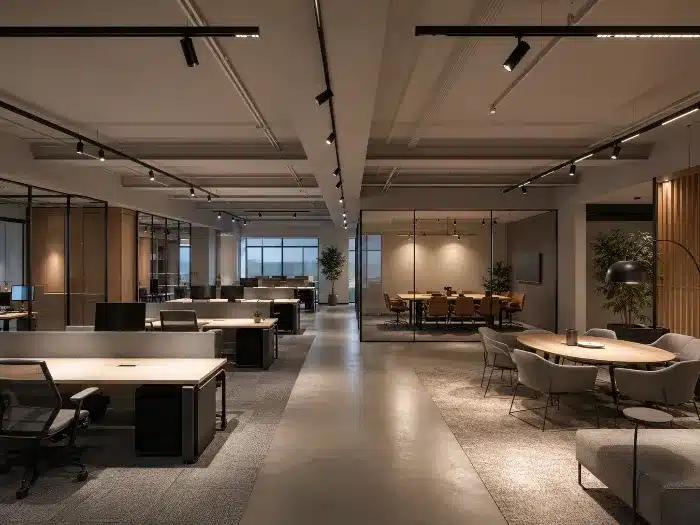
future trends in office lighting design with flexible LED track systems
Conclusion: Creating Flexible and Efficient Office Lighting
Office track lighting design gives modern workspaces a practical way to combine adaptability, visual performance, and maintainability. When fixture type, beam angle, layout, and task zoning are planned correctly, the system can support open offices, workstation lighting, and collaborative areas without repeated ceiling modification.
For commercial projects, that means better reliability, lower maintenance effort, and reduced lifetime system cost. The real strength of track lighting is not only adjustable fixtures, but the ability to keep the lighting infrastructure usable as the workplace evolves.
Recommandation d'ingénierie B2B
For office track lighting projects, project buyers and contractors can send reflected ceiling plans, workstation layouts, proposed track types, circuit schedules, target illuminance, beam-angle requirements, and control information to the TECO engineering team for review before bulk ordering. Track and adapter compatibility, electrical loading, beam distribution, dimming behavior, sample performance, and replacement consistency should be verified before final approval.
Notes de bas de page
Illuminance is the amount of light falling on a surface, typically measured in lux. ↩
Luminaire is the complete lighting unit, including light source, optics, housing, and electrical components. ↩
Beam angle is the angle at which light is distributed from a luminaire. ↩
Uniformity refers to how evenly light is distributed across a task area or space. ↩
CIE 232:2019 discusses discomfort glare from luminaires with non-uniform source luminance and notes limitations in conventional UGR evaluation for some LED luminaire designs. ↩
Photometric data is measured performance data describing light output, distribution, and intensity. ↩
ISO/CIE 8995-1:2025, Light and lighting — Lighting of work places — Part 1: Indoor, specifies lighting requirements for visual comfort, performance, and safety in indoor workplaces. ↩
Luminaire efficacy is the ratio of useful light output to electrical power input, usually expressed in lumens per watt. ↩