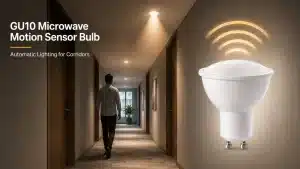
How Do Motion Sensor Lights Work?
Last updated on February 28, 2026
PIR vs Microwave Explained for Home and Commercial Use
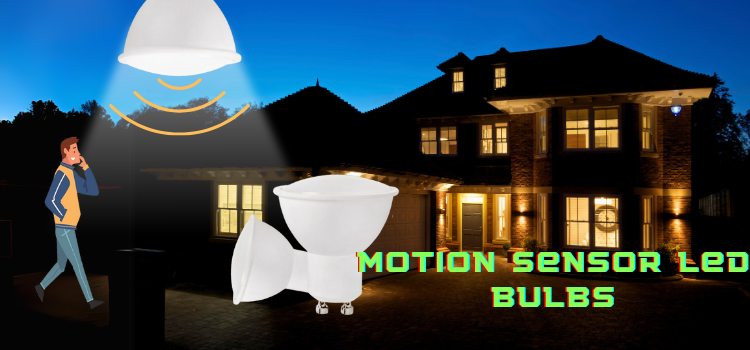
Motion sensor lights are an efficient and convenient lighting solution that automatically turn on when they detect movement within a specific range. Motion sensor LED lights are widely used for security, energy savings, and convenience in both residential and commercial environments.
By reducing unnecessary operating hours, motion sensor lighting can significantly lower electricity consumption—especially in low-traffic areas such as hallways, storage rooms, parking garages, and public spaces.
Below is a detailed explanation of how motion sensor lights work, their detection technologies, and where they are most effectively applied.
Types of Motion Sensors
Motion sensor lights typically use one of the following technologies:
1. Passive Infrared (PIR)
PIR is the most common technology used in PIR motion sensor lights.
- Detects infrared radiation emitted by warm objects (people, animals)
- Triggers the light when a change in heat signature is detected
- Typical detection angle: 90°–180°
- Typical detection range: 5–12 meters
- Energy-efficient and reliable for residential use
- Less likely to detect inanimate movement (e.g., trees)
PIR motion sensor LED lights are ideal for indoor applications and covered outdoor areas where false triggers must be minimized.
2. Microwave (MW)
Microwave motion sensor lights operate differently:
- Emit microwave pulses (typically around 5.8 GHz)
- Measure reflections from moving objects
- Offer 360° detection coverage in many ceiling installations
- Higher sensitivity compared to PIR
- Can detect motion through thin walls or glass
However, microwave motion sensor lights may trigger false alarms from:
- Moving branches
- Passing vehicles
- Structural vibrations
Due to their high sensitivity, microwave sensors are often used in commercial environments such as parking lots, warehouses, and stairwells.
3. Dual Technology
Dual-technology motion sensor lights combine PIR and microwave detection.
- Both sensors must confirm motion before activation
- Significantly reduces false triggers
- Improves reliability in high-traffic commercial areas
- Ideal for security-sensitive applications
Dual-technology motion sensor LED lighting is commonly specified in commercial projects where stability and accuracy are critical.
How Motion Sensor Lights Work
The operation of motion sensor LED lights involves four main components:
🔹 Sensor
The sensor detects movement using either:
- Infrared heat changes (PIR motion sensor)
- Reflected microwave signals (microwave motion sensor)
Detection sensitivity and coverage vary based on design specifications.
🔹 Control Electronics
The control module processes signals and determines:
- Sensitivity level
- Detection range
- Delay time (how long the light remains on)
- Daylight sensor threshold (lux setting)
In commercial installations, adjustable lux settings prevent activation during sufficient daylight, improving overall energy efficiency.
🔹 Power Source
Motion sensor LED lights can be:
- Hardwired (mains voltage)
- Battery-operated
- Solar-powered
For commercial outdoor installations, IP65-rated fixtures are recommended to ensure weather resistance and compliance with outdoor lighting safety standards.
🔹 Lighting Source
Most modern motion sensor lights use Technologie LED because of:
- Low power consumption
- Instant full brightness
- Long lifespan (25,000–50,000 hours typical)
- Minimal heat emission
- Reduced maintenance frequency
Compared to traditional halogen security lights, LED motion sensor lighting can reduce energy usage by 50–80%, depending on application.
Key Usage Scenarios
By activating only when needed, motion sensor lighting improves safety and reduces unnecessary energy consumption.
Home Security
- Driveways
- Garages
- Backyards
- Walkways
Outdoor motion sensor lighting deters intruders and improves nighttime visibility.
Entryways
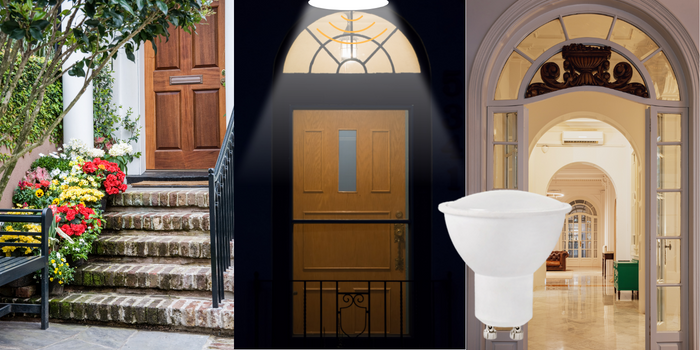
Motion sensor GU10 LED bulbs are highly practical in entryways.
- No need to search for switches
- Hands-free operation
- Ideal for nighttime use
- Suitable for rental properties and renovations
Hallways and Staircases
Automatic illumination reduces the risk of accidents.
Especially beneficial for:
- Children
- Elderly individuals
- Mobility-restricted residents
In commercial buildings, stairwell motion sensor lighting reduces energy consumption during off-peak hours.
Salles de bains
Motion sensor lighting:
- Prevents harsh overhead light exposure at night
- Improves safety during nighttime visits
- Supports better sleep cycles
- Reduces unnecessary daytime operation
Parking Lots and Public Spaces
In commercial applications, motion sensor LED lights:
- Enhance security
- Reduce energy waste
- Improve safety in low-traffic periods
- Lower operational costs
For distributors and contractors, motion sensor lighting systems can reduce annual lighting energy costs by 30–60%, depending on traffic frequency.
Basements and Storage Rooms
Ideal for rarely used spaces:
- Prevents lights from being left on
- Saves electricity
- Improves convenience
- Reduces maintenance cycles
Foire Aux Questions (FAQ)
What is the difference between PIR and microwave motion sensors?
PIR detects heat changes, while microwave sensors detect movement through reflected radio waves. Microwave sensors offer wider coverage but may be more sensitive to environmental interference.
Do motion sensor LED lights consume power when off?
Yes. Most motion sensor lights have standby consumption, typically between 0.3W–1W, depending on the sensor type.
Can motion sensor lights work during daylight?
Yes. Most modern motion sensor LED lights include a daylight sensor (lux adjustment) that prevents activation when ambient light exceeds a set threshold.
Are motion sensor lights suitable for commercial projects?
Yes. In commercial environments such as parking garages, corridors, and warehouses, motion sensor lighting improves energy efficiency and enhances safety.
Conclusion
Motion sensor LED lights combine:
- Sécurité
- Commodité
- Efficacité énergétique
- Coûts de maintenance réduits
They automatically provide illumination only when necessary, making them suitable for both residential and commercial environments.
From improving home security to optimizing operational costs in large commercial buildings, motion sensor LED lighting is a practical and sustainable solution.
For bulk projects, distributors and contractors should review:
- Detection angle specifications
- Standby power consumption
- IP protection rating
- Compatibility with existing infrastructure
Recommandation d'ingénierie B2B
If you are sourcing motion sensor GU10 bulbs or commercial motion sensor lighting fixtures, request:
- Detection range specifications
- Microwave frequency data (if applicable)
- Standby consumption values
- IP protection certifications
Our engineering team can provide technical documentation and application guidance to ensure reliable performance in both residential and commercial installations.
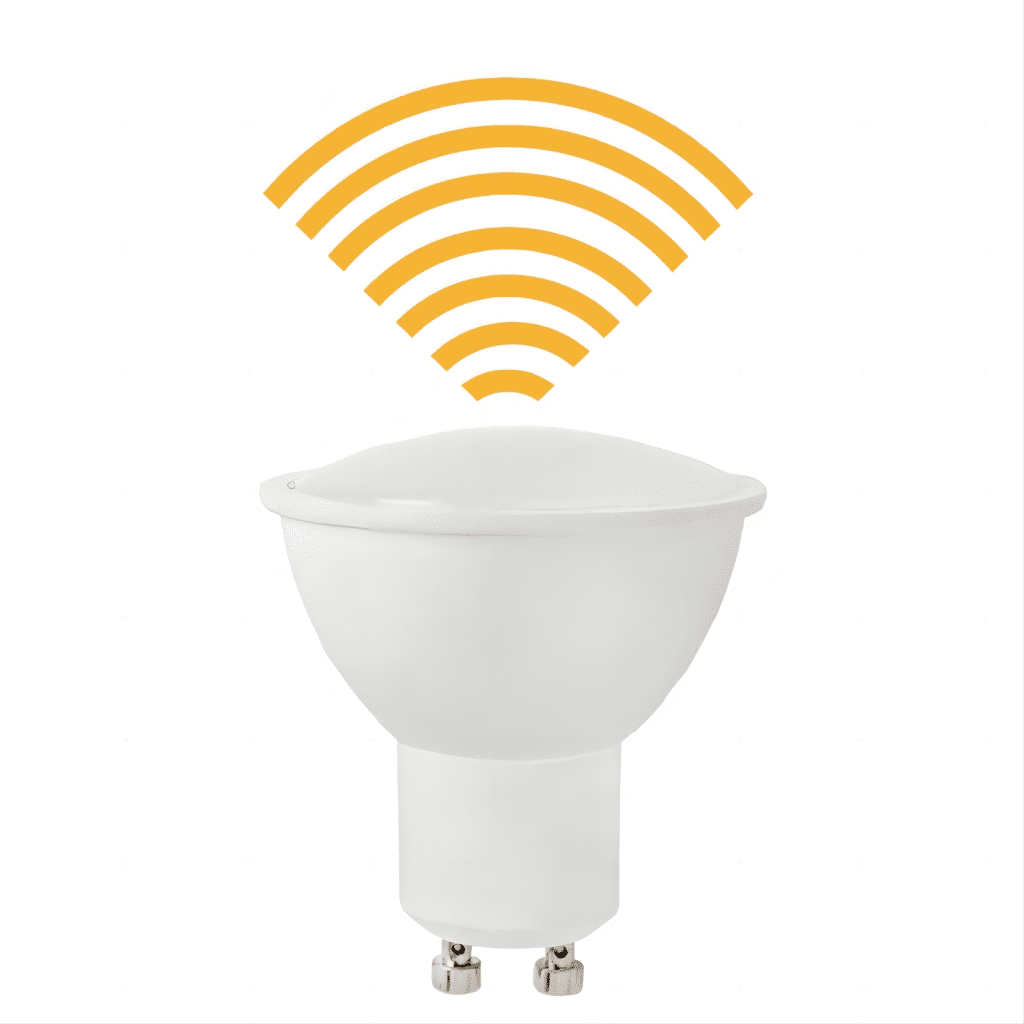
Teco Motion Sensor GU10 LED Bulb