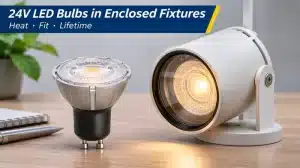
Can 24V LED Bulbs Be Used in Enclosed Fixtures? Heat, Fit and Lifetime Checks
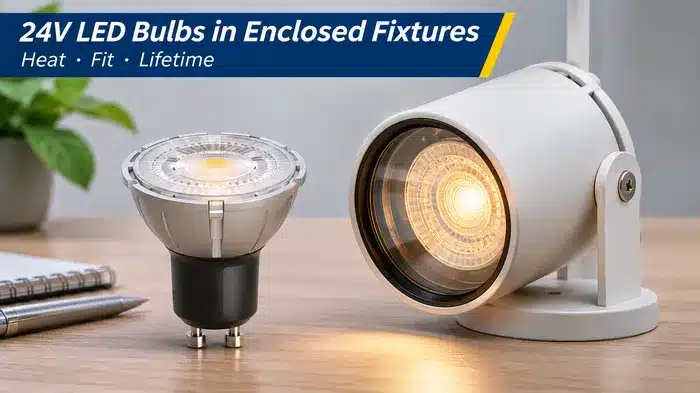
A 24V LED bulb may fit into an enclosed light fixture, switch on normally and appear to work without any immediate problem. That does not automatically mean the combination is suitable for long-term operation.
An enclosed fixture restricts airflow around the lamp. Heat generated by the LED and its internal electronics has fewer ways to escape, and the temperature inside the fitting can rise during continuous operation. This can affect light output, component reliability and service life.
Not every 24V LED bulb has the same thermal design. Some models are suitable for specific enclosed installations, while others are not recommended for this type of application. The voltage alone does not determine whether a lamp can be used in an enclosed fixture.
For lighting OEMs, brand buyers and maintenance teams, the decision should be based on the exact lamp specification and the final luminaire conditions. Check the manufacturer’s installation guidance, confirm mechanical and thermal compatibility, and test the complete assembly before approving it for production or installation.
Read the Enclosed-Fixture Rating for the Exact Lamp
Start with the manufacturer’s instructions for the exact bulb model.
A lamp marked as suitable for enclosed fixtures has been designed or evaluated for the relevant operating conditions. If the manufacturer states that a model is not suitable for enclosed fixtures, do not assume it will be acceptable simply because it operates at 24V or has a relatively low wattage.
The O8 model is one example of a product that is not recommended for enclosed-fixture applications. This restriction applies to that specific model. It should not be interpreted as a general prohibition on using all 24V LED bulbs in enclosed luminaires.
Different products have different thermal designs. Power consumption, LED layout, heatsink structure, internal driver components and available heat-dissipation paths all influence operating temperature. Two 24V GU10 bulbs with similar dimensions and wattage may therefore have different installation limitations.
When reviewing a product, check whether the manufacturer explicitly permits enclosed-fixture use, whether a maximum ambient operating temperature is specified, and whether there are restrictions on installation orientation, ventilation or continuous operation.
If the documentation does not clearly address the intended installation, ask the supplier before approving the combination. A general operating-temperature specification should not be treated as automatic approval for every enclosed fitting. The lamp’s rating and the actual luminaire conditions must be considered together.
Check Mechanical Fit and Thermal Clearance
A bulb fitting into a socket does not mean the complete installation is suitable. Mechanical compatibility, available space and heat dissipation all need to be considered.
Open, Semi-Enclosed and Fully Enclosed Fixtures
The first step is to identify the type of fixture in which the lamp will operate.
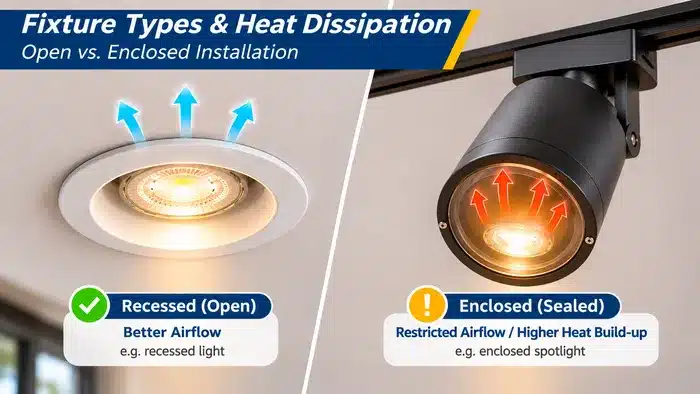
An open fixture allows air to circulate relatively freely around the bulb. A pendant with an exposed lamp or an open spotlight housing is a typical example. These installations generally provide a more direct path for heat to escape, although the lamp’s own temperature limits still apply.
A semi-enclosed fixture has a shade, cover or partial housing that restricts some airflow but leaves openings through which air can circulate. Decorative shades and fittings with open sides or gaps around the cover often fall into this category. Their thermal conditions depend on the size and position of the openings, the fixture material and the distance between the lamp and surrounding surfaces.
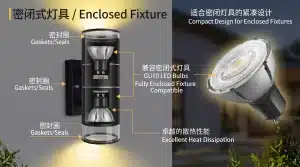
A fully enclosed fixture uses a glass cover, sealed housing or similar structure that significantly restricts air exchange. Heat can accumulate inside during extended operation, particularly in compact fittings or installations with limited ventilation.
These categories are useful for describing the installation environment, but they are not universal safety ratings. A semi-enclosed fitting is not automatically suitable for every LED bulb, and a fully enclosed fitting is not automatically prohibited for every model. The manufacturer’s instructions for the exact lamp remain the deciding reference.
For example, O8 is not recommended for enclosed-fixture use. Other 24V GU10, MR16 and A60 models need to be assessed against their own specifications rather than judged by the O8 restriction.
Clearance Around GU10, MR16 and A60 Lamps
Mechanical fit needs to be checked against the complete lamp body, not just the base.
For GU10 and MR16 bulbs, confirm the overall length and diameter, the position of the retaining ring and the clearance between the lamp and the fixture’s front cover. A bulb may lock into the holder but still press against a glass cover or sit too close to the surrounding housing. This can affect heat dissipation and make later removal difficult.
For A60 bulbs, pay particular attention to the depth of the shade and the position of the bulb inside it. A lamp tucked deep into a pendant may have limited space around its upper section and reduced side clearance. The shade can also block part of the light distribution, changing the amount of useful light reaching the room. Check that the bulb does not touch the shade or diffuser and that the fixture provides the clearance required by the lamp manufacturer.
Installation orientation matters as well. A bulb designed for one operating position should not automatically be assumed suitable for another. Confirm whether the manufacturer permits base-up, base-down or horizontal installation, especially when the fitting holds the lamp in a fixed position.
Thermal clearance should be checked against the manufacturer’s specified measurement points and limits. The air temperature inside the fixture is not necessarily the same as the temperature of the lamp housing or its electronic components. If a maximum case temperature is specified, measure it at the designated point rather than estimating it from the surrounding air. If the specification refers to ambient temperature, follow the corresponding measurement method.
For A60 installation examples and shade-clearance considerations, see our guide to [24V DC A60 Bulbs for Pendant and Table Lamps — INTERNAL LINK: ARTICLE 4].
Do not assume that an external driver eliminates the heat issue. An external power supply keeps the main power-conversion components outside the bulb, but the LED board and other components inside the lamp still generate heat during operation. The bulb’s own thermal design remains important.
For projects using an external 24V power supply, also check that its output voltage, capacity and operating arrangement match the connected lamps. Our guide to [Sizing a 24V DC Power Supply for LED Bulbs — INTERNAL LINK: ARTICLE 6] covers power supply selection in more detail.
Test the Lamp in the Intended Luminaire
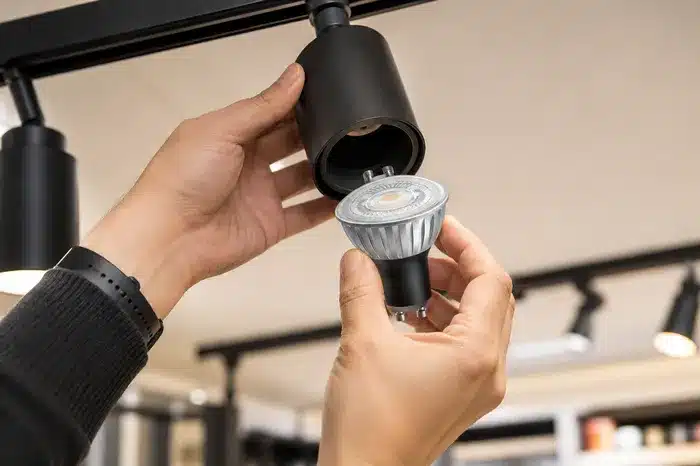
A bench test in open air cannot fully represent an enclosed installation.
The final fixture changes the thermal environment around the lamp. Its housing material, internal dimensions, cover, mounting position and ventilation all affect heat dissipation. A bulb that operates normally in an open holder may reach a different operating temperature when installed behind a glass cover or inside a compact enclosure.
For OEM projects and larger installations, test the actual lamp in the intended luminaire before approving the combination.
Use the production-version bulb, fixture, retaining parts and cover. Install the lamp in the intended orientation and make sure all covers and seals are in place. The test should also use the specified 24V power supply and operating configuration. If the project includes a dimmer or control system, reproduce the relevant operating settings.
The environmental conditions should reflect the expected application. A fitting installed in a warm ceiling void, hotel bathroom or other space with limited airflow may operate under different conditions from one tested in a cool room. A room-temperature test alone does not necessarily represent the highest expected operating temperature.
Allow the lamp to operate until the measured temperatures have stabilised. Record the elapsed operating time and temperature readings rather than relying on a quick check immediately after switching on. Measure the points specified by the manufacturer, which may include the ambient air inside the luminaire and designated case-temperature points on the lamp. Use suitable temperature sensors and keep their positions consistent between tests.
Temperature is only part of the evaluation. During operation, check for abnormal flickering, unexpected dimming, intermittent operation, visible discolouration or other changes in performance. Record the supply voltage, input power, ambient temperature and lamp orientation so the results can be compared later.
For fixtures containing multiple lamps or using different enclosure designs, test each relevant configuration. A result from one fitting should not automatically be applied to another with different dimensions, materials or ventilation.
The purpose of the test is to confirm that the complete lamp-and-luminaire combination operates within the manufacturer’s specified limits. Do not infer a particular internal failure mechanism from an isolated temperature reading or an unverified field complaint.
Separate Lifetime Claims from Warranty Terms
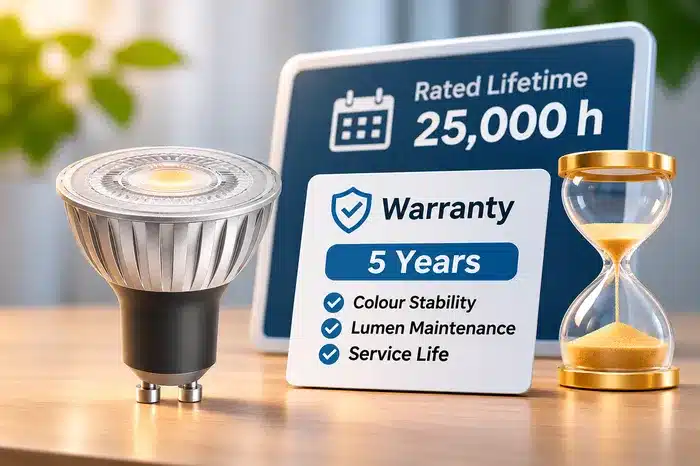
LED lifetime figures need to be read carefully, especially when the lamp will operate in a restricted thermal environment.
A product advertised with a rated life of 25,000 or 30,000 hours is not necessarily guaranteed to operate for that number of hours in every installation. The claim depends on the test conditions, operating temperature, drive conditions and the definition of end of life.
Some lifetime figures describe lumen maintenance rather than complete product operation. L70, for example, refers to the point at which light output has fallen to 70% of its initial value, when this is the stated lifetime criterion. It does not mean that the bulb stops working at that point.
Complete product failure is a different matter. An LED package may retain useful light output while another component in the finished bulb has already failed. Internal driver components, capacitors, electrical connections and other parts also contribute to the service life of the complete lamp.
This is why the projected lifetime of an LED chip should not be presented as a guaranteed lifetime for the finished bulb. When reviewing a product, ask whether the stated figure refers to the LED component or the complete lamp, and under which operating conditions it was established.
Warranty terms are separate from rated lifetime. A three-year warranty defines a contractual coverage period; it does not automatically mean the product has a three-year rated life or that every installation condition is covered.
Before approving a product, clarify the warranty period and its start date, whether coverage applies to the complete lamp or excludes particular components, and whether enclosed-fixture use is permitted. Also confirm any restrictions on ambient temperature, operating hours or installation orientation, together with the procedure for reporting failures and arranging replacements.
If a lamp is installed in an application excluded by the manufacturer’s instructions, warranty coverage may be affected. Confirm the permitted application and relevant responsibility boundaries in writing before the project moves into production.
Build a Maintenance and Replacement Plan
For commercial lighting projects, product selection should include a plan for what happens after installation.
A lamp may be suitable for the initial project but difficult to replace several years later if the exact model, optical specification or supplier arrangement is no longer available. This is particularly relevant for hotel chains, retail stores and other installations using large numbers of GU10, MR16 or A60 lamps.
Start by defining the approved replacement specification. Record the exact bulb model, base, dimensions, input voltage, wattage, CCT, beam angle and relevant performance requirements. Include any enclosed-fixture restrictions in the project documentation.
Where possible, identify an approved replacement SKU before the original product is discontinued. A replacement should not be selected by base type and wattage alone. Differences in dimensions, thermal design, light distribution and installation restrictions can affect compatibility with the existing luminaire.
Responsibility should also be clear. The product supplier should provide current specifications, installation restrictions and relevant test information. The luminaire manufacturer or project integrator should confirm compatibility with the final fixture design. The installer and maintenance team should follow the approved instructions and record the installed model, while the project owner or buyer should retain the replacement specifications and warranty records.
When a failure occurs, collect more information than simply recording that the lamp has stopped working. Record the model, batch number, installation location, operating hours if known, fixture type and environmental conditions. Photographs of the lamp, holder and enclosure can also help with the investigation.
This information helps distinguish an isolated product defect from an application or installation issue. It also gives the supplier and buyer a better basis for deciding whether a replacement, design change or additional test is needed.
For larger projects, keep the approved product specification, sample test results and agreed warranty arrangements together with the purchasing records. Our [24V DC LED Bulb Supplier Checklist — INTERNAL LINK: ARTICLE 10] will cover the information buyers should confirm when evaluating a supplier and approving products for a project.
For installations using external power supplies, include the power supply model and wiring arrangement in the maintenance record. Keeping the driver outside the bulb does not remove the need to monitor the lamp’s operating temperature or check the conditions inside the fixture.
A clear replacement plan reduces uncertainty when products need to be serviced and helps maintain consistent lighting performance across the installation.
Need Help Checking 24V LED Bulb Compatibility?
If you are selecting 24V LED bulbs for an enclosed luminaire, send Tecolite the fixture details before confirming the product.
A cross-sectional drawing or internal dimensions of the fixture, the bulb model and base type, the installation orientation and the expected ambient temperature will help establish the intended operating conditions. Details of the available clearance around the bulb, together with the power supply and control configuration, are also useful.
Photos of the fixture and its internal structure can help clarify the installation when drawings are unavailable.
Tecolite can review the intended application against the relevant product specifications and discuss whether a sample test is needed. For enclosed installations, confirming the lamp and luminaire combination before bulk production is a more reliable approach than relying on socket fit or wattage alone.