Beam Angle Guide for LED Spotlights: 15, 24, 36, 60 Degrees and Ceiling Height
Updated: September 4, 2026
Beam angle controls how wide a spotlight spreads light at a given distance. Narrow angles such as 15 or 24 degrees work for accent lighting and higher intensity on a small target. Medium angles such as 36 degrees are common for general spot lighting. Wider angles around 60 degrees are better for broader ambient coverage but produce lower center intensity.
| Angolo del fascio | Utilizzo tipico | Buyer note |
|---|---|---|
| 15 degrees | Small accent target, display point | Requires careful spacing and aiming |
| 24 degrees | Accent, retail display, higher ceilings | Good when punch and control matter |
| 36 degrees | General spotlighting | Common balance for GU10 and MR16 projects |
| 60 degrees | Wider room or shelf coverage | Check glare and center lux requirements |
For commercial projects, choose beam angle together with ceiling height, spacing, CRI, glare control, dimming type and fixture depth. Tecolite can help compare GU10, MR16, AR111 and ES111 beam options before sampling.
Last updated on March 2, 2026
Choosing the right beam angle can dramatically change how a space looks and feels. Whether you are installing spotlights in a home, retail store, or gallery, the beam angle determines how concentrated or wide the light appears.
If you need a quick answer:
- 15°–25° = Strong accent lighting (Best for: Par series)
- 36°–45° = Balanced task lighting (Best for: Gu10 series)
- 60°+ = Wide ambient lighting (Best for: Gu10 series)
- Ceiling height and distance to the surface matter more than room size
This guide explains what beam angle means, how it is measured, and how to choose the correct beam angle based on ceiling height, distance, and application.
What Is a Beam Angle?

Graphic displaying six types of light beams from hanging fixtures, labeled by angle ranges to distinguish narrow spot patterns from wide flood distributions.
A beam angle refers to the angle at which light spreads from a light source. It is measured in degrees (°).
Technically, beam angle is defined as:
The angle at which light intensity drops to 50% of the maximum center beam intensity.
In termini pratici:
- A smaller beam angle creates a focused spotlight effect.
- A larger beam angle creates broader, softer illumination.
Beam angle does not change brightness (lumens), but it changes how concentrated the light appears.
Why Beam Angle Matters in Lighting Design
Beam angle directly affects:
- Light distribution
- Brightness perception
- Shadow control
- Visual comfort
- Focal emphasis
Ad esempio:
- Museums use narrow beams to highlight artwork.
- Retail stores use mixed beam angles to create visual hierarchy.
- Living rooms use wider beams for comfortable ambient lighting.
Choosing the wrong beam angle can result in glare, dark spots, or insufficient coverage.
15° vs 36° vs 60°: What’s the Difference?
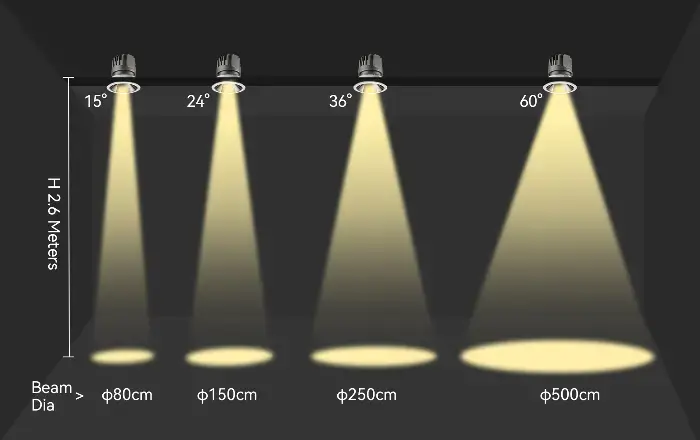
Comparative illustration of spotlight beam angles and their corresponding light spread diameters on the floor when installed at a 2.6-meter ceiling height.
Narrow Beam (15°–25°)
Ideale per:
- Accent lighting
- Opere d'arte
- Sculptures
- Display cabinets
Creates dramatic contrast and strong focus, ideal for precision highlighting of a specific object. Recommended: 15° LED PAR Light for precision spotlighting of artwork and display objects.
Medium Beam (36°–45°)
Ideale per:
- Kitchen islands
- Office desks
- Reading areas
- Scaffalature per la vendita al dettaglio
Offers a balance between focus and coverage. This is one of the most versatile beam angles for residential and commercial spaces. Recommended: 36° beam LED spot light / GU10 LED bulb for balanced task lighting in kitchens and workspaces.
Wide Beam (60°+)
Ideale per:
- General ambient lighting
- Soggiorni
- Camere da letto
- Corridoi
- Community spaces
Provides even light distribution and minimizes harsh shadows. Recommended: 60° wide beam LED bulb for general ambient lighting in living rooms and commercial spaces.
Beam Angle vs Distance: How Light Spread Changes
The farther the light source is from the target surface, the wider the beam spreads and the lower the light intensity per square meter.
Below is an approximate beam spread comparison:
| Angolo del fascio | Distance 2m | Distance 3m | Distance 4m |
|---|---|---|---|
| 15° | ~0.5m spread | ~0.8m | ~1.0m |
| 36° | ~1.2m | ~1.8m | ~2.4m |
| 60° | ~2.0m | ~3.0m | ~4.0m |
If your ceiling height is 3 meters:
- 15° creates a tight spotlight
- 36° creates defined task lighting
- 60° provides broad general lighting
For higher ceilings, narrower beams are often required to maintain focus.
What Beam Angle for 3m Ceiling?
For a 3-meter ceiling:
- Accent lighting → 15°–25°
- Dining table spotlight → 24°–36°
- General room lighting → 36°–60°
Using only wide beams in a 3m ceiling space may reduce visual depth. Layering beam angles often produces better results.
What Beam Angle for Kitchen?
In kitchens:
- Task areas (countertops) → 36°
- Decorative highlights → 24°
- General lighting → 60°
Too narrow a beam can create overly bright spots. Too wide can reduce task clarity.
What Beam Angle for Retail or Commercial Spaces?
Retail environments typically combine:
- 15°–24° for focal displays
- 36° for product shelving
- 60° for ambient fill lighting
Layered beam angles increase perceived brightness and improve product presentation.
How to Calculate Beam Spread
A simplified formula for beam spread diameter:
Spread Diameter ≈ 2 × Distance × tan(Beam Angle ÷ 2)
This formula helps estimate how wide the light will appear at a specific mounting height.
For practical use, charts and manufacturer photometric data provide more accurate guidance.
Common Beam Angle Mistakes
- Using only wide beams in high ceilings
- Ignoring mounting distance
- Overusing narrow beams in small rooms
- Not layering accent and ambient lighting
Professional lighting design often combines multiple beam angles to create depth and visual balance.
Domande frequenti
Is 36° good for living room lighting?
Yes. 36° works well for layered lighting but may need additional wider beams for full coverage.
Is 60° too wide?
Not for general ambient lighting. It provides even illumination but may lack dramatic focus.
What beam angle is best for spotlighting artwork?
Typically 15°–25° to maintain sharp focus.
Does beam angle affect brightness?
No. Brightness depends on lumens. Beam angle affects how concentrated the light appears.
Can I mix beam angles in one room?
Yes. Combining narrow and wide beams often creates the most visually appealing result.
Final Recommendation
Choosing the right beam angle depends on three factors:
- Mounting height
- Distance to target surface
- Desired visual effect
- Use narrow beams for emphasis.
- Use medium beams for task areas.
- Use wide beams for general lighting.
- Combine angles for professional results.
By understanding beam angle and its relationship to distance and application, you can dramatically improve lighting performance, comfort, and spatial perception.