How to Choose Dimmable LED Systems for Commercial & Hospitality Projects (Avoid Flicker and Driver Failure)
Last updated on March 2, 2026
Why Do Dimmable LED Projects Fail After Installation?
Many hotel, office, and retail projects experience LED flicker, limited dimming range, audible buzzing, or even driver failure shortly after commissioning.
In most cases, the LED itself is not the problem.
The real issue is system mismatch.
Dimmable LED technology is not simply a product feature. It is the interaction between:
- The LED light source
- The LED driver
- The dimmer or control protocol
- The electrical load and wiring environment
When these elements are not specified as a coordinated system, instability becomes predictable.
For commercial and hospitality buyers, understanding dimmable LED compatibility is more important than simply choosing a “dimmable” product.
This guide explains how dimmable LED systems work, why flicker occurs, and how to specify reliable solutions that perform consistently in real-world projects.
What Is Dimmable LED Technology?

Schematic illustration of a dimmable LED lighting setup, featuring the LED light source connected to a driver, dimmer control, and the surrounding electrical environment.
Dimmable LED technology allows lighting output to adjust smoothly — typically from 100% down to 1–10% — without visible flicker, noise, or color instability.
Unlike halogen lamps, LEDs do not dim naturally when voltage drops. LEDs are current-driven devices, meaning brightness must be controlled electronically by the driver.
This makes driver quality and dimmer compatibility critical.
A functional dimmable LED system includes four interdependent components:
| Component | Role | Risk if Mismatched |
|---|---|---|
| LED source | Emits light | Color shift, instability |
| Alimentatore LED | Regulates current | Flicker, dropout, failure |
| Dimmer/controller | Sends control signal | Compatibility issues |
| Electrical environment | Load, wiring, voltage | Noise and instability |
Failure in any one area compromises the entire system.
TRIAC, 0–10V, DALI: Which Dimming Method Is Best?
One of the most common specification mistakes is assuming all dimming methods behave the same.
They do not.
Phase-Cut (TRIAC) Dimming
- Common in retrofit projects
- Uses existing AC wiring
- Sensitive to low load conditions
- Most flicker complaints originate here
TRIAC dimming works well when the driver is specifically designed and tested for compatibility. However, mixing brands often causes instability.
Trailing-Edge (ELV) Dimming
- More LED-friendly than leading-edge
- Lower audible noise
- Better stability at low levels
Dimmeraggio 0-10V
- Common in commercial systems
- Linear and stable control
- Requires additional control wiring
DALI (Digital Addressable Lighting Interface)
- Used in smart buildings
- Addressable, programmable control
- Higher system complexity
Internal PWM Control
High-quality drivers use high-frequency PWM (pulse-width modulation) internally to regulate output.
Drivers operating above 1 kHz significantly reduce visible flicker.
The correct dimming method depends on the application scale, wiring conditions, and project budget — not on trend or marketing claims.
High-frequency PWM dimming significantly reduces visible flicker.
Why Do Dimmable LEDs Flicker?
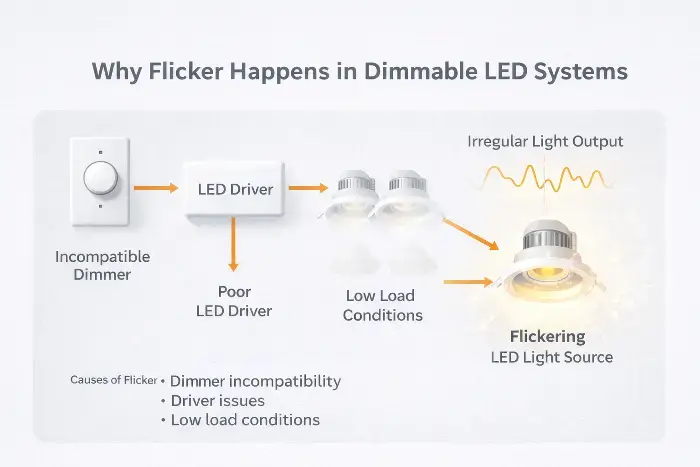
Infographic illustrating why flicker occurs in dimmable LED lighting systems, highlighting dimmer incompatibility and low-load conditions that lead to unstable light output.
Flicker is the most frequent complaint in commercial dimming installations.
According to IEEE flicker guidelines, visible modulation can cause eye strain, headaches, and reduced productivity in commercial environments.
Flicker is rarely random. It usually results from one of these conditions:
| Causa | Perché Succede |
|---|---|
| Dimmer incompatibility | Dimmer not designed for LED loads |
| Low load conditions | Too few fixtures per dimmer |
| Poor driver design | Weak current regulation |
| Missing neutral wiring | Unstable control reference |
| Electrical interference | Noise from HVAC or heavy equipment |
In retrofit hospitality projects, low load is especially common. Dimmers originally designed for 200W halogen circuits may struggle when driving only 30W of LED load.
The result is unstable dimming behavior at lower levels.
Learn more about IEEE flicker measurement standards in our LED flicker technical guide.
The LED Driver: The Most Critical Component
More than half of field failures in LED luminaires are related to driver issues rather than LED chips.
A high-quality dimmable LED driver determines:
- Minimum stable dimming level
- Smoothness of dimming curve
- Prestazioni di sfarfallio
- Thermal stability
- Coerenza del lotto
Key characteristics of reliable dimmable drivers include:
- 1–100% dimming capability
- High-frequency PWM control
- Thermal protection
- Verified dimmer compatibility lists
- Controlled component sourcing
For commercial buyers managing repeat projects, driver consistency between production batches is essential to avoid re-testing costs.
LED driver reliability plays a major role in commercial failures.
Color Stability Under Dimming: Often Overlooked
Brightness control is not the only concern.
Low-quality dimmable LEDs often show:
- Color temperature shift
- Reduced CRI performance
- Uneven output between fixtures
In hospitality environments, this directly affects guest perception.
Fixed CCT dimmable LEDs typically remain stable when paired with high-quality drivers. Tunable white systems offer greater flexibility but require more advanced control logic.
When specifying dimmable LED systems for hotels or premium retail, color behavior under low dimming levels should be verified — not assumed.
How Much Energy Do Dimmable LEDs Really Save?
Energy savings are often overstated in marketing.
In practical commercial environments, dimmable LED systems combined with occupancy or daylight sensors typically reduce lighting energy use by 20–40%.
However, the larger financial advantage often comes from:
- Reduced thermal stress
- Longer driver lifespan
- Lower maintenance frequency
- Improved user comfort
Over a 10-year lifecycle, well-specified dimmable systems often deliver lower total cost of ownership compared to non-dimmable alternatives — especially in high-usage environments like hotels and conference spaces.
Common Specification Mistakes in Commercial Projects
Many dimming issues originate during specification, not installation.
1. Asking “Is It Dimmable?” Without Defining Conditions
Dimmable for which dimmer?
At what load?
Down to what minimum level?
Without this clarity, instability is likely.
2. Ignoring Circuit Load Calculations
LED loads behave differently from halogen loads. Dimmer minimum load thresholds must be respected.
3. Allowing Driver Substitution
Uncontrolled driver changes between production batches can create inconsistent dimming behavior.
4. Over-Specifying Simple Areas
Not every space requires deep dimming or tunable white systems. Complexity increases risk if not justified.
Practical Buyer Checklist for Reliable Dimmable LED Projects
Before confirming orders, commercial buyers should verify:
- Which dimmers are used on-site?
- What is the minimum stable dimming level?
- How many fixtures per circuit?
- Has flicker been measured?
- Are drivers locked for repeat orders?
- Is documentation available for compliance?
Professional suppliers should provide test reports and compatibility lists — not generic “dimmable” claims.
Where Dimmable LED Technology Makes the Most Sense

Visual showcase of dimmable LED technology enhancing atmospheres in hotels, restaurants, event spaces, and retail environments through soft, adjustable lighting.
High-Value Applications
- Hotels and hospitality
- Restaurants and lounges
- Meeting and conference rooms
- Retail display environments
- Residential developments
Lower Priority Applications
- Fixed-output corridors
- Utility rooms
- Back-of-house areas
Strategic deployment — rather than universal installation — typically delivers the strongest ROI.
Frequently Asked Questions About Dimmable LED Systems
Why do dimmable LEDs flicker at low levels?
Usually due to dimmer incompatibility or insufficient circuit load. Driver quality also plays a major role.
Are all LED bulbs compatible with TRIAC dimmers?
No. Many are labeled “dimmable” but have not been tested with specific dimmer models.
What is the minimum dimming level for commercial LEDs?
High-quality drivers typically achieve 1–10% stable dimming without flicker.
Is 0–10V better than TRIAC for commercial projects?
0–10V generally offers more stable control in new-build commercial systems, but requires separate control wiring.
How can flicker be tested?
Flicker can be measured using specialized photometric instruments or high-speed cameras to assess modulation percentage and frequency.
The Future of Dimmable LED Technology
The dimming market continues to evolve toward:
- Higher-frequency PWM drivers
- Improved thermal management in compact formats
- Standardized compatibility testing
- Deeper smart building integration
Future lighting standards increasingly evaluate flicker performance and human comfort — not just lumen output.
Conclusione
Dimmable LED technology delivers measurable value in commercial and hospitality projects when treated as a system — not as a standalone feature.
Reliable performance depends on:
- Correct dimming method selection
- High-quality driver design
- Verified compatibility testing
- Controlled specification and sourcing
For B2B buyers, success is not determined by whether a product is labeled “dimmable,” but by how the complete dimming system is specified, tested, and implemented in the field.
When these elements are aligned, dimmable LED systems provide stable performance, improved ambience, energy savings, and long-term reliability.