
Understanding GU10 LED Certifications – CE, RoHS & Energy Labels
GU10 LED bulbs placed on the European Union market must comply with a defined set of regulatory requirements covering electrical safety, environmental protection, and energy efficiency transparency. For importers, brand owners, wholesalers, and project buyers, these certifications are not optional references—they are legal prerequisites for market access.
CE marking, RoHS compliance, and EU energy labeling together form the minimum regulatory framework for GU10 LED lamps in the EU.
They are actively enforced through customs controls, national market surveillance authorities, and post-market audits. Failure to comply can result in shipment detention, forced product withdrawal, administrative penalties, or reputational damage across B2B supply chains.
This article explains what each certification actually covers, what it does not cover, how regulatory requirements have evolved, and how professional buyers can verify compliance in real sourcing scenarios. The focus is practical and regulatory—not marketing-driven.
Why Do Certifications Matter for GU10 Buyers?
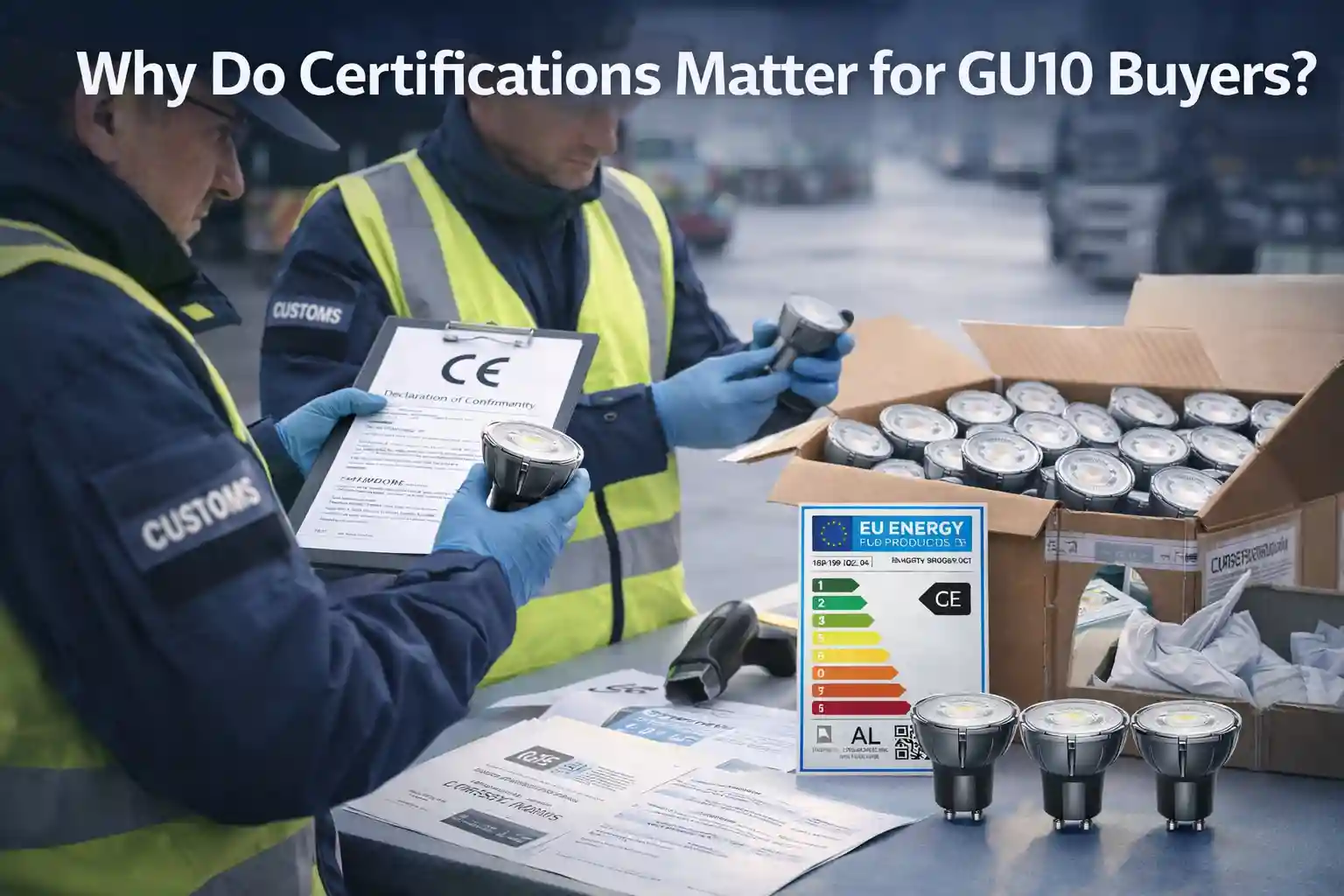
Customs workers examining energy-efficient GU10 bulbs, with a clipboard showing certifications and energy labels on the packaging.
For GU10 LED bulbs, certifications are legal conditions of sale, not quality endorsements.
Within the EU, lighting products are subject to continuous market surveillance under the EU Product Safety and Market Surveillance framework. Compliance issues are frequently identified after products have entered the market, rather than at the point of purchase. This exposes importers and distributors to downstream legal and financial risk.
Certifications matter because they:
- establish legal EU market access
- define regulatory responsibility and liability
- protect downstream buyers such as hotels, offices, and public-sector projects
- enable participation in tenders requiring documented compliance
- reduce exposure during inspections, audits, and recalls
Typical risks when certification compliance is incomplete
According to European Commission market surveillance data, lighting products consistently rank among the most frequently flagged electrical goods. Common consequences include:
- customs detention or refusal of release
- mandatory product withdrawal from the market
- administrative fines under national enforcement laws
- project delays and contract disputes
- long-term reputational damage in B2B channels
What certifications actually solve for professional buyers
| Certification | Primary Purpose | Practical Buyer Value |
|---|---|---|
| CE marking | Electrical safety & EMC compliance | Legal right to place products on EU market |
| RoHS | Restriction of hazardous substances | Environmental and recycling compliance |
| Energy label | Energy efficiency transparency | Procurement comparison & regulatory alignment |
For professional buyers, certification verification is a risk-management step, not a branding preference.
What Does CE Certification Cover for GU10 LEDs — and What Doesn’t It?

Illustration of CE certification coverage for GU10 LEDs, featuring a conformity declaration, safety checkboxes, and the LED bulb itself.
CE marking is the mandatory conformity marking for GU10 LED bulbs sold in the European Union.
What CE certification covers
For GU10 LED lamps, CE marking demonstrates conformity with applicable EU directives, typically including:
- Low Voltage Directive (2014/35/EU) – electrical safety
- EMC Directive (2014/30/EU) – electromagnetic compatibility
Compliance indicates that the product:
- operates safely at mains voltage
- does not present fire or electric shock hazards
- does not generate unacceptable electromagnetic interference
CE compliance is supported by a Declaration of Conformity (DoC) and corresponding technical documentation, including test reports to harmonized EN standards.
Legal responsibility for CE compliance
In the EU, legal responsibility lies with the manufacturer or the importer placing the product on the market.
Downstream distributors may also bear responsibility if they modify products or place them under their own brand.
A CE logo printed on packaging does not transfer liability away from the economic operator responsible for market placement.
What CE certification does not cover
CE marking does not certify:
- energy efficiency
- product lifetime or lumen maintenance
- color consistency or photometric quality
- environmental substance restrictions
It also does not guarantee manufacturing consistency or long-term reliability.
Because CE is largely self-declared, professional buyers should always verify supporting documentation rather than relying on visual marking alone.
Practical CE verification checklist
| Item | What to Verify |
|---|---|
| Declaration of Conformity | Correct directives and product identification |
| Test reports | EN 60598 / EN 62560 / EMC standards |
| Product labeling | Proper CE logo format and placement |
CE marking should be treated as the minimum legal baseline, not a comprehensive quality assurance system.
Why Does RoHS Compliance Matter for GU10 LED Bulbs?

Arrangement of GU10 LED bulbs next to papers displaying CE conformity, green RoHS symbol, and energy efficiency labels with checkmarks.
RoHS compliance is legally mandatory for GU10 LED bulbs sold in the EU.
What RoHS regulates
The RoHS Directive (2011/65/EU and amendments) restricts hazardous substances including:
- lead (Pb)
- mercury (Hg)
- cadmium (Cd)
- hexavalent chromium (Cr⁶⁺)
- specific flame retardants and plasticizers
In LED lamps, these substances are commonly associated with:
- solder joints
- electronic components
- phosphor materials and PCB assemblies
Why RoHS matters in real market conditions
Non-compliant GU10 LED bulbs may:
- violate EU environmental law
- block participation in green building and public projects
- create liability during recycling and disposal
- trigger recalls during post-market inspections
In practice, RoHS non-compliance is frequently identified during market surveillance audits rather than at customs, increasing recall risk and financial exposure.
RoHS compliance also supports alignment with downstream obligations under WEEE and circular economy regulations.
What buyers should request from suppliers
| Document | Scopo |
|---|---|
| RoHS declaration | Supplier compliance confirmation |
| Material composition data | Substance threshold verification |
| Test reports (if required) | Independent laboratory confirmation |
RoHS compliance cannot be substituted by CE marking and must be verified independently.
How Have EU Energy Labels for GU10 Bulbs Changed?

Side-by-side view of old and new EU energy labels for GU10 light bulbs, illustrating the simplified rating system introduced in 2021.
EU energy labeling for lighting products was fundamentally revised in 2021.
Key changes in the new energy label system
The former A+++ to G scale was replaced by a rescaled A to G system, significantly tightening efficiency thresholds.
Key updates include:
- stricter lumen-per-watt requirements
- mandatory registration in the EPREL database
- QR codes linking to official product records
Old vs. new energy label comparison
| Aspect | Old System | New System |
|---|---|---|
| Scale | A+++ → G | A → G |
| Metric | Relative efficiency | Lumens per watt |
| Database | Optional | Mandatory (EPREL) |
| Transparency | Limited | Alto |
Many GU10 LED bulbs previously rated A+ or A++ are now classified as C, D, or E, despite unchanged performance.
Common procurement misconception
A lower energy class under the new system does not indicate inferior product quality.
It reflects stricter regulatory thresholds designed to future-proof efficiency standards.
Practical checks for buyers
- verify correct label format
- confirm EPREL registration number
- ensure consistency between label, datasheet, and packaging
Selling GU10 bulbs with outdated energy labels is a frequent cause of enforcement action.
Minimum Certification Requirements for GU10 LED Bulbs in the EU

Illustration of essential EU certifications for GU10 LED bulbs, including CE, RoHS, and EPREL standards with a sample bulb and energy tag.
At minimum, GU10 LED bulbs sold in the EU must comply with:
| Requirement | Mandatory | Scopo |
|---|---|---|
| CE marking | Sì | Electrical safety & EMC |
| RoHS | Sì | Environmental protection |
| Energy label + EPREL | Sì | Energy efficiency transparency |
Additional requirements, such as Ecodesign regulations, may apply depending on product type and regulatory updates.
Common Misconceptions About GU10 LED Certifications
| Misconception | Reality |
|---|---|
| CE equals quality | CE only confirms safety & EMC compliance |
| RoHS is optional | RoHS is legally mandatory |
| Energy labels are marketing | Energy labels are regulated legal documents |
| Old labels are acceptable | Outdated labels are non-compliant |
Clarifying these points early prevents costly sourcing errors.
Practical Sourcing Recommendations for B2B Buyers
Certification verification should be embedded into procurement workflows.
Recommended verification process
| Stage | Action |
|---|---|
| Supplier selection | Request DoC, RoHS declaration, EPREL ID |
| Pre-shipment | Verify label artwork and documentation consistency |
| Post-delivery | Archive compliance files for audits (≥10 years) |
For large-volume or high-risk projects, third-party testing may be appropriate.
This guidance is particularly relevant for importers, private-label brands, project distributors, and engineering contractors supplying EU-regulated markets.
Conclusione
GU10 LED certifications—CE for safety, RoHS for environmental compliance, and EU energy labels for efficiency transparency—form the legal foundation for EU market access.
For professional buyers, understanding what each certification covers, where its limits lie, and how to verify compliance in practice is essential to reducing regulatory risk, protecting supply chains, and delivering compliant lighting projects with confidence.



 English
  French
  German
  Italian
  Spanish
  Portuguese
  Arabic
  Russian
  Japanese
  Chinese