Introduction: Why LED Dimming Issues Become Project Risks
In hotels, offices, and commercial renovations, LED dimming problems rarely appear during product selection. They surface during commissioning, handover, or early operation—when schedules are tight and changes are expensive.
Flicker, unstable dimming, or sudden shutdowns are not just technical annoyances. They often lead to:
- delayed project handover
- repeated site visits and labor overruns
- rejected inspections or client complaints
- increased RMAs and warranty disputes
Most of these failures are not caused by poor LED quality, but by dimmer-related mistakes made early in the project.
This article explains the most common LED dimmer mistakes seen in commercial projects, why they happen, and how professional buyers and contractors can avoid them before they turn into cost and reputation risks.
Mistake 1: Choosing Incompatible LED Dimmers
What Goes Wrong on Real Projects
During hotel ballroom or conference room retrofits, incompatible dimmers often cause erratic dimming behavior or complete system failure. Troubleshooting usually happens after ceilings are closed, scaffolding is removed, and schedules are locked.
What should be a simple commissioning step turns into days of investigation and rework.
Why This Happens (Engineering Reality)
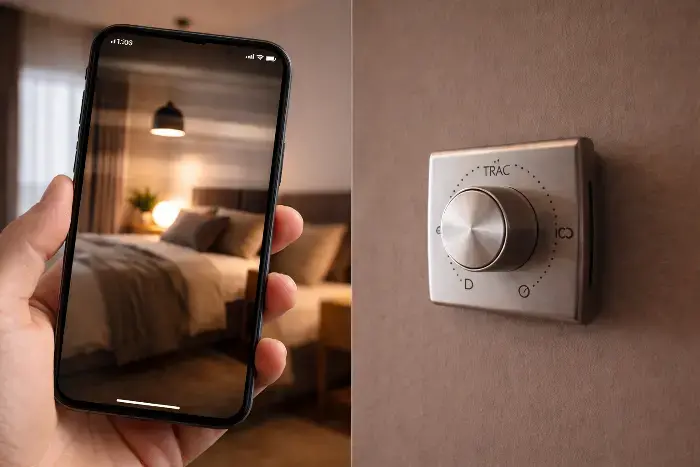
Traditional dimmers were designed for resistive halogen loads. LED drivers, however, present non-linear electrical behavior, including low power factor and inrush current.
- Leading-edge dimmers (TRIAC-based) can introduce voltage spikes
- Trailing-edge dimmers (IGBT-based) provide smoother control for LED drivers
When the dimmer’s output waveform does not match the driver’s input design, instability appears across the dimming range.
Business Impact
Incompatible dimmer selection is one of the leading causes of on-site commissioning delays.
In large hospitality projects, this often results in repeated ceiling access, increased labor cost, and late-stage product replacement.
How to Avoid It
- Confirm the LED driver’s supported dimming protocol
- Prefer trailing-edge or verified universal dimmers
- Request tested dimmer–lamp compatibility lists from suppliers
- For mixed loads, require adjustable low-end trim capability
Mistake 2: Installation Errors That Cause Flicker
What Contractors Encounter On Site
Flicker frequently appears during corridor or guestroom handover testing. Even when the lamps and dimmers are technically compatible, unstable light output causes failed inspections and client rejection.
In operational buildings, this often leads to night-time repairs and guest complaints.
Why This Happens (Engineering Reality)
Common causes include:
- missing neutral wire at the dimmer location
- improper grounding
- electromagnetic interference from nearby systems
- mismatch between dimmer signal and driver PWM behavior
Without a stable reference voltage, LED drivers respond inconsistently, especially at low dimming levels.
Business Impact
Flicker-related callbacks typically increase electrical labor cost by 20–30% in retrofit projects and create ongoing maintenance exposure.
How to Avoid It
- Verify neutral wire availability during rough-in
- Avoid sharing circuits with high-interference equipment
- Use dimmers with built-in filtering for dense installations
- In large zones, consider 0–10V or centralized control systems
Mistake 3: Ignoring LED Dimmer Wattage Limits

What Happens During Commissioning
Overloaded dimmers may appear functional during initial testing, then shut down under sustained operation. Thermal trips often occur after hours or days, forcing circuit redesign after installation.
Why This Happens (Engineering Reality)
Dimmer wattage ratings reflect thermal dissipation limits, not just nominal load.
LED projects must account for:
- driver inrush current
- continuous operation derating
- heat accumulation in wall boxes
Exceeding safe limits—even by 15–20%—significantly shortens dimmer lifespan.
Business Impact
Thermal overload issues frequently lead to full circuit redesigns, stranded labor, and delayed approvals—especially costly in multi-floor commercial buildings.
How to Avoid It
- Calculate connected load with a 0.8 derating factor
- Distribute fixtures across multiple dimmers
- Select dimmers with thermal protection and capacity headroom
- Oversize dimmers where access is difficult
Why These Mistakes Keep Repeating in Commercial Projects
Most dimmer problems are not caused by negligence. They occur because:
- dimmers are treated as accessories, not system components
- LED drivers vary widely across suppliers
- compatibility testing is skipped under schedule pressure
LED dimming is a system-level issue, not a product-level one.
Projects that succeed treat dimmers, drivers, and lamps as a verified combination, not interchangeable parts.
A Practical Checklist Before Finalizing LED Dimming Systems
Before locking specifications or releasing purchase orders, professional buyers should confirm:
- Has the dimmer been tested with the selected LED driver?
- Is the minimum and maximum load clearly defined?
- Is a neutral wire available at every dimmer point?
- Has thermal derating been considered?
- Who carries responsibility if flicker appears after handover?
If these questions cannot be answered clearly, the project carries avoidable risk.
Conclusion: Dimmer Mistakes Are Preventable — and Expensive When Ignored
LED dimming failures rarely come from one dramatic error. They result from small compatibility assumptions compounded across dozens or hundreds of fixtures.
Projects that address dimmer selection early experience:
- smoother commissioning
- fewer RMAs
- lower lifetime maintenance cost
- better client satisfaction
The difference is not better products—it is better system thinking.
Teco supports B2B buyers, contractors, and project teams by validating LED lamp and dimmer compatibility before mass deployment.
We help with:
- dimmer–driver compatibility verification
- load calculation and derating support
- pre-production simulation for hospitality and commercial projects
- reducing on-site risk and post-installation callbacks
メール: [email protected]
ウェブサイト: www.tecolite.com
If you are planning a dimmable LED project and want to avoid late-stage failures, share your fixture list and dimming method.
We will help you confirm what works—before it becomes a site problem.