GU10 LED認証の理解 – CE、RoHS、エネルギーラベル
欧州連合市場に投入されるGU10 LED電球は、以下をカバーする定義された一連の規制要件に準拠しなければならない: 電気安全、環境保護、エネルギー効率の透明性. 。輸入業者、ブランド所有者、卸売業者、プロジェクトバイヤーにとって、これらの認証は任意の参考資料ではなく、 市場参入の法的前提条件.
CEマーキング、RoHS準拠、およびEUエネルギーラベリングは、EUにおけるGU10 LEDランプの最低限の規制枠組みを共同で形成する。.
これらは税関管理、国内市場監視当局、および市場投入後の監査を通じて積極的に実施される。不遵守は、貨物の差し止め、製品の強制撤去、行政罰、またはB2Bサプライチェーン全体での評判の低下につながる可能性がある。.
本記事では 各認証が実際に何をカバーし、何をカバーしないか、規制要件がどのように進化してきたか、そして専門的な買い手が実際の調達シナリオで準拠をどのように確認できるかを説明する. 焦点は実用的かつ規制に基づくものであり、マーケティング主導ではありません。.
GU10の買い手にとって認証が重要な理由
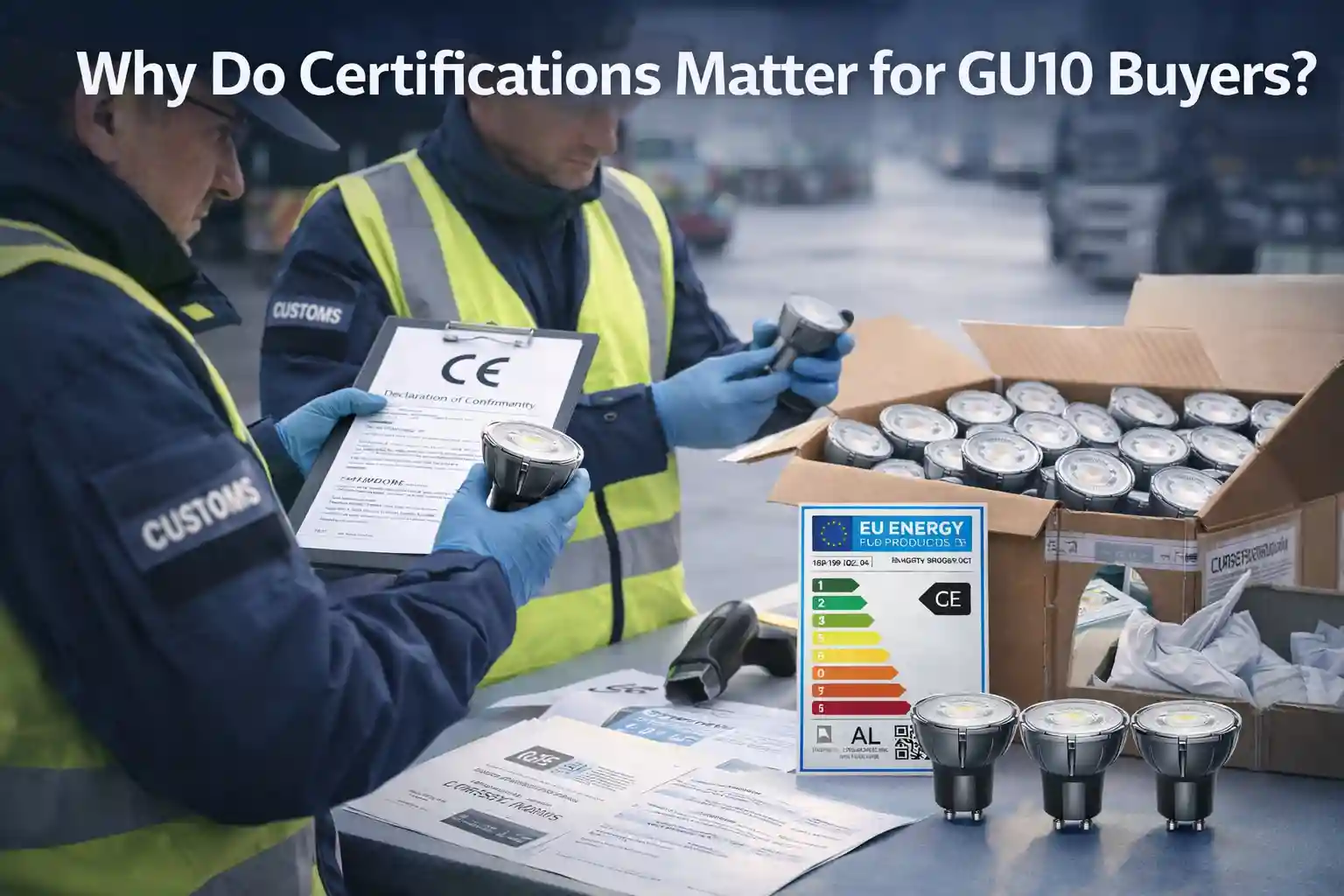
税関職員がエネルギー効率の高いGU10電球を検査し、クリップボードには包装上の認証とエネルギーラベルが表示されている。.
GU10 LED電球の場合、認証は 販売の法的条件, 品質保証ではありません。.
EU内では、照明製品はEU製品安全・市場監視枠組みの下で継続的な市場監視の対象となります。コンプライアンスの問題は頻繁に特定されます 製品が市場に投入された後, 購入時点ではなく、輸入業者や流通業者は下流の法的・財務的リスクにさらされます。.
認証が重要な理由:
- 確立する EU市場への法的アクセス
- 定義する 規制上の責任と義務
- ホテル、オフィス、公共部門プロジェクトなどの下流バイヤーを保護
- 文書化されたコンプライアンスを必要とする入札への参加を可能にする
- 検査、監査、リコール中の露出を減らす
認証準拠が不完全な場合の典型的なリスク
欧州委員会の市場監視データによると、照明製品は一貫して最も頻繁にフラグが立てられる電気製品の一つである。一般的な結果には以下が含まれる:
- 税関での抑留または放行拒否
- 市場からの強制製品回収
- 国内執行法に基づく行政罰
- プロジェクトの遅延と契約紛争
- B2Bチャネルでの長期的な評判損害
プロフェッショナルバイヤーにとって認証が実際に解決すること
| 認証 | 主な目的 | 実用的なバイヤー価値 |
|---|---|---|
| CEマーキング | 電気安全とEMC準拠 | EU市場での製品販売の法的権利 |
| RoHS | 有害物質の制限 | 環境およびリサイクルコンプライアンス |
| エネルギーラベル | エネルギー効率の透明性 | 調達比較と規制適合 |
プロフェッショナルバイヤーにとって、認証確認は リスク管理ステップ, ブランディングの好みではありません。.
GU10 LEDのCE認証は何をカバーし、何をカバーしないのか?

Illustration of CE certification coverage for GU10 LEDs, featuring a conformity declaration, safety checkboxes, and the LED bulb itself.
CE marking is the mandatory conformity marking for GU10 LED bulbs sold in the European Union.
What CE certification covers
For GU10 LED lamps, CE marking demonstrates conformity with applicable EU directives, typically including:
- Low Voltage Directive (2014/35/EU) – electrical safety
- EMC指令(2014/30/EU) – electromagnetic compatibility
Compliance indicates that the product:
- operates safely at mains voltage
- does not present fire or electric shock hazards
- does not generate unacceptable electromagnetic interference
CE compliance is supported by a Declaration of Conformity (DoC) and corresponding technical documentation, including test reports to harmonized EN standards.
Legal responsibility for CE compliance
In the EU, legal responsibility lies with the manufacturer or the importer placing the product on the market.
Downstream distributors may also bear responsibility if they modify products or place them under their own brand.
A CE logo printed on packaging does not transfer liability away from the economic operator responsible for market placement.
What CE certification does not cover
CE marking does not certify:
- エネルギー効率
- product lifetime or lumen maintenance
- color consistency or photometric quality
- environmental substance restrictions
It also does not guarantee manufacturing consistency or long-term reliability.
Because CE is largely self-declared, professional buyers should always verify supporting documentation rather than relying on visual marking alone.
Practical CE verification checklist
| 項目 | What to Verify |
|---|---|
| 適合宣言 | Correct directives and product identification |
| Test reports | EN 60598 / EN 62560 / EMC standards |
| Product labeling | Proper CE logo format and placement |
CE marking should be treated as the minimum legal baseline, not a comprehensive quality assurance system.
Why Does RoHS Compliance Matter for GU10 LED Bulbs?

Arrangement of GU10 LED bulbs next to papers displaying CE conformity, green RoHS symbol, and energy efficiency labels with checkmarks.
RoHS compliance is legally mandatory for GU10 LED bulbs sold in the EU.
What RoHS regulates
The RoHS Directive (2011/65/EU and amendments) restricts hazardous substances including:
- lead (Pb)
- mercury (Hg)
- cadmium (Cd)
- hexavalent chromium (Cr⁶⁺)
- specific flame retardants and plasticizers
In LED lamps, these substances are commonly associated with:
- solder joints
- electronic components
- phosphor materials and PCB assemblies
Why RoHS matters in real market conditions
Non-compliant GU10 LED bulbs may:
- violate EU environmental law
- block participation in green building and public projects
- create liability during recycling and disposal
- trigger recalls during post-market inspections
In practice, RoHS non-compliance is frequently identified during market surveillance audits rather than at customs, increasing recall risk and financial exposure.
RoHS compliance also supports alignment with downstream obligations under WEEE and circular economy regulations.
What buyers should request from suppliers
| Document | 目的 |
|---|---|
| RoHS declaration | Supplier compliance confirmation |
| Material composition data | Substance threshold verification |
| Test reports (if required) | Independent laboratory confirmation |
RoHS compliance cannot be substituted by CE marking and must be verified independently.
How Have EU Energy Labels for GU10 Bulbs Changed?

Side-by-side view of old and new EU energy labels for GU10 light bulbs, illustrating the simplified rating system introduced in 2021.
EU energy labeling for lighting products was fundamentally revised in 2021.
Key changes in the new energy label system
The former A+++ to G scale was replaced by a rescaled A to G system, significantly tightening efficiency thresholds.
Key updates include:
- stricter lumen-per-watt requirements
- mandatory registration in the EPRELデータベース
- QR codes linking to official product records
Old vs. new energy label comparison
| 側面 | Old System | New System |
|---|---|---|
| Scale | A+++ → G | A → G |
| 指標 | Relative efficiency | Lumens per watt |
| Database | オプション | Mandatory (EPREL) |
| Transparency | 限定的 | 高い |
Many GU10 LED bulbs previously rated A+ or A++ are now classified as C, D, or E, despite unchanged performance.
Common procurement misconception
A lower energy class under the new system does not indicate inferior product quality.
It reflects stricter regulatory thresholds designed to future-proof efficiency standards.
Practical checks for buyers
- verify correct label format
- confirm EPREL registration number
- ensure consistency between label, datasheet, and packaging
Selling GU10 bulbs with outdated energy labels is a frequent cause of enforcement action.
Minimum Certification Requirements for GU10 LED Bulbs in the EU

Illustration of essential EU certifications for GU10 LED bulbs, including CE, RoHS, and EPREL standards with a sample bulb and energy tag.
At minimum, GU10 LED bulbs sold in the EU must comply with:
| Requirement | Mandatory | 目的 |
|---|---|---|
| CEマーキング | はい | Electrical safety & EMC |
| RoHS | はい | Environmental protection |
| Energy label + EPREL | はい | エネルギー効率の透明性 |
Additional requirements, such as Ecodesign regulations, may apply depending on product type and regulatory updates.
Common Misconceptions About GU10 LED Certifications
| Misconception | Reality |
|---|---|
| CE equals quality | CE only confirms safety & EMC compliance |
| RoHS is optional | RoHS is legally mandatory |
| Energy labels are marketing | Energy labels are regulated legal documents |
| Old labels are acceptable | Outdated labels are non-compliant |
Clarifying these points early prevents costly sourcing errors.
Practical Sourcing Recommendations for B2B Buyers
Certification verification should be embedded into procurement workflows.
Recommended verification process
| Stage | Action |
|---|---|
| Supplier selection | Request DoC, RoHS declaration, EPREL ID |
| Pre-shipment | Verify label artwork and documentation consistency |
| Post-delivery | Archive compliance files for audits (≥10 years) |
For large-volume or high-risk projects, third-party testing may be appropriate.
This guidance is particularly relevant for importers, private-label brands, project distributors, and engineering contractors supplying EU-regulated markets.
結論
GU10 LED certifications—CE for safety, RoHS for environmental compliance, and EU energy labels for efficiency transparency—form the legal foundation for EU market access.
For professional buyers, understanding what each certification covers, where its limits lie, and how to verify compliance in practice is essential to reducing regulatory risk, protecting supply chains, and delivering compliant lighting projects with confidence.