GU10 LED電球の寿命を解説:試験基準、比較、実際の耐久性
A Technical Insight for Engineers, Contractors, and Procurement Managers by Teco Lighting
Introduction: Why GU10 Lifespan Matters in Commercial Lighting

In professional lighting projects — from retail display systems and hospitality environments to office retrofits — the lifespan and performance stability of GU10 LED bulbs directly affect project ROI, maintenance budgets, and client satisfaction.
によると 国際エネルギー機関(IEA), lighting accounts for approximately 15% of global electricity consumption, and LED technology has reduced this figure by nearly 50% in the past decade. However, not all LEDs are created equal — and understanding testing standards, real-world conditions, and durability factors is critical for B2B decision-makers.
This article provides a detailed breakdown of how long GU10 LED bulbs last, how their longevity compares to other technologies, and which technical parameters define their real-world durability.
Understanding GU10 LED Lifespan Metrics
1. Rated Lifespan (Nominal Hours)
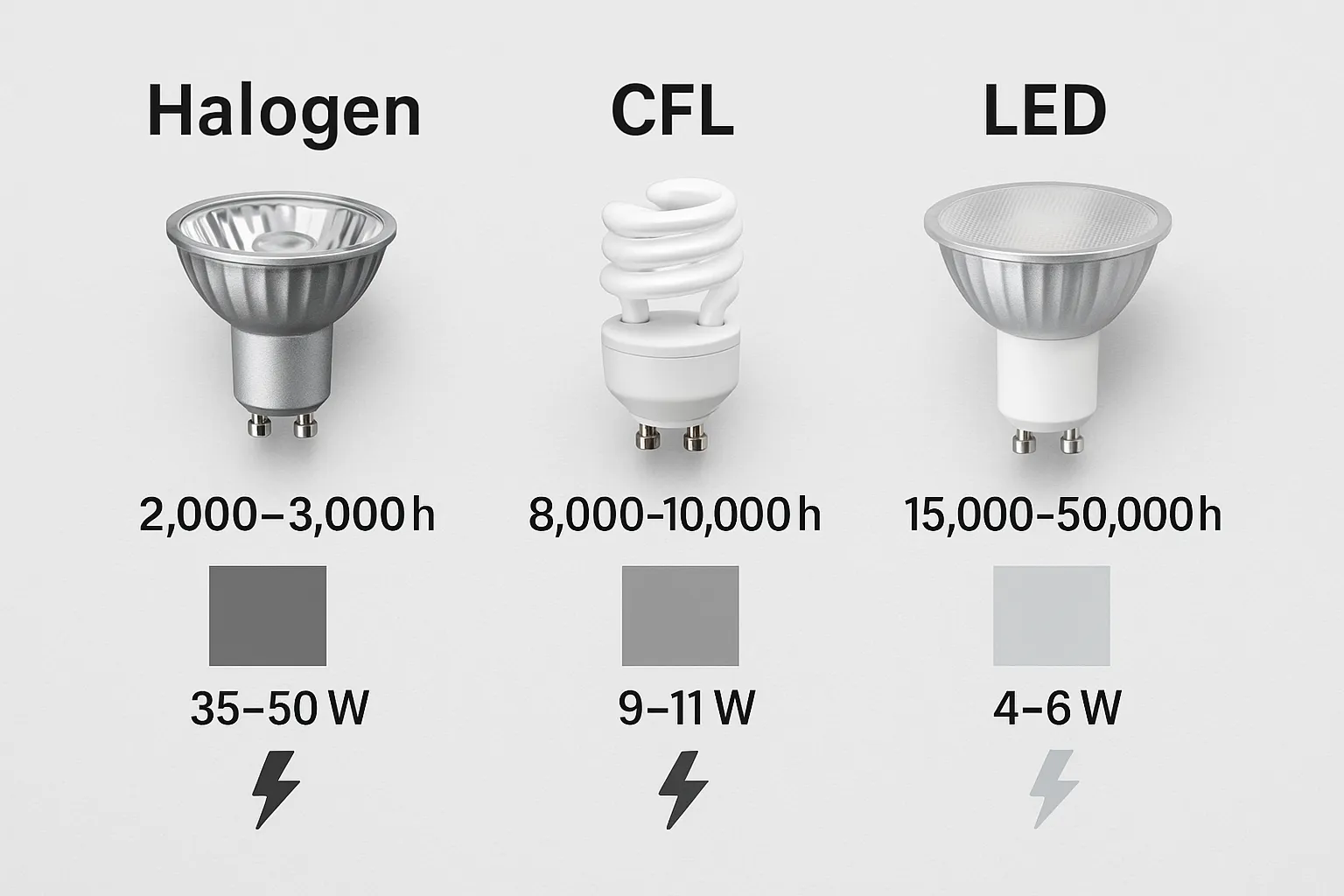
The typical rated lifespan of a GU10 LED bulb ranges between 15,000 and 50,000 hours, depending on component quality, driver design, and operating conditions.
In commercial usage (≈5 hours/day), this translates to 8–25 years of service — significantly outperforming halogen or CFL counterparts.
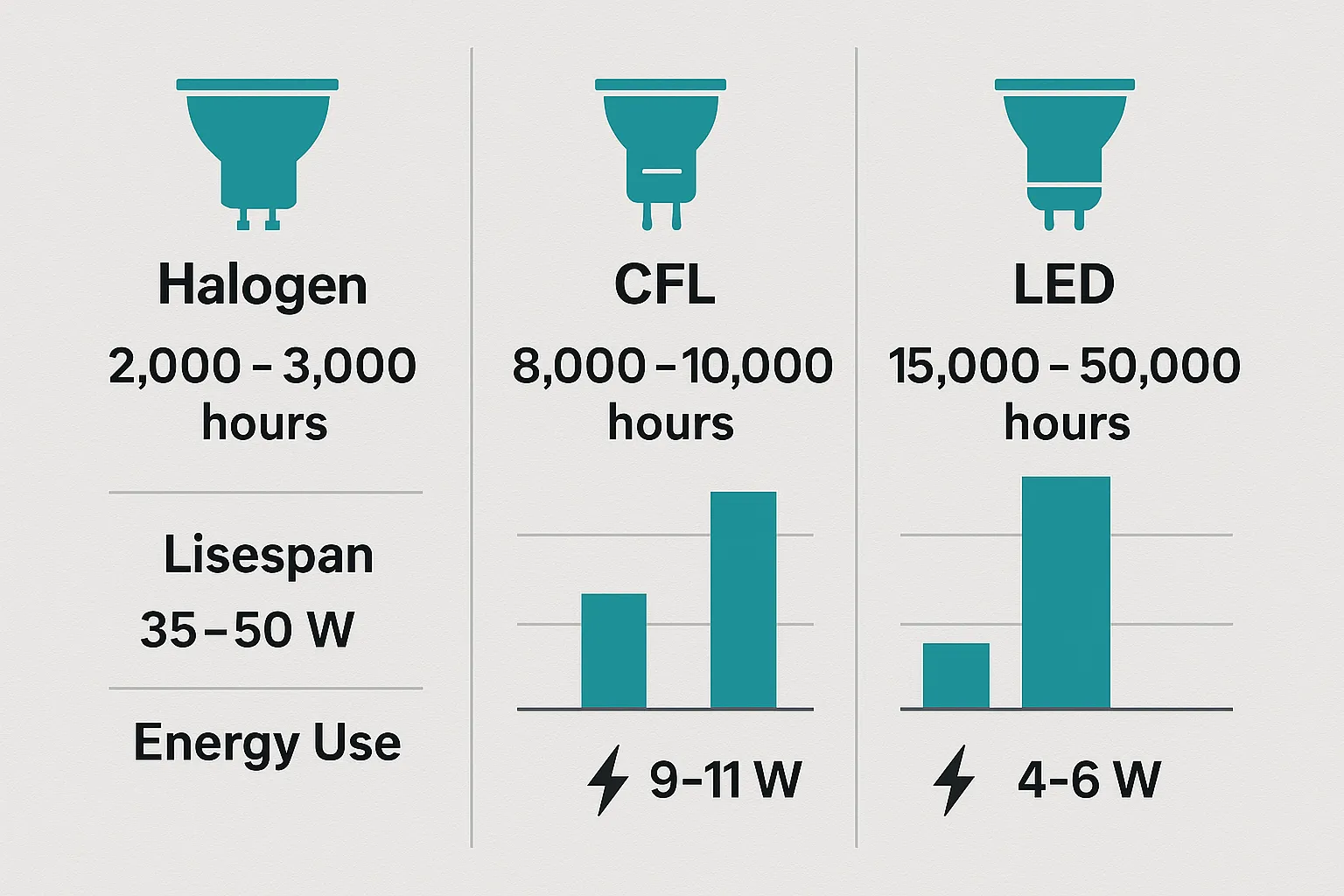
| Light Source | Typical Lifespan (hours) | Energy Use (W equivalent) |
|---|---|---|
| Halogen GU10 | 2,000 – 3,000 | 35–50 W |
| CFL GU10 | 8,000 – 10,000 | 9–11 W |
| LED GU10 | 15,000 – 50,000 | 4–6 W |
(Data Source: U.S. Department of Energy – LED Basics)
2. L70, L80, and L90 Standards

LED lifespan is measured by how long a bulb maintains a certain percentage of its initial light output, not when it fails completely.
- L70: Light output drops to 70% (considered end of useful life)
- L80: 80% brightness maintained
- L90: Premium-grade LEDs, used in critical applications like museums or medical spaces
Most professional GU10 LEDs are rated for L70 ≥ 25,000 hours or L80 ≥ 30,000 hours under standard testing.
(参照: IES TM-21-19)
III. Testing Standards that Define LED Longevity
1. LM-80 — LED Chip Lifetime Testing
その LM-80 standard, published by the 照明学会(IES), measures lumen maintenance of LED packages, arrays, or modules over time.
Manufacturers test LEDs for at least 6,000 hours (often 10,000) at various temperatures (e.g., 55°C, 85°C, 105°C).
This data establishes how much light output (lumen) declines under controlled conditions.
2. TM-21 — Lifetime Projection
その TM-21 method uses LM-80 data to predict the extrapolated lifetime of LED products.
For example, if an LED maintains 95% of its output after 10,000 hours at 85°C, TM-21 can project its L70 lifetime to 35,000+ hours.
TM-21 helps project engineers estimate real-world service life for warranty and ROI calculations.
3. IEC 62560 — Safety and Performance
その IEC 62560 standard defines safety, interchangeability, and testing requirements for self-ballasted LED lamps like GU10 models. It covers aspects such as:
- Electrical safety (dielectric strength, insulation)
- Mechanical integrity (base torque, lamp weight)
- Thermal performance
4. EN/IEC 62612 — Performance Requirements
Complementary to IEC 62560, EN 62612 assesses photometric performance, including luminous flux, power factor, color rendering (CRI), and start-up time.
5. ERP & Energy Labelling
For the European market, GU10 LED bulbs must comply with EU Regulation 2019/2020 (Ecodesign) and 2019/2015 (Energy Label).
These define efficiency grades (A–G), flicker limits (Pst LM ≤ 1.0), and stroboscopic visibility (SVM ≤ 0.9).
(出典: European Commission Ecodesign for Light Sources)
Factors Influencing Real-World GU10 Lifespan
While test data defines theoretical longevity, real-life operation depends on multiple engineering and environmental variables.
1. Thermal Management
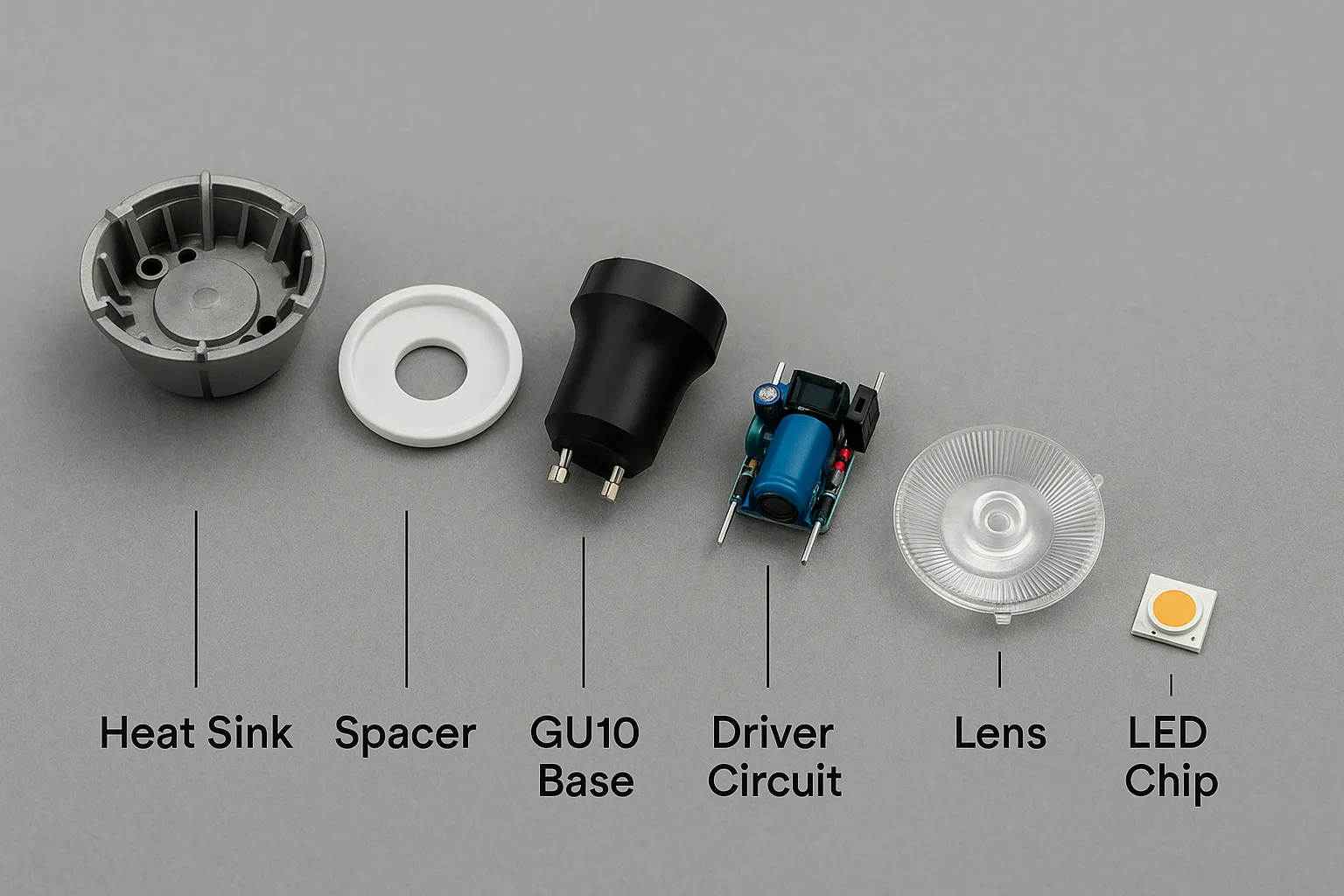
LEDs are temperature-sensitive devices. Each 10°C increase in junction temperature can reduce lifespan by up to 30% (Cree Lighting White Paper).
High-quality GU10 bulbs use aluminum housings and integrated heat sinks for optimal dissipation.
Poorly ventilated fixtures or enclosed downlights can trap heat, accelerating degradation of both LEDs and drivers.
2. Driver Quality and Component Design
その LED driver (power supply) is often the limiting factor in lifespan.
- High-grade GU10 drivers use isolated topology そして high-temperature capacitors (105°C-rated).
- Low-cost models often employ unregulated circuits, which can fail prematurely under surge or thermal stress.
(参照: Lighting Research Center – Driver Reliability Study)
3. Load Cycle (Switching Frequency)
Frequent on/off cycles create electrical surges, stressing driver circuits and LED junctions.
While GU10 LEDs handle cycling better than CFLs, minimizing unnecessary switching helps extend service life.
| Switching Frequency | Impact on Lifespan |
|---|---|
| Continuous operation | Ideal stability |
| Switched multiple times/day | Minor degradation |
| Automated sensor switching | Potential reduction of 5–10% lifespan |
4. Installation Environment
| Environment | Effect on Lifespan |
|---|---|
| Open fixtures, ambient < 35°C | Optimal lifespan |
| Enclosed housings or ceilings | Heat buildup, shorter lifespan |
| Outdoor damp or high humidity | Potential corrosion risk (unless IP65+) |
In commercial environments such as retail stores, ambient heat from ceiling fixtures can significantly impact GU10 performance if not properly ventilated.
5. Power Quality
Voltage fluctuations and harmonics can cause premature driver failure.
Industrial buildings with variable loads should install surge protection or line filters to safeguard LED fixtures.
(出典: IEEE 519-2014 Power Quality Standard)
Comparative Lifespan and ROI Analysis
Even when derated for environmental stress, GU10 LEDs outperform older lighting technologies across all operational metrics.
| Technology | Nominal Life (hours) | Failure Mode | メンテナンスコスト | エネルギー効率 |
|---|---|---|---|---|
| ハロゲン | 2,000 | Filament burnout | 高い | 低 |
| CFL | 8,000–10,000 | Ballast failure | 中程度 | 中程度 |
| GU10 LED | 25,000–50,000 | Driver fatigue / heat stress | Very Low | 高い |
When analyzed in terms of cost per lumen-hour, GU10 LEDs deliver a 70–80% lower lifecycle cost than halogens and a 40% advantage over CFLs.
(Data Source: LightingEurope LED Performance Study, 2024)
GU10 LED Lifespan in Commercial Applications
Hospitality and Retail
Constant operation (10–14 hrs/day) demands L80 @ 25,000h minimum performance. High-CRI (Ra > 90) GU10 LEDs maintain color consistency crucial for visual merchandising.
Office and Educational Facilities
Energy and maintenance savings drive ROI — typically achieving payback within 18–24 months
Industrial and Warehouse
GU10s used in task or accent lighting benefit from robust heat management そして surge-protected drivers, ensuring consistent illumination in high-temperature zones.
The Role of Certification and Warranty
Professional-grade GU10 LED bulbs should include:
- LM-80 / TM-21 reports for lumen maintenance verification
- CE / RoHS / ERP compliance for European markets
- UL / FCC listing for North America
- Minimum 3–5 year warranty, backed by replacement policy
A warranty backed by actual third-party test data is a reliable indicator of manufacturer confidence.
(参照: TÜV Rheinland Lighting Certification Guidelines)
Practical Recommendations for B2B Buyers
- Request full datasheets — include LM-80/TM-21 curves and driver MTBF values.
- Verify test standards — ensure testing under IEC 62560, EN 62612, and TM-21.
- Audit the supply chain — confirm LED chip brand and driver supplier.
- Assess installation conditions — plan for ventilation, surge protection, and thermal safety.
- Compare lifecycle cost — consider not just unit price, but maintenance and energy savings.
By implementing these steps, lighting engineers can extend GU10 performance, minimize downtime, and maximize long-term project ROI.
Conclusion: The Science Behind Longevity
The lifespan of GU10 LED bulbs is a result of engineering discipline — combining chip efficiency, thermal control, driver reliability, and quality manufacturing.
While the nominal life may reach 50,000 hours under ideal conditions, real-world installations typically achieve 25,000–35,000 hours, depending on thermal management and power quality.
In comparison to halogen or CFL lamps, GU10 LEDs deliver:
- Up to 10× longer life
- 80% energy savings
- Drastically lower maintenance costs
In professional lighting environments, a GU10 LED bulb isn’t just a product — it’s a long-term investment in operational efficiency and sustainability.
Looking to source LM-80 and TM-21 certified GU10 LED bulbs for your next project?
Contact Teco Lighting — your trusted partner for commercial-grade LED lighting solutions, engineered for performance, reliability, and global compliance.