GU10 LED with Adjustable Color Temperature & Easy Control: The Ultimate Guide for Businesses
Lighting doesn’t have to be complicated. Yet for many buyers—especially wholesalers, distributors, retailers, and project contractors—the challenges are always the same: too many SKUs, mismatched color temperatures, customer complaints, and unnecessary inventory costs.
A GU10 LED bulb with three-stage color temperature そして easy switch control solves all of these problems in one design.
This technology gives end users flexibility without dimmers, apps, hubs, or extra wiring—and helps businesses simplify stock, reduce returns, and cover multiple use cases with a single SKU.
This guide explains exactly how the technology works, where it performs best, and how B2B buyers can use it to streamline procurement and improve lighting consistency across projects.
What Is GU10 LED with 3-Stage Color Temperature?
Color temperature determines how a space feels—warm light is relaxing, neutral light is balanced, and cool light improves focus. But choosing one fixed color temperature often leads to complaints or the need for multiple bulb types.
A three-stage GU10 LED solves this friction by allowing users to switch between warm, neutral, and cool white using a standard wall switch—no dimmer required.
Instead of buying three different GU10 models, a single bulb covers all common room types. This flexibility is valuable not only for end users, but especially for distributors and contractors handling diverse projects.
Common Color Temperature Stages
| Stage | Kelvin Range | Best Use |
|---|---|---|
| Warm White (2700–3000K) | Cozy, relaxing | Living rooms, hotels, dining areas |
| Neutral White (3500–4000K) | Balanced clarity | Hallways, kitchens, retail stores |
| Cool White (5000–6500K) | Bright, energizing | Offices, bathrooms, workshops |
Why the 3-Stage System Matters
- Covers multiple interior needs with one product
- Reduces customer dissatisfaction from “wrong color” purchases
- Eliminates the need to stock three separate SKUs
- Boosts resale performance and improves end-user experience
For businesses managing large inventories or multiple installation environments, this is a practical, cost-saving solution.
How DIP Switch Control Works

A DIP switch is a small physical toggle located on the bulb body. It allows installers to preset the color temperature before the bulb is mounted.
This approach is ideal for contractors or project engineers who want to determine lighting color once, then keep it fixed for long-term stability.
Benefits of DIP Switch Control
- Simplifies stock: One product replaces several fixed-CCT models
- Reduces ordering mistakes: Perfect for contractors and installers
- Ensures consistency: Useful for hotels, offices, retail chains
DIP Switch vs Wall Switch
| 特徴 | DIP Switch | 壁スイッチ |
|---|---|---|
| 制御方法 | Set before installation | User cycles via wall switch |
| Flexibility | Low after installation | High, can change anytime |
| 最適用途 | Contractors, large projects | Homes, hotels, offices |
Many renovation companies prefer DIP switch GU10s because they can install one SKU across all rooms and set temperatures according to project requirements—leading to fewer delays and returns.
Wall Switch Control: Simple, User-Friendly Ambience Adjustment

The wall-switch version repeats the same cycle every time the switch is toggled:
- First click → Warm white
- Second click → Neutral white
- Third click → Cool white
This gives users intuitive control without training, apps, or smart-home devices.
Advantages of Wall Switch Control
- Uses standard wall switches—no rewiring
- No dimmer compatibility issues
- Perfect for renters, hotels, and offices
- Allows rapid ambience changes based on activity
Ideal Applications
- Hotels: Guests adjust ambience easily
- 小売: Bright mode for product clarity, warm mode for atmosphere
- オフィス: Cool white for work; warm for meeting or break areas
- Homes: One bulb fits living rooms, studies, and kitchens
This capability significantly enhances user experience while reducing installation complexity.
Why Three-Stage GU10 LEDs Are a Smart Choice for B2B Buyers
For wholesalers and project buyers, the most important factors are cost control, product reliability, and reducing the risk of customer complaints.
Three-stage GU10 LEDs achieve all three.
Top B2B Benefits
Fewer SKUs → Lower Inventory Costs
No more stocking 2700K, 4000K, 6500K separately.Higher Sell-Through Rate
Customers prefer flexibility; retailers see fewer returns.Easy Installation → Fewer Support Requests
Contractors love products that reduce complexity.Energy Savings Up to 90%
A 5W LED replaces a 50W halogen.
Energy-Saving Example (1,000 Bulbs)
- ハロゲン: 50,000W
- LED: 5,000W
- Reduction: 45,000W (90% less)
At 10 hours/day use, this equals tens of thousands of dollars saved annually—especially impactful in hotels, offices, and retail chains.
How to Choose the Right 3-Stage GU10 LED
Lighting performance varies widely across brands. To avoid flicker, mismatched colors, or premature failure, use the following checklist:
Buyer’s Checklist

| ファクター | Recommendation |
|---|---|
| ワット数 | 4–6W (replaces 35–50W halogen) |
| ルーメン | 350–500lm |
| CRI | ≥90 for retail, ≥80 for general use |
| Control Type | DIP switch or wall switch |
| Certifications | CE, RoHS, ERP (Europe); UL (North America) |
避けるべき一般的な間違い
- Choosing by wattage instead of lumens
- Forgetting size differences (50mm standard vs 35mm mini)
- Ignoring dimmer compatibility
- Buying from suppliers without official test reports
For B2B purchases, always request LM-79/LM-80 test data, photometric files, and certification documents.
Applications & Practical Case Studies

Three-stage GU10 LEDs are versatile and work in nearly every indoor environment.
Where They Perform Best
- ホテル — warm for guests, cool for cleaning
- Retail Stores — neutral for displays, cool for product detail
- オフィス — cool white for work, warm for lounge areas
- Homes — a single bulb fits bedrooms, kitchens, studies
Case Study: Singapore Boutique
A boutique alternates between cool white during daytime sales and warm white in the evening for a premium ambience. Customer satisfaction improved significantly after the switch.
Case Study: German Office Renovation
A contractor standardized on DIP switch GU10s for a 200-unit office project.
Warm white went into lounges, neutral into meeting rooms, and cool white into open workspaces—using the same bulb across all floors.
Installation Tips & Troubleshooting
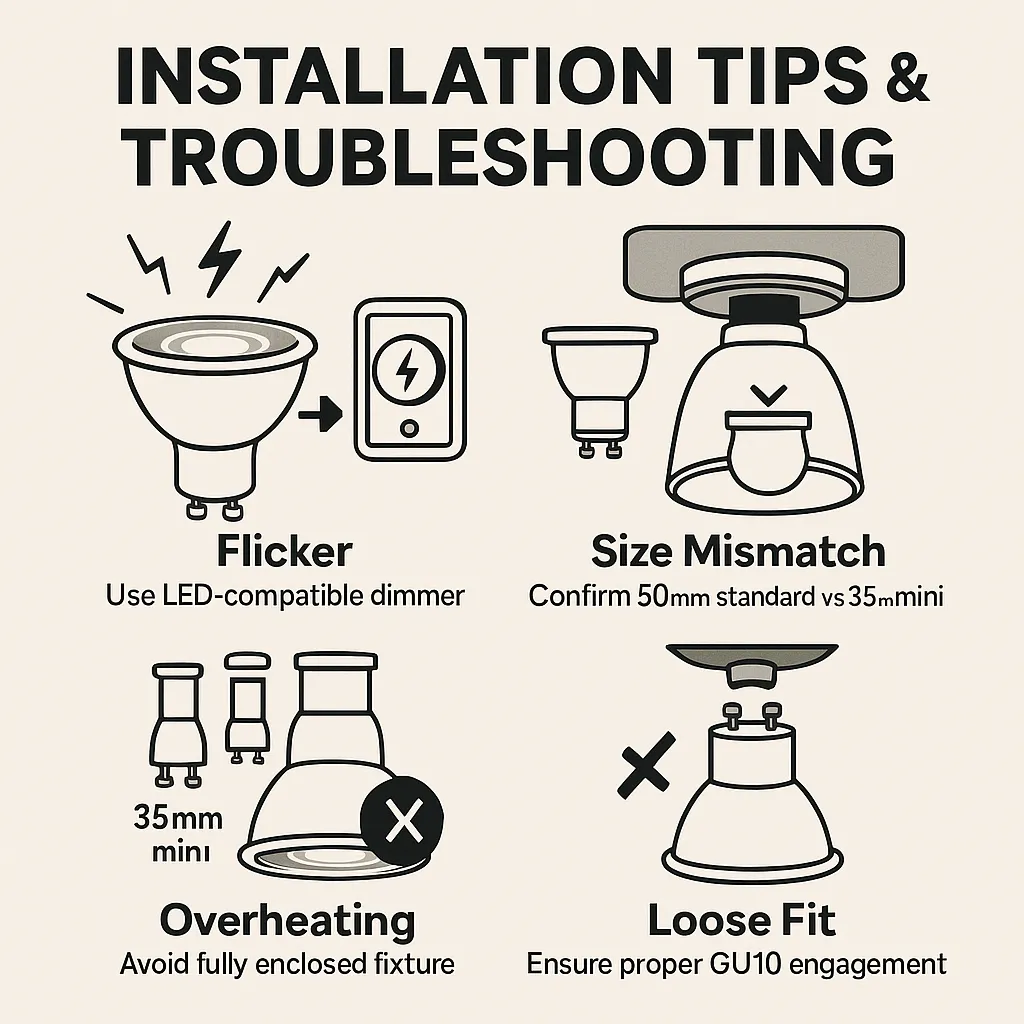
Even the best products can underperform if installed incorrectly. Here’s how to avoid common issues:
Common Problems & Solutions
- フリッカー → Use LED-compatible dimmers or avoid dimmers altogether
- Size mismatch → Confirm 50mm standard vs 35mm mini
- Overheating → Avoid fully enclosed fixtures
- Loose fit → Ensure proper GU10 twist-lock engagement
Pro Tips
- Always test one sample before bulk install
- Label DIP switch settings during installation
- Keep spare units for fast replacements in hotels or retail stores
FAQ: GU10 LEDs with 3-Stage Color Temperature
Q1: Do these bulbs require a dimmer?
No, they use a standard wall switch.
Q2: Are they easy for end users?
Yes. A simple on/off toggle changes the color temperature.
Q3: Can I replace halogen GU10s directly?
Yes—just match the bulb size and check for ventilation.
Q4: Are these bulbs energy efficient?
A 5W LED delivers the same brightness as a 50W halogen, saving up to 90%.
Q5: What certifications matter for B2B buyers?
CE, RoHS, ERP for Europe; UL for North America.
結論
GU10 LEDs with three-stage color temperature deliver flexibility, efficiency, and simplicity—making them ideal for homeowners, installers, and especially B2B buyers. One bulb can serve multiple rooms, reduce inventory pressure, and ensure consistent lighting across large projects.
If you need help choosing the right model for hotels, retail chains, offices, or distribution, I can help you optimize the product selection or even generate a product detail page for your website。