Qual É a Diferença Entre Escurecimento para Quente e Branco Ajustável?
Os compradores de LED frequentemente confundem dim-to-warm e branco ajustável. Este erro pode causar amostras erradas, dimmers errados e resultados de iluminação deficientes.
O dim-to-warm altera o brilho e a temperatura de cor em conjunto. O branco ajustável altera a temperatura de cor e o brilho separadamente. O dim-to-warm imita o dimmer de halogéneo. O branco ajustável dá controlo digital sobre a CCT e a potência.
Costumo explicar esta diferença aos compradores antes de escolherem spots GU10 ou lâmpadas LED. As duas funções parecem semelhantes no papel, mas servem hábitos de iluminação muito diferentes.
O Que É Iluminação Dim-to-Warm?
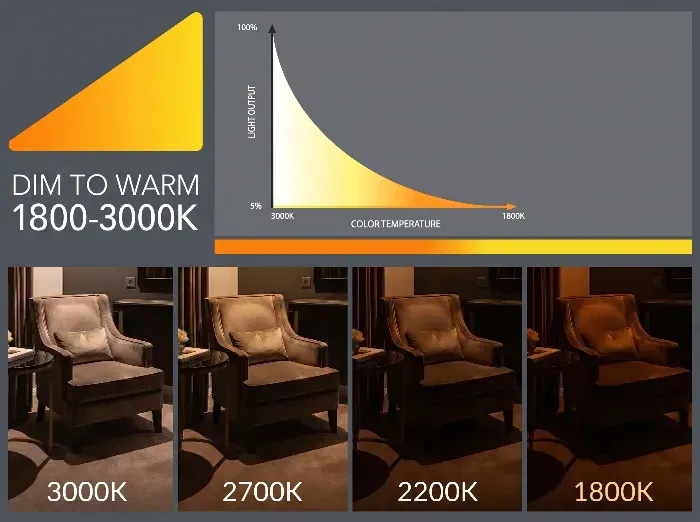
A iluminação dim-to-warm é uma função LED que torna a luz mais quente quando o brilho diminui. Imita a sensação do dimmer de incandescentes e halogéneo.
As lâmpadas LED dim-to-warm reduzem a potência e a temperatura de cor ao mesmo tempo. Na potência máxima, a luz pode ser mais fria e mais brilhante. Quando atenuada, a luz torna-se mais quente e suave.
Por que existe dim-to-warm
O dim-to-warm vem de um antigo hábito de iluminação. Na era das incandescentes e halogéneas, as pessoas usavam dimmers front-edge para controlar a corrente. O filamento de tungsténio recebia mais ou menos energia. Quando a potência era alta, a temperatura do filamento era alta. A luz parecia mais branca e brilhante. Quando a potência diminuía, a temperatura do filamento também diminuía. A luz tornava-se amarela, suave e quente.
Isto não foi um efeito digital. Foi um resultado físico. O filamento comportou-se como um corpo negro. Diferentes temperaturas criaram cores de luz diferentes.
Muitos utilizadores ainda gostam desta sensação. Usaram esta lógica de iluminação durante muitos anos. Não querem apenas um brilho mais baixo. Também esperam um ambiente mais quente quando a sala fica mais escura.
Como o LED dim-to-warm imita o halogéneo
O LED não funciona naturalmente como o tungsténio. Os chips LED precisam de um design eletrónico para imitar este comportamento. Uma lâmpada LED dim-to-warm geralmente usa dois canais de cor. Um canal é mais frio. Um canal é mais quente. O driver altera a proporção da mistura quando o dimmer muda a potência.
Por exemplo, um GU10 dim-to-warm de 8W pode funcionar a 6500K quando atinge a potência máxima. Quando o dimmer de parede diminui, a potência desce. Ao mesmo tempo, a temperatura de cor também desce. Pode finalmente parar por volta de 3000K.
| Nível de Atenuação | Sensação de Potência | Temperatura de Cor | Sensação do Utilizador |
|---|---|---|---|
| 100% | Máximo 8W | 6500K | Brilhante e claro |
| 70% | Médio alto | 5000K | Ainda ativo |
| 40% | Médio baixo | 4000K | Mais suave |
| 10% | Muito baixo | 3000K | Quente e relaxado |
O ponto-chave é simples. O dim-to-warm liga o brilho e a cor. O utilizador não pode manter 6500K com brilho muito baixo. O utilizador também não pode obter 3000K com os 8W completos, a menos que o produto seja projetado dessa forma.
Porque os compradores escolhem dim-to-warm
Normalmente sugiro dim-to-warm para hotéis, restaurantes, vivendas, quartos, salas de estar e espaços comerciais que desejam iluminação emocional. Não é feito para iluminação de tarefas rigorosas. É feito para atmosfera.
Um bom produto dim-to-warm precisa de uma curva CCT suave. A mudança não deve saltar de frio para quente. Deve sentir-se suave. É aqui que o design da fábrica importa. Produtos baratos podem mudar de cor demasiado depressa. Alguns produtos também cintilam em níveis baixos de atenuação. Para compradores B2B, isto gera reclamações após a instalação.
O Que É Iluminação de Branco Ajustável?
A iluminação de branco ajustável é um método de controlo digital LED que permite aos utilizadores ajustar a temperatura de cor e o brilho separadamente. Não segue o antigo hábito de dimmer de halogéneo.
Uma lâmpada LED de branco ajustável pode manter a mesma potência enquanto a temperatura de cor muda. Também pode atenuar o brilho mantendo a CCT selecionada estável.
A lógica básica do branco ajustável
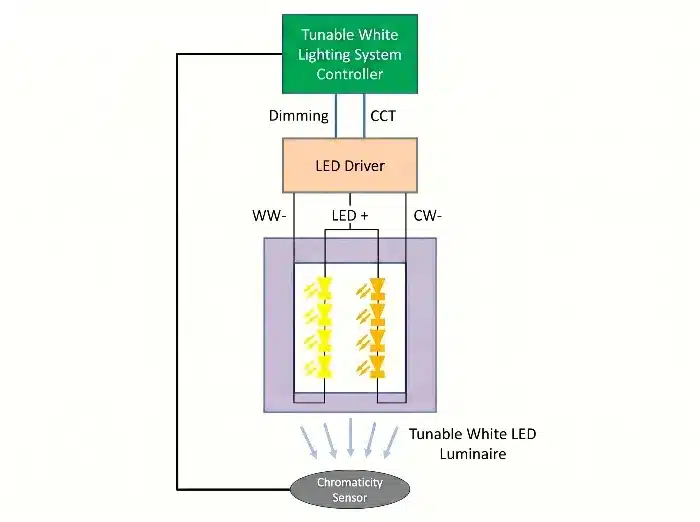
O branco ajustável normalmente usa canais LED de branco quente e branco frio. O driver controla estes canais através de PWM ou outro método de controlo digital. O sistema pode alterar a proporção entre os dois canais sem forçar a potência total a diminuir.
Por exemplo, uma lâmpada de branco ajustável de 8W 3000K–6500K pode funcionar a 3000K com a potência total de 8W. Também pode funcionar a 6500K com a potência total de 8W. Quando o utilizador altera a CCT, o brilho pode manter-se praticamente o mesmo.
| Função | 3000K | 4000K | 6500K |
|---|---|---|---|
| Branco ajustável na potência máxima | 8W | 8W | 8W |
| Comportamento dim-to-warm | Baixa potência | Potência média | Potência máxima |
Esta é a principal diferença. O branco ajustável separa a cor e a potência. O dim-to-warm liga-as.
Porque o branco ajustável parece mais moderno
O branco ajustável adapta-se ao controlo moderno de iluminação. Funciona bem com sistemas inteligentes, comandos à distância, painéis de parede, aplicações, DALI, Bluetooth, Zigbee ou outros métodos de controlo digital. O utilizador pode escolher uma cor fria para trabalhar, uma cor neutra para uso diário e uma cor quente para relaxar.
Vejo o branco ajustável como uma ferramenta para espaços flexíveis. Escritórios, showrooms, salas de aula, cozinhas, salas de reuniões e áreas comerciais frequentemente precisam desta função. A mesma sala pode precisar de luz diferente em momentos diferentes.
The buyer risk in tunable white
Tunable white sounds better because it gives more control. But it also needs better system matching. The control method must match the lamp. The dimmer or controller must support the function. A normal phase-cut dimmer usually cannot give full tunable white control.
This is a common sourcing mistake. A buyer may ask for “dimmable and CCT adjustable” but does not define the control method. The supplier may offer a product that needs a remote. The project may need wall control. Then the sample works in the office but fails in the real project.
For wholesale buyers, the question should not be only “Can it change color?” The better question is “How does the user control color and brightness separately?”
Which One Should You Choose for LED Spotlights?
You should choose dim-to-warm when you want a halogen-like mood. You should choose tunable white when you need separate control of brightness and color temperature.
Dim-to-warm is better for comfort and emotion. Tunable white is better for flexible function. The best choice depends on the project, control system, and user habit.

Choose dim-to-warm for familiar dimming
Dim-to-warm is the right choice when the user already understands traditional dimming. A hotel guest does not want to learn a control system. A restaurant owner may only want one rotary dimmer. A villa owner may want warm light at night without pressing many buttons.
In these cases, dim-to-warm gives a natural feeling. The light gets lower and warmer together. This matches old halogen logic. It also reduces user confusion.
| Tipo de Projeto | Better Choice | Razão |
|---|---|---|
| Hotel room | Dim-to-warm | Simple and emotional |
| Restaurant | Dim-to-warm | Warm mood at low brightness |
| Bedroom | Dim-to-warm | Comfortable night lighting |
| Escritório | Tunable white | Different tasks need different CCT |
| Showroom | Tunable white | Product display needs flexible color |
| Classroom | Tunable white | Activity and focus change during the day |
Choose tunable white for control freedom
Tunable white is better when the project needs flexible scenes. A showroom may need 3000K for a warm product area and 6500K for a technical display. A kitchen may need cool light for food preparation and warm light for dinner. An office may need neutral or cool light during working hours.
Tunable white also makes more sense in smart lighting. The user can set scenes. Morning can be 5000K. Evening can be 3000K. Meeting mode can be 4000K. Cleaning mode can be 6500K. Brightness can stay stable or change based on the scene.
My factory view for B2B buyers
From a factory view, dim-to-warm and tunable white should not be sold as the same upgrade. They need different drivers, different testing, and different quality control points.
For dim-to-warm, I care about the dimming curve. I test whether the CCT change is smooth. I also test whether the lamp flickers, buzzes, or shuts off too early. The feeling must be close to halogen.
For tunable white, I care about channel balance. I test whether 3000K and 6500K can both reach strong output. I also check whether the middle CCT looks clean. If the mixing is poor, 4000K may look strange or uneven.
A buyer should also ask for clear specifications:
| Item | Dim-to-Warm | Tunable White |
|---|---|---|
| Control logic | Brightness and CCT together | Brightness and CCT separate |
| Typical control | Phase-cut dimmer | PWM, remote, smart control, DALI |
| Main feeling | Halogen-like | Digital and flexible |
| Melhor uso | Mood lighting | Multi-scene lighting |
| Key risk | Flicker and rough CCT curve | Controller mismatch |
I usually ask buyers about the project before I recommend one. A product can be technically good but still wrong for the application. A restaurant does not always need tunable white. An office does not always need dim-to-warm. The best product is the one that matches the real user behavior.
Conclusão
Dim-to-warm copies the old halogen feeling. Tunable white gives separate digital control. Buyers should choose based on scene, control method, and user habit.
Recommended Products for Your Project
Based on the lighting principles discussed above, we have selected high-performance GU10 solutions to match different control systems and installation needs.
Top Dim-to-Warm Solutions (TRIAC Dimming)
Best for hotels, luxury villas, restaurants, and traditional wired dimming environments.
TECO Premium GU10 LED Bulb
Dim-to-Warm | Die-Cast Aluminum
- Fitting Type: GU10 LED Spotlight
- Dimming: Triac / Dim-to-Warm
- Color Temperature: 3000K → 1800K
- Luminous Flux: Up to 580lm
- Lifespan: 40,000 hours
- Compatibility: Works with 180+ dimmer brands
View Product Details → https://tecolite.com/product/gu10-dim-to-warm-led-spotlight-3000k-1800k/
TECO LED Essential GU10 Dimmable Bulb
5.5W | Plastic Body | High CRI
- CRI: >90
- Beam Angle: 38° / 60°
- Luminous Flux: 510lm
- Color Temperature: 2700K / 3000K / 4000K
- Lifespan: 25,000 hours
- Body: Thermoplastic, halogen-size replacement
View Product Details → https://tecolite.com/product/led-essential-plastic-gu10-dimmable-bulbs-5-5w/
Top Tunable White Solutions (Smart Wireless)
Best for smart homes, modern offices, apartments, and personalized lighting scenes.
Tuya Zigbee GU10 Smart LED Bulb
Smart CCT | RGBCW | Wireless Control
- Socket: GU10
- Control: WiFi / Zigbee / Bluetooth (Tuya ecosystem)
- Beam Angle: 38° / 60°
- Luminous Flux: 330–350lm
- Lifespan: 25,000 hours
- Smart Integration: Alexa / Google Home / SmartThings
- Equivalent: ~50W halogen lamp
View Product Details → https://tecolite.com/product/wireless-bluetooth-control-smart-tuya-cct-dimming-5w-glass-gu10-led-bulb/