GU4 против GU5.3 светодиодных ламп: расстояние между контактами, MR11 против MR16, напряжение и совместимость с осветительными приборами
Обновлено: 4 сентября 2026
GU4 и GU5.3 — это разные двухштырьковые цоколи ламп, и они не взаимозаменяемы. GU4 обычно используется с меньшими лампами MR11, а GU5.3 — с 12-вольтовыми лампами MR16. Перед заменой проверьте расстояние между штырьками, размер отражателя, напряжение, совместимость с трансформатором или светодиодным драйвером, требования к яркости и доступную глубину светильника.
| База | Типичная лампа | Расстояние между штырьками | Общий риск |
|---|---|---|---|
| GU4 | MR11 | Около 4 мм | Малое пространство светильника и меньший световой поток |
| GU5.3 | MR16 | Около 5.3 мм | Минимальная нагрузка трансформатора и стабильность диммирования |
Не вставляйте лампу GU4 в патрон GU5.3 и не считайте MR11 и MR16 одинаковой заменой. Для B2B-заказов отправляйте фотографии патрона, маркировки лампы, модели трансформатора и целевое количество до одобрения образца.
Выбор правильного цоколя низковольтного прожектора может показаться небольшим решением в более широком контексте светодизайна. Но для оптовиков, световых брендов и планировщиков коммерческих проектов выбор между GU4 и GU5.3 — это выбор, который имеет реальные последствия — влияя на совместимость установки, уровни яркости, циклы обслуживания, затраты на закупку и, в конечном итоге, на восприятие освещаемого пространства.
Хотя оба являются 12-вольтовыми двухштырьковыми цоколями, используемыми в низковольтных лампах, GU4 и GU5.3 служат совершенно разным целям на современном рынке освещения. Их механическая структура, тепловое поведение, возможности яркости и типичные области применения различаются гораздо больше, чем многие покупатели осознают. Поскольку ваши целевые клиенты зависят от надежного, стабильного освещения, которое легко заменять и обслуживать со временем, понимание этих различий крайне важно для избежания дорогостоящих ошибок.
Эта статья предоставляет полную, заводскую перспективу о том, как GU4 и GU5.3 лампы сравниваются — технически, коммерчески, оптически и эксплуатационно. Также объясняется, для каких светильников предназначен каждый тип, и как специалистам по освещению следует выбирать между ними для реальных проектов.
Понимание технических определений: сравнение GU4 и GU5.3

Самое основное различие — в расстоянии между штырьками:
- GU4 → расстояние между штырьками 4,0 мм отличаются
- GU5.3 → расстояние между штырьками 5.3 мм отличаются
Это расстояние не взаимозаменяемо. Лампы с одним типом цоколя нельзя вставить в светильники, предназначенные для другого, потому что:
- Ширина патрона отличается.
- Глубина и диаметр корпуса лампы различаются.
- Механическая удерживающая структура внутри патрона лампы отличается.
В большинстве случаев, обычно, GU4 цоколи сочетаются с компактным форм-фактором MR11 (35 мм), в то время как GU5.3 цоколи чаще всего ассоциируются с более крупным форм-фактором MR16 (50 мм). Это размерное соотношение объясняет почти каждую последующую разницу — яркость, управление теплом, оптику и область применения.
Справочник CIE по определениям ламп и отражателей: https://cie.co.at
Размер и форм-фактор: почему физические размеры важнее, чем ожидают покупатели

Лампа GU4 (MR11) значительно меньше и легче, чем лампа GU5.3 (MR16):
Разница в 15 мм может показаться незначительной, но в светотехнике она существенно влияет на:
• Способность рассеивания тепла
Маленькие лампы имеют ограниченную площадь поверхности для рассеивания тепла. Светодиоды быстро деградируют, если температура перехода не контролируется. Вот почему светодиоды GU4 редко превышают 3–4 Вт.
• Место доступно для оптики
GU5.3 отражатели и линзы могут формировать лучи более точно и поддерживать более широкие диапазоны углов луча.
• Пространство для схемы драйвера
Более крупные корпуса ламп позволяют использовать более надежные драйверы постоянного тока, улучшая стабильность и срок службы.
• Совместимость с коммерческими светильниками
Многие архитектурные встраиваемые светильники, трековые головки и акцентные приборы разработаны специально под форм-фактор MR16.
Это первый основной раздел между двумя системами:
GU4 is used where space is tight; GU5.3 is used where performance matters.
Optical Engineering: Beam Angles, Light Distribution, and Color Rendering

Optics in GU4 and GU5.3 lamps differ substantially because of their physical geometry.
GU4 (MR11) Optical Characteristics
- Smaller reflector area → more concentrated beam
- Usually offered in 15°–35° beams
- More suitable for small accent points, display cabinets, jewelry lighting
- Limited space for advanced diffusers or anti-glare structures
GU5.3 (MR16) Optical Characteristics
- Larger reflector → accommodates narrow, medium, and wide beams (15°/24°/36°/60°)
- Compatible with advanced TIR lenses and coated reflectors
- Better center-beam intensity
- More uniform distribution for general commercial lighting
For commercial spaces like retail stores or hotel corridors, GU5.3 optics offer a level of visual comfort and distribution uniformity that GU4 cannot match.
Voltage and Driver Considerations: Understanding 12V System Behavior
Оба GU4 и GU5.3 lamps operate on 12-вольтовые низковольтные системы, but it is critical for buyers to understand how transformer compatibility affects performance.
Types of Transformers Used in the Field
- Magnetic transformers (compatible with most LEDs)
- Electronic halogen transformers (often incompatible with LEDs)
- LED constant-voltage drivers (recommended for modern installations)
Common Issues in Real Projects
- Flickering due to under-load
- Buzzing caused by high-frequency output
- Failure to turn on when transformer minimum load is not met
- Early LED degradation due to voltage instability
For large-scale installations (hotels, restaurants, malls), using LED-specific drivers dramatically improves reliability.
IEC standards for low-voltage lighting systems: https://www.iec.ch
Thermal Engineering: Heat Determines Lifespan and Stability
Heat management is one of the most critical engineering challenges in LED bulbs. GU4 и GU5.3 differ strongly here:
GU4
- Tiny heat sink
- Limited airflow in small fixtures
- Heat accumulates quickly
- Typical power: 1.5W–3.5W
- Higher risk of color shift over time
GU5.3
- Larger aluminum or composite heat sinks
- Better airflow in most fixtures
- Supports 5W–7W or more
- Far longer stable lifespan (when properly designed)
This is why most lighting designers choose GU5.3 for general illumination in commercial spaces.
ENERGY STAR data on LED thermal performance: https://www.energystar.gov
Brightness and Efficiency: GU5.3 Is the Clear Winner

Because GU5.3 lamps support higher wattage and better thermal design, they deliver significantly higher brightness.
Typical commercial LED lumen outputs:
| Тип | Typical Lumen Output | Эффективность |
|---|---|---|
| GU4 (MR11) | 150–300 lm | 45–70 lm/W |
| GU5.3 (MR16) | 350–650 lm | 70–95 lm/W |
The difference is not minor. It determines whether a fixture can serve as:
- General illumination
- Акцентное освещение
- High-intensity spot lighting
- Retail product highlighting
For most commercial applications, GU5.3 provides the necessary visual performance.
GU4 vs GU5.3: Comparison of Compatible Fixtures)
Different lamp bases require different fixture types. This is a critical difference often overlooked by buyers.
GU4-Compatible Fixtures
Because GU4 lamps are smaller, they are used in fixtures requiring compact design:
- Display cabinets (museum displays, jewelry stores)
- Under-cabinet lights
- Mini spotlight fixtures
- Micro track lights
- Furniture-integrated lighting
- Small showcase downlights
Characteristics of GU4 fixtures:
- Very small beam focus
- Lightweight and compact
- Limited heat dissipation space
- Usually used at eye-level or close-range illumination
- Low installation depth
GU5.3-Compatible Fixtures
GU5.3 lamps are compatible with significantly more fixture categories:
- Architectural downlights
- Office spotlights
- Hotel ceiling fixtures
- Retail track lighting
- Restaurant general illumination
- Recessed ceiling fixtures
- Landscape lighting (12V)
Characteristics of GU5.3 fixtures:
- Larger housings allow robust heat management
- Better anti-glare design (baffles, reflectors)
- Wider range of beam angles
- Designed for long operating hours
Compatible with dimming systems used in commercial lighting
Key Insight for B2B Buyers:
Fixture availability strongly favors GU5.3, making it easier to use for new construction, renovations, and large-scale commercial upgrades.
Real-World Applications: When to Choose GU4 vs GU5.3
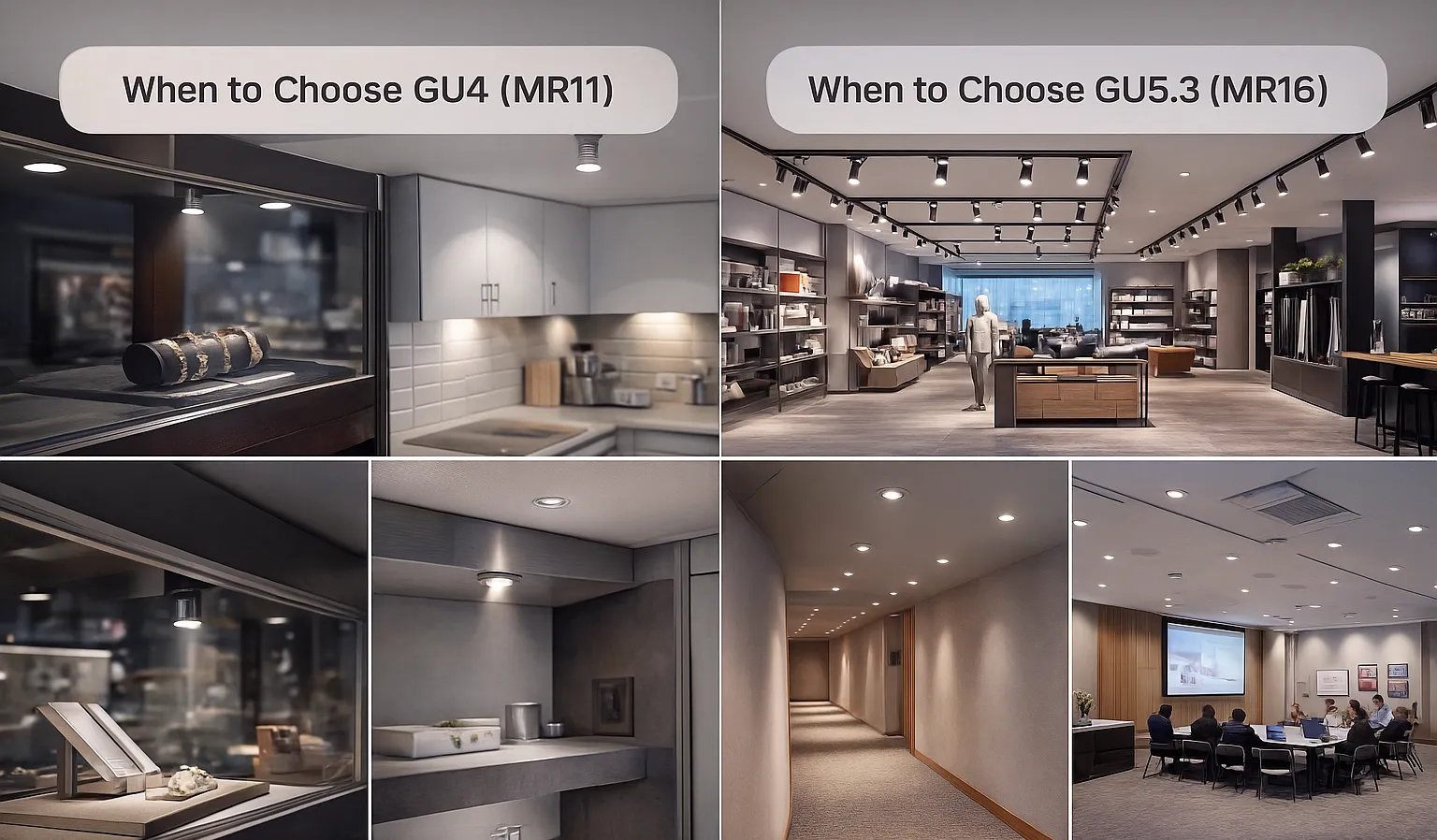
Choose GU4 when:
- Space is extremely limited
- Precision accent lighting is required
- Light must be integrated into furniture or displays
- Illumination distance is short
- Brightness requirements are modest
Choose GU5.3 when:
- The installation involves ceilings or track lights
- Light must reach medium to long distances
- Brightness is important
- Dimming performance matters
- Fixtures require heat management
- Project scale is large (hotel, retail chain, office renovation)
Commercial Buyer Considerations: Cost, Availability, and Supply Chain
Market Demand
Supply Chain Stability
- GU5.3 has more mature tooling, higher-volume chip matching, and optimized production lines.
- GU4 often requires semi-custom assembly.
Cost Factors
- GU5.3 is cheaper due to economies of scale.
- GU4 costs more per lumen and per unit due to smaller market size.
Inventory Risk
- Wholesalers stocking GU5.3 move units faster.
- GU4 sells more slowly but has steady demand in specialty markets.
Common Mistakes Buyers Make (and How to Avoid Them)
- Assuming GU4 и GU5.3 are interchangeable
- Using halogen electronic transformers with LED replacements
- Ignoring fixture size or heat constraints
- Choosing too small a lamp (GU4) for general illumination
- Only comparing wattage rather than lumen output
- Not confirming compatibility with existing dimmers
- Buying non-branded drivers to save cost (reduces lifespan)
Practical Recommendation: Which Base Should You Choose?
Для most commercial projects, GU5.3 is the reliable, versatile, cost-efficient choice.
Для small-scale, precision, cabinet, or furniture lighting, GU4 is the right choice.
For wholesalers and lighting brands:
- Primary inventory → GU5.3
- Supplementary inventory → GU4 for professional/retail niche markets
For contractors and project planners:
- Always verify the original fixture type
- Ensure transformer/driver compatibility
- Choose GU5.3 when in doubt
Заключение
GU4 и GU5.3 both serve important roles in modern lighting, but they are designed for entirely different environments. GU4 excels in compact, close-range accent lighting where space is limited. GU5.3 dominates commercial architectural lighting because of its superior brightness, optics, thermal stability, and compatibility with a wide range of fixtures.
Understanding these distinctions helps lighting brands plan better product assortments, helps wholesalers maintain more efficient inventory, and helps contractors avoid installation headaches that slow down projects.
If you’re looking for reliable, high-quality GU4 or GU5.3 LED solutions—custom branding, dimmable options, high-CRI models, or specialized commercial beam angles—I can help.
Contact:
[email protected]
https://www.tecolite.com
Let’s build a product lineup and supply chain that supports your business growth across every lighting application.