Supermarket Shelf Lighting: Design Strategies to Improve Product Visibility and Sales
Introduction
In supermarket projects, shelf lighting is not a decorative layer added at the end of the design process. It directly affects product visibility, shopper attention, merchandising performance, and the overall efficiency of store operations. When shelf lighting is poorly planned, the result is usually inconsistent product presentation, dark zones, glare, visual fatigue, and avoidable rework during fit-out.
For retailers, distributors, and project contractors, this is a commercial issue as much as a lighting issue. Poor beam control or incorrect color temperature can make fresh food look unappealing, packaged goods look flat, and promotional displays lose impact. On site, badly integrated shelf lighting often leads to late adjustments, power-access problems, driver placement conflicts, and maintenance difficulties after handover. A practical shelf lighting strategy must therefore balance optical performance, installation constraints, energy use, and long-term serviceability.
Executive Summary
Effective supermarket shelf lighting improves product visibility, directs customer attention, and supports sales. The best results come from combining correct fixture type, color temperature, brightness, and mounting position with service-friendly installation and verified performance across different product categories.
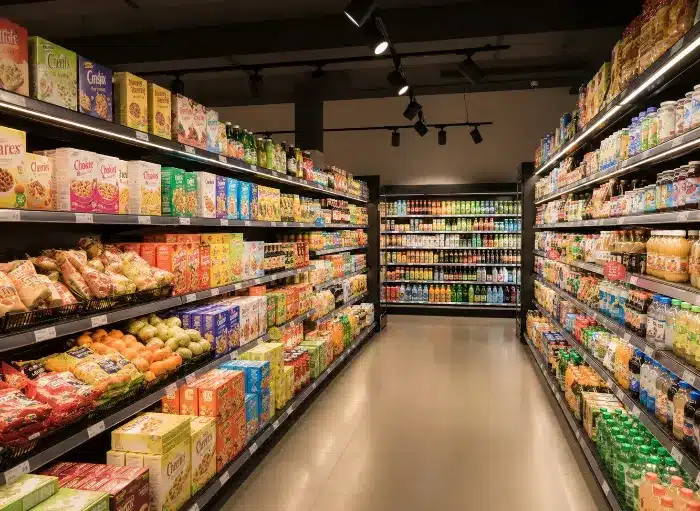
supermarket shelf lighting design for product visibility and retail sales
Why Shelf Lighting Matters in Supermarkets
On-Site / Commercial Reality
In a supermarket, shelves compete for attention within a visually crowded environment. General ambient lighting alone rarely provides enough vertical illumination1 to make products read clearly from the customer’s viewing angle. As a result, labels become harder to identify, packaging loses contrast, and higher-margin products may not stand out. For operators, this means weaker display performance and reduced return on floor space.
From a project perspective, shelf lighting becomes especially important in aisles with dense product stacking, deep shelving, or promotional endcaps. If this layer is missed during planning, the store may need additional fittings after installation, creating access issues, wiring modifications, and disruption to trading schedules.
Deep Dive & Engineering Solution
Shelf lighting works because it increases usable light on the product face rather than only on the floor plane. In retail environments, customers make rapid visual decisions. Products that appear brighter, clearer, and better defined are more likely to draw initial attention. Properly designed shelf lighting improves:
- front-facing product recognition
- packaging color accuracy
- readability of labels and pricing
- visual hierarchy between standard and promotional stock
The most effective approach is to treat shelf lighting as targeted vertical illumination instead of relying only on ceiling fixtures. LED strip lighting can provide continuous linear emphasis along shelf edges, while adjustable spotlights can highlight selected displays, premium products, or seasonal promotions.
| Feature | Linear Shelf Lighting | Adjustable Spotlights | Impact on Maintenance / ROI |
|---|---|---|---|
| Main function | Uniform product illumination | Accent highlighting | Better display control improves merchandising effectiveness |
| Best use case | Standard gondola shelves | Endcaps, featured products | Reduces need for over-lighting the whole store |
| Visual effect | Continuous and clean | Focused and dramatic | Supports category differentiation |
| Maintenance impact | More fixtures but simpler pattern | Fewer fixtures but needs aiming | Proper selection reduces ongoing adjustment labor |
Factory Note
From a manufacturing perspective, optical consistency matters more in retail shelving than many specifiers initially expect. Even small color or output variation between batches becomes visible when linear fixtures run continuously across multiple bays. Batch verification and output matching are essential for a clean store presentation.
Key Objectives of Supermarket Shelf Lighting
On-Site / Commercial Reality
Supermarket shelf lighting must do more than make shelves look bright. The actual objective is to support product visibility, shopper navigation, and category presentation without creating glare, hot spots, or service complications. If the design only targets high lux levels2 without considering beam direction and customer sightlines, the result can be visually uncomfortable and commercially ineffective.
For contractors, unclear objectives often lead to poor fixture selection. A project may end up using the same lighting solution for packaged groceries, fresh produce, chilled cases, and premium displays, even though these areas need different optical treatment.
Deep Dive & Engineering Solution
The core objectives of supermarket shelf lighting usually include:
- improving product recognition at browsing distance
- guiding customer attention to key product zones
- creating visual contrast between standard shelves and promotional displays
- supporting food appearance with appropriate color temperature3
- maintaining visual comfort across long aisles
- limiting energy waste and simplifying maintenance access
A good shelf lighting scheme should therefore combine ambient lighting for circulation with dedicated shelf lighting for merchandise presentation. The lighting should make products appear clear and attractive, but not exaggerated or unnatural.
The design process should ask four practical questions:
- What is the target product category?
- What is the customer viewing distance and angle?
- Is the goal uniformity or accent?
- How will the system be maintained after store opening?
Factory Note
In large retail projects, the best-performing lighting layouts are usually the ones that define objectives by merchandise type first, not by fixture type first. Once the display goal is clear, optical distribution, CCT, mounting detail, and driver arrangement become much easier to finalize.
Types of Lighting Used for Supermarket Shelves
On-Site / Commercial Reality
Different shelf zones have different physical constraints. Some shelves have limited space for fixture integration, some require front-edge mounting, and others need flexible aiming due to changing merchandise layouts. Selecting the wrong luminaire type can create shadows from shelf lips, visible diode dots, poor cable routing, or difficult replacement access.
For installers, the choice of fixture type also affects commissioning time. A neat, modular shelf-lighting system reduces field adaptation and helps keep project schedules under control.
Deep Dive & Engineering Solution
The main lighting types used for supermarket shelves include:
LED Strip Lighting
LED strip lighting is widely used for shelf-edge and under-shelf applications because it provides continuous linear light and is easy to integrate into joinery or metal shelf systems. It is suitable for packaged goods, cosmetics, beverages, and other categories where even illumination is preferred.
Best practice requires:
- aluminum profiles for thermal management4
- diffusers to reduce pixelation and improve visual comfort
- appropriate LED driver sizing and voltage-drop control5 on long runs
Linear Shelf Luminaires
These are purpose-built rigid fixtures designed for more stable optical performance and faster installation. They usually offer better beam control and cleaner appearance than flexible strip solutions, especially in larger supermarket rollouts where repeatability matters.
Adjustable Spotlights
Spotlights are used for promotional areas, feature displays, premium shelves, or endcaps where higher contrast is needed. Compact GU10 LED spotlights can work well for smaller accent heads, while larger ES111 LED spotlights are often considered where a wider optical face or stronger retail accent is required. They are less suitable for continuous shelf runs but very effective in directing attention.
Integrated Shelf Lighting Systems
Some supermarket systems combine shelf uprights, power tracks, and modular luminaires into one coordinated structure. For projects that use ceiling or accent fittings together with shelf lighting, reviewing compatible lighting fixtures at the same time improves consistency and can simplify future layout changes.
| Feature | LED Strip Lighting | Linear Shelf Luminaire | Spotlight | Impact on Maintenance / ROI |
|---|---|---|---|---|
| Uniformity | High | High | Medium | Better uniformity reduces visual dead zones |
| Flexibility | High | Medium | High | Supports changing merchandising layouts |
| Installation speed | Medium | High | Medium | Faster rollout in chain-store projects |
| Beam control | Medium | High | High | Better targeting reduces wasted light |
| Best application | Standard shelves | Repetitive shelf modules | Promotions/endcaps | More accurate application improves sales efficiency |
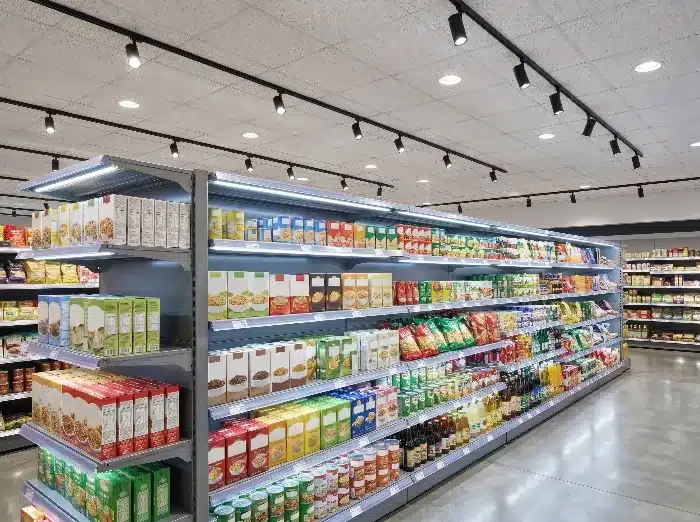
LED strip and linear shelf lighting installed under supermarket shelves
Factory Note
From a manufacturing perspective, LED strips are often selected for cost reasons, but project performance depends heavily on the profile, diffuser, driver, and mounting detail around them. The strip alone does not define the result. In retail projects, the full system must be evaluated as one assembly.
Choosing the Right Color Temperature for Food Displays
On-Site / Commercial Reality
Color temperature selection has a direct effect on how food appears to customers. If the light is too cool, bakery items may look dry and uninviting. If it is too warm, packaged dairy or frozen products may lose the clean, fresh visual impression expected in those categories. A wrong CCT choice can reduce category appeal even when brightness levels are adequate.
This becomes a serious issue during commissioning because the mismatch is often noticed only after products are stocked. At that stage, changing fixtures or LED modules is expensive and disruptive.
Deep Dive & Engineering Solution
Different food categories respond differently to light color. The goal is not to apply one CCT across the whole supermarket, but to align light tone with product perception.
Typical practical ranges include:
- Warm white 2700K–3000K: bakery, bread, pastries, some ready-to-eat displays
- Neutral white 3500K–4000K: packaged groceries, general shelf goods, balanced presentation
- Cooler white 4000K–5000K: seafood, chilled displays, some produce and frozen sections where freshness and cleanliness are priorities
For food presentation, color rendering index (CRI)6 is also important. General retail shelf lighting should normally avoid low-CRI sources, while fresh food, bakery, premium packaged goods, and color-sensitive displays often benefit from CRI 90 or higher. Meat, fruit, and vegetables may also need category-specific spectra rather than only a warmer or cooler CCT. In other words, color temperature controls the tone of white light, while spectral quality controls how accurately product colors appear.
| Product Category | Practical CCT Range | CRI / Spectrum Focus | Visual Goal |
|---|---|---|---|
| Bakery | 2700K–3000K | High CRI, good warm-tone rendering | Warmth and freshness |
| Packaged groceries | 3500K–4000K | CRI 80+ or higher for premium aisles | Balanced clarity |
| Produce | 3500K–4000K or tuned by display | High CRI or produce-specific spectrum | Natural color and freshness |
| Chilled/frozen | 4000K–5000K | Clean white appearance, controlled glare | Hygiene and crispness |
Factory Note
During retail mock-up reviews, color temperature disagreements usually come from evaluating luminaires without actual products on display. In large hospitality and retail projects alike, final CCT decisions should be made with real merchandise under the intended shelf geometry, not from catalogue assumptions.
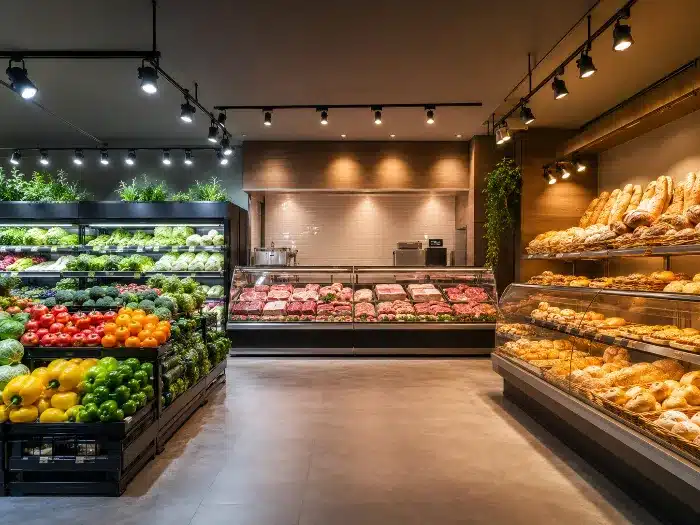
color temperature selection for supermarket food display lighting
Recommended Brightness Levels for Supermarket Shelves
On-Site / Commercial Reality
Too little light leaves products visually flat. Too much light creates glare, reflections on packaging, and unnecessary energy use. In supermarkets, brightness must be set according to product type, shelf depth, and ambient lighting level. If shelf lighting greatly exceeds the surrounding environment, customer comfort can suffer and the aisle may feel visually fragmented.
For contractors and facility teams, over-lighting also increases operating cost and thermal load, while under-lighting may trigger complaints and retrofits.
Deep Dive & Engineering Solution
There is no single lux target for all supermarket shelves, but practical shelf lighting design usually aims for stronger vertical illuminance than the general aisle background. The objective is clear product visibility with controlled contrast. Final levels should be checked against local standards, visual mock-ups, product reflectance, glare limits, and the store’s own brand presentation.
As a working reference for early design discussion:
| Area / Display Type | Typical Working Range | Design Intent |
|---|---|---|
| General supermarket aisles | 300–500 lx horizontal ambient lighting | Comfortable circulation and shelf browsing |
| Standard packaged goods shelves | 500–750 lx vertical product-face lighting | Clear labels and uniform product visibility |
| Promotional shelves and endcaps | 750–1000 lx or about 1.5–2x nearby shelf emphasis | Stronger attention without harsh contrast |
| Fresh food and premium displays | 500–1000 lx depending on product, optics, and glare control | Product appeal with accurate color rendering |
It is important to measure not only horizontal lux on the floor, but also the light reaching the front of products on each shelf tier. Deep shelves often show acceptable brightness on top levels but insufficient light at lower tiers. Under-shelf lighting or multi-point distribution is then required.
Factory Note
From a manufacturing perspective, output selection should consider diffuser loss, mounting setback, and shelf shadowing. Nominal lumen values on a datasheet do not directly translate to actual product-face illumination. In retail applications, mock-up measurement is much more reliable than theoretical output alone.
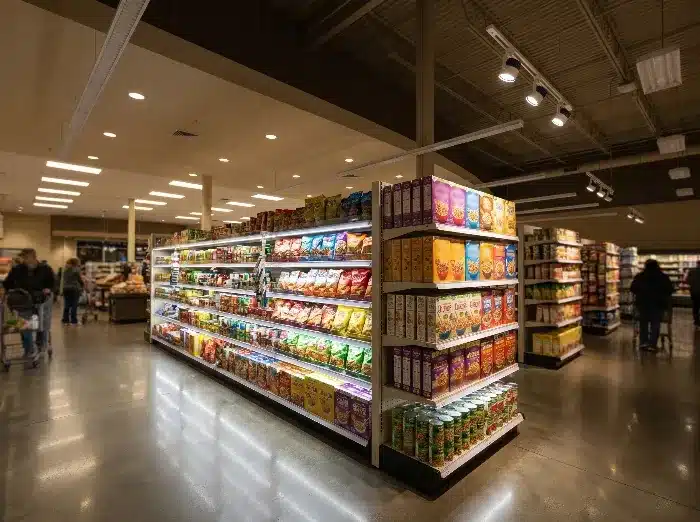
recommended brightness levels for supermarket shelf displays
Shelf Lighting Placement and Installation Strategies
On-Site / Commercial Reality
Placement determines whether the light reaches the product face or simply creates glare. In practice, many shelf lighting failures come from mounting the fixture too far back, too close to the customer’s line of sight, or without considering the shadow cast by shelf fronts and product packaging. Poor placement increases adjustment work and may require bracket modifications after installation.
Maintenance access is equally important. Drivers hidden behind fixed panels or inaccessible shelf components create service problems that become costly once the store is operational.
Deep Dive & Engineering Solution
The most common placement strategies include:
- Front-edge under-shelf mounting for direct illumination of the shelf below
- Recessed profile integration for cleaner appearance and glare reduction
- Back-panel lighting for shallow shelves or featured product walls
- Adjustable spotlight aiming for endcaps and promotional displays
Key placement principles:
- position the light to illuminate the front product face, not only the shelf surface
- avoid direct sight of the LED source from normal customer viewing angles
- use profiles or optics to control glare
- coordinate cable routing and driver location before shelving fabrication
- allow service access for replacement without dismantling the full display
| Installation Factor | Good Practice | Poor Practice | Impact on Maintenance / ROI |
|---|---|---|---|
| Mounting position | Front-edge or optimized angle | Deep setback | Better product visibility, less shadowing |
| Driver access | Serviceable location | Hidden sealed cavity | Lower maintenance labor |
| Cable routing | Planned with shelving design | Added after fabrication | Fewer site delays and cleaner finish |
| Glare control | Diffuser/optics/recessing | Exposed source | Better shopper comfort and product focus |
Factory Note
During hotel commissioning and retail fit-outs, access planning is often underestimated. A lighting system may perform well optically but fail commercially if maintenance requires dismantling shelves, moving stock, or working during store hours. Serviceability should be treated as part of the design, not a post-installation issue.
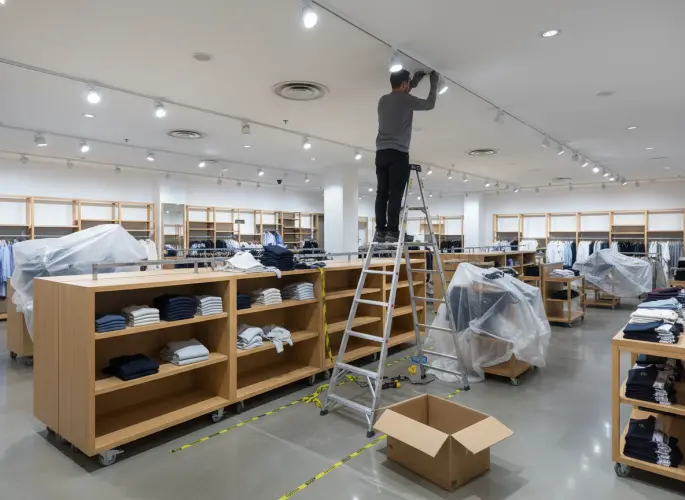
shelf lighting placement and installation for supermarkets
Supermarket Shelf Lighting Design Example
On-Site / Commercial Reality
A design example helps clarify how shelf lighting should be layered in a real supermarket instead of specified as isolated fixtures. In live projects, store operators need a solution that works across packaged goods, fresh food, promotional areas, and circulation aisles without creating visual inconsistency.
Deep Dive & Engineering Solution
Consider a medium-sized supermarket with the following zones:
- ambient aisle lighting for general circulation
- linear shelf lighting on gondola shelves for packaged goods
- warmer shelf lighting in bakery displays
- cooler, crisp lighting in chilled sections
- accent spotlights on promotional endcaps
A practical design strategy could be:
- Use neutral white linear shelf lighting on standard grocery aisles for uniform clarity.
- Integrate front-edge under-shelf lighting to improve lower-shelf visibility.
- Apply warm CCT in bakery shelving to enhance golden product tones.
- Use spotlights at endcaps to create hierarchy and draw attention to promotions.
- Maintain visual balance between ambient and shelf lighting so highlighted products stand out without causing discomfort.
This approach improves customer navigation by making categories easier to read and promotions easier to notice. It also helps maintain a clean visual rhythm across the store.
Factory Note
From a manufacturing perspective, chain-store projects benefit from standardized module lengths, connector types, and driver architecture. This reduces installation variability between locations and improves spare-part management over the life of the rollout.
Energy Efficiency in Supermarket Shelf Lighting
On-Site / Commercial Reality
Supermarkets operate long hours, so shelf lighting energy use has a direct impact on running cost. However, reducing wattage alone is not enough. If a low-power solution fails to illuminate products effectively, the store may compensate by adding more fixtures or increasing ambient lighting, which cancels out the intended savings.
For facility teams, the real target is useful light on products per watt consumed, combined with low maintenance frequency.
Deep Dive & Engineering Solution
Energy-efficient shelf lighting depends on several factors:
- high-efficacy LED sources
- efficient optics that direct light where needed
- dimming control7 where operating schedules vary
- correct driver matching
- reduced over-lighting through task-focused design
Linear LED systems are generally more efficient than broad over-lighting from ceiling fixtures because they place light closer to the display surface. This allows lower total system wattage while maintaining strong visual performance.
Other useful strategies include:
- zoning shelf lighting by department
- reducing output during low-traffic hours where appropriate
- selecting long-life components to reduce replacement cycles
- verifying thermal design to preserve LED performance over time
Factory Note
From a manufacturing perspective, thermal stability and driver reliability are central to energy performance. A system that starts efficiently but degrades quickly in output or fails early will not deliver real lifecycle savings. In commercial projects, long-term stability matters more than headline efficacy alone.
Common Supermarket Shelf Lighting Mistakes
On-Site / Commercial Reality
Most shelf lighting problems seen after store opening are not caused by a lack of fixtures, but by poor coordination between lighting design, merchandising, and installation. These mistakes increase maintenance calls, reduce presentation quality, and can damage the retailer’s brand image.
Deep Dive & Engineering Solution
Common mistakes include:
- relying only on ambient ceiling lighting
- using one CCT for all product categories
- ignoring lower-shelf illumination
- placing fixtures where customers can see direct glare
- choosing brightness based only on wattage, not delivered shelf illumination
- installing LED strips without proper thermal support
- hiding drivers in inaccessible locations
- failing to account for reflections from glossy packaging
Each of these issues reduces the commercial effectiveness of the lighting system. The correction is usually simple in concept but expensive in execution once shelving, stock, and wiring are already in place.
Factory Note
In large rollout projects, the most expensive lighting mistake is not usually the fixture cost. It is the accumulated cost of on-site correction, delayed opening, technician revisits, and inconsistent execution across branches. Early mock-up validation prevents most of these problems.
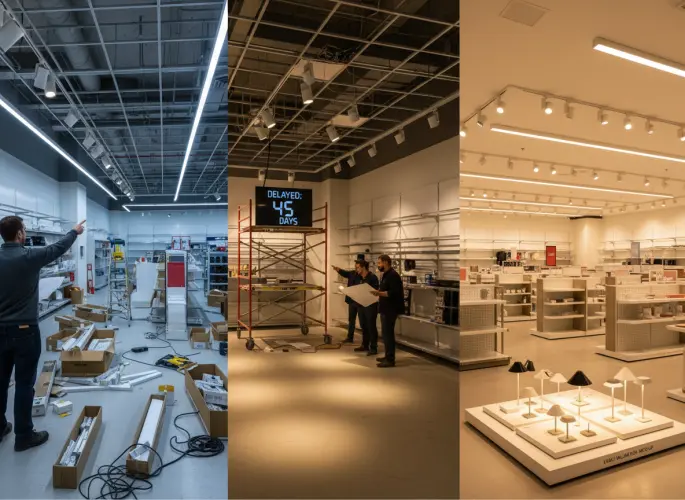
common mistakes in supermarket shelf lighting design
Future Trends in Retail Shelf Lighting
On-Site / Commercial Reality
Retail shelf lighting is moving toward more adaptive, category-specific solutions. For supermarket operators, future upgrades will not only focus on energy savings, but also on flexibility, visual consistency, and easier store refresh cycles. Systems that are difficult to modify will become less attractive in fast-changing retail formats.
Deep Dive & Engineering Solution
Several trends are shaping the next generation of shelf lighting:
- more integrated linear systems within modular shelving
- better optical control for reduced glare and tighter shelf targeting
- tunable white solutions8 for category-specific presentation
- smarter dimming and control by time schedule or zone
- lower-profile fixtures with cleaner mechanical integration
- increased emphasis on lifecycle maintenance planning
For multi-site retailers, modular lighting architectures will become more valuable because they support category updates and merchandising changes without full rewiring.
Factory Note
From a manufacturing perspective, the future of shelf lighting is not just smarter electronics. It is better system integration between optics, mechanics, thermal management, drivers, and installation method. The projects that age well are usually those built on stable, serviceable hardware platforms.
FAQ
What is supermarket shelf lighting?
Supermarket shelf lighting is targeted lighting used to illuminate product faces, labels, shelf tiers, and promotional displays. It supports vertical visibility rather than only lighting the floor or aisle.
How many lux do supermarket shelves need?
There is no single number for every store, but many projects use 300–500 lx for general aisles, 500–750 lx on standard product faces, and 750–1000 lx for promotional or high-emphasis displays. These values should be verified by mock-up and local lighting standards.
What color temperature is best for supermarket shelves?
Packaged goods often work well around 3500K–4000K. Bakery displays usually benefit from 2700K–3000K, while chilled and frozen sections often use 4000K–5000K. Fresh food may need higher CRI or category-specific spectra, not only a different CCT.
Is LED strip lighting good for supermarket shelves?
Yes, LED strip lighting can work well for shelf-edge and under-shelf applications, especially when used with aluminum profiles, diffusers, correct driver sizing, and voltage-drop control. Without those details, strips may show dots, uneven brightness, or premature degradation.
Where should shelf lights be installed?
Shelf lights are usually most effective near the front edge or at an optimized angle that reaches the product face. The fixture should not shine directly into customers’ eyes, and drivers should remain accessible for maintenance.
How can supermarkets reduce shelf lighting energy cost?
The most effective approach is to direct light only where it is needed, use efficient optics, apply zoning or dimming where appropriate, avoid over-lighting, and select reliable drivers and thermally stable LED systems.
Conclusion: Business Value
Well-designed supermarket shelf lighting improves product visibility, strengthens category presentation, and creates a more effective shopping environment. For B2B stakeholders, the value is clear: better merchandising impact, fewer installation corrections, easier maintenance access, and lower lifetime system cost.
A practical solution combines the right fixture type, correct color temperature, appropriate brightness, and careful mounting detail. When these elements are aligned, shelf lighting does more than make displays look brighter. It helps products sell more effectively while reducing operational friction.
B2B Engineering Recommendation
For large supermarket projects, share the shelf drawings, fixture layout, product categories, target CCT, dimming plan, driver locations, and expected operating schedule before mass production. The Teco engineering team can simulate the electrical load, review thermal and optical risks, build a sample configuration, and verify compatibility in the lab before rollout. For project-specific support, buyers can contact Teco with drawings, lamp schedules, and target lighting requirements.
Footnotes
Vertical illumination refers to light falling on vertical surfaces such as product fronts, labels, and shelf displays rather than only on the floor or horizontal plane. ↩
Lux is the unit of illuminance, indicating how much light reaches a given surface area. ↩
Color temperature is the visual warmth or coolness of white light, typically expressed in Kelvin (K). ↩
Thermal management is the control of heat within a lighting system to protect LED performance, color stability, and lifetime. ↩
Voltage drop is the reduction in electrical voltage along a cable or LED strip run, which can cause uneven brightness if not properly managed. ↩
Color rendering index (CRI) measures how accurately a light source reveals colors compared with a reference source. ↩
Dimming control is the ability to adjust light output to suit operating conditions, energy targets, or visual requirements. ↩
Tunable white solutions allow adjustment of the light’s color temperature to suit different products, times of day, or retail scenes. ↩