GU10 LED Lumens Guide: Brightness, Beam Angle and Application Selection
Updated: September 10, 2026
GU10 lumens measure total light output, but they do not show how bright the illuminated surface will appear. A narrow beam concentrates the same lumens into a smaller area, while a wide beam spreads them more evenly. Select GU10 brightness by application, beam angle, mounting height, target lux, surface reflectance, glare limit and dimming strategy.
| Selection factor | Why it matters | Buyer question |
|---|---|---|
| 流明 | Total emitted light | Is the output range suitable for the task? |
| 光束角度 | Controls concentration and coverage | Is the goal accent, display or general lighting? |
| Lux and mounting height | Describe light reaching the working surface | Has the layout been checked at the real distance? |
| Glare and dimming | Affect comfort and usable brightness | Will samples remain comfortable and stable in use? |
For B2B projects, specify a lumen range together with beam, CCT, CRI, dimming behavior and fixture conditions, then validate the final choice with samples or a lighting calculation.
许多买家认为选择一款 GU10 LED灯泡 这一点很直接:流明值越高意味着光线越亮,因此选择最大输出似乎最安全。在实际项目中,这种假设常常导致眩光投诉、照明不均以及令人失望的用户体验——尤其是在酒店、零售环境和办公室中。.
GU10 LED灯泡的流明输出并非衡量亮度的独立指标。.
只有当流明输出与光束角度、应用类型、运行时间以及视觉舒适度期望一起评估时,亮度才变得有意义。.
本指南解释了GU10流明输出的真正含义、为何感知亮度差异如此之大、不同应用场景下哪些流明范围最合适,以及买家如何正确指定GU10亮度——无需依赖试错。.
买家快速解答
在深入技术细节之前,明确设定预期会有所帮助:
- 大多数GU10亮度问题是由 错误的光束角度选择, ,而非流明不足。.
- 更高的流明输出并不会自动提升视觉质量,反而常常会增加眩光。.
- “正确”的GU10流明输出取决于 应用场景、光束控制和运行特性, ,而非产品类别。.
基于这一基准,以下部分将解释如何正确选择GU10亮度。.
GU10 LED灯泡的流明输出究竟意味着什么?
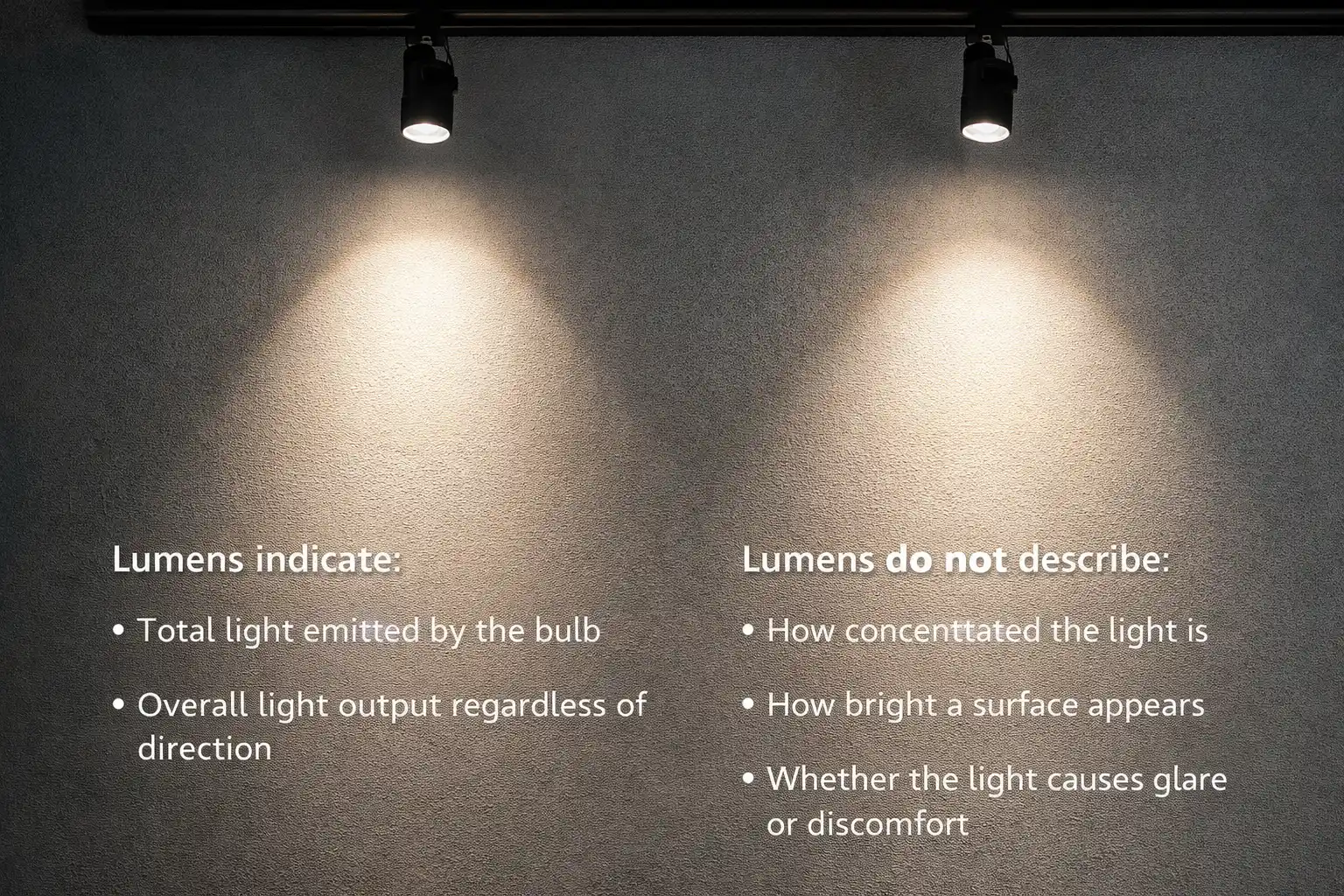
并排聚光灯图示,解释流明作为总光输出与其他关键因素(如光束集中度、感知亮度以及可能产生的眩光或视觉不适)的对比。.
流明输出是GU10购买中最常被误解的参数之一。.
流明输出描述的是GU10 LED灯泡总共发出的光量——而不是它在空间中看起来有多亮。.
流明衡量的是光量,而非视觉体验
流明表示:
- 灯泡发出的总光量
- 不考虑方向的总光输出
流明确实 不 描述:
- 光线的集中程度
- 表面看起来有多亮
- 灯光是否造成眩光或不适
对于像GU10聚光灯这样的定向照明,这种区分至关重要。.
为何GU10流明的表现与E27灯泡不同
GU10灯泡本质上是定向的。.
与全向灯不同,GU10的亮度由光学元件和反射器塑造。因此:
- 两个流明输出相同的GU10灯泡看起来可能完全不同
- 光束角度对感知亮度的影响往往比流明输出本身更大
这就是为什么任何不考虑光束角度的GU10流明比较都是不完整的。.
市场上典型的GU10流明范围
大多数GU10 LED灯泡的输出范围属于以下区间:
- 250–350 流明
- 350–450 流明
- 450–550 流明
- 550–700+ 流明
每个范围都有其适用场景。问题在于买家误以为数值越高就越好。.
买家为何感到困惑
实际上,许多买家在比较GU10灯泡时使用:
- 仅凭流明数值
- 营销宣传或卤素灯等效值
这种方法忽略了GU10光学原理,常导致照明过度。.
Understanding what lumens represent—and what they do not—is the foundation of correct GU10 brightness selection.
Lumen vs Beam Angle: Why Brightness Perception Changes Dramatically

Illustration of spotlight beam angles, comparing a narrow 24° beam delivering higher illuminance with a wide 60° beam providing broader, lower-intensity light distribution against a neutral wall.
Perceived brightness depends on how light is distributed, not just how much light exists.
In GU10 spotlights, beam angle often affects perceived brightness more than lumen output.
How beam angle concentrates light
Beam angle defines how wide the light spreads:
- Narrow beam = light concentrated in a small area
- Wide beam = light spread over a larger surface
A narrower beam produces higher illuminance (lux) on the target even with fewer lumens.
Same lumens, very different results
例如:
- 400 lm GU10 with a 24° beam
- 400 lm GU10 with a 60° beam
The 24° version will appear significantly brighter on shelves or walls, despite identical lumen output.
This is why the question “how many lumens for a GU10 spotlight?” cannot be answered without specifying beam angle.
Why wide beams often feel “dim”
Wide-beam GU10 bulbs may feel dim because:
- Light is distributed over a larger area
- Contrast is reduced
- Surfaces receive lower intensity
Buyers often compensate by choosing higher lumen bulbs, unintentionally creating glare.
Lux vs lumens in real spaces
- Lumens describe total light
- Lux describes light on a surface
Users perceive lux, not lumens.
Beam angle controls how lumens are converted into usable lux.
Practical takeaway
Never specify GU10 LED bulb lumen output without defining beam angle first.
Most brightness complaints originate from beam mismatch, not insufficient output.
Recommended GU10 Lumen Ranges for Common Applications
There is no single “correct” GU10 lumen output. Only appropriate ranges for specific applications.
Typical application-based guidance
| 应用 | 光束角度 | Recommended Lumens |
|---|---|---|
| 重点照明 | 10°–24° | 250–350 lm |
| General residential lighting | 36°–60° | 350–450 lm |
| Retail display | 24°–36° | 400–600 流明 |
| Office task areas | 36°–60° | 450–650 lm |
| Hospitality corridors | 36°–60° | 300–500 流明 |
These ranges reflect how GU10 brightness is specified in real projects, not laboratory conditions.
Why accent lighting needs fewer lumens
Accent lighting relies on:
- 对比度
- 专注
- Direction
A narrow beam with moderate lumens produces stronger visual impact than high-output wide beams.
Why general lighting requires balance
General lighting must:
- Avoid glare
- Provide comfort
- Maintain uniformity
Higher lumens are often needed—but only when paired with appropriate beam spread.
The risk of over-lighting
Choosing maximum lumen output “to be safe” frequently results in:
- Harsh visual environments
- Reduced comfort
- Complaints in hospitality and residential spaces
Brightness should support the space, not dominate it.
Commercial vs Residential GU10 Brightness Requirements
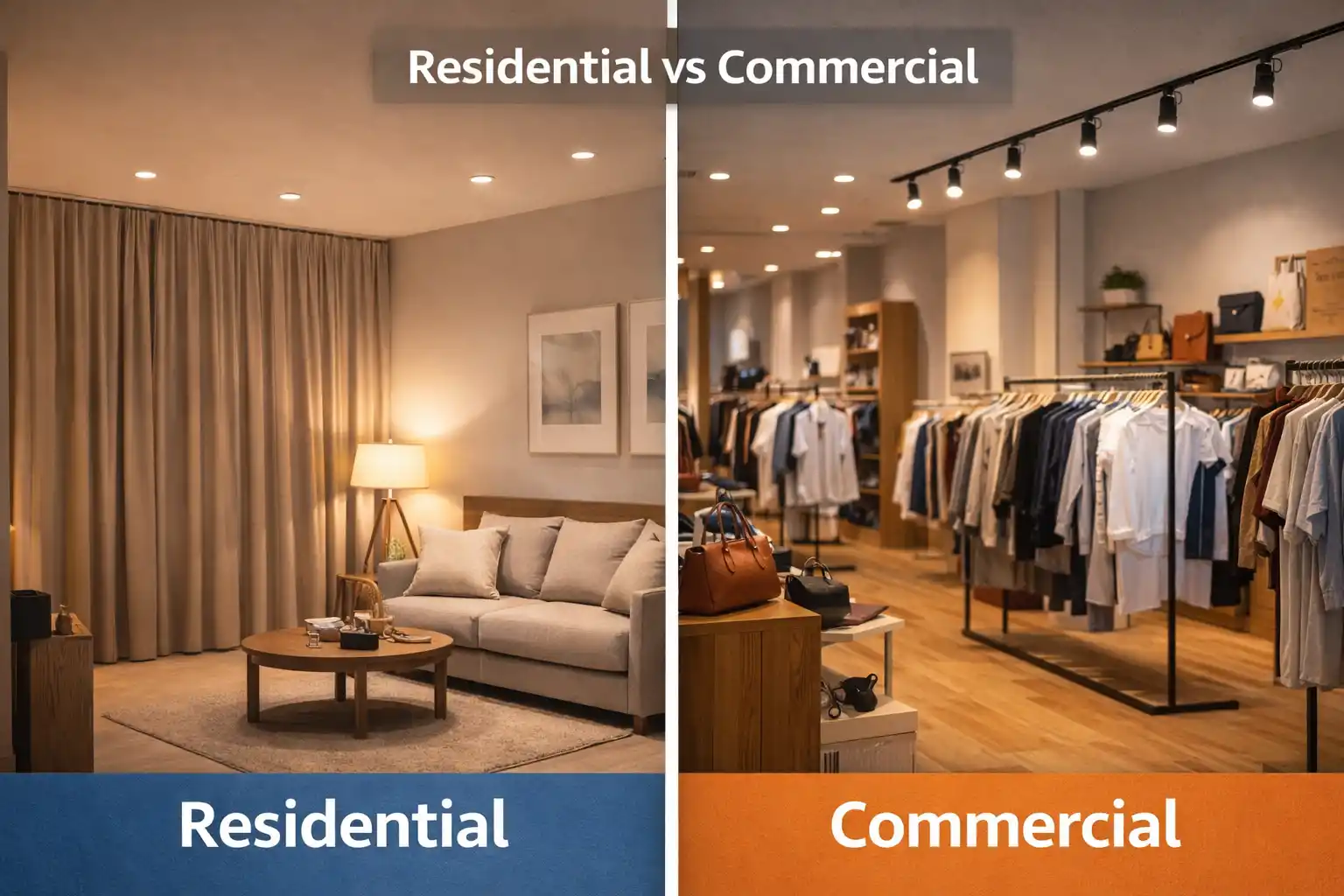
Visual comparison of residential versus commercial interior lighting setups, highlighting differences between home environments and retail applications.
Residential and commercial spaces use light very differently.
Commercial GU10 lumen requirements are often higher than residential, but tolerance for glare is lower.
Residential brightness logic
In homes, GU10 lighting supports:
- 舒适性
- Mood
- 灵活性
Typical residential ranges:
- 250–400 lm for accent
- 350–450 lm for general lighting
Overly bright GU10 bulbs quickly feel uncomfortable in living spaces.
Commercial brightness logic
Commercial environments prioritize:
- 可见度
- 一致性
- 功能清晰度
Typical commercial ranges:
- 400–600 lm for retail and offices
- Up to 700 lm in high-ceiling or task-focused areas
However, glare control becomes more critical as brightness increases.
Hospitality as a hybrid case
Hotels combine residential comfort with commercial scale:
- Guest rooms usually require lower lumens
- Public areas often require higher output
Many hotel lighting complaints stem from applying commercial brightness logic to residential-style spaces.
Buyer implication
Always clarify whether the GU10 bulb is intended for:
- Private residential use
- Public commercial spaces
- Mixed hospitality environments
Brightness targets change accordingly.
Common Mistakes Buyers Make When Choosing GU10 Lumens

Living room scene illustrating overly bright GU10 ceiling spotlights that cause significant glare and visual discomfort while occupants watch television.
Most GU10 brightness issues follow predictable patterns.
Mistake 1: Choosing the highest lumen available
High-lumen GU10 bulbs often cause:
- 眩光
- Hot spots
- Visual fatigue
Especially when paired with narrow beams.
Mistake 2: Ignoring beam angle
Comparing lumen numbers alone leads to:
- Over-bright narrow beams
- Underwhelming wide beams
Beam angle should be specified before lumen output.
Mistake 3: Blindly copying halogen equivalents
Halogen-to-LED equivalence charts are approximations.
LED optics behave differently and require independent evaluation.
Mistake 4: Using one lumen level everywhere
Uniform brightness across all areas:
- Flattens visual hierarchy
- Wastes energy
- Reduces comfort
Layered lighting requires varied lumen outputs.
Mistake 5: Ignoring surface reflectance
Dark surfaces absorb light; bright surfaces reflect it.
The same GU10 lumen output feels very different in each environment.
Mistake 6: Overlooking dimming behavior
If dimming is used, full lumen output is rarely needed.
Moderate lumen output with stable dimming often performs better than extreme brightness.
Practical Buyer Checklist: How to Specify GU10 Brightness Correctly
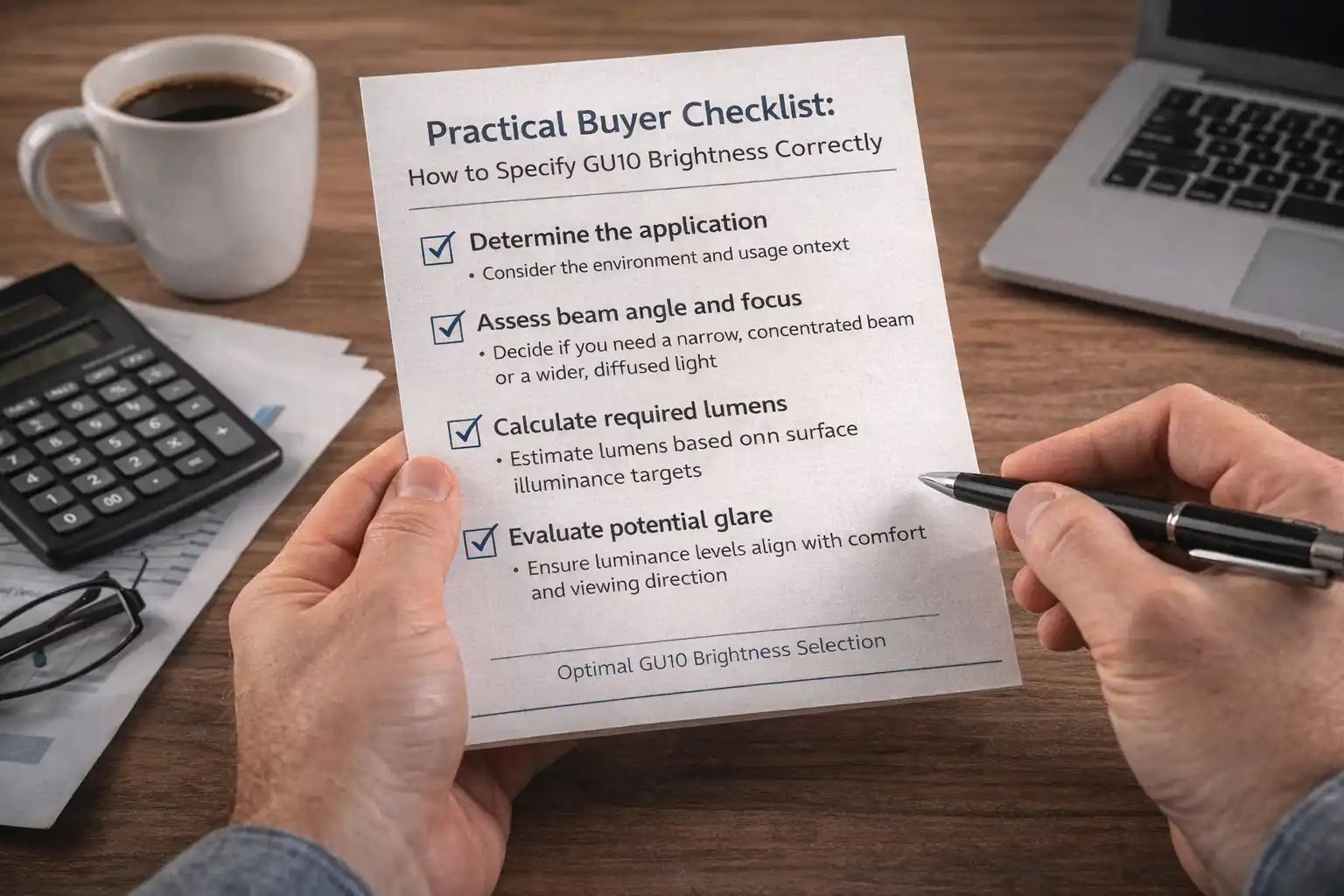
Practical buyer checklist for specifying GU10 brightness correctly, featuring steps such as environment assessment, beam focus selection, and optimal luminance planning in an office setting.
Correct GU10 brightness selection starts with the right questions.
Step 1: Define the application
- Accent or general lighting?
- Residential, commercial, or hospitality?
Step 2: Choose beam angle first
- Narrow (10°–24°)
- Medium (36°)
- Wide (60°)
Step 3: Select a lumen range, not a single number
Consider:
- 天花板高度
- Fixture spacing
- Surface reflectance
Step 4: Evaluate glare and comfort
Check:
- Viewing angles
- Eye-level exposure
- Reflective materials
Step 5: Align with dimming strategy
Ensure:
- Stable low-end dimming
- No need to rely on extreme output
Step 6: Standardize SKUs intelligently
For bulk buyers:
- Use a limited set of lumen levels
- Match beam angles consistently
This reduces inventory complexity without sacrificing performance.
结论
Choosing the right GU10 LED灯泡 lumen output is not about selecting the brightest option. It is about balancing beam angle, application requirements, operating profile, and user comfort.
Projects succeed when brightness supports visual intent rather than overpowering it. Buyers who treat lumen output as part of a system—rather than a standalone number—achieve more predictable, comfortable, and professional lighting results.
Technical Support for GU10 Brightness Specification
Selecting the right GU10 LED灯泡 brightness is rarely about choosing a higher lumen number—it is about matching beam angle, operating hours, and visual comfort to the actual application.
For bulk buyers, project managers, and lighting specifiers, incorrect GU10 lumen selection often becomes visible only after installation, when glare complaints or uneven lighting appear.
如果您正在从事:
hotel or hospitality lighting projects
retail or office GU10 spotlight specifications
mixed residential–commercial environments
bulk GU10 LED bulb procurement
our team supports buyers with application-based GU10 brightness guidance, including:
GU10 lumen range validation by beam angle
residential vs commercial brightness alignment
mock-up and sample review recommendations
SKU standardization strategies for bulk orders
Share your application scenario, beam angle, and project scale, and we can help you define GU10 brightness that performs correctly in real spaces—not just on datasheets.
Contact: [email protected]
网站: www.tecolite.com