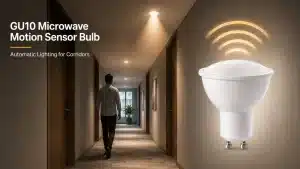
GU10与一体化LED筒灯在2026年:哪个更适合您的项目?
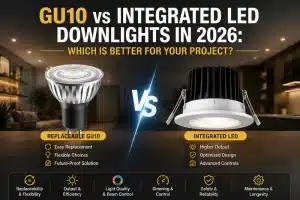
选择可更换GU10灯泡与一体化LED筒灯,不再是简单的“旧技术对新技术”决策。两种形式均采用LED技术,都能提供高效美观的照明。真正的区别在于光引擎、驱动器、光学系统和热管理系统的位置——以及当项目五年后需要不同光束、色温或更换时会发生什么。.
GU10筒灯将灯具与光源分离。天花板安装件包含一个标准化的GU10插座,用户可以拆卸和更换灯泡。集成式LED筒灯则将LED模块、驱动器、散热器和光学系统整合为一个灯具。当其光源或驱动器失效时,通常需要更换整个模块——有时甚至是整个安装件。.
两种形式并非自动优劣。GU10通常在可更换性、产品选择和未来灵活性上胜出。一体化LED通常在紧凑尺寸、热设计和小孔径最大输出方面占优。正确选择取决于应用场景、维护策略和建筑预期寿命。.
快速解答
选择 GU10筒灯 当项目重视:
- 可更换光源
- 轻松调整色温、显色指数、光束角或输出功率
- 可获取专业灯具,例如 CRI98 GU10, ,可调光至暖光或窄光束型号
- 无需更换天花板装置即可进行简单的本地维护
- 减少对单一灯具型号持续可用的依赖
选择一款 集成LED筒灯 当项目重视:
- 紧凑孔径下更高的流明输出
- 作为一个单元设计的完整光学与热学系统
- 极浅的天花板深度
- 宽泛的通用照明分布
- 项目级控制,如DALI、0-10V或远程驱动器
对于长寿命住宅、酒店和零售项目,不要仅比较采购价格。需比较完整系统:灯具、灯泡或模块、驱动器、调光控制、安装人工、更换可用性,以及产品停产后恢复外观一致性的成本。.
GU10与集成LED:结构差异是什么?
在GU10系统中,天花板灯具主要提供机械支撑、电气连接,以及(在适用产品中)防火、隔音或防护等级保护。GU10灯泡自带LED封装、驱动器、光学元件和热管理结构。标准GU10灯泡直径通常约50毫米,但其长度和前部轮廓各异。我们的指南 GU10尺寸与灯具兼容性 解释了为何检查深度和边框间隙很重要。.
在集成式筒灯中,LED板、散热器、透镜或反射器以及驱动器被选作一个匹配的系统。这为制造商提供了更大的自由度。散热器可以大于可见孔径,驱动器可以置于光源引擎外部,且光学系统无需适配可更换的50毫米灯罩。.
这种设计自由度可以提升输出和效率,但也带来了依赖性:替换品通常需要匹配原有的开孔尺寸、深度、连接器、驱动器、外观、颜色以及光度分布。.
并排对比
| 决策因素 | 可更换GU10筒灯 | 集成式LED筒灯 |
|---|---|---|
| 光源更换 | 更换GU10灯具 | 通常更换模块或灯具 |
| 初始产品选择 | 非常广泛 | 仅限于所选灯具系列 |
| 输出潜力 | 受灯泡尺寸和热量限制 | 相同可见孔径下通常更高 |
| 光束灵活性 | 更换灯泡或选择可调光学元件 | 由灯具固定(除非光学元件可互换) |
| 高显色指数选项 | 易于指定专业灯具 | 可用,但需与完整灯具配套选择 |
| 调光性能 | 取决于灯具、调光器及电路负载 | 取决于配套驱动器和控制协议 |
| 天花板深度 | 灯具和灯座需要空间 | 提供超薄设计型号 |
| 维护 | 熟悉快捷的灯具更换方式 | 可能需要电工或匹配的替换模块 |
| 未来可用性 | 标准化接口降低绑定风险 | 具体型号可能停产 |
| 防护等级/防火等级 | 由完整灯具决定,而非仅灯泡本身 | 通常作为完整灯具进行测试 |
1. 可替换性与产品淘汰
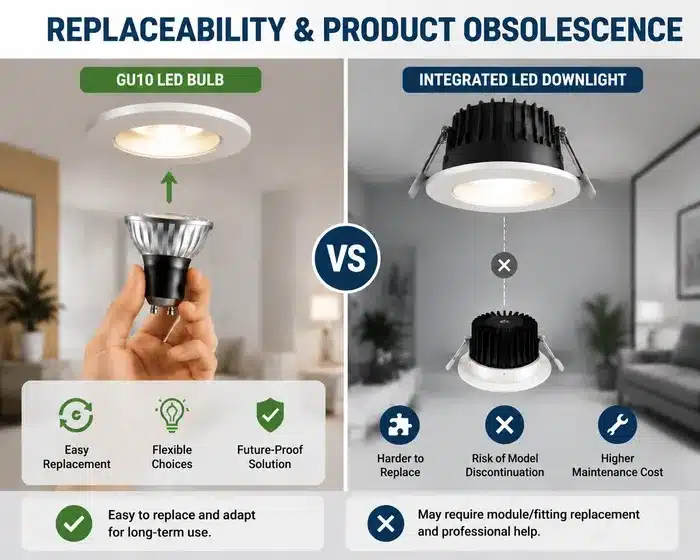
可替换性是GU10最显著的优势。若某盏灯损坏,维护团队通常可隔离电路、取下旧灯并安装兼容替换品,无需触动天花板。该灯具可历经数代LED灯迭代而持续使用。.
这并不意味着每个GU10在视觉上都可以互换。更换不同色温、光束角、光通量输出、透镜纹理或颜色容差的灯具,可能会与旧灯具显得不一致。专业项目应记录型号、色温、显色指数、光束、调光类型和颜色容差数据,并保留少量原生产批次的备用灯具。.
对于集成式筒灯,更换可能更为复杂。即使电气连接器简单,新模块也必须适合现有的开孔和安装深度。其边框尺寸、表面处理、光通量输出和光束分布也应与相邻单元匹配。如果原始型号已停产,更换一个故障筒灯可能会导致明显的视觉不协调——或迫使进行更大范围的更换。.
一体化产品未必不可靠,问题在于系统连续性。宣称的50,000小时LED寿命并不能保证驱动器、连接器和具体型号在同一时期内持续可用。.
2. 输出、能效与热管理
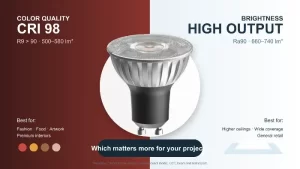
一体化LED筒灯可为散热器和驱动器分配更多物理空间,这有助于在控制LED结温的同时实现高光通量输出。因此它们非常适合高天花板、基础照明以及需要少量灯具实现高照度的应用场景。.
GU10灯具必须将LED、光学元件、驱动器和散热路径集成在紧凑的灯体内。更高瓦数未必更好:如果安装底座积热,灯具可能降低输出、色偏或缩短驱动器寿命。实际限制取决于灯具结构、气流和周边环境——而不仅是包装盒标注的瓦数。.
GU10在重点照明领域依然高效,因为总光通量仅是效果的一部分。相较于高流明宽光束筒灯,可控的10°或24°光束能为小型产品陈列区提供更高照度。请阅读我们的指南: GU10光通量、光束角与亮度 在比较输出参数前.
为公平比较,请要求:
- 工作温度下的实际光通量
- 光束角与视场角
- 峰值光强(坎德拉)
- 在预期安装距离下的照度(勒克斯)
- 光通维持率数据
- 最高环境温度
- 可用光度学文件(如IES或LDT格式)
3. 光质量:显色指数、R9与色彩一致性
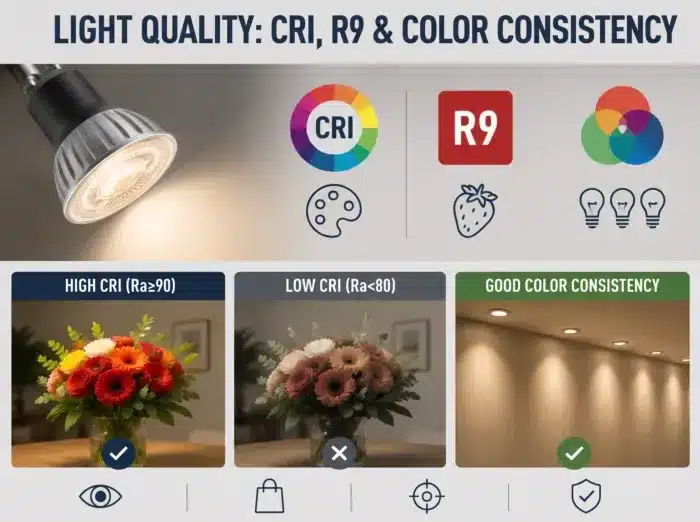
一体化LED不会自动提供更佳色彩,可替换灯具也不会自动导致色彩表现下降。两种形式均可采用高品质LED,差异在于规格变更的便捷程度。.
GU10为设计师提供专业组合方案:高显色指数、强R9值、不同色温、窄光束、调光暖色及高输出变体。若时装零售商后期更换材料,或餐厅需要更暖的晚间灯光,更换灯具可能已足够。.
当LED板、反射器和驱动器协同设计时,一体化灯具可提供卓越的色彩一致性。但所需的色彩质量选项通常需随灯具一并订购。后期改装不同光谱可能意味着需要更换模块或整个灯具。.
切勿仅凭CRI批准任一系统。需审查饱和红色的R9值、颜色一致性、相关色温(CCT)、Duv值,以及在颜色对业务至关重要的场合下的TM-30数据。零售应用请参阅我们的 高显色指数GU10项目指南.
4. 光束角与指向灵活性
大多数GU10系列提供多种光束角。一个项目可以使用窄光束照亮艺术品,中光束照亮桌面,宽光束用于流通区域,同时保持相同的可见灯具外观。有些灯具提供可调光学;例如, 可调焦GU10 无需更换天花板硬件即可改变照明区域。.
集成式筒灯通常能提供更干净、更广泛的整体照明分布,因为反射器和光源引擎是共同设计的。专业产品系列可能也提供可互换的反射器,但购买前需确认此功能。.
确认应用场景需要固定式筒灯还是可调万向节。光束角描述光线扩散范围,而瞄准方向决定光束落点。优质光束若指向错误位置仍会导致照明效果不佳。.
5. 调光与控制兼容性
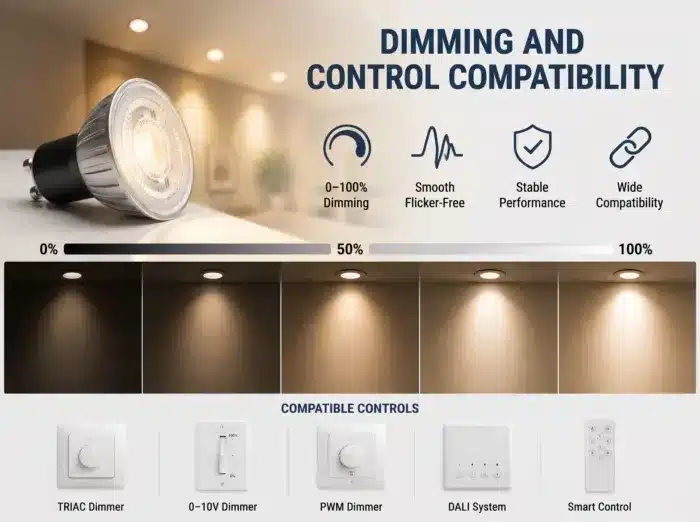
GU10灯具通常直接使用主电源电压工作,并常用相位切割/TRIAC调光。性能取决于三个组件的协同工作:灯具驱动器、调光器和总电路负载。标记为“可调光”的灯具若与不合适的调光器搭配,仍可能出现闪烁、嗡嗡声、突然点亮、熄灭或低端范围受限的情况。.
集成式筒灯也可使用相位切割驱动器,但它们有更多空间用于远程或专用驱动器。商用版本可能支持0-10V、DALI、DMX或无线控制。这使得集成式灯具对大型建筑控制系统更具吸引力。.
然而,复杂的控制标签并不能替代测试。请验证:
- 控制协议与布线拓扑
- Minimum and maximum driver load
- Number of luminaires per channel
- Low-end dimming level
- Flicker performance at full and reduced output
- Standby behavior and switch-off leakage
- Compatibility with emergency and automation systems
If the project uses phase-cut controls, review what 0–100% dimmable GU10 really means and test the exact lamp–dimmer combination before bulk ordering.
6. Installation Depth, Fire Rating and Wet Locations
Integrated downlights can be extremely shallow, making them useful where ducts, concrete or limited ceiling voids restrict depth. A GU10 fitting must accommodate the lamp, holder, wiring and safe clearance, so the complete assembly is often deeper.
Safety and environmental ratings apply to the installed system. An IP65 bezel does not make every lamp or installation suitable for every wet location. Similarly, fire rating is normally a characteristic of the complete downlight construction and its installation method—not a claim created by inserting a particular GU10 bulb.
Before specifying either format, confirm:
- Ceiling cutout and available depth
- Required fire rating and test standard
- IP rating for the installation zone
- Insulation-clearance requirements
- Ventilation and maximum ambient temperature
- Local electrical and building regulations
Do not modify an integrated fitting or convert its wiring to accept a GU10 lamp unless the luminaire manufacturer provides an approved retrofit method. Unauthorized modification can create electrical, thermal, certification and insurance risks.
7. Maintenance and Total Cost of Ownership
The cheapest unit price does not necessarily produce the lowest project cost. A useful comparison covers the expected operating period.
GU10 cost model
Include:
- Downlight fitting
- GU10 lamp
- Compatible dimmer or control
- Replacement lamps
- Labor for accessible lamp changes
- Spare stock for visual consistency
Integrated LED cost model
Include:
- Complete luminaire and driver
- Control gear
- Replacement modules or fittings
- Electrician access and ceiling work
- Recommissioning of control systems
- Potential group replacement if the original model is unavailable
For a small residence with accessible ceilings, replacing an integrated downlight may be manageable. For a hotel with hundreds of rooms, a discontinued module can become a procurement and visual-consistency problem. Conversely, an integrated system with a documented replaceable driver and guaranteed module availability may deliver an excellent lifecycle result.
Ask the supplier what is replaceable, how long replacements will remain available and whether the warranty covers only the component or also removal and reinstallation labor.
Application Guide
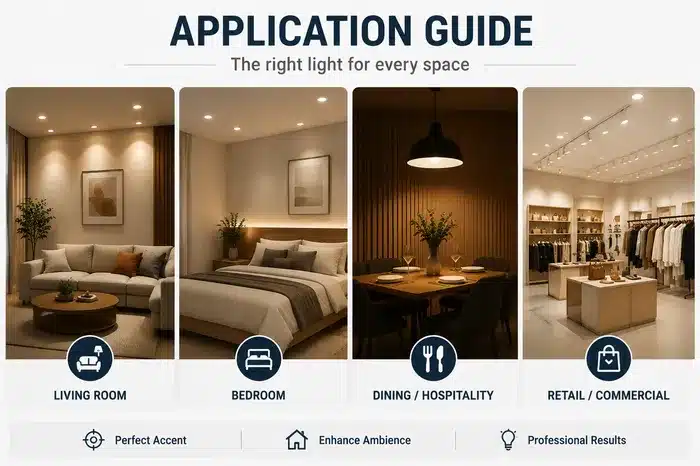
Residential renovations
GU10 is a strong choice when homeowners want to change color temperature, beam or smart functions later. Integrated downlights are useful in shallow ceilings, bathrooms and areas needing a tested sealed fitting. Many homes benefit from a mixed approach rather than forcing one format into every room.
Hotels and restaurants
GU10 supports fast room-level replacement and specialist dim-to-warm or high-CRI options. Integrated LED may be preferred for lobby general lighting, high-output areas and centralized control. Standardize a small number of approved lamp and fitting combinations to reduce maintenance complexity.
Retail and galleries
GU10 is valuable when merchandise, exhibitions or layouts change frequently. Replaceable beam and color options give the visual-merchandising team flexibility. Integrated track or recessed systems may be better where the project needs higher intensity, precision accessories or advanced controls.
Offices and large commercial spaces
Integrated luminaires are usually more suitable for broad, efficient general lighting and building-wide controls. GU10 can still support reception desks, artwork, meeting-room accents and small focused zones.
高天花板
Do not select by lamp format alone. Calculate required target lux and compare candela at the installed distance. Integrated products often offer higher intensity, but a narrow-beam professional GU10 may be sufficient for selected accent applications.
A Better Decision Framework
Answer these questions before requesting quotations:
- Is the lighting primarily ambient, task or accent lighting?
- What lux level is required on the target surface?
- Will the layout, merchandise or artwork change?
- Must the light source be replaceable without changing the fitting?
- What ceiling depth, cutout, IP and fire requirements apply?
- Which CRI, R9, CCT and color-tolerance values are required?
- Is the beam fixed, adjustable or zoomable?
- Which dimming or control system will be used?
- Who will maintain the installation, and how difficult is access?
- What replacement components will be available in five or ten years?
If the answers emphasize flexibility, local replacement and specialist light quality, GU10 is likely the better platform. If they emphasize compact construction, high output and system-level control, integrated LED is likely stronger.
Sample Testing Checklist for Project Buyers
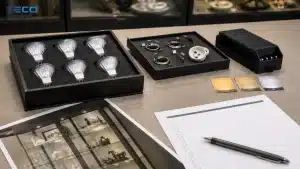
Never approve a large order from a catalog comparison alone. Install samples in the real or representative fitting and check:
- Physical fit, depth and bezel clearance
- Startup consistency across multiple units
- Beam shape, cutoff and spill light
- Target lux at the actual mounting height
- Color appearance on skin, food, textiles, wood and painted surfaces
- Color consistency between samples
- Dimming from maximum to minimum and back again
- Flicker, buzzing, pop-on and dropout
- Surface temperature after extended operation
- Removal and replacement procedure
- Appearance of a replacement sample beside an aged unit
Use the same supply voltage, dimmer, circuit load and enclosure planned for the project. Our LED quality inspection checklist provides additional checks for bulk procurement.
Common Purchasing Mistakes
Comparing only watts and lumens
Watts describe input power, and lumens describe total light output. Neither tells you whether the target receives enough light or whether the beam is appropriate.
Treating “replaceable” as “identical forever”
GU10 sockets are standardized, but lamp appearance and performance vary. Keep full specifications and project spares.
Assuming a long LED-life claim covers the complete luminaire
LED lumen maintenance, driver survival and product availability are different issues. Ask for the evidence and warranty terms behind each claim.
Ignoring the dimmer until installation
Dimming compatibility must be confirmed before the bulk order, not after flicker appears on site.
Applying the bulb’s rating to the complete fitting
IP, fire and insulation requirements must be evaluated for the complete installed assembly.
Final Verdict: Which One Should You Choose?
The strongest reason to choose GU10 in 2026 is not nostalgia. It is modularity. A standardized replaceable lamp lets the project change output, spectrum, beam and dimming characteristics while retaining the fitting. This is valuable where visual requirements change and maintenance teams need a straightforward replacement process.
The strongest reason to choose integrated LED is engineering freedom. A purpose-designed luminaire can use a larger heat sink, optimized reflector and dedicated driver to achieve higher output, shallow dimensions and advanced control from a compact product.
For many projects, the best specification is hybrid:
- Integrated LED for broad general lighting, shallow ceilings or centralized controls
- Replaceable GU10 for accent lighting, high-CRI displays, hospitality atmosphere and areas where future flexibility matters
Judge the result at project level. A well-designed GU10 installation is better than a poorly selected integrated system, and a well-supported integrated luminaire is better than a low-quality replaceable lamp. The correct product is the one that meets the photometric target today and can still be maintained consistently tomorrow.
常见问题
Are integrated LED downlights better than GU10?
Not universally. Integrated downlights often provide higher output, shallower construction and more control options. GU10 provides easier replacement and greater freedom to change beam, color and light quality.
What happens when an integrated LED downlight fails?
Depending on its construction, the driver, LED module or complete fitting must be replaced. Confirm component replaceability and future availability before purchase.
Can GU10 bulbs be used in fire-rated downlights?
They can be used in compatible fire-rated GU10 fittings, but the complete installed downlight—not the bulb alone—must meet the required rating and installation conditions.
Which option is better for dimming?
Both can dim well when properly engineered. GU10 phase-cut performance depends on lamp and dimmer compatibility. Integrated downlights may offer dedicated phase-cut, 0–10 V or DALI drivers. Test the exact system.
Which option produces more light?
Integrated products usually have greater high-output potential because they have more room for thermal management. However, target brightness also depends on beam angle and candela, so a narrow-beam GU10 can outperform a wider high-lumen product on a small target.
Is GU10 still relevant in 2026?
Yes. GU10 remains relevant where replaceability, beam choice, high-CRI options, dim-to-warm performance and simple maintenance are priorities. It is not the ideal format for every general-lighting application.
Comparing GU10 With an Integrated LED Solution?
Send TECO your ceiling detail, mounting height, target lux, required beam angle, CCT, CRI, dimming system and project quantity. We can recommend a GU10 configuration and provide samples, photometric data and compatibility information for project evaluation.
Primary button: Request GU10 Samples
Secondary button: Compare GU10 Models
Text link: Download Technical Data