IP20与IP65:IP防护等级对室内外LED照明的意义
引言
在照明项目中,IP等级的选择常常被视为一项例行公事,直到现场开始出现故障。环境防护不足的灯具可能导致湿气侵入、灰尘污染、驱动器过早失效、腐蚀和重复安装工作。在商业项目中,这不仅影响产品寿命,还影响通道成本、天花板返工、项目交付时间表和承包商的声誉。.
对于进口商、分销商和项目团队而言,IP等级是一种实用的工程规范,用于判断LED灯具是否适合其实际安装环境。IP20和IP65之间的区别不仅仅是“室内”与“室外”之分。它关乎灯具对固体颗粒和水分侵入提供多少防护,以及该防护级别是否与长期使用条件相匹配。.
这就是为什么照明工程师会结合安装位置、清洁方法、湿度水平、溅水风险和维护通道来评估IP等级。在办公室天花板表现良好的产品,可能并不适用于浴室、雨篷、外墙或半暴露的走廊。.
执行摘要
IP等级定义了灯具抵抗灰尘和水分侵入的能力。.1 IP20通常适用于干燥的室内区域,而IP65专为多尘或暴露于水的环境设计。正确选择可以减少故障、重新安装工作和长期维护成本。.
室内外应用中的IP20与IP65 LED照明防护等级
照明中的IP等级是什么?
现场/商业现实
在规格制定和采购过程中,IP等级是快速筛选灯具是否适合其环境的最快捷方式之一。如果早期判断失误,问题通常会在调试期间或入住后显现:灯具内部起雾、接线端子周围腐蚀、跳闸、变色,或LED模块或驱动器完全失效。.
在商业建筑中,更换故障灯具很少仅仅是产品问题。它可能需要夜间工作、脚手架通道、租户协调、天花板开口和重复劳动。这就是为什么在安装第一个灯具之前,IP等级就很重要。.
深度解析与工程解决方案
IP代表侵入防护。.2 该等级以两位数字表示,例如IP20或IP65。.
- 第一位数字表示对固体物体或灰尘的防护
- 第二位数字表示防水保护
该编码系统为规范制定者提供了一种实用的方法,以比较不同产品的防护外壳等级。.
对于LED照明,IP等级有助于评估外壳、扩散器、密封垫系统、电缆入口和密封细节是否适合安装条件。这一点尤为重要,因为LED灯具是电子系统,而不仅仅是光源。一旦灰尘或水进入内部电气部件,可靠性会迅速下降。.
以下是一个简化的比较:
| 特点 | IP20 | IP65 | 对维护/投资回报率的影响 |
|---|---|---|---|
| 固体颗粒防护 | 防止手指和较大物体进入 | 防尘 | 在严苛环境中降低污染风险 |
| 防水保护 | 无特殊防水保护 | 防喷水保护 | 减少与潮湿相关的故障 |
| 典型安装区域 | 干燥室内区域 | 潮湿、多尘或暴露区域 | 更适应环境,减少返工 |
| 灯具构造 | 通常为较简单的防护外壳 | 采用垫圈和受保护入口的密封外壳 | 前期成本较高,但在存在暴露风险的地方降低了服务风险 |
工程观点很直接:IP等级不是性能奢侈品。它是一个环境适用性指标,用于降低故障风险。.
工厂备注
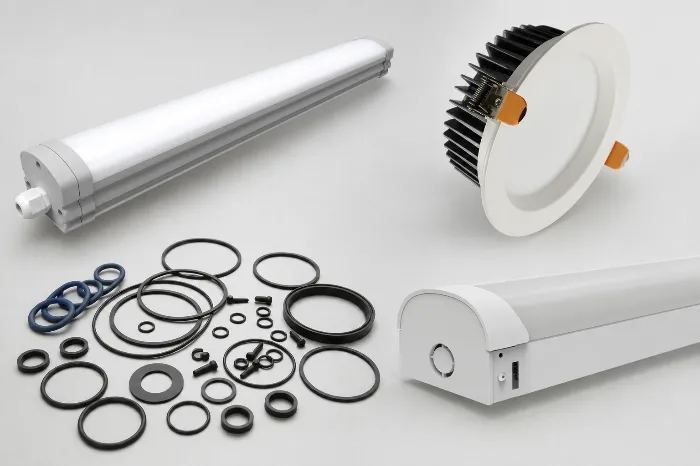
从制造角度来看,IP性能取决于完整的封闭系统,而不仅仅是外壳形状。透镜配合、垫圈压缩、电缆接头质量、螺丝扭矩和组装一致性都会影响额定防护等级是否在生产中实际保持。.
了解商业环境中LED灯具的IP等级
理解IP20:典型的室内照明防护
现场/商业现实
IP20灯具广泛应用于办公室、会议室、零售商店、酒店客房及其他干燥室内空间。在这些区域,主要的环境风险是意外接触、天花板灰尘和正常的室内空气条件,而非直接的水暴露。.
对于这些安装,指定IP65通常会增加不必要的成本、外壳复杂性,有时还会影响散热性能,而无法提供实际价值。在大批量项目中,过度指定可能严重影响预算和采购效率。.
深度解析与工程解决方案
IP20通常表示:
- 第一位数字2:防止手指或大于12.5毫米的固体物体侵入
- 第二位数字0:无额定防水保护
这使得IP20适用于灯具不暴露于滴水、冲洗、喷溅或严重冷凝的室内空间。.
典型的商业应用包括:
- 办公室天花板嵌入式筒灯
- 零售环境中的轨道灯
- 干燥公共室内空间的装饰吊坠
- Hotel room lighting
- Corridor lighting in enclosed, climate-controlled areas
The key engineering judgment is that “indoor” does not automatically mean IP20 is acceptable everywhere. Some indoor zones still involve elevated humidity or periodic cleaning exposure. Bathrooms, spa areas, covered loading zones, and some food service spaces may require a higher protection class depending on fixture position.
| 特点 | Standard Dry Indoor Area | Humid or Splash-Prone Indoor Area | 对维护/投资回报率的影响 |
|---|---|---|---|
| Typical IP choice | IP20 | Often IP44, IP54, or IP65 depending on zone | Correct selection avoids premature failure |
| Cost level | 降低 | 更高 | Over-specification raises capex; under-specification raises service cost |
| Service risk | Low in dry conditions | High if wrong fixture is used | Better environmental match improves system life |
工厂备注
In large hospitality projects, IP20 is often the correct choice for the majority of decorative and architectural indoor lighting. The problem is usually not understanding IP20 itself, but extending it into semi-wet areas simply because the space is technically indoors.
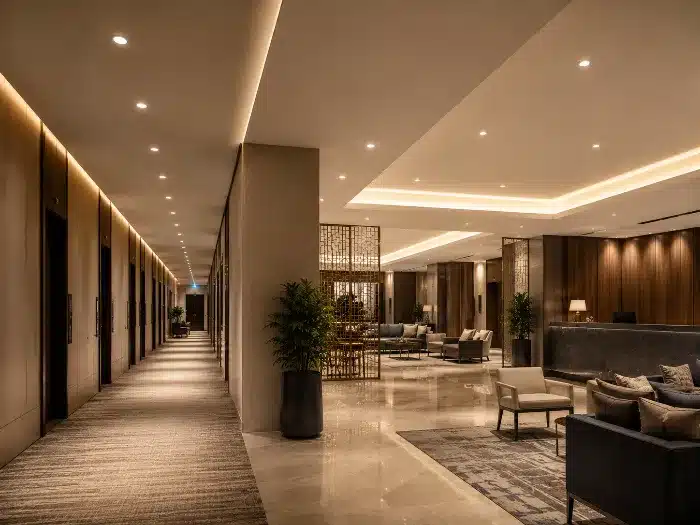
IP20 indoor LED lighting for offices retail stores and hotel interiors
Understanding IP65: Waterproof Lighting Protection
现场/商业现实
IP65 fixtures are commonly specified where water spray, rain exposure, cleaning procedures, or airborne dust can affect the luminaire. In these environments, using a lower-rated fitting can result in visible water ingress, internal condensation residue, terminal corrosion, and driver instability.
For contractors, the risk is amplified in exterior façades, canopies, landscape lighting, parking areas, bathrooms, and back-of-house service zones because access for replacement is more difficult and maintenance windows are limited.
深度解析与工程解决方案
IP65 typically means:
- First digit 6: dust-tight protection
- Second digit 5: protection against water jets from any direction
In practical terms, IP65 is used when the fixture must resist both particulate intrusion and meaningful water exposure. It does not mean the product is suitable for full submersion, but it is a strong protection level for many outdoor and wet-area applications.
典型的商业应用包括:
- Exterior wall-mounted luminaires
- Outdoor soffit or canopy lighting
- Bathroom fittings in appropriate zones
- Service corridors with washdown exposure
- Landscape and façade lighting where direct spray or rain is expected
For LED products, achieving IP65 usually requires:
- Sealed lens-to-housing interface
- Reliable gasket design
- Properly rated cable glands or sealed connectors
- Controlled assembly torque
- Housing design that limits ingress pathways
| 特点 | IP20 | IP65 | 对维护/投资回报率的影响 |
|---|---|---|---|
| Dust resistance | 有限 | 防尘 | Lower internal contamination over time |
| Water exposure suitability | Dry area only | Suitable for jets and outdoor splash exposure | Fewer field failures in exposed zones |
| Typical enclosure design | Open or lightly protected | Sealed enclosure | Better reliability in harsh environments |
| Commercial use case | Offices, retail, guestrooms | Bathrooms, canopies, outdoor areas | Correct fit reduces call-backs |
工厂备注
From a manufacturing perspective, an IP65 claim should never be separated from process control. The sealing design may be correct on paper, but without batch verification, gasket consistency checks, and assembly discipline, field performance can vary significantly between production runs.
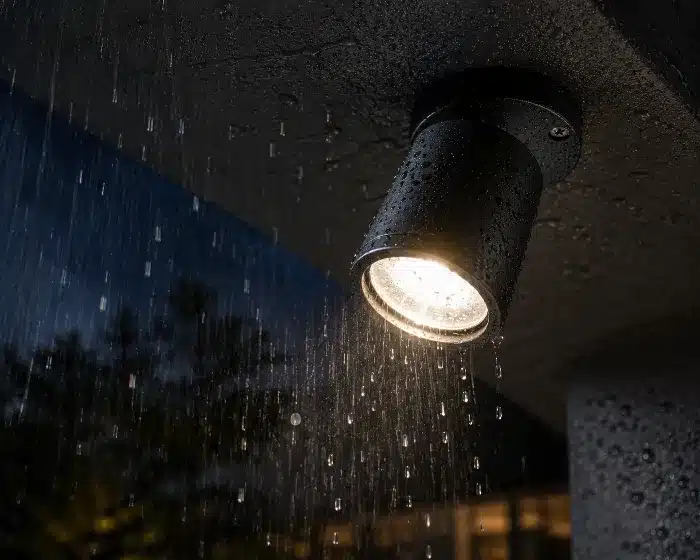
IP65 waterproof LED lighting for bathrooms outdoor commercial installations
IP20 vs IP65: Key Differences in Lighting Applications
现场/商业现实
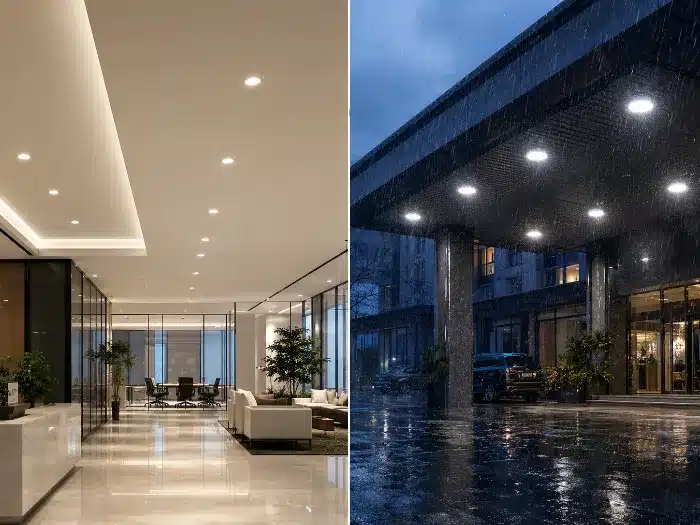
The practical difference between IP20 and IP65 appears when the fixture is exposed to the real building environment rather than the drawing set. An office lobby, for example, may safely use IP20 decorative fittings indoors, while the entrance canopy outside may require IP65 because of wind-driven rain and cleaning exposure.
This distinction matters during project execution because a visually similar fixture may be acceptable in one zone and a maintenance liability in another.
深度解析与工程解决方案
The decision between IP20 and IP65 is driven by environmental exposure, not by appearance or general building type.
Key differences include:
| 特点 | IP20 | IP65 | 对维护/投资回报率的影响 |
|---|---|---|---|
| Protection against contact | Basic | 高 | Both may be acceptable depending on location |
| Protection against dust | 有限 | Complete dust protection | IP65 performs better in dusty service areas |
| Protection against water | 无 | Water jet resistant | Critical for wet or outdoor installation |
| 典型用途 | Dry interior zones | Outdoor or wet interior/exterior zones | Environment-based selection reduces failure risk |
| Enclosure complexity | 降低 | 更高 | IP65 usually costs more but protects better where needed |
Commercial examples make the difference clearer:
- Office open-plan ceiling: IP20 is usually appropriate
- Retail shop interior: IP20 is commonly sufficient
- Bathroom ceiling near wet zones: often higher than IP20
- Exterior walkway: IP65 is generally preferred
- Loading area or service yard: IP65 is often necessary
- Indoor decorative chandelier in climate-controlled space: IP20 can be fully adequate
The engineering approach is to review actual installation conditions:
- Is there direct or indirect water exposure?
- Is the fixture in a dusty or dirty environment?
- Will the area be cleaned with spray equipment?
- Is condensation likely due to temperature change?
- Is fixture replacement difficult after handover?
工厂备注
During hotel commissioning, the most common mistake is assuming “under cover” means dry. Entrance soffits, open corridors, and porte-cochère ceilings may still experience wind-driven moisture and airborne contamination that exceed IP20 capability.
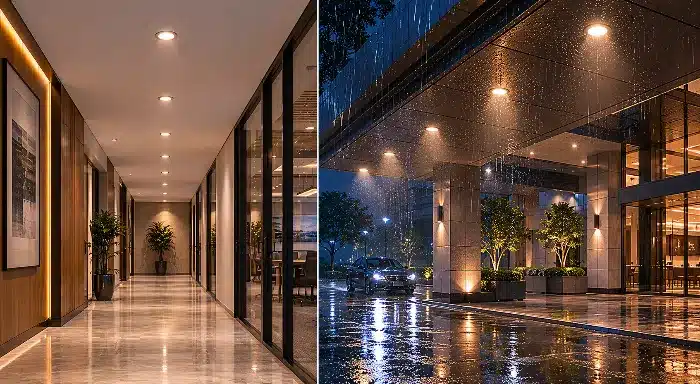
IP20 vs IP65 lighting applications for offices bathrooms and outdoor projects
How to Choose the Right IP Rating for Lighting Projects
现场/商业现实
Choosing the wrong IP rating creates two kinds of cost. Under-specification leads to failures and replacements. Over-specification increases procurement cost unnecessarily and can limit product options. On large commercial projects, both errors scale quickly across hundreds or thousands of fixtures.
The correct decision is made by reviewing the installation environment fixture by fixture, especially in projects with mixed-use spaces.
深度解析与工程解决方案
A practical selection method should consider:
Installation location
Determine whether the fixture is in a dry indoor zone, humid area, washdown area, covered exterior, or fully exposed outdoor position.Water exposure level
Check for drips, splashes, steam, cleaning spray, rain, or water jets.Dust and contamination level
Warehouses, service spaces, transport hubs, and exterior zones usually demand higher ingress protection.Maintenance difficulty
The harder the fixture is to access, the less tolerance there is for environmental mismatch.Long-term reliability target
Projects with high occupancy, luxury positioning, or strict maintenance windows should avoid marginal specification.
A useful rule is that lighting engineers and buyers should not choose IP rating by catalog category alone. The same building can require different protection levels across offices, washrooms, reception areas, façades, and service corridors.
At the product-selection stage, compare candidate LED lighting fixtures by IP rating, cable entry method, mounting position, material finish, and available test documentation rather than by appearance alone.
| Project Area | Typical Environmental Condition | Common IP Direction | 对维护/投资回报率的影响 |
|---|---|---|---|
| 办公室 | Dry, climate-controlled | IP20 | Economical and usually sufficient |
| Retail interior | Dry indoor use | IP20 | Good cost control in protected zones |
| 浴室 | Humidity, splash risk | Higher than IP20, often IP65 in exposed positions | Better resistance to moisture-related failures |
| Outdoor entrance | Rain, wind-driven moisture | IP65 | Reduces corrosion and ingress risk |
| Service yard / exterior corridor | Dust, spray, exposure | IP65 | Lower long-term replacement frequency |
工厂备注
From a manufacturing perspective, the most effective way to reduce project risk is to review the actual installation schedule and location list before production. The IP rating should be matched to the site condition, not assumed from the product family name.
Common Mistakes When Selecting IP Ratings
现场/商业现实
Most IP-related failures do not come from dramatic misuse. They come from small assumptions made during specification, substitution, or procurement. Once installed, these mistakes are expensive because the fixture may physically fit and illuminate correctly at first, but fail months later under environmental stress.
深度解析与工程解决方案
常见错误包括:
Assuming all indoor spaces can use IP20
Bathrooms, semi-open corridors, poolside areas, and service rooms often require higher protection.Assuming all outdoor fixtures must be the same IP rating
Some sheltered outdoor zones may not need the same protection level as fully exposed areas, but this should be confirmed carefully.Focusing only on the luminaire body
Connectors, cable entries, junction interfaces, and installation workmanship also affect system-level ingress protection.Treating IP65 as universal waterproofing
IP65 protects against water jets, not submersion or every extreme exposure scenario.Ignoring maintenance access
A marginal IP decision may become very costly if the fixture is mounted high above a lobby, stairwell, or exterior façade.Trusting claims without verification
Rated protection should be supported by test evidence and consistent production control.
| 错误 | Result | 对维护/投资回报率的影响 |
|---|---|---|
| Using IP20 in damp zones | Moisture ingress and premature failure | Increased service calls and replacement cost |
| Using IP65 everywhere without review | Unnecessary cost escalation | Lower procurement efficiency |
| Ignoring connectors and sealing points | System leakage despite rated housing | Hidden failure risk after installation |
| No validation of supplier claim | Batch inconsistency | Higher RMA exposure |
工厂备注
结论:商业价值
IP20 and IP65 are not just technical labels. They are practical indicators of whether a luminaire can survive its operating environment with stable long-term performance. When the IP rating matches the installation condition, projects benefit from better reliability, fewer maintenance interventions, and lower lifetime system cost.
For distributors, contractors, and specifiers, the most effective approach is to evaluate lighting by environmental exposure zone rather than by product appearance or generic indoor/outdoor assumptions.
B2B工程建议
For projects involving bathrooms, canopies, façades, exterior corridors, or service areas, share the fixture schedule, installation drawings, exposure conditions, cable entry method, and maintenance requirements before purchase.
As a professional LED lighting manufacturer, Teco can review environmental suitability and help match fixture protection ratings, material selection, dimming compatibility, and installation details before mass production. OEM and project-based customization support are also available for distributors, wholesalers, contractors, and lighting brands.