引言
在商业照明项目——如酒店、办公室和零售空间中——LED产品常被标称寿命声明如 “50,000小时”.
然而,这些声明常被误解或夸大。.
在实际项目中,这可能导致:
- 早期光通量衰减
- 意外的维护周期
- 高天花板下的昂贵更换
- 承包商与供应商之间的争议
为避免这些风险,必须理解LED寿命的实际定义与计算方式。.
本指南解释 从实际决策角度理解LM-80与TM-21, ,帮助您验证寿命声明并选择可靠的LED产品。.
快速解答:如何评估LED寿命声明
| 如果您看到 | 含义 | 您应采取的措施 |
|---|---|---|
| LM-80 <6,000小时 | 测试数据不足 | 拒绝或要求完整报告 |
| TM-21 >6倍预测 | 过度外推 | 不可靠 |
| 仅列出L70 | 不完整的度量标准 | 要求提供L80 / L90 |
| 无Tc温度数据 | 不切实际的测试 | 高项目风险 |
| 无原始LM-80报告 | 仅为营销声明 | 切勿依赖 |
本清单有助于排除大多数不可靠的LED寿命声明。.
核心概念
LM-80定义了LED流明维持率的 随时间测量方式(真实测试数据), ,而TM-21定义了该数据如何 预计用于估算长期寿命.
有效的TM-21预测 必须基于符合IES标准的LM-80报告.
LM-80与TM-21:快速对比
- 标准机构:IES(照明工程学会)
- 目的:实测(LM-80)与预估(TM-21)
- 最短测试时长:6,000小时(建议10,000小时)
- 关键输出:光通维持率(%)与预估寿命(L70/L80/L90)
LED寿命声明的真实含义
常见误解
When a product is labeled:
“L70 50,000 hours”
It does NOT mean:
- the LED will last 50,000 hours without change
It actually means:
- the LED is projected to reach 70% of its initial brightness at 50,000 hours
关键洞察
LED lifetime is about lumen depreciation, not failure
- LEDs rarely burn out
- they gradually become dimmer over time
The Rule of Six (TM-21 Limitation)

Chart illustrating lumen maintenance curves for LED light output normalized to 1 at zero hours, showing performance degradation at different operating temperatures over time.
TM-21 projections are limited by the Rule of Six:
Maximum projection = 6 × LM-80 test duration
示例:
- 6,000h test → max 36,000h claim
10,000h test → max 60,000h claim
Claims beyond this range are not considered reliable
Why Lifetime Claims Can Be Misleading
In real-world conditions:
- temperature is higher
- drivers introduce additional stress
dimming cycles affect performance
As a result:
Actual lifetime is often 20–40% lower than TM-21 projections
How to Read LM-80 Reports
Key Parameters to Check
Test duration
→ ≥10,000 hours preferredTest temperatures (Tc)
→ typically 55°C / 85°C / 105°CSample size
→ minimum 10 LEDs
Why Tc Temperature Matters
LM-80 tests are conducted under controlled temperatures.
In real installations:
- fixture temperature must be ≤ tested Tc
- otherwise, TM-21 projections become invalid
警示信号
- only summary data (no raw curve)
- short test duration
- single temperature test
LED Package vs Luminaire Lifetime
LM-80 applies to:
- LED package (chip/module)
But real projects depend on:
- driver performance
- thermal design
- fixture enclosure
关键洞察
Luminaire lifetime is typically 10–30% lower than LED package projections
Understanding L70, L80, and L90
| 公制 | Meaning | 应用 |
|---|---|---|
| L70 | 70% 亮度 | 一般照明 |
| L80 | 80% 亮度 | 酒店照明 |
| L90 | 90% brightness | Retail / display |
Decision Insight
For commercial projects:
- L70 = minimum requirement
- L80 = better real-world target
Key Factors That Affect Real LED Lifetime

1. Temperature (Most Critical)
Each +10°C increase can significantly reduce LED lifetime.
This relationship follows the Arrhenius model:
Lx = L0 × e^[(Ea / k) × (1/Tj − 1/Tj0)]
2. Drive Current
- overdriving LEDs accelerates degradation
3. Thermal Design
- poor heat dissipation → unstable performance
4. Dimming Conditions
- PWM / TRIAC dimming cycles
- can reduce lifetime by 10–20%
Real Risk: Why “50,000 Hours” Often Fails
Typical Scenario
- Specified: L70 50,000h
- Actual environment: higher temperature + dimming
Result
- brightness drops earlier than expected
- uneven lighting across fixtures
- increased maintenance cost
成本影响
- labor (especially high ceilings)
- downtime in commercial spaces
更换成本
Total lifecycle cost can exceed initial savings
How to Evaluate LED Lifetime for Real Projects
Step-by-Step Process
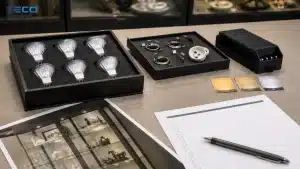
- Request full LM-80 report
- Verify ≥10,000h test duration
- Check Tc vs project conditions
- confirm TM-21 ≤6× projection
- adjust for real operating conditions
Pro Tip
Always evaluate 系统级性能, not just LED chips
需避免的常见错误
| 错误 | 风险 | Correct Approach |
|---|---|---|
| Trusting marketing claims | Overestimated lifetime | Verify LM-80 |
| Ignoring temperature | 早期故障 | Match Tc |
| Using only L70 | Poor quality | Consider L80 |
| Ignoring dimming | 寿命缩短 | Use tested systems |
FAQ: LM-80 & LED Lifetime
What is the difference between LM-80 and TM-21?
LM-80 measures actual LED performance, while TM-21 projects long-term lifetime.
我可以相信 100,000 小时 LED 的宣称吗?
Only if supported by ≥16,000h LM-80 data (Rule of Six). Otherwise, it is unreliable.
What does L70 mean?
It means the LED has dropped to 70% brightness—not failed.
What is the safest metric for projects?
L80 with ≥10,000h LM-80 data.
结论
Understanding LM-80 and TM-21 is essential for making reliable LED lighting decisions.
Instead of relying on marketing claims, focus on:
real test data
realistic projections
project-specific conditions
This ensures:
稳定性能
lower maintenance cost
long-term project reliability
- Download: Annotated LM-80 & TM-21 Sample Report
- 请求: Project-Based Lifetime Evaluation
- Get: Thermal Simulation & Lifetime Prediction