户外景观照明设计:原则、技术与实际应用
引言
Outdoor landscape lighting is not only a visual design decision. In commercial and hospitality projects, it directly affects circulation safety, façade perception, wayfinding, maintenance frequency, and the overall nighttime value of the site. Poor fixture selection or incorrect beam planning often leads to dark zones, glare complaints, uneven illumination, repeated site adjustment, and unnecessary replacement cost.
👉 In practice, most failures come from system-level coordination issues rather than fixture performance.
In practice, landscape lighting must work as a coordinated system: optics, mounting position, aiming angle, control strategy, and environmental durability all need to align. Whether the project involves a hotel entrance, garden pathway, courtyard, resort façade, or public landscape, the design objective is the same: create a stable nighttime environment that is visually comfortable, operationally efficient, and maintainable over time.
执行摘要
Effective landscape lighting balances safety, visual hierarchy, and long-term maintainability. The correct combination of fixture placement, beam angle, and lighting technique reduces glare, avoids over-lighting, improves night aesthetics, and lowers rework risk across gardens, pathways, façades, and public outdoor spaces.
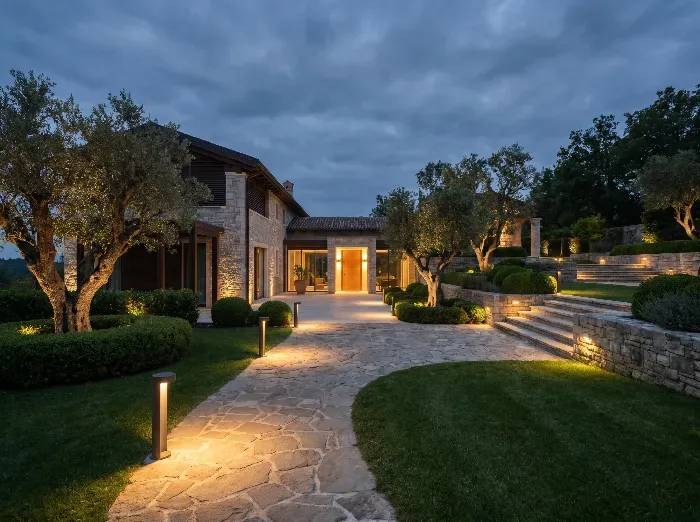
outdoor landscape lighting design principles and applications
Goals of Landscape Lighting Design
现场/商业现实
On-site, landscape lighting is usually judged first by what goes wrong. If pathways are underlit, safety complaints follow. If façades are overlit, the building loses depth and visual comfort. If trees, signage, and circulation areas are lit without hierarchy, the entire site appears flat and uncoordinated. In hotels, resorts, and mixed-use projects, this becomes more than an aesthetic issue. It affects guest experience, site usability, and the number of call-backs after handover.
深度解析与工程解决方案
The primary goals of landscape lighting design are typically fourfold:
- Improve safety and orientation
- Build visual hierarchy
- Highlight architectural or natural features
- Support nighttime identity without excessive energy use
A well-designed outdoor lighting plan should guide the eye naturally. Pathways need consistent low-level illumination. Trees and vertical elements benefit from focused accent lighting. Walls and façades often require broader, more even distribution to avoid patchiness. Public landscapes and hospitality gardens also require controlled contrast, so illuminated areas feel intentional rather than scattered.
Common applications include pathway lighting, tree uplighting, wall washing, and architectural accent lighting. Each serves a different visual and functional purpose.
| 特点 | Functional Lighting | 装饰照明 | 对维护/投资回报率的影响 |
|---|---|---|---|
| Main purpose | Safety and circulation | Visual focus and atmosphere | Balanced use avoids over-specification |
| Typical targets | Paths, steps, entrances | Trees, façades, sculptures | Reduces unnecessary fixture quantity |
| Beam requirement | Controlled, uniform spread | Narrow to medium directional optics | Improves aiming accuracy and site consistency |
| Failure impact | Safety risk and complaints | Loss of visual effect | Functional zones should have higher redundancy |
工厂备注
From a manufacturing perspective, the best outdoor lighting results usually come from restraint rather than output escalation. Many projects fail because the design attempts to light every object equally. A better system uses contrast selectively, which reduces fitting count, driver load, and future maintenance exposure.
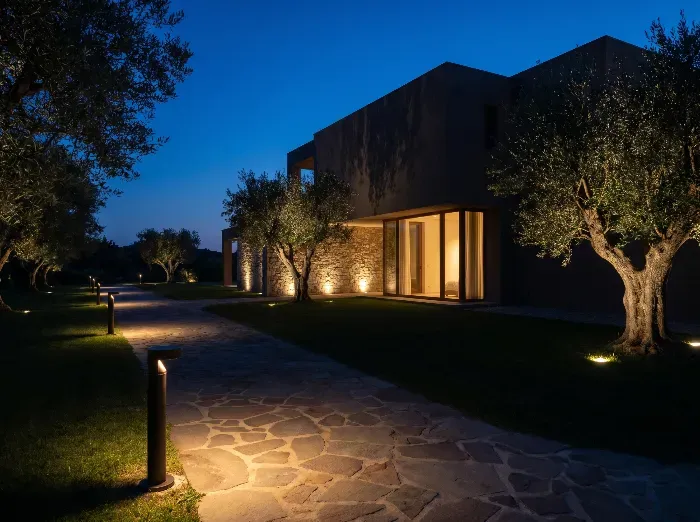
outdoor landscape lighting goals for pathways gardens facades
Key Landscape Lighting Techniques
现场/商业现实
During installation, lighting techniques are often simplified too aggressively. A contractor may use one fixture type across paths, planting areas, and façade edges to reduce procurement complexity. That usually creates poor visual layering and inconsistent beam control. The result is a site that meets neither design intent nor operational efficiency.
深度解析与工程解决方案
Several core techniques are widely used in professional outdoor landscape lighting design:
- Pathway lighting
- Tree uplighting
- Wall washing1
- Architectural accent lighting
Each technique requires different optical behavior and mounting logic.
| Technique | Typical Fixture Characteristic | 最佳使用场景 | 对维护/投资回报率的影响 |
|---|---|---|---|
| Pathway lighting | Shielded, low-glare, wide low-level distribution | Walkways, garden routes, courtyards | Reduces trip-risk complaints and relamping access issues |
| Tree uplighting | Narrow to medium beam, adjustable aiming | Trees, palms, feature planting | Preserves visual drama with limited wattage |
| Wall washing | Wide beam with uniform spread | Boundary walls, façades, vertical surfaces | Reduces patchiness and re-aiming labor |
| Architectural accent lighting | Controlled directional beam | Columns, signs, entry features | Improves focal clarity without over-lighting background |
The design should not treat these techniques as decorative effects only. They must respond to viewing distance, object scale, surface reflectance, and maintenance access. For example, a textured stone wall may need a different setback and beam spread than a smooth rendered façade. A large tree canopy needs layered illumination, not simply a stronger uplight.
👉 Practical Insight: optical cutoff and shielding are as important as lumen output.
工厂备注
In large hospitality projects, tree uplighting often causes avoidable glare because fixture shielding is not considered early enough. A technically correct output can still fail visually if the source is directly visible from guest circulation paths.
Outdoor Lighting Fixture Placement Strategies
现场/商业现实
Fixture placement errors are among the most expensive issues to correct after paving, planting, or façade finishing is complete. Once conduit routes, sleeves, and mounting bases are fixed, even small aiming mistakes can require disruptive site work.
深度解析与工程解决方案
Good fixture placement starts with target-based planning, not fixture-based planning.
Key principles include:
- Keep fixtures outside direct line of sight to reduce glare
- Use offset positioning rather than symmetry
- Maintain proper setback from walls
- Avoid blockage from plant growth
- Ensure maintenance access
👉 Most placement issues only become visible during night commissioning.
| Placement Strategy | 典型应用 | Risk if Misapplied | 对维护/投资回报率的影响 |
|---|---|---|---|
| Close-to-edge pathway placement | Walkways | Glare and uneven lighting | More complaints |
| Correct wall setback | Façades | Hotspots or dark bands | Better consistency |
| Offset uplighting | Trees | Blocked light | Long-term degradation |
| Hidden accent placement | Features | Visible fixture clutter | Reduced visual quality |
工厂备注
Real-world site conditions often differ from drawings due to grading, planting, and construction tolerances. A practical lighting design must allow adjustment range.
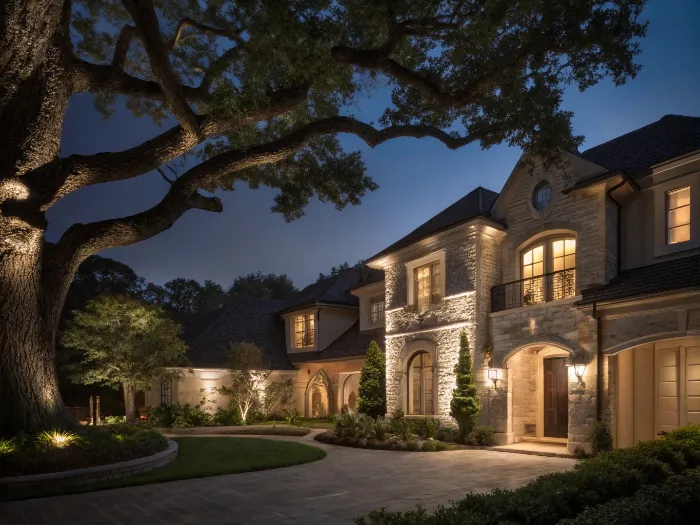
outdoor fixture placement strategies for landscape lighting
Choosing Beam Angles for Landscape Lighting
现场/商业现实
Beam angle selection is one of the most underestimated causes of unsatisfactory outdoor lighting. Incorrect selection leads to hotspots or uncontrolled spill light.
深度解析与工程解决方案
光束角度2 determines light spread and intensity distribution.
Typical guidance:
- Narrow beam: trees, columns, statues
- Medium beam: shrubs, signage
- Wide beam: walls, open surfaces
👉 Beam angle should always be selected with distance and viewing direction in mind.
| Beam Angle Type | 典型用途 | Main Advantage | 对维护/投资回报率的影响 |
|---|---|---|---|
| Narrow | Accents | High focus | Fewer fixtures |
| 中等 | Mixed use | 灵活性 | Balanced design |
| Wide | Walls | Soft coverage | Less adjustment |
工厂备注
Even small optical differences between batches can become visually obvious in façade lighting systems.
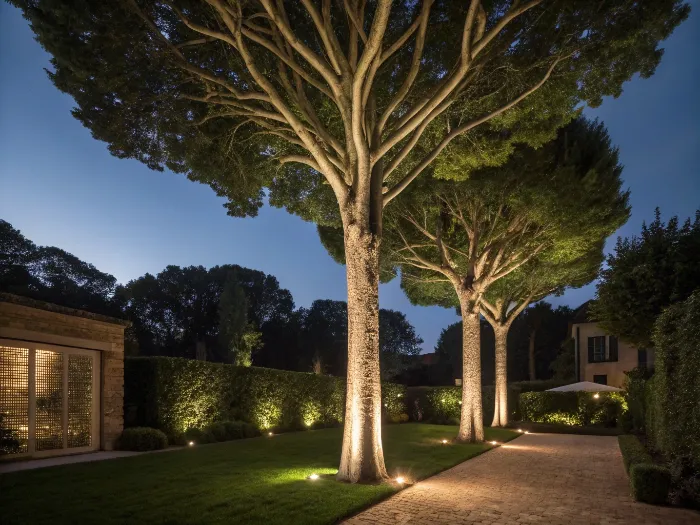
choosing beam angles for outdoor landscape lighting
Residential Landscape Lighting Layout Example
Pathway lighting, tree uplighting, wall washing, and accent lighting are commonly combined in residential-scale projects.
Lighting layers:
- Base layer → safety
- Vertical layer → depth
- Focal layer → identity
Common Landscape Lighting Mistakes
Typical issues include:
- Over-lighting all elements
- Glare from exposed fixtures
- Wrong beam selection
- No plant growth allowance
- Poor maintenance access
👉 Most systems fail after installation season, not on day one.
结论:商业价值
Well-executed outdoor landscape lighting improves safety, usability, and architectural identity while reducing long-term maintenance effort.
A properly designed system performs consistently beyond handover and reduces operational intervention over its lifecycle.
B2B工程建议
For commercial projects with dimming and load requirements, system validation is recommended before installation.
The Teco engineering team can simulate lighting distribution and electrical load to reduce commissioning risk.