شرح مقاييس الإضاءة اليومية: لوكس الميلانوبي، CS، و MR
تبدو العديد من مشاريع الإضاءة اليومية ناجحة على الورق. تظهر التقارير مستويات مقبولة من لوكس الميلانوبي، وتقع قيم CS ضمن النطاقات الموصى بها، وتشير المواصفات إلى أحدث المعايير.
ومع ذلك لا يزال المستخدمون يبلغون عن سوء النوم، والتململ المسائي، والتعب النهاري.
نادرًا ما تكون المشكلة في الجهاز الإضاءة نفسه.
إنها كيف يتم تفسير مقاييس الإضاءة اليومية وتطبيقها، وفي أغلب الأحيان، إساءة استخدامها.
تصف مقاييس الإضاءة اليومية إمكانات الضوء البيولوجي. وهي لا تضمن فعالية الإيقاع اليومي.
يشرح هذا المقال ما هي مقاييس الإضاءة اليومية الرئيسية—لوكس ميلانوبي، التحفيز اليومي (CS)، ونسبة الميلانوبي (MR)— تقيس فعليًا، وأين تكون مفيدة، وأين تضلل، وكيف يجب على المشترين والمصممين تطبيقها بمسؤولية في المشاريع الحقيقية.
لماذا تحتاج الإضاءة اليومية إلى مقاييس - ولكن لا يجب الاعتماد عليها

مقارنة جنبًا إلى جنب بين مقاييس الإضاءة التقليدية للراحة البصرية مقابل مقاييس الاستجابة اليومية، مع عرض أيقونات العيون ومصطلحات القياس الرئيسية.
الإضاءة اليومية متجذرة في علم الأحياء، وليس في الراحة البصرية. توجد المقاييس لأن قيم الإضاءة التقليدية لا يمكنها وصف الاستجابة البيولوجية.
تساعد مقاييس الإضاءة اليومية في قياس تأثير الضوء البيولوجي، لكنها لا يمكن أن تحل محل التصميم القائم على الوقت، أو التخطيط المكاني، أو التحكم السلوكي.
لماذا ظهرت المقاييس اليومية
تركز مقاييس الإضاءة التقليدية على الرؤية:
- لوكس
- لومن
- درجة حرارة اللون المترابط
- CRI
هذه تصف كيف يبدو الضوء - وليس كيف يؤثر على النظام اليومي.
بحث يحدد الخلايا العقدية الشبكية الحساسة جوهريًا للضوء (ipRGCs) كشف أن الاستجابة اليومية حساسة بشكل خاص للأطوال الموجية القصيرة والتوقيت.
هذا خلق الحاجة لمقاييس مرجحة بيولوجيًا.
ما المقصود بالإجابة عليه بالمقاييس
تحاول مقاييس الإيقاع اليومي قياس:
- مدى التحفيز البيولوجي لمصدر الضوء
- ما إذا كان الضوء من المرجح أن ينشط أو يكبح إشارات الإيقاع اليومي
- كيف يهم الطيف خارج سطوع الرؤية
إنها أدوات تحليلية - وليست ضمانات للنتائج.
لماذا تفشل المقاييس وحدها في التطبيق العملي
ما تفعله المقاييس ليس مراعاة:
- وقت التعرض
- المدة والتكرار
- اتجاه المشاهدة
- سلوك المستخدم والتجاوزات
يمكن للضوء الذي “يلبي المقاييس” خلال النهار أن يزعج النوم إذا استُخدم ليلاً.
لهذا السبب قياس الإضاءة اليومية بدون سياق زمني يؤدي إلى ثقة زائفة.
المقاييس تشير إلى الإمكانية، وليس النجاح
تعمل الإضاءة اليومية فقط عندما:
- تتوافق المقاييس مع الوقت
- التزامن الزمني مع البيولوجيا
- السلوك يعزز النظام
لا يمكن للمقاييس وحدها فرض تلك السلسلة.
ما هو لوكس الميلانوبي – وكيف يجب تفسيره
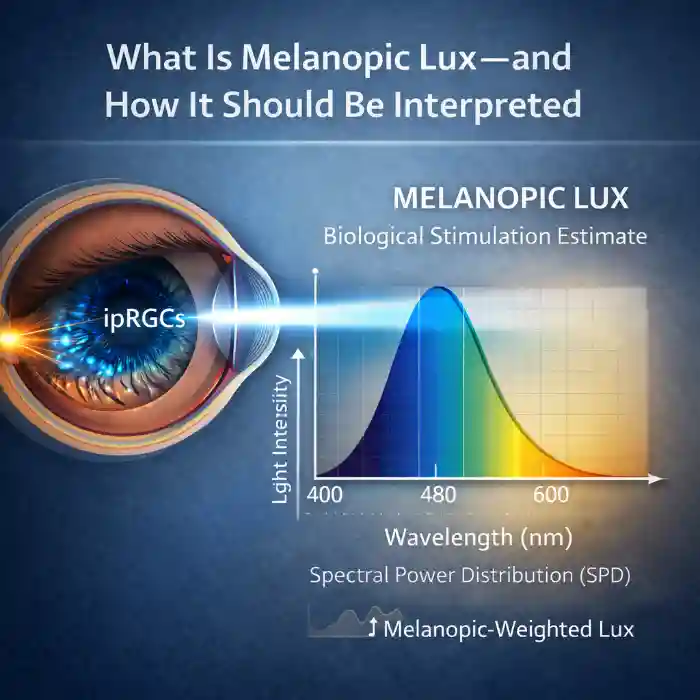
مخطط تعليمي يشرح لوكس الميلانوبي، ويضم نموذج عين مع خلايا ipRGCs ورسم بياني لتوزيع القدرة الطيفية لتفسير الضوء البيولوجي.
يتم الاستشهاد على نطاق واسع باللوكس الميلانوبي، وغالبًا ما يُساء فهمه وتطبيقه بشكل خاطئ.
Melanopic lux measures the biological stimulation of melanopsin-containing retinal cells, not visual brightness or comfort.
What melanopic lux actually measures
Melanopic lux is calculated by weighting light intensity according to the melanopsin action spectrum, based on the spectral power distribution (SPD) of the source.
It estimates potential circadian activation strength.
Where melanopic lux is useful
Melanopic lux is best used for:
- daytime circadian stimulation assessment
- comparing biological impact between spectra
- evaluating morning and workday lighting strategies
In these contexts, higher melanopic values often support alertness and circadian entrainment.
What melanopic lux does not tell you
Melanopic lux does ليس indicate:
- whether light is appropriate at night
- whether exposure duration is sufficient
- whether light reaches the eyes vertically
A high melanopic lux value at 22:00 is not beneficial—it is biologically disruptive.
The most common misuse
Many projects chase melanopic targets without asking a simple question:
When will this light be used?
Melanopic lux has no built-in time logic.
Time determines whether the signal helps or harms.
Proper interpretation boundary
- Daytime: melanopic lux can be a design target
- Nighttime: melanopic lux is a warning indicator
Used outside its intended time window, melanopic lux becomes misleading.
Circadian Stimulus (CS): Strengths and Practical Limitations
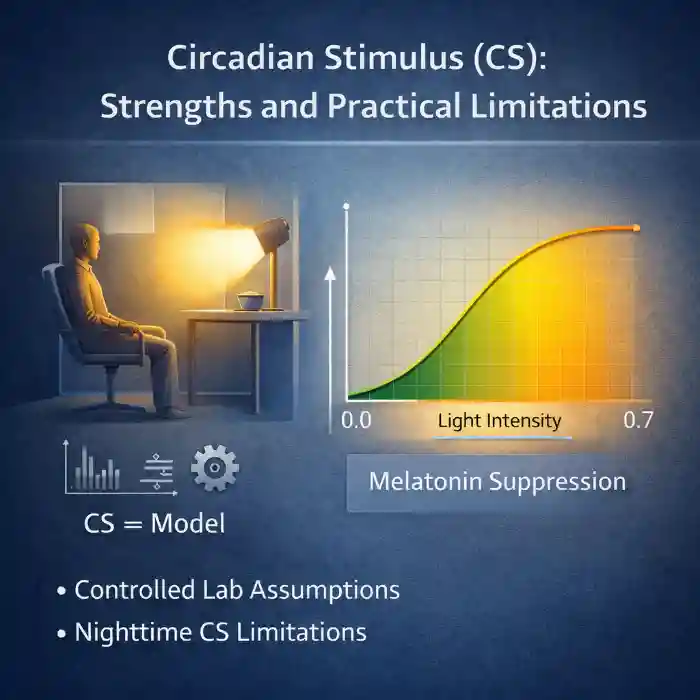
Presentation slide illustrating the strengths and limitations of the Circadian Stimulus (CS) model, featuring a melatonin suppression graph and a controlled nighttime laboratory lighting scenario.
Circadian Stimulus (CS) was developed to link light exposure more directly to melatonin suppression.
CS attempts to model circadian effectiveness, but only under specific assumptions.
What CS represents
CS estimates the likelihood of melatonin suppression based on:
- spectrum
- intensity
- retinal response modeling
It is expressed on a relative scale (approximately 0.0–0.7).
Where CS performs well
CS is useful for:
- comparative daytime lighting evaluation
- office and educational environments
- research-aligned design validation
It offers a biologically anchored framework when assumptions are respected.
Key limitations of CS
CS is derived from controlled laboratory conditions and assumes:
- fixed exposure duration
- frontal eye exposure
- stable viewing geometry
Real environments rarely meet these conditions.
CS and nighttime misapplication
CS was not designed as a nighttime safety metric.
Low CS values do not guarantee:
- sleep protection
- melatonin preservation
At night, even low-CS white light can still disrupt circadian rhythm.
Responsible CS use
CS should be treated as:
- a relative daytime comparison tool
- not a universal pass/fail threshold
It supports analysis—it does not replace design judgment.
Melanopic Ratio (MR): What It Tells You—and What It Cannot
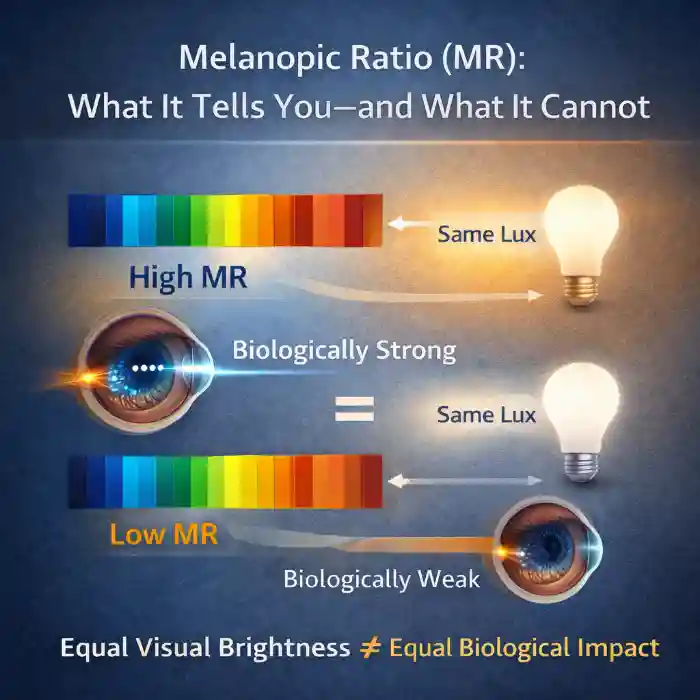
Visual explanation of melanopic ratio (MR), illustrating how light with a higher MR delivers stronger biological stimulation while lower MR light remains biologically weaker, even at the same visual lux level.
Melanopic Ratio (MR) compares biological stimulation to visual brightness.
MR describes how melanopically active a spectrum is per unit of visual lux.
Why MR is useful
MR helps designers:
- compare spectra independently of brightness
- identify blue-heavy or biologically intense white light
- evaluate reduction strategies in evening lighting
What MR cannot determine
MR does ليس indicate:
- correct timing
- safe nighttime use
- adequate or excessive intensity
A low MR light at high lux can still overstimulate the circadian system.
Common MR misunderstanding
Marketing claims often imply:
“Low MR = circadian safe.”
This ignores timing.
At night, the issue is not MR—it is white light itself.
Correct MR boundary
MR is meaningful when:
- comparing spectra within the same time phase
- supporting evening reduction strategies
It does not replace night-safe spectral selection.
Why Time Changes the Meaning of Every Metric

Graphic illustrating how time of day affects lighting metrics for circadian health, highlighting higher stimulation benefits during daytime hours and reduced biological risk during nighttime with color-coded evaluations.
Circadian lighting metrics change meaning entirely depending on when light is used.
The same metric value can represent success during the day and failure at night.
Daytime interpretation
During the day:
- higher melanopic stimulation supports alertness
- CS can guide activation strategies
- MR helps compare biological efficiency
Metrics act as targets.
Nighttime interpretation
At night:
- any melanopic stimulation is undesirable
- CS should approach zero
- MR becomes irrelevant if white light is avoided
Metrics act as risk indicators, not goals.
A clear design rule
| Time Phase | Metric Role |
|---|---|
| Morning | Target stimulation |
| Afternoon | Maintain stability |
| Evening | Reduce stimulation |
| Night | Avoid stimulation entirely |
Applying daytime targets at night is the most common cause of circadian failure.
Common Metric Misuses in Real Projects
Most circadian failures come from predictable mistakes.
Circadian lighting metrics fail when treated as certifications instead of analytical tools.
Common misuses include:
- relying on a single number for validation
- ignoring vertical eye exposure
- applying lab thresholds to living spaces
- optimizing daytime metrics without a night strategy
- assuming automation replaces biology
Metrics without behavioral control remain theoretical.
How Buyers and Designers Should Use Circadian Metrics Responsibly
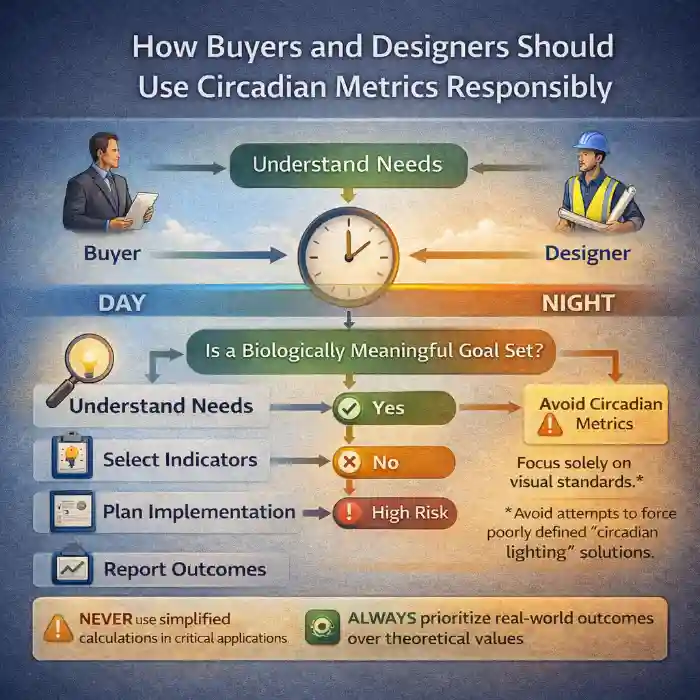
Visual guide showing a decision flowchart for buyers and designers to use circadian metrics responsibly, focusing on needs assessment and risk avoidance in lighting design.
Metrics should support decisions—not replace them.
Responsible circadian lighting design integrates metrics, timing logic, spatial design, and user behavior.
Practical guidance
- Use metrics comparatively, not absolutely
- Always define time context
- Combine metrics with design intent
- Treat metrics as risk-management tools
Better buyer questions include:
- When is this light used?
- How long is exposure?
- Where does the light reach the eye?
- What happens at night?
Metrics inform. Design decides. Behavior completes.
الخلاصة
Circadian lighting metrics—melanopic lux, CS, and MR—are valuable analytical tools, but only when applied with time awareness, biological understanding, and realistic project context.
Used without these constraints, metrics create false confidence and real-world failure.
Teco supports B2B buyers and designers applying circadian lighting metrics responsibly in hospitality, residential, and commercial projects.
We help with:
- interpreting melanopic lux, CS, and MR in real environments
- aligning biological metrics with practical fixture choices
- avoiding metric-driven but biologically weak designs
Our focus is not selling numbers, but delivering lighting that works in real life.
البريد الإلكتروني: [email protected]
الموقع الإلكتروني: www.tecolite.com
Tell us which metrics you are evaluating and in what context.
We help you understand what they mean—and what they do not.