كيف تعمل مصابيح LED ذات التعتيم ثلاثي الخطوات مع مفتاح الإضاءة العادي؟
مقدمة
In many retrofit projects, the request is simple: add dimming without replacing the existing wall switch or opening the wiring. On site, however, this becomes a system-level problem rather than a bulb-only decision. If the control method is not clearly understood, the result can be inconsistent user experience, complaints after handover, and unnecessary maintenance visits.
Three-step dimming LED bulbs are designed to work from a standard on/off wall switch by changing brightness in fixed steps. This can be useful in selected applications, especially where rewiring is not practical. But in shared spaces, circulation areas, and commercial projects with frequent switching, the same feature can create confusion because the lamp changes output based on the timing of power interruptions rather than a dedicated control signal.
For importers, distributors, and project buyers, the real question is not whether the lamp can dim. The real question is whether this control logic matches the operating behavior of the space.
ملخص تنفيذي
3-step dimming LED bulbs use rapid power cycling from a normal switch to move between preset brightness levels. They are suitable for simple retrofit use, but they are not ideal for spaces requiring predictable user control, scene consistency, or commercial-grade dimming performance.
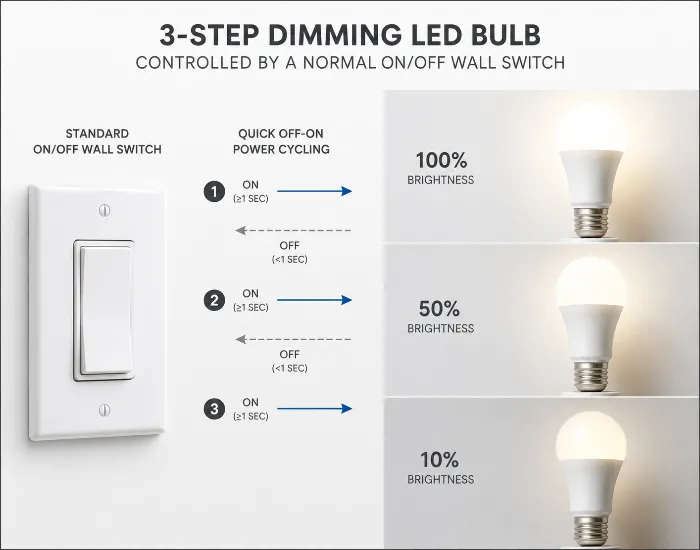
3-step dimming LED bulb controlled by normal light switch
What Does 3-Step Dimming Mean?
الواقع الميداني / التجاري
Buyers often assume “dimmable” means smooth adjustment. In practice, 3-step dimming means the lamp only offers a few fixed output levels, typically low, medium, and high. If this is not clarified before procurement, end users may expect full-range dimming and reject the product after installation.
غوص عميق وحل هندسي
A 3-step dimming LED bulb contains an internal driver1 programmed to switch between preset power levels. Instead of receiving a phase-cut2 dimming signal from a wall dimmer, it monitors the mains power interruption pattern from a standard switch.
Each rapid off-on cycle tells the internal control circuit to advance to the next brightness level. In most designs, the sequence repeats in a loop, such as:
| ميزة | 3-Step Dimming Bulb | Full Range Triac Dimming Bulb | التأثير على الصيانة / العائد على الاستثمار |
|---|---|---|---|
| Output control | Fixed preset levels | Continuous dimming range | Preset levels reduce wiring changes, but limit user flexibility |
| User interface | Standard switch | Dedicated dimmer required | Easier retrofit, but more user confusion |
| Brightness accuracy | Fixed by internal driver | Depends on dimmer-driver matching | Fewer compatibility variables in simple installations |
ملاحظة المصنع
From a manufacturing perspective, the main issue is not whether the stepping function works in the lab. The real issue is whether the switching window is calibrated tightly enough to avoid accidental step changes during normal use, while still remaining responsive across production batches.
How Does a Normal Light Switch Dim an LED Bulb?
الواقع الميداني / التجاري
Installers may believe the wall switch is “dimming” the lamp. It is not. The switch is only cutting and restoring power. If facility managers do not understand this, they may misdiagnose user complaints as lamp failure or wiring instability.
غوص عميق وحل هندسي
The internal electronics detect short power interruptions and interpret them as a control command. If the switch is turned off and back on within a defined time window, the bulb advances from one preset output level to the next.
This means the dimming action depends on timing, not analog control. The bulb effectively counts rapid power cuts and uses that timing logic to select brightness. That is why different users can produce different results from the same switch.
A simplified operating logic looks like this:
| ميزة | Normal Switch 3-Step Control | Conventional Wall Dimmer Control | التأثير على الصيانة / العائد على الاستثمار |
|---|---|---|---|
| Control signal | Timed power interruption | Phase-angle power modulation | Simpler installation, less predictable operation |
| Wiring changes | None in most retrofits | Usually requires dimmer replacement | Lower upfront labor cost |
| User consistency | Depends on switching rhythm | More direct control | More complaints in shared spaces if behavior is misunderstood |
ملاحظة المصنع
During hotel commissioning, timing-based switching logic often performs acceptably in mock-up rooms but becomes less predictable in real operation once multiple users interact with the switch differently. This is where functional acceptance can diverge from laboratory validation.
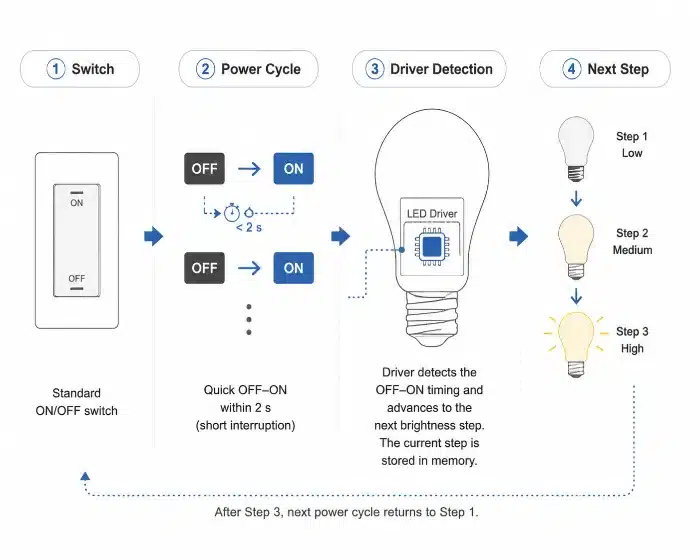
3-step dimming LED bulb controlled by standard on-off switch
Why Do 3-Step Dimming Bulbs Not Need a Wall Dimmer?
الواقع الميداني / التجاري
This is the main commercial attraction. In retrofit work, replacing hundreds of wall dimmers can add material cost, electrician time, and coordination risk. A lamp that offers basic brightness adjustment from an existing switch can reduce initial installation scope.
غوص عميق وحل هندسي
The dimming intelligence is built into the lamp driver, not the wall device. Because the bulb interprets on-off timing internally, the switch only needs to provide stable mains isolation and reconnection.
This avoids a common LED retrofit issue: incompatibility between legacy halogen dimmers and low-wattage LED loads. DOE testing notes that LED lamp performance with phase-cut dimmers can depend on the selected dimmer and other circuit components, so compatibility should not be assumed from the word "dimmable" alone.3 With 3-step dimming, that compatibility problem is bypassed because no phase-cut dimmer is used.
However, the tradeoff is that control remains crude. There is no smooth dimming curve, no precise scene setting, and no guaranteed recall of a preferred brightness level after switching.
What Brightness Levels Do 3-Step Dimming LED Bulbs Usually Have?
الواقع الميداني / التجاري
Procurement teams often specify only wattage and CCT4, but not the actual lumen output5 at each dimming step. This creates mismatch between user expectation and installed performance, especially in guest rooms and bedside applications.
غوص عميق وحل هندسي
Most 3-step dimming bulbs use three fixed output bands, commonly around:
- 100% output
- 50% to 60% output
- 10% to 25% output
The exact levels vary by driver design, thermal limit, LED efficacy, and product positioning. Some suppliers market the steps as low / medium / high, but without providing measured lumen maintenance at each level. For B2B purchasing, this is not sufficient.
Buyers should request the actual electrical and photometric data for each step, because light output, flicker, audible noise, and minimum-output behavior are all relevant when evaluating dimming performance in LED lamps.6
| ميزة | Typical 3-Step Dimming Levels | What Buyers Should Request | التأثير على الصيانة / العائد على الاستثمار |
|---|---|---|---|
| Brightness steps | Low / medium / high | Measured lumen output at each step | Avoids under-lighting complaints |
| Power draw | Reduced by step | Wattage at each level | Supports energy calculations |
| CCT stability | May shift slightly | CCT data across all steps | Prevents visual inconsistency in projects |
ملاحظة المصنع
In large hospitality projects, the low-level step often matters more than the full-output step. If the lowest setting is still too bright for bedside or nighttime use, the product may be technically functional but commercially unsuitable.
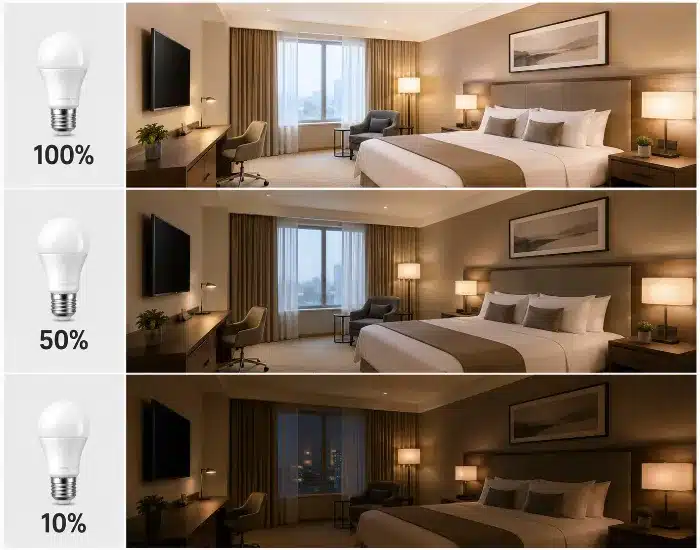
3-step dimming LED bulb brightness levels
Where Are 3-Step Dimming Bulbs Most Useful?
الواقع الميداني / التجاري
The best applications are spaces with one primary user, simple lighting expectations, and limited need for precise scene control. The worst applications are shared-use or high-traffic areas where switch behavior is inconsistent.
غوص عميق وحل هندسي
Three-step dimming bulbs are most useful when rewiring is undesirable and the user only needs basic brightness selection. Suitable examples may include:
- Guest room bedside lamps
- Table lamps in serviced apartments
- Small retrofit hospitality rooms
- Temporary renovation phases
- Decorative fixtures with difficult wiring access
They are less suitable for:
- الممرات
- Shared rooms
- Stairwells
- Public lobbies
- غرف الاجتماعات
- Any area needing predictable scene recall
This is because different users operate the same switch with different timing. The resulting brightness level can become random from the occupant’s perspective.
What Are the Advantages of 3-Step Dimming LED Bulbs?
الواقع الميداني / التجاري
For certain retrofit jobs, the value is straightforward: no wall dimmer replacement, reduced electrician time, and quick functional upgrade. This can be attractive where access to existing controls is costly or disruptive.
غوص عميق وحل هندسي
The main advantages are practical rather than advanced:
| ميزة | 3-Step Dimming Bulb | Standard Non-Dimmable Bulb | التأثير على الصيانة / العائد على الاستثمار |
|---|---|---|---|
| Brightness flexibility | Yes, in fixed steps | لا | Better usability without major rewiring |
| Installation complexity | منخفض | منخفض | Minimal retrofit disruption |
| Dimmer compatibility issue | Not applicable in most cases | Not applicable | Avoids legacy dimmer mismatch if dimming is needed |
| Upfront control cost | Lower than dimmer-based retrofit | Lowest | Useful when basic dimming is enough |
Key benefits include:
- Uses a normal wall switch
- Avoids replacement of legacy on/off controls
- Reduces initial installation labor
- Provides simple low / medium / high adjustment
- Bypasses many wall-dimmer compatibility issues
What Are the Limitations of 3-Step Dimming LED Bulbs?
الواقع الميداني / التجاري
This is where many post-installation complaints originate. If occupants expect stable memory, repeatable scene selection, or intuitive operation in shared spaces, the product may generate service calls even when there is no hardware defect.
غوص عميق وحل هندسي
The main limitations are tied to the control method itself:
- Only fixed brightness levels are available
- No smooth dimming
- Brightness selection depends on switching rhythm
- Accidental double switching can move the lamp to the wrong level
- Memory behavior may not match user expectations
- Performance in multi-user spaces is often inconsistent
| ميزة | 3-Step Dimming Bulb | Dedicated Dimming System | التأثير على الصيانة / العائد على الاستثمار |
|---|---|---|---|
| Control precision | منخفض | عالية | More user complaints if expectations are high |
| Scene repeatability | محدود | Strong | Better for commercial consistency with dedicated controls |
| Shared-use suitability | Weak | أفضل | Lower complaint rate in commercial environments |
3-Step Dimming vs Triac Dimming: What Is the Difference?
الواقع الميداني / التجاري
These two products are frequently grouped together under the word “dimmable,” but they solve different problems. Selecting the wrong one can lead to incompatibility, poor user experience, or unnecessary control hardware cost.
غوص عميق وحل هندسي
Triac dimming7 uses a wall dimmer that modifies the AC waveform to reduce power delivered to the lamp driver. A compatible LED driver then interprets that waveform and adjusts output continuously.
Three-step dimming does not read a phase-cut waveform. It simply monitors rapid power resets from a standard switch and changes between preset steps.
| ميزة | 3-Step Dimming | تعتيم ترياك | التأثير على الصيانة / العائد على الاستثمار |
|---|---|---|---|
| Control device | Standard on/off switch | Triac wall dimmer | 3-step reduces retrofit hardware changes |
| Dimming range | Fixed steps | Usually continuous | Triac better for scene control |
| Compatibility risk | Lower with simple switches | Higher if dimmer-driver mismatch occurs | Triac needs pre-validation |
| User precision | منخفض | أعلى | Triac better for commercial repeatability |
| Best use case | Simple retrofit | Engineered dimming application | Correct selection reduces complaints |
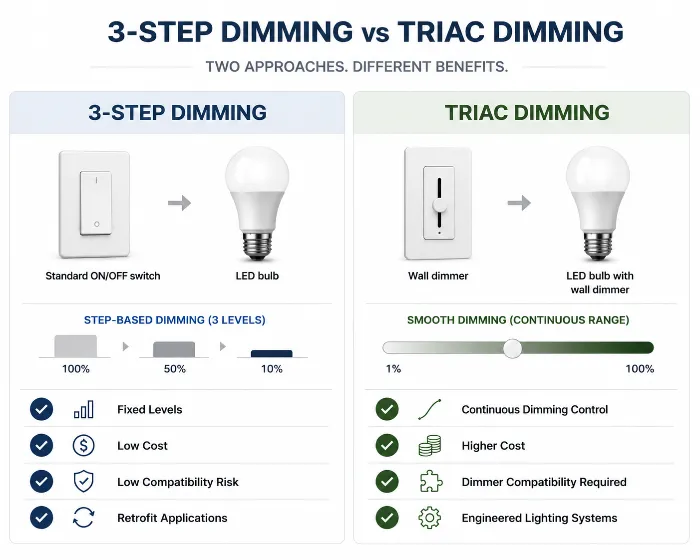
3-step dimming LED bulb vs Triac dimming comparison
What Should Buyers Check Before Ordering 3-Step Dimming Bulbs?
الواقع الميداني / التجاري
Ordering based only on appearance, wattage, and price is risky. The control behavior must be reviewed in the context of the application, otherwise return rates and field dissatisfaction can increase after deployment.
غوص عميق وحل هندسي
Before placing an order, buyers should confirm:
- Exact brightness sequence
- Memory or restart behavior
- Required switch timing window
- Lumen output at each step
- Power consumption at each step
- CCT consistency across steps
- Driver reliability under repeated switching
- Suitability for enclosed fixtures if relevant
- Batch consistency of control timing
A practical evaluation checklist is below:
| Item to Check | لماذا يهم | B2B Impact |
|---|---|---|
| Restart default level | Affects user acceptance | Reduces complaints after handover |
| Step transition timing | Determines ease of use | Prevents accidental brightness changes |
| Measured lumen per step | Confirms real lighting effect | Avoids underperformance claims |
| Repetitive switching endurance | Reflects actual use condition | Lowers RMA exposure |
| Application suitability | Prevents misuse in shared spaces | Protects project reputation |
ملاحظة المصنع
From a manufacturing perspective, repetitive switching endurance should not be treated as a minor test item. In this category, control behavior under repeated mains interruption is central to product reliability, not a secondary feature.
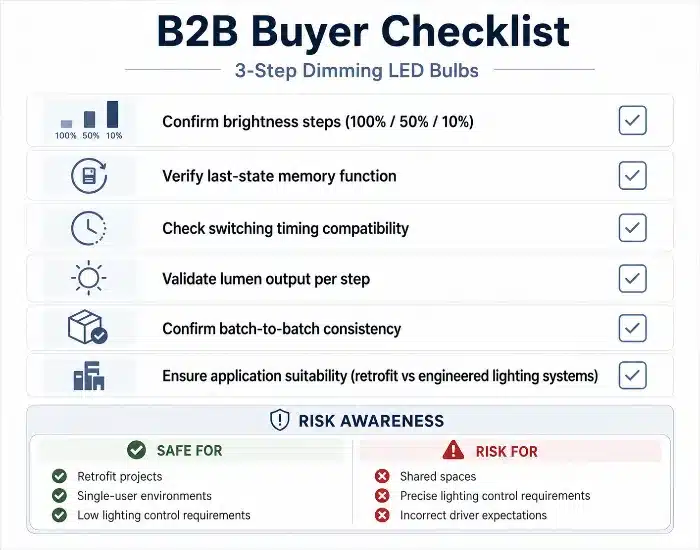
B2B buyer checklist for 3-step dimming LED bulbs
Are 3-Step Dimming Bulbs Suitable for Commercial Projects?
الواقع الميداني / التجاري
The short answer is: only in limited scenarios. Commercial projects usually require predictable operation, repeatable user experience, and low complaint rates across many rooms or users.
غوص عميق وحل هندسي
Three-step dimming bulbs can be suitable in narrowly defined commercial applications:
- Retrofit wiring changes are not practical
- One person usually controls the lamp
- Exact scene recall is not required
- Preset low / medium / high output is acceptable
They are generally weak choices for:
- Shared controls
- Repeatable lighting scenes
- Centralized control systems
- Public or staff-operated areas
ملاحظة المصنع
During hotel commissioning, shared-use areas quickly reveal the weakness of timing-based control. A product may satisfy the specification sheet yet still create operational friction if brightness changes depend on how different people tap the switch.
Final Thoughts: When Should You Choose 3-Step Dimming LED Bulbs?
الواقع الميداني / التجاري
This product category should be selected as a control compromise, not as a universal dimming solution.
غوص عميق وحل هندسي
Choose 3-step dimming LED bulbs when the project mainly needs a simple retrofit upgrade:
- Existing on/off switches must stay
- Basic stepped output is enough
- A dedicated wall dimmer is not justified
Choose a dedicated dimming system instead when user consistency, scene control, or low complaint tolerance matters.
| ميزة | Choose 3-Step Dimming | Choose Dedicated Dimming | التأثير على الصيانة / العائد على الاستثمار |
|---|---|---|---|
| Retrofit simplicity | Strong | معتدل | 3-step lowers initial installation cost |
| User predictability | Weak | Strong | Dedicated dimming reduces callbacks |
| Commercial scalability | محدود | أفضل | Better long-term control consistency |
Conclusion: Business Value
Three-step dimming LED bulbs can reduce retrofit complexity and avoid the cost of replacing wall controls, but their value depends heavily on the application. In the right setting, they offer acceptable flexibility with low installation disruption. In the wrong setting, they increase user confusion, service calls, and dissatisfaction after handover.
For B2B buyers, the key business value is not the dimming feature itself. It is selecting a control method that reduces maintenance effort, limits post-installation complaints, and keeps lifetime system cost under control.
توصية هندسية بين الشركات
For 3-step dimming bulb projects, buyers should confirm the switching sequence, restart behavior, memory logic, minimum brightness level, lumen output at each step, and batch consistency before mass production. TECO’s 3-step dimming GU10 LED bulb can be considered for selected retrofit applications where normal-switch control is acceptable. The TECO engineering team can support sample testing and project-specific evaluation to confirm whether this control logic is suitable for the intended application.
هوامش
Driver: the electronic circuit inside an LED lamp that regulates current and power supplied to the LEDs. ↩
Phase-cut dimming: a mains dimming method that changes lamp power by cutting part of each AC waveform. See the DOE/PNNL report Dimming LEDs with Phase-Cut Dimmers. ↩
The U.S. DOE CALiPER report notes that LED lamp dimming performance can depend on the control device and other circuit components, especially with phase-cut dimmers. See DOE CALiPER Retail Lamps Study 3.1. ↩
CCT: correlated color temperature, the perceived warmth or coolness of white light. See IES CCT Definition. ↩
Lumen output: the total visible light emitted by a lamp. See IES Lumen Definition. For project purchasing, measured lumen output at each step is more useful than nominal wattage alone. ↩
ENERGY STAR dimming guidance discusses light output, minimum output, flicker metrics, and audible noise as dimming-performance considerations for LED lamps. See ENERGY STAR Dimming LED Lights. ↩
Triac dimming: a common phase-cut dimming method using a triac-based wall dimmer to control AC power delivery. See the DOE/PNNL report Dimming LEDs with Phase-Cut Dimmers. ↩