ما هو أفضل مؤشر تجسيد اللون (CRI) لمصابيح LED؟
آخر تحديث في 2 فبراير 2026
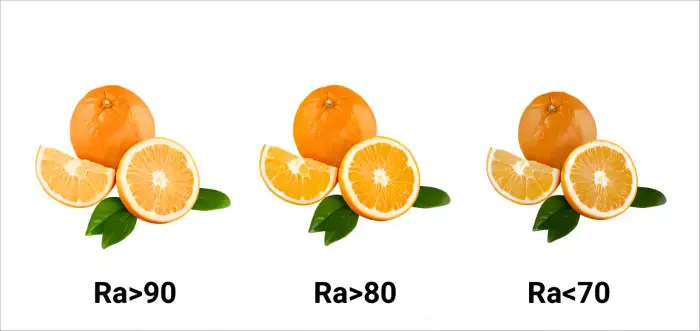
Comparison of oranges displayed under different Color Rendering Index (CRI) values: Ra90 on the left, Ra80 in the center, and Ra70 on the right, highlighting how CRI affects color appearance.
What CRI Means
مؤشر تجسيد اللون (CRI) is a metric that measures how accurately a light source reveals the true colors of objects compared with natural light.
CRI values range from 0 إلى 100. The higher the CRI, the closer the light source is to natural daylight in terms of color accuracy and realism.
CRI is one of the most important parameters for evaluating lighting quality—especially in environments where accurate color judgment is critical, such as healthcare, art galleries, retail stores, and residential lighting.
Why CRI Is Important
CRI directly affects how we perceive colors, which in turn influences mood, comfort, productivity, and even health.
Realistic color rendering
High-CRI lighting reproduces object colors more faithfully, creating a natural and comfortable environment. In retail spaces, this helps products appear more attractive and true to life.Improved spatial aesthetics
In interior design, high-CRI light sources accurately reveal wall colors, furniture finishes, and materials, enhancing overall visual harmony.Enhanced visual comfort
Higher CRI reduces color distortion and eye fatigue, which is especially important in offices, schools, and study environments where people spend long hours.Better work efficiency
Professions that rely on precise color judgment—such as printing, painting, photography, and design—benefit greatly from high-CRI lighting.Positive health impact
Studies indicate that natural light or high-CRI artificial light can improve mood, support circadian rhythms, and enhance overall well-being.
Because of these factors, selecting a light source with an appropriate CRI is essential from aesthetic, functional, and health perspectives.

Collage of retail environments featuring vibrant fashion displays, elegant accessories, and fresh fruit arrangements, illustrating the importance of accurate color rendering in different retail settings.
The Impact of CRI on LED Lighting
Most standard LED lights have a CRI between 70 and 80, which is sufficient for general residential and commercial lighting.
However, applications that demand precise color reproduction—such as art galleries, jewelry stores, museums, and printing facilities—typically require LEDs with CRI ≥90.
Key considerations:
Visual performance
High-CRI LEDs reproduce colors more vividly and naturally, improving the overall visual experience.Application suitability
CRI largely determines where an LED light is best used. High-CRI LEDs are better suited for color-critical environments.Cost and efficiency trade-off
Higher CRI usually involves higher production costs. In some cases, achieving very high CRI may slightly reduce luminous efficacy compared with lower-CRI LEDs.
Practical guideline:
- Home lighting: CRI ≥80 is generally sufficient
- Professional, display, or color-critical lighting: CRI ≥90 is recommended
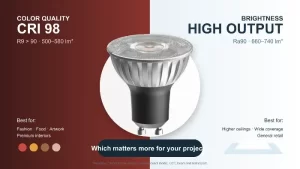
TECO GU10: Excellent Color Rendering Performance
TECO GU10 LED bulbs typically feature a CRI above 90, ensuring accurate and vivid color reproduction. This makes them well suited for:
- Art galleries and exhibition spaces
- Jewelry and retail display lighting
- Accent lighting in residential environments
In addition to superior color rendering, TECO GU10 LED bulbs offer:
- High energy efficiency
- Long service life
- Strong long-term cost performance
With a standard GU10 base, these bulbs are easy to install and compatible with most existing GU10 fixtures, allowing for quick upgrades without changing luminaires.