Einführung
For LED manufacturers, importers, and project contractors, ErP compliance is not optional—it is a legal requirement for entering the EU market.
Failure to comply can result in:
- shipment rejection at customs
- project delays in hospitality and commercial installations
- costly redesign and retesting
- legal liability for importers
A real-world case:
A lighting supplier failed to complete EPREL registration.
Result: €50,000 worth of LED products was held at a German port for over 3 weeks.
The critical question is:
Can your LED product legally enter the EU market?
ErP Compliance Checklist (SLR & ELR Verified)
| Requirement | Legal Basis | Compliance Requirement | Source |
|---|---|---|---|
| Energy efficiency (on-mode power) | SLR (EU) 2019/2020 | Pon ≤ Ponmax, calculated using Φuse, CRI, and correction factors | Regulation (EU) 2019/2020 |
| Energy label classification | ELR (EU) 2019/2015 | Energy class A–G based on ηTM (lm/W) | Regulation (EU) 2019/2015 |
| Standby power (Psb, Pnet) | SLR (EU) 2019/2020 | Typically ≤0.5 W (depends on product type) | Regulation (EU) 2019/2020 |
| Flicker (Pst LM) | SLR (EU) 2019/2020 | Pst LM ≤1.0 | Regulation (EU) 2019/2020 |
| Stroboscopic effect (SVM) | SLR (EU) 2019/2020 | SVM ≤0.4 | Regulation (EU) 2019/2020 |
| Functional requirements (lifetime, switching, lumen maintenance) | SLR (EU) 2019/2020 | Must meet durability and performance criteria defined in Annex | Regulation (EU) 2019/2020 |
| EPREL registration | ELR (EU) 2019/2015 | Product must be registered before placing on EU market | EPREL-Datenbank |
| Technical documentation | ErP Directive 2009/125/EC | Must be retained for 10 years | Directive 2009/125/EC |
| CE-Kennzeichnung | Multiple directives (LVD, EMC, RoHS) | Required before market placement | CE marking EU |
If any item fails, your product cannot be sold in the EU.
What Regulations Actually Apply (SLR & ELR)
The ErP framework (2009/125/EC) is implemented through:
- (EU) 2019/2020 — Single Lighting Regulation (SLR)
- (EU) 2019/2015 — Energy Labelling Regulation (ELR)
Official sources:
Kernkonzept
- SLR (ErP) → defines minimum technical performance
- ELR (Energy Label) → defines efficiency class (A–G)
You must pass SLR first before applying ELR labeling.
EU Energy Label Reality
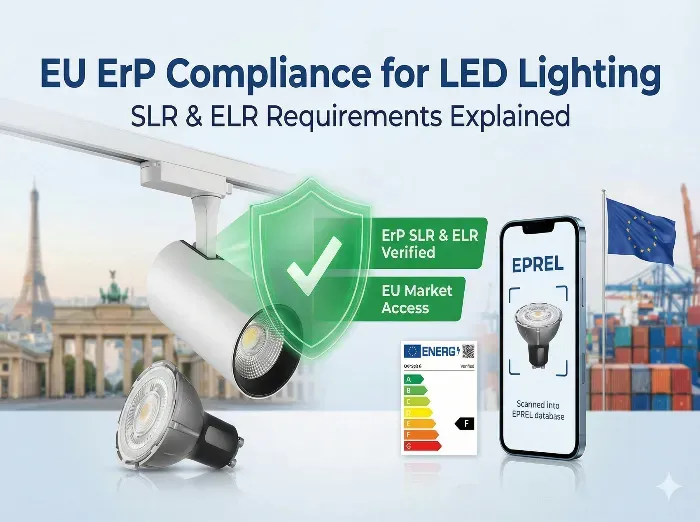
Key Industry Fact
Most compliant LED products today fall between Class D–F.
- Class A (>210 lm/W) → extremely rare
- Class B–C → premium products
- Class D–F → mainstream compliant products
Do not reject products simply because they are not Class A.
Key ErP Technical Requirements
Core Performance Parameters (Regulatory + Market Reference)
| Parameter | Requirement | Type | Critical Note |
|---|---|---|---|
| Luminous efficacy | Not fixed (ηTM-based under EU SLR) | Regulatory | Cannot be simplified as lm/W threshold |
| Standby power (Psb) | ≤0.5 W (≤2.0 W network standby) | Regulatory | Important for smart / connected lighting |
| Lebensdauer | 15,000–25,000h (L70B50 typical) | Market | Not a mandatory EU requirement |
| CRI (Ra) | ≥80 (general lighting) | Regulatory | ≥90 recommended for retail |
| Pst LM | ≤1.0 | Regulatory | Short-term flicker |
| SVM | ≤0.4 | Regulatory | Stroboscopic effect safety |
How to Calculate LED Efficacy
To verify compliance, efficacy must be calculated as:
Luminous Efficacy (η) = Total Luminous Flux (lm) / Power Input (W)Example
- 900 lm / 10 W = 90 lm/W → PASS
- 800 lm / 10 W = 80 lm/W → FAIL
This is one of the most common failure points in EU inspections.
Minimum Efficacy by Product Type (Market Reference, Not Regulatory Limit)
| Produkttyp | Typical Market Range (lm/W) | Key Influencing Factors |
|---|---|---|
| Non-directional lamps | 90–130 lm/W | Thermal design, driver efficiency |
| Directional lamps (GU10) | 70–110 lm/W | Beam angle, optical losses |
| High-output lamps | 110–160+ lm/W | Power level, heat dissipation |
Always verify category-specific requirements before testing.
Why Flicker Metrics Matter
- Pst LM → visible flicker
- SVM → motion distortion
These are frequent failure points in EU compliance audits.
Recommended internal link:
(Warum flackern dimmbare LED-Spots?)
Common Reasons LED Products Fail ErP Compliance
❌ Low Efficiency (<85 lm/W)
- outdated LED chips
- poor optical design
❌ High Standby Power (>0.5 W)
- inefficient drivers
- leakage in dimming circuits
❌ Missing EPREL Registration
- product not in EU database
- automatic customs rejection
❌ Incomplete Technical Documentation
- missing test reports
- no Declaration of Conformity
❌ Thermal Mismatch (Ta vs Real Use)
- tested at 25°C
- installed at 40°C+
leads to real-world failure
Manufacturer Insight
Over 60% of ErP failures are caused by documentation—not product performance.
EPREL Registration: What You Actually Need
EPREL database:
https://eprel.ec.europa.eu
Required Data
- product datasheet
- energy label parameters
- test reports (efficacy, power, flicker)
- supplier account (EU-based)
Critical Rule
EPREL registration must be completed before placing the product on the EU market
How to Achieve ErP Compliance
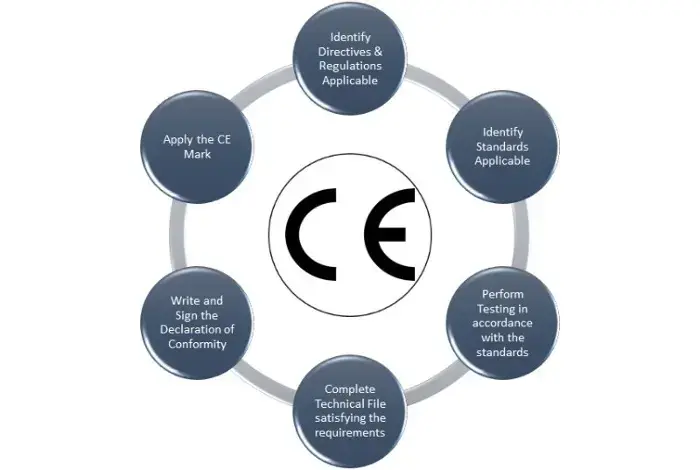
Diagram illustrating the step-by-step procedure for obtaining CE marking certification, with the CE logo at the center surrounded by key compliance activities such as testing and documentation.
Step 1: Identify Product Scope
- determine lamp vs luminaire
- confirm SLR applicability
Step 2: Perform Laboratory Testing
- efficacy
- standby power
- flicker (Pst LM / SVM)
- lifetime (LM-80 / TM-21)
Step 3: Verify Against SLR Limits
- compare results with thresholds
Step 4: Prepare Technical File
- test reports
- drawings
- risk assessment
- Konformitätserklärung
Step 5: Register in EPREL
- upload product data
- generate energy label
Step 6: Apply CE Marking
- confirm compliance
- prepare for inspection
Manufacturer vs Importer Responsibilities
| Role | Responsibility | Risk |
|---|---|---|
| Manufacturer | Design, testing, documentation | Production halt |
| Importer | Verify compliance, keep files (10 yrs) | Import ban / fines |
Key Rule
Der importer is legally responsible for placing compliant products on the EU market.
Compliant vs Non-Compliant LED Products
| Aspekt | Compliant Product | Non-Compliant Product |
|---|---|---|
| Customs | Pass | Rejected |
| EPREL | Registered | Missing |
| Performance | Verifiziert | Unstable |
| Legal Risk | Niedrig | Hoch |
Critical Engineering Factors
Ambient Temperature (Ta)
Performance is valid only under defined Ta conditions.
If exceeded:
- lumen output drops
- lifetime shortens
L70B50 Meaning
- L70 → 70% lumen maintenance
- B50 → 50% population
Industry standard = L70B50
Recommended internal link:
(Insert your L70 article)
System vs Component
- LM-80 → LED chip only
Real system includes:
- driver
- thermal design
- optics
Final Compliance Checklist
✔ ≥85 lm/W efficacy
✔ ≤0.5W standby power
✔ Pst LM ≤1.0
✔ SVM ≤0.4
✔ ≥25,000h (L70B50)
✔ EPREL registered
✔ CE marked
✔ documents stored for 10 years
FAQ
What is ErP compliance for LED?
ErP compliance ensures LED products meet EU efficiency and environmental requirements for legal sale.
Can I sell LED lights in the EU without ErP?
No. Non-compliant products will be rejected or banned.
What is EPREL registration?
EPREL is the EU database for energy-labelled products required before market entry.
What are the most common failures?
Low efficacy, high standby power, missing EPREL registration, and incomplete documentation.
Schlussfolgerung
ErP compliance is not just a technical requirement—it is a market access gatekeeper.
Failure leads to:
- shipment rejection
- financial loss
- project delays
Compliance ensures legal entry, stable performance, and long-term business reliability.
Get Your Product EU-Ready Before Shipping
Avoid:
- customs rejection
- project delays
- compliance penalties
We support:
- SLR compliance verification
- EPREL registration
- full technical file preparation