Kurze Antwort: Wie man Einzelhandels-Spots positioniert
- Verwenden Sie eine 30°–45° Beleuchtungswinkel um Blendung und Schatten zu vermeiden
- Wählen Strahlwinkel zwischen 15°–40° basierend auf der Anzeigegröße
- Beibehalten 1000–3000 Lux für die meisten Einzelhandelspräsentationen
- Leuchten positionieren 1,0–2,0 m von den Anzeigezielen entfernt
Für die meisten Einzelhandelsgeschäfte:
30° Winkel + 24°–36° Strahl = beste Balance aus Fokus und Gleichmäßigkeit
Einführung
Die Positionierung von Einzelhandels-Spots ist Teil einer umfassenden Einzelhandelsbeleuchtungsstrategie, einschließlich Umgebungs- und Allgemeinbeleuchtungsdesign.
Bei kommerziellen Einzelhandelsausbauten führt unsachgemäße Positionierung von Einzelhandels-Spotlights ist eine der häufigsten Ursachen für Inbetriebnahmeverzögerungen und kostspielige Nacharbeiten.
Schlechte Lichtplatzierung führt zu:
- ungleichmäßige Beleuchtung über Displays hinweg
- sichtbare Schatten auf Schaufensterpuppen und Regalen
- Blendung, die die Produktklarheit reduziert
- inkonsistente Beleuchtung über Zonen hinweg
Laut Richtlinien der Illuminating Engineering Society beeinflusst die Lichtqualität direkt die visuelle Wahrnehmung und die Einzelhandelsleistung, was eine korrekte Spotlight-Positionierung für beide entscheidend macht technische Umsetzung und kommerzielle Ergebnisse.
Für Auftragnehmer und Händler bedeuten diese Probleme oft:
- 20–30% erhöhte Arbeitskosten bei der Nachjustierung
- verzögerte Ladenöffnungen
- Kundenunzufriedenheit und potenzielle Projektstrafen
Leitfaden für die Positionierung von Einzelhandels-Spotlights

Um reale Entscheidungen zu vereinfachen:
- Schaufensterpuppen → 30° Winkel + 24° Strahl
- Regale → 35°–45° + 36° Strahl
- Schmuck → 30° + 15° schmaler Strahl
- Fensterdisplays → 20°–30° + breiterer Strahl
Beste Praxis:
Abstimmen Strahlwinkel zur Anzeigegröße, und Beleuchtungswinkel zur Betrachtungsrichtung
Warum die Positionierung von Einzelhandels-Spotlights wichtig ist
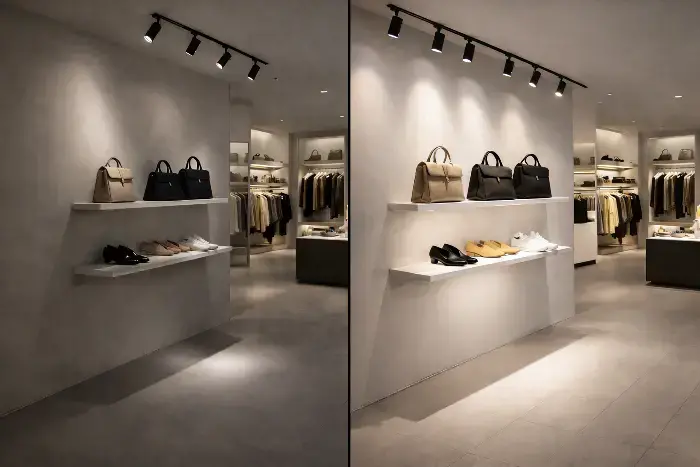
Vorher-nachher-Vergleich der Boutique-Beleuchtung, der zeigt, wie verbesserte Beleuchtung die Sichtbarkeit und Präsentation von Kleidung, Accessoires und Schuhen in den Regalen verbessert.
Auswirkung auf echte Projekte
Unsachgemäße Spot-Positionierung führt häufig zu:
- dunkle Zonen auf wichtigen Waren
- ungleichmäßige Helligkeitsverteilung
- repeated on-site adjustments
This increases installation time and reduces lighting performance consistency.
Engineering Perspective
Retail lighting is based on controlling contrast and direction, not just brightness.
The principles are derived from photometric laws such as the
Inverse Square Law and
Lambert’s Cosine Law.
These determine how light spreads and how effectively it illuminates surfaces.
Reference:
CIE Lighting Standards – https://cie.co.at/publications
The 30°–45° Rule for Retail Lighting
Der 30°–45° rule is the most widely used guideline in retail lighting design.
Why It Works
- <30° → harsh shadows and overly dramatic contrast
45° → increased glare and flattened lighting
Practical Application
| Angle | Anmeldung | Effect |
|---|---|---|
| 30° | Luxury displays / mannequins | Starker Kontrast |
| 35°–40° | General retail | Balanced |
| 45° | Wall displays | Uniform lighting |
Quick Engineering Formula
To achieve a 30° lighting angle:
D = (H_ceiling − H_target) × tan(30°)Example:
- Ceiling height: 3.0m
- Display height: 1.2m
Offset ≈ 1.0m
This aligns with retail lighting recommendations from
CIBSE LG9 Guide: https://www.cibse.org/knowledge-research/knowledge-portal/lighting-guides
30° vs 45°: Focus vs Uniformity
30° → “Museum effect”
- Starker Kontrast
- Ideal for luxury and jewelry
45° → “Commercial wash”
- Even illumination
- Suitable for apparel and shelves
Choose based on whether emphasis or uniformity is required
How Beam Angle Affects Visibility
Beam angle defines how light spreads across a surface.
Typical Applications
| Strahlwinkel | Anmeldung | Effect |
|---|---|---|
| 15° | Jewelry | High focus |
| 24°–36° | Mannequins | Balanced |
| 40°–60° | Shelves | Wide coverage |
For a more detailed comparison of beam angles such as 24° vs 36°, refer to our guide on spotlight beam angle selection.
Reference:
Lighting Research Center – https://www.lrc.rpi.edu/programs
Recommended Spotlight Placement by Retail Area
| Area | Angle | Beam | Spacing |
|---|---|---|---|
| Walls | 40°–45° | 36° | 1.2–1.5m |
| Mannequins | 30° | 24° | 1.0–1.2m |
| Windows | 20°–30° | 36°–60° | 0.8–1.0m |
Verwendung one dominant light direction per zone to avoid shadow overlap
Recommended Illuminance Levels
| Display Type | Avg Lux | Peak Lux |
|---|---|---|
| Apparel | 1000–2000 | 3000 |
| Jewelry | 2000–4000 | 5000+ |
| Cosmetics | 1500–3000 | 4000 |
Reference:
IES Lighting Handbook – https://www.ies.org/store/
Color Quality Consideration (CRI & R9)
For retail spotlight positioning:
- CRI > 90 ensures overall color accuracy
- R9 > 50 enhances red tones and product vibrancy
Especially critical for apparel, cosmetics, and fresh products
For detailed explanation, refer to your CRI article (internal link recommended)
Glare Control (UGR) in Retail Lighting
When spotlight angles exceed 45°, glare risk increases.
To reduce visual discomfort:
- Verwendung deep-recessed fixtures
- Add honeycomb louvers
- Beibehalten UGR < 19
Reference:
EN 12464-1 Standard – https://standards.iteh.ai
Track Lights vs Recessed Spotlights
- Track lights → flexible, ideal for changing displays
- Recessed spotlights → fixed, clean ceiling design
Choose based on layout flexibility and design intent
Common Spotlight Positioning Mistakes
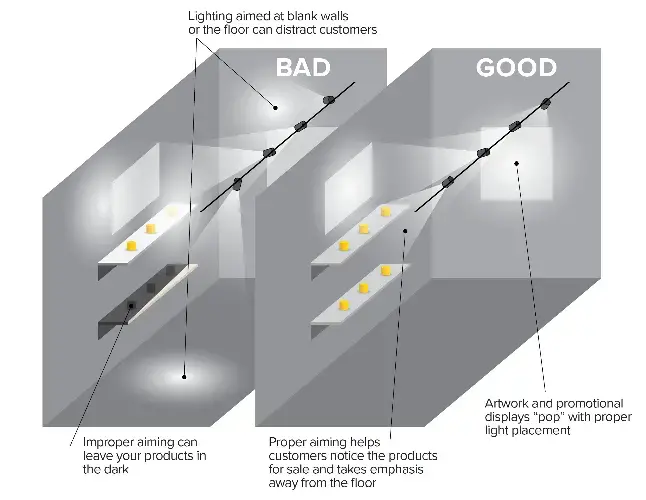
Side-by-side illustration showing poor lighting that distracts from products versus effective lighting that highlights displays and artwork for improved visual merchandising.
- Vertical lighting → glare
- Overlapping beams → hotspots
- Excessive spacing → dark zones
- Incorrect beam angle → uneven lighting
Result: increased rework and poor display performance
Practical Example: 3m Ceiling Retail Layout

- Grid spacing: 1.2–1.5m
- Beam: 24°–36°
- Tilt: 30°–40°
Ergebnis:
- ~1200 lux average
- Uniformity >0.8
Validated using DIALux evo
To ensure stable lighting performance, it is also important to consider Flimmern und dimming compatibility in LED systems.
Best Practices for Retail Spotlight Positioning
- Use angled lighting (30°–45°)
- Match beam angle to display width
- Maintain 3:1 contrast ratio
- Avoid direct overhead lighting
- Use high CRI + adequate R9
These principles apply across most retail environments
Schlussfolgerung
Effective Positionierung von Einzelhandels-Spotlights combines:
- correct angles
- proper beam selection
- controlled spacing
- high-quality light
For most projects:
30°–45° angle + 24°–36° beam = optimal retail lighting solution
Free Retail Lighting Simulation for Your Project
Worried about delays caused by on-site adjustments?
Our engineering team provides:
- Dialux-based 3D lighting simulations
- Pre-calculated spotlight layouts
- Verified lux and uniformity results