Pourquoi les Spots LED Dimmerables Clignotent-ils ?
Dernière mise à jour le 3 mars 2026
A Complete Compatibility & Buyer’s Guide
Dimmable LED spotlights are widely used in residential, hospitality, and commercial projects. Yet despite technological maturity, dimming-related failures remain one of the most common causes of:
- Flicker at low brightness
- Buzzing noise
- Sudden shut-off
- Plage de gradation limitée
- Client complaints after handover
The core issue is simple:
“Dimmable” does NOT mean “universally compatible.”
In this technical buyer’s guide, we explain why dimmable LED spotlights fail, how dimmer compatibility really works, and how to select the correct system to avoid rework and margin loss.
This article is written for:
- Lighting designers
- Electrical contractors
- Procurement teams
- Engineers
- Hospitality and retail specifiers
1. Why Do Dimmable LED Spotlights Flicker?
Flicker is not random. It is usually caused by system-level mismatch entre :
Dimmer → Electrical wiring → Driver → LED load
Most problems occur because:
- The dimmer minimum load is not met
- The driver cannot handle phase-cut distortion
- The transformer (MR16 systems) is incompatible
- Mixed lamp models are used on one circuit
For deeper understanding of waveform distortion and flicker mechanisms, see:
👉 【Fréquence de gradation PWM dans l'éclairage LED】
2. Start With the Electrical System — Not the Lamp

Before selecting any dimmable LED spotlight, confirm:
- Is the system 120V / 230V line voltage?
- Is it GU10, MR16 (GU5.3), AR111, or track-mounted?
- Is there an electronic transformer involved?
- Is dimming local (wall dimmer) or centralized?
Why this matters
Dimming behavior depends on the entire electrical chain.
A GU10 spotlight designed for direct phase-cut may perform perfectly on line voltage — but the same driver may flicker in an MR16 system with an incompatible transformer.
If you are working with MR16 systems, review:
👉 【 Qu'est-ce qu'un transformateur électronique ?】
3. Leading Edge vs Trailing Edge — The Most Common Confusion
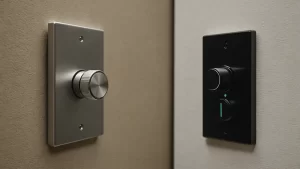
A detailed comparison of trailing-edge and leading-edge dimmers, highlighting their design characteristics and functional differences.
Most dimming failures originate from using the wrong dimmer type.
Leading Edge (Forward Phase)
- Originally designed for incandescent loads
- Higher electrical stress
- Greater risk of buzzing
- Limited LED compatibility
Trailing Edge (Reverse Phase)
- Conçu pour les charges électroniques
- Lower noise
- Better low-end stability
- Wider dimming range
In modern LED installations, trailing-edge dimmers are generally preferred unless compatibility data confirms otherwise.
For deeper technical explanation of TRIAC behavior, see:
👉 【TRIAC Dimming for LED Bulbs】
4. “LED Compatible” Is Not a Technical Specification
Many dimmers are labeled “LED compatible,” but this does not guarantee stability.
When specifying dimmable LED spotlights, verify:
- Supported dimmer types
- Minimum load requirement
- Dimming range (e.g., 100–10%, 100–5%)
- Driver topology
- Compatibility test results
Absence of documentation increases risk.
5. Dimming Quality Indicators Professionals Should Check
A lamp that turns on and dims is not automatically acceptable for professional use.
Evaluate:
- Low-end stability below 10%
- Visible flicker (IEEE 1789 guidance)
- Audible noise from driver or dimmer
- Smoothness of transition
- Color consistency during dimming
For hospitality and residential projects, deep dimming below 5% is often required to achieve nighttime comfort.
6. Driver Quality Determines Long-Term Reliability
The LED driver is the most critical component in a dimmable spotlight.
High-quality drivers feature:
- Active current regulation
- Thermal protection
- Phase-cut optimization
- Stable output under waveform distortion
- Voltage fluctuation tolerance
Low-quality drivers often result in:
- Color shift at low brightness
- Early failure
- Inconsistent behavior across dimmer brands
For procurement teams, requesting driver technical data is a risk-control step — not optional documentation.
7. Special Risk Area: MR16 Dimming Systems
MR16 dimming introduces transformer complexity.
Common problems:
- Transformer minimum load not met
- Electronic transformer incompatibility
- Audible transformer buzzing
- Reduced dimming range
Successful MR16 dimming requires compatibility across:
Dimmer → Transformer → LED Spotlight
Never assume compatibility without verification.
8. Load Calculations in Multi-Lamp Circuits
In real projects, one dimmer often controls multiple spotlights.
Important considerations:
- Total connected wattage
- Minimum / maximum dimmer load
- Inrush current
- Circuit diversity
Oversizing dimmers improves stability and reduces stress on electronic components.
9. Procurement Checklist for Dimmable LED Spotlights
Before approving product selection, confirm:
- Stated dimming method
- Supported dimmer types
- Exigences de charge minimale
- Dimming range specification
- Driver technical documentation
- Transformer compatibility (if applicable)
- Warranty coverage for dimming use
- Availability of technical support
Lack of transparency is a warning signal.
10. Common Mistakes That Cause Dimming Failures
Even experienced teams often:
- Select based on wattage only
- Mix different LED models on one dimmer
- Ignore minimum load thresholds
- Skip compatibility testing
- Assume all “dimmable” lamps behave the same
Each of these increases callback risk.
Conclusion: Dimming Is a System Decision, Not a Product Feature
Dimmable LED spotlights can deliver exceptional flexibility and visual comfort — but only when specified correctly.
Reliable dimming depends on:
- Electrical system clarity
- Dimmer compatibility
- Driver quality
- Load calculation
- Application context
Treat dimming as a system-level engineering decision, not a packaging checkbox.
Reduce Project Risk Before Installation
If you are evaluating dimmable LED spotlights for:
- Projets d'hôtellerie
- Retail rollouts
- Residential developments
- Standardized multi-site installations
Our technical team can assist with:
- Dimmer compatibility evaluation
- Driver and transformer matching
- Flicker performance analysis
- Load calculation guidance
- Pre-procurement validation
Contact us to review your dimming system architecture before installation — and avoid costly on-site corrections.