Comment concevoir un système d'éclairage circadien d'une journée complète en utilisant des luminaires LED standard
Beaucoup de gens supposent que l'éclairage circadien nécessite des systèmes architecturaux complexes, des luminaires sur mesure ou des plateformes intelligentes coûteuses. En pratique, la plupart des échecs en matière d'éclairage circadien ne sont pas causés par des limitations de luminaires, mais par une mauvaise planification et une utilisation incorrecte des outils d'éclairage standard.
Les schémas d'échec courants incluent :
- appliquer un spectre unique tout au long de la journée
- ignorant l'exposition à la lumière verticale, au niveau des yeux
- utiliser la “ lumière chaude ” comme substitut à l'éclairage nocturne biologiquement sûr
Un système d'éclairage circadien sur toute la journée peut être mis en œuvre à l'aide de luminaires LED standard lorsque le timing, le spectre, l'intensité et le placement suivent la biologie humaine plutôt que les catégories de produits.
L'éclairage circadien est une stratégie de conception, pas une référence. Les spots GU10, les ampoules E27 et les downlights standards existent déjà dans la plupart des bâtiments. Lorsque chaque type de luminaire se voit attribuer un rôle biologique clair, ces produits courants peuvent favoriser la vigilance, le confort et le sommeil sur un cycle complet de 24 heures.
Le cadre d'éclairage circadien sur 24 heures

Diagramme illustrant le cycle circadien d'éclairage de 24 heures avec les phases pour la vigilance matinale, le maintien de l'après-midi, la détente du soir et le soutien au sommeil nocturne, mettant en scène des intérieurs quotidiens.
L'éclairage circadien ne fonctionne que lorsque la journée entière est considérée comme un seul système. Concevoir des scènes d'éclairage isolées sans continuité biologique affaiblit les signaux circadiens et réduit l'efficacité.
Une stratégie circadienne fonctionnelle divise la journée en phases biologiques distinctes, chacune avec un objectif d'éclairage clair et des limites définies.
Les quatre phases biologiques de la journée
Le rythme circadien humain suit des phases prévisibles principalement dictées par l'exposition à la lumière.
| Phase | Fenêtre temporelle typique | Objectif biologique |
|---|---|---|
| Matin | Réveil jusqu'à ~11:00 | Activer et alerter |
| Après-midi | ~11:00–17:00 | Maintenir la stabilité |
| Soirée | ~17:00–21:00 | Se détendre |
| Nuit | ~21:00–réveil | Protéger le sommeil |
Le timing exact varie selon l'individu, mais la la séquence ne.
Pourquoi la plupart des systèmes échouent
De nombreux bâtiments reposent sur :
- un spectre
- un niveau de luminosité
- toute la journée
Cela supprime le contraste biologique.
Le système circadien nécessite fortes différences entre les phases, pas un éclairage constant.
Planifier avant de sélectionner les luminaires
Avant de choisir des lampes ou des systèmes de contrôle, les concepteurs doivent répondre à trois questions :
- Quand les occupants doivent-ils se sentir vigilants ?
- Quand doivent-ils commencer à se détendre ?
- Quand la lumière doit-elle éviter toute stimulation ?
La sélection des luminaires n'a de sens qu'après que ces limites ont été définies.
Principe de planification central
L'éclairage circadien n'est pas un éclairage d'ambiance.
C'est signalisation biologique directionnelle:
- signaux forts tôt
- signaux réduits plus tard
- pas de stimulation la nuit
Conception de l'éclairage de la phase matinale

Scène de bureau moderne mettant en scène une femme près d'une fenêtre, illustrant la conception de l'éclairage de la phase matinale qui favorise la vigilance grâce à l'intégration de la lumière naturelle du jour et de l'éclairage artificiel.
La lumière matinale signale le début de la journée biologique. Sans un signal matinal fort, les gens se sentent souvent fatigués même après un sommeil suffisant.
L'éclairage matinal doit fournir une lumière riche en bleu et de haute intensité aux yeux pour supprimer la mélatonine résiduelle et initier la libération de cortisol.
Objectif biologique
Une lumière matinale efficace doit :
- supprimer la mélatonine
- augmenter le cortisol
- améliorer la vigilance
- ancrer l'horloge circadienne
Des recherches de la Harvard Medical School confirment que la lumière matinale riche en bleu améliore la vigilance et l'humeur.
Source : https://health.harvard.edu/staying-healthy/blue-light-has-a-dark-side
Cibles de spectre et d'intensité
| Paramètre | Cible matinale |
|---|---|
| Température de couleur | 4000K–6500K |
| Luminosité | Haut |
| Contenu bleu | Présent |
| Durée d'exposition | 1 à 3 heures |
Un éclairage matinal faible réduit la force circadienne plus tard dans la journée.
Utiliser des luminaires standard le matin
Downlights et ampoules E27 sont les principaux outils pour cette phase.
Les meilleures pratiques incluent :
- spectre blanc neutre à froid
- un éclairage vertical intense
- la réflexion indirecte des murs
Les spots GU10 peuvent contribuer, mais seulement en complément.
D'un point de vue technique, les luminaires GU10 fournissent généralement un éclairement vertical limité en raison du contrôle du faisceau et de la hauteur de montage. Cela limite leur efficacité pour l'ancrage de la phase circadienne lorsqu'ils sont utilisés seuls.
Lorsqu'une lumière naturelle suffisante est disponible, l'éclairage circadien artificiel devrait supporter—non remplacer—l'exposition à la lumière naturelle.
Stratégie de placement
- privilégier l'éclairage des murs plutôt que l'éclairage du sol
- éviter les faisceaux étroits dirigés directement vers le bas
- s'assurer que la lumière atteint le niveau des yeux
La réponse circadienne dépend de exposition à hauteur des yeux, pas le luxe du plan de tâches.
Source : WELL Building Standard v2
https://standard.wellcertified.com/light
Erreurs courantes de conception matinale
- un éclairage blanc chaud le matin
- scènes “cosy” de faible intensité
- compter uniquement sur des lampes de bureau
Celles-ci retardent l'activation circadienne et entraînent souvent une fatigue en fin d'après-midi.
Stratégie d'éclairage de la phase de l'après-midi
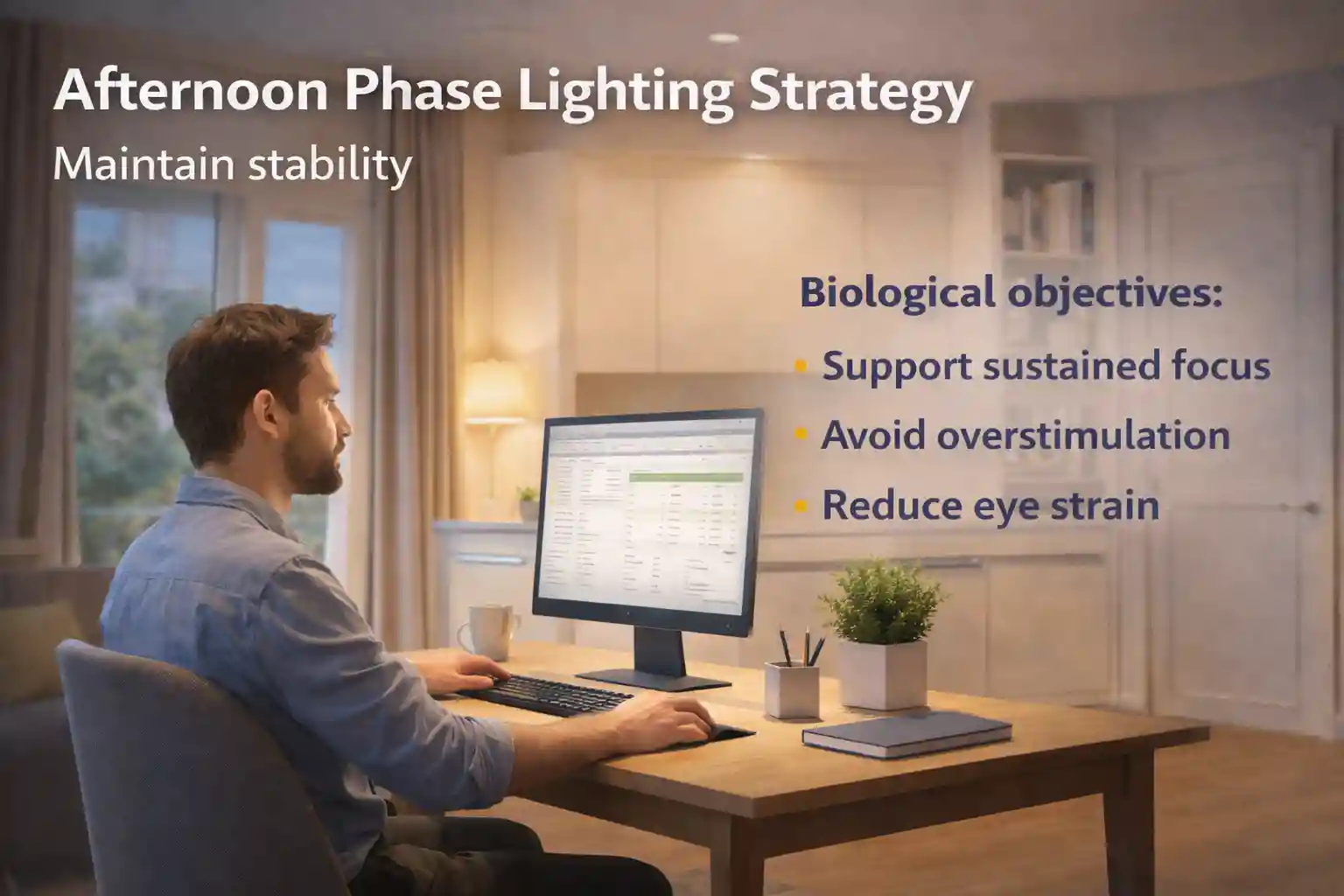
Professionnel travaillant dans un environnement de bureau chaleureux avec un éclairage de phase après-midi, utilisant un éclairage équilibré pour maintenir la concentration et réduire la fatigue visuelle.
La phase de l'après-midi ne vise pas à augmenter la stimulation circadienne, mais à préserver le confort visuel et neurologique.
L'éclairage de l'après-midi doit maintenir la vigilance tout en minimisant le stress biologique et la fatigue visuelle.
Objectif biologique
La lumière de l'après-midi doit :
- soutenir une concentration soutenue
- éviter la surstimulation
- réduire la fatigue oculaire
À ce stade, le système circadien est déjà actif et nécessite un renforcement, pas une escalade.
Paramètres de spectre et d'intensité
| Paramètre | Cible de l'après-midi |
|---|---|
| Température de couleur | 3500K–4500K |
| Luminosité | Moyen |
| Contraste | Modéré |
| Scintillement | Minimal |
Une luminosité ou un contraste excessif provoque souvent de la fatigue plutôt qu'une amélioration des performances.
Stratégie des luminaires
Les luminaires standards fonctionnent bien lorsqu'ils sont correctement équilibrés :
- Downlights pour l'éclairage général
- Ampoules E27 pour un éclairage d'ambiance
- GU10 pour les accents de tâches localisées
À éviter :
- luminosité extrême
- éblouissement dans le champ de vision
- faisceaux étroits dirigés vers les yeux
Considérations de confort visuel
En pratique, l'inconfort de l'après-midi est plus souvent causé par :
- scintillement
- éblouissement
- luminance inégale
plutôt que le désalignement circadien lui-même.
La norme IEEE Std 1789 confirme que le scintillement peut affecter le confort neurologique.
Source : https://ieeexplore.ieee.org/document/6575776
Préparation à la transition du soir
L'éclairage de l'après-midi devrait préparer progressivement le soir.
Une réduction progressive est plus efficace que des changements soudains.
Contrôle de l'éclairage de la phase du soir
Le soir est l'endroit où de nombreuses conceptions d'éclairage circadien échouent. La lumière reste trop brillante et trop blanche trop longtemps.
L'éclairage du soir doit réduire la stimulation biologique tout en préservant le confort et l'utilité sociale.
Objectif biologique
La lumière du soir doit :
- permettre aux niveaux de mélatonine de monter
- réduire la vigilance
- signaler au corps de ralentir
Cette phase influence fortement la qualité du sommeil.
Cibles de spectre et d'intensité
| Paramètre | Cible du soir |
|---|---|
| Température de couleur | 2200K–3000K |
| Luminosité | Faible à moyen |
| Contenu bleu | Réduit |
| Direction | Indirect |
La lumière blanche au-dessus de 3000K va à l'encontre de la biologie du soir.
La soirée comme transition, pas comme destination
L'éclairage du soir doit être traité comme un phase de transition, pas un point final.
Il prépare le corps à l'obscurité mais ne remplace pas un éclairage sûr pour la nuit.
Utiliser des luminaires standards le soir
Les luminaires GU10 deviennent importants pendant cette phase.
Les utilisations efficaces incluent :
- éclairage d'accentuation GU10 chaud
- GU10 à gradation vers le chaud pour une transition progressive
- Ampoules chaudes E27 pour une lueur ambiante
Les downlights doivent être fortement atténués ou éteints.
Stratégie de placement
- réduire l'éclairage basé sur le plafond
- mettre l'accent sur l'éclairage des murs et du périmètre
- minimiser l'exposition directe des yeux
Erreurs courantes du soir
- laisser l'éclairage diurne actif
- utiliser le blanc froid pour une clarté perçue
- surdimensionnement des spots encastrés
Cela retarde l'endormissement et augmente la vigilance nocturne.
Éclairage de phase nocturne et protection du sommeil
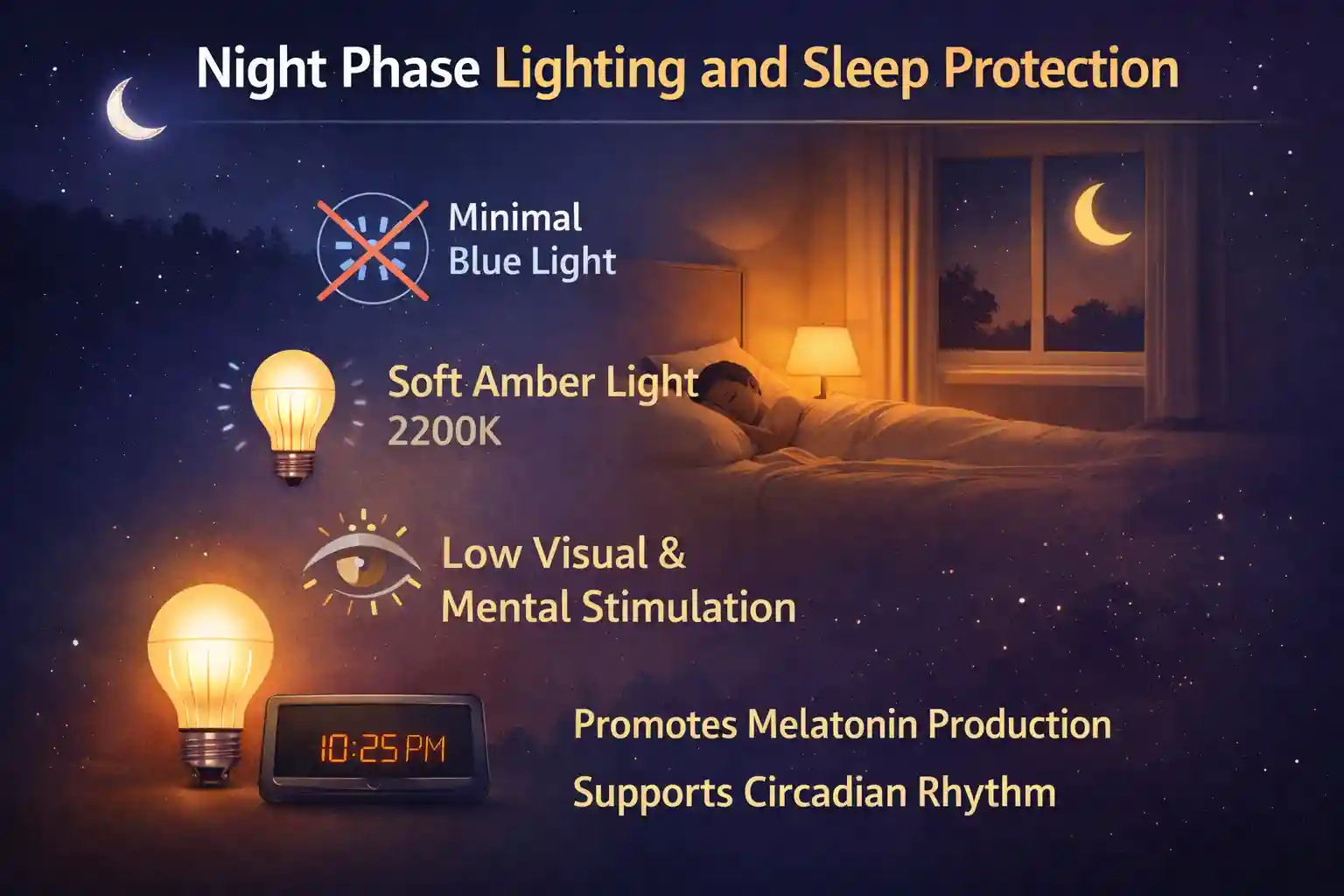
Scène de chambre la nuit avec éclairage ambré, une icône de lumière bleue barrée, et des repères visuels expliquant un éclairage à faible stimulation pour améliorer la qualité du sommeil et la production de mélatonine.
L'éclairage nocturne ne devrait exister que pour prévenir les accidents.
La nuit, l'éclairage doit éviter toute stimulation biologique tout en maintenant l'orientation et la sécurité.
Objectif biologique
L'éclairage nocturne doit :
- protéger la mélatonine
- éviter les longueurs d'onde bleues
- rester extrêmement bas
Même une brève exposition compte.
La recherche montre que la suppression de la mélatonine peut survenir à des niveaux de lumière bleue très faibles, même en dessous de 10 lux.
Source : Journal of Clinical Endocrinology & Metabolism
https://academic.oup.com/jcem/article/100/6/2209/2836073
Spectres acceptables la nuit
| Spectre | Sécurité nocturne |
|---|---|
| Rouge | Excellent |
| Ambre sans bleu | Limitée |
La lumière blanche n'est pas sûre pour le rythme circadien la nuit, même lorsqu'elle est atténuée.
Stratégie des luminaires
GU10 est idéal pour l'éclairage de la phase nocturne.
Meilleures applications :
- éclairage de chemin au niveau du sol
- lumières de guidage pour salle de bain
- orientation des couloirs
Règles de placement :
- en dessous de la hauteur des genoux
- protégé de la vue directe
- luminosité minimale
Dans les projets d'hôtellerie et résidentiels, l'éclairage nocturne doit supposer comportement utilisateur incorrect et restent sûrs par défaut.
Ce que l'éclairage nocturne n'est pas
- “Le ” blanc très chaud » n'est pas sûr pour la nuit
- Les spots encastrables atténués ne sont pas sûrs pour le rythme circadien
- L'éclairage contrôlé par l'utilisateur n'est pas une protection fiable
Utilisation de luminaires standards dans un système circadien

Diagramme illustrant comment les luminaires standards s'adaptent aux rythmes circadiens tout au long de la journée, passant des lampes à sortie fixe de base à des commandes d'éclairage intelligentes et adaptatives.
Un système circadien complet sur toute la journée ne nécessite pas de luminaires spécialisés. Il nécessite attribution claire des rôles.
Attribution des rôles des luminaires
| Type de luminaire | Rôle approprié | Mauvaise utilisation courante |
|---|---|---|
| Downlights | Matin et après-midi | Laissé allumé la nuit |
| Ampoules E27 | Ambiance diurne et nocturne | Utilisation trop lumineuse le soir |
| GU10 | Transition du soir et guidage nocturne | Utilisé pour l'activation matinale |
Des problèmes surviennent lorsqu'un type de luminaire tente de servir toutes les phases.
Logique de contrôle plutôt que complexité
Les systèmes circadiens efficaces ne nécessitent pas de plateformes avancées.
Les solutions simples incluent :
- commutation basée sur le temps
- circuits séparés par phase
- programmes d'atténuation prévisibles
La simplicité comportementale surpasse la complexité technique.
Un exemple réaliste de chambre
- downlight éteint la nuit
- Lampe chaude E27 pour le soir
- Lumière rouge GU10 pour la navigation
Il s'agit d'un système circadien fonctionnel — aucune application requise.
Conclusion
Un système d'éclairage circadien toute la journée peut être conçu en utilisant des luminaires LED standard lorsque chaque phase biologique est soutenue par le spectre, l'intensité et le placement corrects.
L'efficacité circadienne provient de contraste net entre les phases, et non à partir de produits spécialisés ou de commandes complexes.
Travaillez avec nous – Support technique et conseils de projet
Teco fabrique Spots LED GU10 et prend en charge Solutions E27 et LED standard pour des projets d'éclairage conscients du rythme circadien et centrés sur l'humain.
Nous opérons strictement en Environnements B2B, en se concentrant sur les systèmes qui fonctionnent dans des bâtiments réels, avec des budgets et des délais réalistes.
Notre usine basée en Chine prend en charge :
- solutions GU10 chaudes, ambrées et rouges
- développement dim-to-warm
- gradation bas niveau stable
- Personnalisation OEM et ODM
- conformité pour l'Europe, le Moyen-Orient et l'Asie du Sud-Est
Si vous planifiez une stratégie d'éclairage circadien utilisant des luminaires standards :
Email : [email protected]
Site Web : www.tecolite.com
Décrivez votre type d'espace et ses contraintes.
Nous aidons à valider les stratégies circadiennes avant l'acquisition—pas après l'installation.