GU4 vs GU5.3 LED Bulbs: Pin Spacing, MR11 vs MR16, Voltage and Fixture Fit
Updated: September 4, 2026
GU4 and GU5.3 are different two-pin lamp bases, and they are not interchangeable. GU4 is commonly used with smaller MR11 lamps, while GU5.3 is commonly used with 12V MR16 lamps. Before replacement, check pin spacing, reflector size, voltage, transformer or LED driver compatibility, brightness requirement and available fixture depth.
| Base | Typical lamp | Pin spacing | Common risk |
|---|---|---|---|
| GU4 | MR11 | About 4 mm | Small fixture space and lower lumen output |
| GU5.3 | MR16 | About 5.3 mm | Transformer minimum load and dimming stability |
Do not force a GU4 lamp into a GU5.3 socket or treat MR11 and MR16 as the same replacement. For B2B orders, send socket photos, lamp markings, transformer model and target quantity before sample approval.
Choosing the right low-voltage spotlight base may seem like a small decision in the larger context of lighting design. But for wholesalers, lighting brands, and commercial project planners, selecting between GU4 e GU5.3 is a choice that carries real implications—affecting installation compatibility, brightness levels, maintenance cycles, procurement costs, and ultimately the experience of the space being illuminated.
While both are 12-volt bi-pin bases used in low-voltage lamps, GU4 e GU5.3 serve very different purposes in today’s lighting market. Their mechanical structure, thermal behavior, brightness capability, and typical applications differ far more than many buyers realize. Because your target customers depend on reliable, consistent lighting that is easy to replace and maintain over time, understanding these differences is essential for avoiding costly mistakes.
This article provides a complete, factory-level perspective on how GU4 e GU5.3 lamps compare—technically, commercially, optically, and operationally. It also explains which fixtures each type is designed for and how lighting professionals should choose between them for real-world projects.
Understanding the Technical Definitions: GU4 and GU5.3 Compared

The most basic difference is in the pin spacing:
This spacing is not interchangeable. Lamps using one base cannot be inserted into fixtures meant for the other because:
- The socket width is different.
- The lamp body depth and diameter are different.
- The mechanical retention structure inside the lamp holder differs.
In most cases, Typically, GU4 bases are paired with the compact MR11 (35 mm) form factor, while GU5.3 bases are most commonly associated with the larger MR16 (50 mm) form factor.. This dimensional relationship explains nearly every downstream difference—brightness, heat management, optics, and application area.
CIE reference for lamp and reflector definitions: https://cie.co.at
Size and Form Factor: Why Physical Dimensions Matter More Than Buyers Expect

A GU4 (MR11) lamp is far smaller and lighter than a GU5.3 (MR16) lamp:
The difference of 15 mm may seem minor, but in lighting engineering it dramatically affects:
• Heat dissipation capacity
Small lamps have limited surface area to disperse heat. LEDs degrade quickly if the junction temperature is not controlled. This is why GU4 LEDs rarely exceed 3–4 watts.
• Space available for optics
GU5.3 reflectors and lenses can shape beams more precisely and support wider beam angle ranges.
• Driver circuitry space
Larger lamp bodies allow more robust constant-current drivers, improving stability and lifespan.
• Compatibility with commercial fixtures
Many architectural downlights, track heads, and accent fixtures are designed specifically around the MR16 form factor.
This is the first major divide between the two systems:
GU4 is used where space is tight; GU5.3 is used where performance matters.
Optical Engineering: Beam Angles, Light Distribution, and Color Rendering

Optics in GU4 and GU5.3 lamps differ substantially because of their physical geometry.
GU4 (MR11) Optical Characteristics
- Smaller reflector area → more concentrated beam
- Usually offered in 15°–35° beams
- More suitable for small accent points, display cabinets, jewelry lighting
- Limited space for advanced diffusers or anti-glare structures
GU5.3 (MR16) Optical Characteristics
- Larger reflector → accommodates narrow, medium, and wide beams (15°/24°/36°/60°)
- Compatible with advanced TIR lenses and coated reflectors
- Better center-beam intensity
- More uniform distribution for general commercial lighting
For commercial spaces like retail stores or hotel corridors, GU5.3 optics offer a level of visual comfort and distribution uniformity that GU4 cannot match.
Voltage and Driver Considerations: Understanding 12V System Behavior
Both GU4 e GU5.3 lamps operate on 12-volt low-voltage systems, but it is critical for buyers to understand how transformer compatibility affects performance.
Types of Transformers Used in the Field
- Magnetic transformers (compatible with most LEDs)
- Electronic halogen transformers (often incompatible with LEDs)
- LED constant-voltage drivers (recommended for modern installations)
Common Issues in Real Projects
- Flickering due to under-load
- Buzzing caused by high-frequency output
- Failure to turn on when transformer minimum load is not met
- Early LED degradation due to voltage instability
For large-scale installations (hotels, restaurants, malls), using LED-specific drivers dramatically improves reliability.
IEC standards for low-voltage lighting systems: https://www.iec.ch
Thermal Engineering: Heat Determines Lifespan and Stability
Heat management is one of the most critical engineering challenges in LED bulbs. GU4 e GU5.3 differ strongly here:
GU4
- Tiny heat sink
- Limited airflow in small fixtures
- Heat accumulates quickly
- Typical power: 1.5W–3.5W
- Higher risk of color shift over time
GU5.3
- Larger aluminum or composite heat sinks
- Better airflow in most fixtures
- Supports 5W–7W or more
- Far longer stable lifespan (when properly designed)
This is why most lighting designers choose GU5.3 for general illumination in commercial spaces.
ENERGY STAR data on LED thermal performance: https://www.energystar.gov
Brightness and Efficiency: GU5.3 Is the Clear Winner

Because GU5.3 lamps support higher wattage and better thermal design, they deliver significantly higher brightness.
Typical commercial LED lumen outputs:
| Tipo | Typical Lumen Output | Efficienza |
|---|---|---|
| GU4 (MR11) | 150–300 lm | 45–70 lm/W |
| GU5.3 (MR16) | 350–650 lm | 70–95 lm/W |
The difference is not minor. It determines whether a fixture can serve as:
- General illumination
- Accent lighting
- High-intensity spot lighting
- Retail product highlighting
For most commercial applications, GU5.3 provides the necessary visual performance.
GU4 vs GU5.3: Comparison of Compatible Fixtures)
Different lamp bases require different fixture types. This is a critical difference often overlooked by buyers.
GU4-Compatible Fixtures
Because GU4 lamps are smaller, they are used in fixtures requiring compact design:
- Display cabinets (museum displays, jewelry stores)
- Under-cabinet lights
- Mini spotlight fixtures
- Micro track lights
- Furniture-integrated lighting
- Small showcase downlights
Characteristics of GU4 fixtures:
- Very small beam focus
- Lightweight and compact
- Limited heat dissipation space
- Usually used at eye-level or close-range illumination
- Low installation depth
GU5.3-Compatible Fixtures
GU5.3 lamps are compatible with significantly more fixture categories:
- Architectural downlights
- Office spotlights
- Hotel ceiling fixtures
- Retail track lighting
- Restaurant general illumination
- Recessed ceiling fixtures
- Landscape lighting (12V)
Characteristics of GU5.3 fixtures:
- Larger housings allow robust heat management
- Better anti-glare design (baffles, reflectors)
- Wider range of beam angles
- Designed for long operating hours
Compatible with dimming systems used in commercial lighting
Key Insight for B2B Buyers:
Fixture availability strongly favors GU5.3, making it easier to use for new construction, renovations, and large-scale commercial upgrades.
Real-World Applications: When to Choose GU4 vs GU5.3
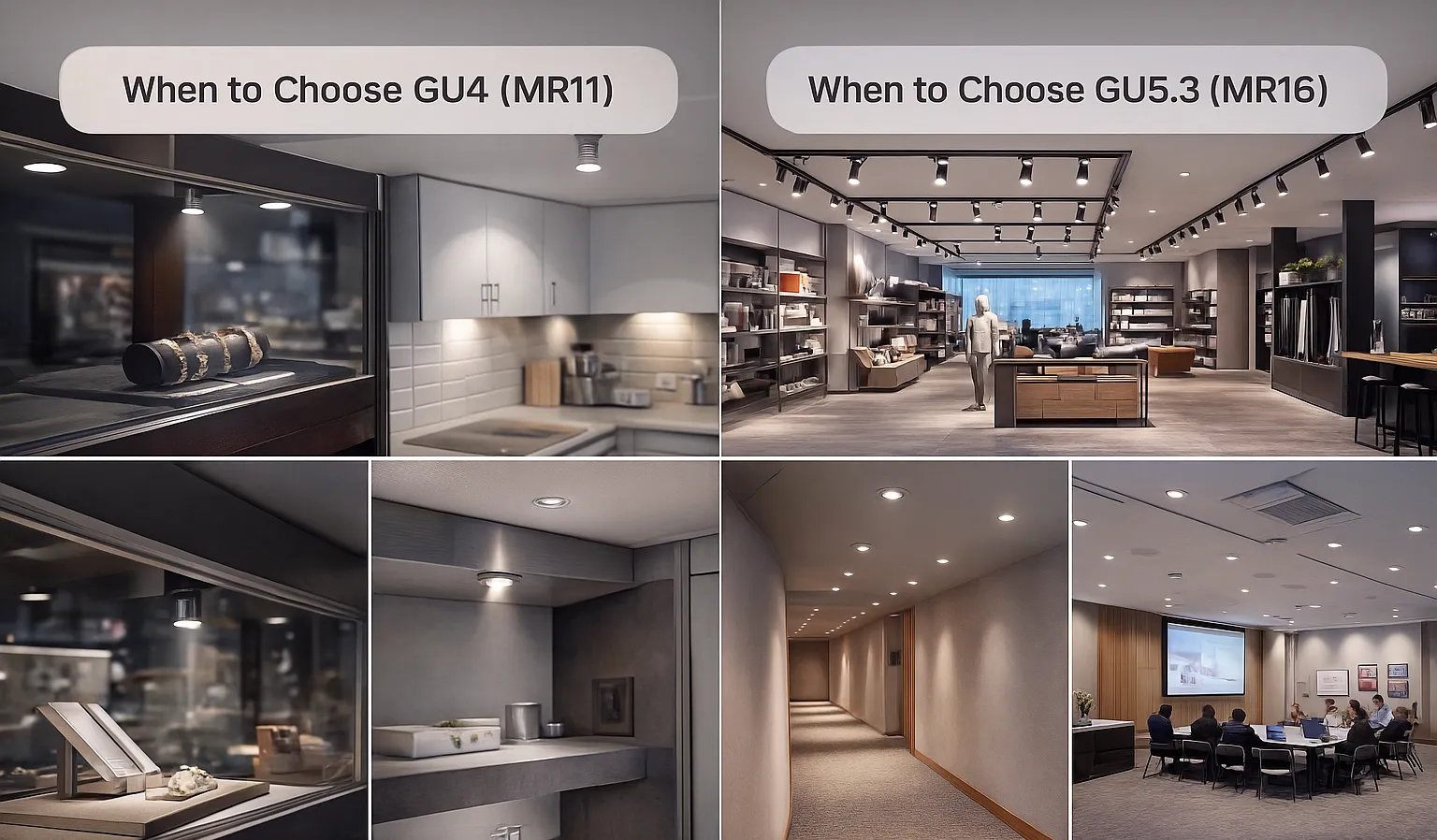
Choose GU4 when:
- Space is extremely limited
- Precision accent lighting is required
- Light must be integrated into furniture or displays
- Illumination distance is short
- Brightness requirements are modest
Choose GU5.3 when:
- The installation involves ceilings or track lights
- Light must reach medium to long distances
- Brightness is important
- Dimming performance matters
- Fixtures require heat management
- Project scale is large (hotel, retail chain, office renovation)
Commercial Buyer Considerations: Cost, Availability, and Supply Chain
Market Demand
Supply Chain Stability
- GU5.3 has more mature tooling, higher-volume chip matching, and optimized production lines.
- GU4 often requires semi-custom assembly.
Cost Factors
- GU5.3 is cheaper due to economies of scale.
- GU4 costs more per lumen and per unit due to smaller market size.
Inventory Risk
- Wholesalers stocking GU5.3 move units faster.
- GU4 sells more slowly but has steady demand in specialty markets.
Common Mistakes Buyers Make (and How to Avoid Them)
- Assuming GU4 e GU5.3 are interchangeable
- Using halogen electronic transformers with LED replacements
- Ignoring fixture size or heat constraints
- Choosing too small a lamp (GU4) for general illumination
- Only comparing wattage rather than lumen output
- Not confirming compatibility with existing dimmers
- Buying non-branded drivers to save cost (reduces lifespan)
Practical Recommendation: Which Base Should You Choose?
For most commercial projects, GU5.3 is the reliable, versatile, cost-efficient choice.
For small-scale, precision, cabinet, or furniture lighting, GU4 is the right choice.
For wholesalers and lighting brands:
- Primary inventory → GU5.3
- Supplementary inventory → GU4 for professional/retail niche markets
For contractors and project planners:
- Always verify the original fixture type
- Ensure transformer/driver compatibility
- Choose GU5.3 when in doubt
Conclusione
GU4 e GU5.3 both serve important roles in modern lighting, but they are designed for entirely different environments. GU4 excels in compact, close-range accent lighting where space is limited. GU5.3 dominates commercial architectural lighting because of its superior brightness, optics, thermal stability, and compatibility with a wide range of fixtures.
Understanding these distinctions helps lighting brands plan better product assortments, helps wholesalers maintain more efficient inventory, and helps contractors avoid installation headaches that slow down projects.
If you’re looking for reliable, high-quality GU4 or GU5.3 LED solutions—custom branding, dimmable options, high-CRI models, or specialized commercial beam angles—I can help.
Contact:
[email protected]
https://www.tecolite.com
Let’s build a product lineup and supply chain that supports your business growth across every lighting application.