封入型器具対応定格LED電球:熱、寿命、安全な交換ルール
更新日: 2026年9月10日
密閉器具対応LED電球は、密閉または換気不良の照明器具内に閉じ込められた高い熱に耐えるように設計されています。. 標準LED電球は密閉型器具でも点灯する場合がありますが、熱によってドライバーの寿命が短縮され、色が変化し、ルーメン出力が低下し、保証問題が発生する可能性があります。商業プロジェクトでは、交換の決定には、器具の換気、周囲温度、稼働時間、メンテナンスコストを含める必要があります。.
| 器具の状態 | 標準LEDのリスク | 購入者の行動 |
|---|---|---|
| 密閉グローブまたはランタン | 熱の蓄積と早期のドライバー故障 | 密閉器具対応LEDのみを使用する |
| 気流が制限されたダウンライト | 光束減衰と寿命の不安定性 | 熱定格とランプ寸法を確認する |
| 長い日々の稼働時間 | より高いメンテナンスとコールバックコスト | 寿命と保証の証拠を要求する |
B2B調達では、ワット数相当性のみに頼らず、熱設計詳細、試験条件、器具互換性に関する注意点、安定したバッチ供給について熱設計の詳細を求めてください。.
はじめに
密閉器具内で早期に切れる電球は、単なるランプの問題ではありません。ほとんどの商業プロジェクトでは、システムレベルでの熱管理問題です。ランプ、ドライバー、器具キャビティ、周囲温度、動作時間、設置方向、およびメンテナンスアクセスがすべて相互作用します。.
これは、ホスピタリティ、小売、廊下、階段、浴室、屋外壁面ランタン、および公共エリアで高コストな問題となります。これらの場所では器具が長時間動作し、アクセスが困難です。開放空間では許容できる性能のランプも、密閉または換気不良の照明器具に設置されると、はるかに早期に故障する可能性があります。結果は交換コストだけでなく、労力の再作業、アクセス機器、業務中断、回避可能な評判リスクです。.
多くの購入者は、「密閉型器具対応LED電球」、「密閉型器具用LED電球」、「密閉型器具にLED電球は使用できるか」などの用語を検索します。これは、パッケージのラベルが常に十分明確ではないためです。「密閉型器具対応」は重要な出発点ですが、実際の熱限界、ドライバー設計の余裕、設置方向、または基本的な試験を通過することと実際のプロジェクト条件で生き残ることの違いを説明するものではありません。.
エグゼクティブサマリー
"「密閉型器具対応」とは、LEDランプが密閉された照明器具内のより高い内部温度に耐えるように設計されていることを意味しますが、性能は依然として器具の設計、周囲の熱、ドライバーの品質、ワット数、稼働時間、熱検証に依存します。商業的な信頼性のためには、熱検証はパッケージの主張だけよりも重要です。.
実際には:
- 標準LED電球は、密閉器具内で安全であると想定すべきではありません。.
- 密閉型器具対応LED電球は耐熱性が高いだけで、熱に完全に耐性があるわけではありません。.
- ドライバーとコンデンサの温度は、LEDチップの品質と同様に重要です。.
- 定格寿命と実際の現場寿命は大きく異なる場合があります。.
- 大規模プロジェクトでは、ラベルの文言だけに頼るよりも、実際の照明器具でのパイロット試験を行う方がはるかに安全です。.

密閉器具対応LEDランプの熱性能
密閉型器具とは何ですか?
現場 / 商業的現実
密閉器具とは、ランプが気流が制限されたハウジング内で動作する照明器具です。.1 実際には、ガラスカバー付き天井灯、装飾壁面照明、密閉ダウンライト、屋外用ランタン、浴室用器具、および多くの廊下や階段照明器具が含まれます。現場では、これらの器具は外観、侵入保護、グレア制御、または安全性で選ばれることが多く、ランプの熱挙動は故障が始まってから初めて考慮されます。.
メンテナンスチームにとって、密閉器具はよりリスクの高い用途です。なぜなら、ランプ交換にはしばしばはしご、天井アクセス、客室エリアの停止、または時間外作業が必要になるからです。誤ったLEDがプロジェクト全体に設置された場合、コストは急速に増加します。.
詳細分析とエンジニアリングソリューション
LEDランプはハロゲンよりも輻射熱が少ないですが、電子部品とLED接合部は依然として熱を発生させ、それを伝導・放散させる必要があります。.2 開放型器具では、自然対流がその熱を除去するのに役立ちます。密閉型器具では、ランプ本体とドライバー部品の周りに熱気が閉じ込められ、動作温度が大幅に上昇します。.
重要な点は、LEDの寿命が温度に強く依存することです。LEDパッケージの接合温度とドライバー内の電解コンデンサの内部温度は、密閉された筐体内で上昇します。.3 これらの温度が設計限界を超えると、光束減衰が加速し、色ずみが増加し、ドライバー故障の可能性が高まります。.
| 特徴 | 開放型器具 | 密閉型器具 | メンテナンス/ROIへの影響 |
|---|---|---|---|
| 気流 | 比較的自由 | 制限された | 密閉使用時の熱ストレスの増加 |
| ドライバー温度 | 低い | より高い | 設計余裕が不十分な場合のドライバー寿命の短縮 |
| LED接合温度 | より管理しやすい | 高所設置 | より速いルーメン損失と早期故障 |
| 交換頻度 | 低い | 不一致の場合に高くなる | More labor and service disruption |
工場注記
From a manufacturing perspective, "enclosed" is not a cosmetic classification. It is a thermal operating condition. A lamp that passes basic electrical checks in open-air testing can still become unstable once installed in a sealed cavity with elevated ambient temperature.
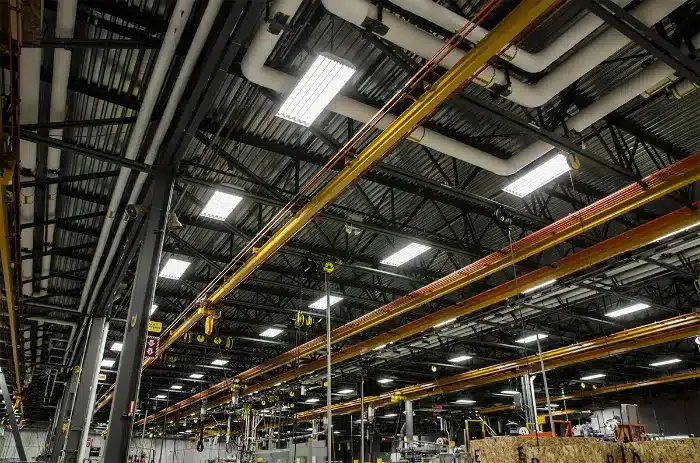
commercial enclosed luminaire LED heat buildup
Why LED Bulbs Fail in Enclosed Fixtures
現場 / 商業的現実
When LEDs fail in enclosed fixtures, the failure pattern often looks inconsistent at first. Some lamps flicker, some dim noticeably, some shift color, and some stop working altogether. On site, this is frequently mistaken for voltage instability or random product inconsistency. In many cases, the common root cause is heat accumulation.
For contractors, this creates a dangerous situation during handover. A project may pass initial installation, then failures appear within months, leading to claims, callbacks, and fixture-by-fixture troubleshooting.
詳細分析とエンジニアリングソリューション
The main reasons LED bulbs fail in enclosed fixtures are:
Excessive driver temperature
The LED driver converts mains power into regulated output current.4 In enclosed spaces, the driver runs hotter, especially when using compact housings with limited heat sinking. Capacitor life falls rapidly as temperature rises.Elevated LED junction temperature
Higher junction temperature reduces light output over time and accelerates material degradation in the LED package.Poor thermal path
If the lamp housing, PCB, thermal interface, and outer shell do not transfer heat effectively, internal heat remains concentrated around sensitive components.Long operating hours
Enclosed fixtures in corridors, lobbies, lift areas, stairwells, and exterior pathways often operate far longer than residential use assumptions. Even a "rated" lamp may fail early if designed around light-duty operating patterns.High ambient temperature
Ceiling voids, decorative glass fittings, bathrooms, and sun-exposed outdoor enclosures can push internal temperatures beyond normal lab assumptions.
| Failure Driver | Mechanism | Typical Field Result | メンテナンス/ROIへの影響 |
|---|---|---|---|
| Driver overheating | Capacitor and IC stress | Flicker, intermittent startup, or no output | Early replacement and service calls |
| LED overheating | Junction degradation | Faster lumen depreciation | Visible performance drop before failure |
| Weak thermal design | Heat concentration | Inconsistent life across batches | Reduced trust in product line |
| Long daily runtime | Accelerated aging | Earlier-than-expected burnouts | Higher lifetime lamp cost |
工場注記
During hotel commissioning, premature LED failures in enclosed fittings are often traced not to the LED chips themselves, but to thermal stress on the driver section. This is why driver layout, capacitor grade, ripple-current margin, and heat dissipation path matter more than headline wattage claims.
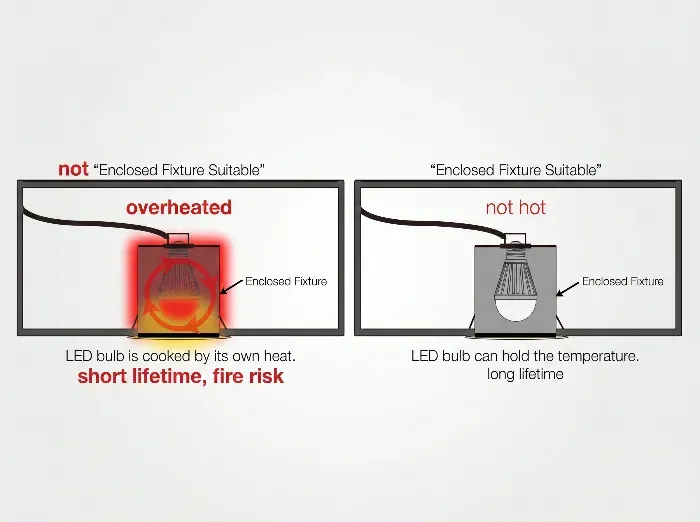
LED driver overheating in enclosed fixture
What Does "Enclosed Fixture Rated" Mean?
現場 / 商業的現実
Buyers often assume that "enclosed fixture rated" guarantees full lifespan in any closed luminaire. That assumption causes avoidable claims. The label only indicates that the lamp is intended for use in enclosed fixtures under defined conditions. It does not mean every sealed fitting, every ambient temperature, every wattage level, and every operating profile is equally safe.
In commercial projects, this distinction matters because fixture geometry varies widely. A small decorative globe, a deep recessed can, a bathroom cover, and a sealed outdoor wall lantern do not create the same thermal environment.
詳細分析とエンジニアリングソリューション
"Enclosed fixture rated" generally means the lamp has been designed and tested to operate in a more heat-restrictive environment than a standard open-fixture lamp. Typical design upgrades may include:
- Better heat sink structure
- Higher-temperature driver components
- Improved thermal interface materials
- More conservative current setting
- Lower internal power density
- Thermal protection or thermal derating behavior5
However, the market uses this term broadly. One manufacturer may apply robust thermal derating, while another may only meet a minimum compliance threshold. The packaging does not usually show the actual thermal test conditions, maximum case temperature, installation orientation, or expected life at elevated ambient.
A more useful engineering interpretation is this: enclosed-rated lamps are not immune to heat; they are simply more tolerant of heat within defined limits.
工場注記
From a manufacturing perspective, the reliable way to evaluate enclosed-rated products is not by printed wording alone, but by thermal validation under realistic operating temperature. Burn-in, elevated ambient aging, in-fixture temperature measurement, and batch verification reveal far more than carton claims.
What Happens If You Use the Wrong LED?
現場 / 商業的現実
Using a non-enclosed-rated LED inside a closed fixture may not cause immediate failure. That is exactly why the mistake is common. The installation appears acceptable at day one, but thermal aging starts immediately. By the time failures become visible, the project is already occupied and access becomes more difficult.
In hospitality and commercial environments, this leads to scattered failures that damage visual consistency and increase maintenance scheduling complexity.
詳細分析とエンジニアリングソリューション
If the wrong LED is used in an enclosed fixture, the most common outcomes are:
- Rapid lumen loss
- Flicker during warm operation
- Color inconsistency over time
- Intermittent shutdown from thermal protection
- Driver failure before rated life
- Increased batch failure spread across the site
The key issue is that rated lifespan on packaging is usually based on specific thermal assumptions. Once the lamp is installed in a hotter environment, actual component life drops. For electrolytic capacitors, a widely used engineering estimate is that life roughly doubles for every 10°C reduction in operating temperature, or roughly halves for every 10°C increase, within the limits of the component design.6 In practical terms, a lamp advertised for long life may deliver only a fraction of that under sustained enclosure heat.
| Installation Choice | Thermal Condition | Likely Result | メンテナンス/ROIへの影響 |
|---|---|---|---|
| Standard LED in open fixture | 中程度 | Normal life | Stable maintenance cycle |
| Standard LED in enclosed fixture | 高い | Early failure risk | Higher labor and relamping cost |
| Enclosed-rated LED in mild enclosure | Controlled | Improved life | Better maintenance predictability |
| Enclosed-rated LED in severe enclosure | 非常に高い | Life still reduced | Requires thermal review, not assumption |
工場注記
In large hospitality projects, the biggest cost is usually not lamp price difference. It is the cost of repeated access, replacement coordination, and guest-area disruption after a wrong lamp choice has been distributed across hundreds of enclosed fittings.
Not All "Enclosed Rated" LEDs Are the Same
現場 / 商業的現実
This is where many procurement problems begin. Two products can both say "enclosed fixture rated," yet perform very differently in the field. One may survive long corridor operating hours; the other may degrade quickly in the same application.
For distributors and project buyers, this creates false equivalence during product comparison. The result is often selection by unit cost rather than thermal margin.
詳細分析とエンジニアリングソリューション
Differences between enclosed-rated LEDs typically come from:
- Driver topology and component temperature rating
- Capacitor lifetime specification and ripple-current margin
- Heat sink mass and material efficiency
- Lamp geometry and internal airflow path
- Operating current density
- Thermal protection strategy
- Consistency of assembly process
- Quality of aging and outgoing batch control
A compact lamp with aggressive lumen output may run much hotter than a slightly lower-output design with better thermal headroom. On paper, both can look similar. In enclosed use, they do not age the same way.
| 特徴 | Basic Enclosed-Rated LED | Robust Enclosed-Rated LED | メンテナンス/ROIへの影響 |
|---|---|---|---|
| Driver components | Standard margin | High-temperature margin | Lower field failure rate |
| Thermal design | Minimal compliance | Engineered heat path | Longer stable operation |
| Output strategy | Maximum lumen push | Balanced lumen vs temperature | Better life consistency |
| Validation | Limited declaration | Elevated ambient and aging verification | Lower site risk |
| Batch consistency | Variable | Controlled | More predictable maintenance planning |
工場注記
From a manufacturing perspective, enclosed-fixture reliability depends heavily on process discipline. Solder quality, thermal compound application, driver spacing, and aging control all affect whether a lamp survives real enclosed operation or only passes a nominal specification.
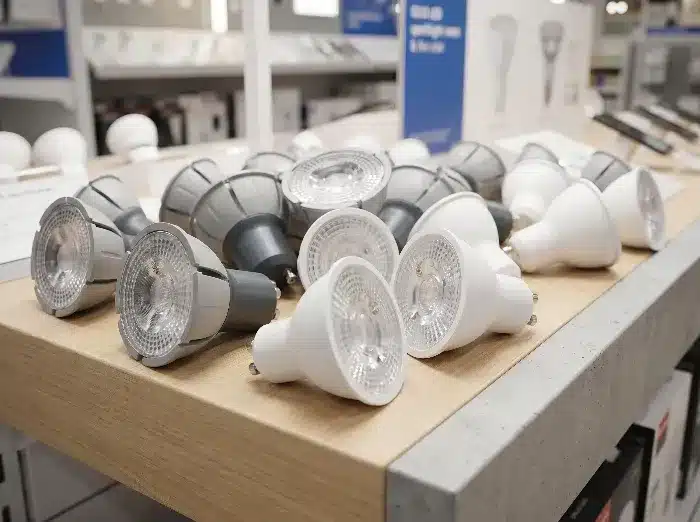
enclosed rated LED comparison for commercial use
How to Choose the Right LED for Enclosed Fixtures
現場 / 商業的現実
Selecting the right lamp before purchase is far less expensive than replacing failed lamps after occupancy. This is especially important in stairwells, facade lanterns, guest corridors, bathrooms, public areas, and decorative ceiling fixtures where maintenance access is restricted or disruptive.
詳細分析とエンジニアリングソリューション
For commercial evaluation, use these criteria:
Confirm explicit enclosed-fixture suitability
Do not assume all LED lamps are suitable for enclosed use.Review operating environment
Consider ambient temperature, fixture cavity size, ventilation level, orientation, and daily runtime.Check wattage against enclosure size
Higher wattage in a small enclosed volume raises internal temperature quickly.Ask for thermal or aging validation
Request evidence of elevated-temperature testing, not only nominal life claims.Evaluate driver design
In enclosed applications, driver robustness often determines service life more than LED chip branding.Verify consistency across batches
Stable thermal behavior requires consistent materials and assembly, not just one good sample.Run a pilot installation
For larger projects, test a sample batch in the actual luminaire before full rollout.
For retrofit spotlight projects, product families such as GU10 LED bulbs, MR16 LED電球, ES111 LED spotlights, 、および LED PAR bulbs should be reviewed against the actual fixture cavity, wattage, beam requirement, dimming system, and operating hours before bulk purchase.
| 選択係数 | What to Check | なぜ重要なのか | メンテナンス/ROIへの影響 |
|---|---|---|---|
| Enclosed suitability | Explicit rating | Avoid misuse | Fewer early failures |
| Thermal validation | Aging and temperature data | Confirms real tolerance | Lower claim risk |
| Driver robustness | Component grade and design margin | Main life determinant | Better reliability |
| Fixture match | Lamp size vs enclosure | Controls heat buildup | Longer service interval |
| Pilot test | Site simulation | Confirms compatibility | Avoids project-wide rework |
工場注記
During hotel commissioning, the safest approach is always fixture-specific verification. A lamp may perform well in one enclosed fitting and poorly in another if cavity volume, glass cover design, installation orientation, or ambient heat changes the thermal condition.
Real Lifespan vs Rated Lifespan
現場 / 商業的現実
Rated lifespan is often used in purchasing decisions, but maintenance teams live with real lifespan. These are not the same. A lamp may be marketed at 15,000 or 25,000 hours, yet fail much earlier in a sealed fitting operating every night.
This gap creates frustration because the packaging may be technically true under defined test conditions, while the site condition is far harsher.
詳細分析とエンジニアリングソリューション
Rated lifespan is usually determined under controlled laboratory conditions. Real lifespan depends on:
- Internal operating temperature
- Switching frequency
- Runtime profile
- Mains quality
- Fixture enclosure design
- Ambient heat
- Component tolerance spread
- Driver and capacitor stress
For LED products, it is also important to separate ルーメンメンテナンス from whole-lamp reliability. LM-80 data is used for LED packages, arrays, or modules, and TM-21 projections estimate LED lumen maintenance. These methods are useful, but they do not by themselves prove the lifetime of the complete lamp, because the driver, capacitors, optics, solder joints, and housing materials can also determine failure.
ENERGY STAR lamp specifications provide useful reference points for elevated-temperature evaluation. For example, many lamps are tested at 45°C +/- 5°C, while directional lamps above 20 W may be tested at 55°C +/- 5°C. Some qualification paths also reference 10 samples per model, commonly split between base-up and base-down operation unless the lamp is restricted to a specific position. These are useful benchmarks, not a guarantee that every enclosed fixture is covered.
A more practical B2B question is: what is the expected service life in this exact luminaire, at this ambient temperature, in this installation orientation, under this duty cycle?
工場注記
From a manufacturing perspective, lifespan claims become meaningful only when linked to application conditions. For enclosed commercial fittings, accelerated aging, temperature-rise verification, in-fixture testing, and driver component review are more useful than headline lifetime figures on retail-style packaging.
Best Solutions for Enclosed Fixtures
現場 / 商業的現実
The best solution depends on how severe the enclosure is and how difficult maintenance access will be. In high-access-cost areas, the priority should be stable operation rather than maximum initial efficacy on paper.
詳細分析とエンジニアリングソリューション
The most reliable solutions for enclosed fixtures typically include:
- LED lamps specifically engineered for enclosed use
- Lower thermal loading through moderate wattage selection
- Fixtures with improved ventilation where design permits
- Integrated LED luminaires with system-level thermal management
- Driver-on-board or remote-driver designs where appropriate
- Pre-project thermal verification for long-hour applications
For projects with strict maintenance targets, integrated luminaires often outperform retrofit lamps because the thermal path is designed as one system rather than as a lamp adapted to many fixture types. However, retrofit enclosed-rated lamps remain practical when legacy fixture retention is required.
Where the project allows fixture replacement, reviewing compatible 照明器具 together with the lamp specification can make thermal control easier than changing the bulb alone.
| 解決策 | Best Use Case | Strength | メンテナンス/ROIへの影響 |
|---|---|---|---|
| Enclosed-rated retrofit LED | Existing fixtures retained | Lower upgrade cost | Good if thermal match is verified |
| Lower wattage enclosed-rated lamp | Small sealed fixtures | Reduced heat stress | Longer replacement interval |
| Better ventilated fixture | New installation | Improved thermal condition | Lower long-term failure risk |
| Integrated LED luminaire | Full project redesign | System-level thermal control | Best long-term stability |
工場注記
In large hospitality projects, the most cost-effective decision is often to reduce thermal stress slightly rather than push for the highest lumen package. A modest reduction in watt density can improve service life more than most buyers expect.
避けるべき一般的な間違い
現場 / 商業的現実
Most enclosed-fixture failures come from a short list of repeat mistakes. These are usually preventable during specification and purchasing, yet expensive once the site is occupied.
詳細分析とエンジニアリングソリューション
Common mistakes include:
- Assuming all LEDs are suitable for enclosed fixtures
- Treating "enclosed rated" as equal across all brands
- Ignoring ambient temperature and runtime
- Choosing highest lumen output without thermal review
- Relying only on packaging claims
- Skipping pilot testing in the actual luminaire
- Comparing unit price without including replacement labor cost
- Ignoring installation orientation, especially base-up operation in small housings
These mistakes shift the focus from total system cost to initial purchase cost, which is rarely the right metric in commercial environments.
工場注記
From a manufacturing perspective, the most expensive failures are predictable ones: undersized thermal design, overdriven output, weak driver margin, and product selection made without considering the actual fixture cavity and operating hours.
よくあるご質問
Can LED bulbs be used in enclosed fixtures?
Yes, but only when the LED bulb is rated for enclosed fixtures and the fixture condition is within the lamp’s thermal capability. Standard LED bulbs may overheat in sealed or poorly ventilated luminaires.
What does "not for use in totally enclosed luminaires" mean?
It means the lamp should not be installed inside a fully enclosed or mostly sealed fixture. The manufacturer is warning that heat buildup may shorten life or create an unsuitable operating condition.
Do enclosed fixture rated LED bulbs last as long as regular LED bulbs?
They can last longer than standard LEDs inside enclosed fixtures, but actual life depends on fixture design, ambient temperature, wattage, driver quality, and operating hours. The rating improves suitability; it does not guarantee full package life in every enclosure.
Why do LED bulbs flicker in enclosed fixtures?
Flicker can come from driver overheating, capacitor aging, dimmer incompatibility, or voltage issues. In enclosed fixtures, heat-related driver stress is a common cause.
Is a lower watt LED better for enclosed fixtures?
Often, yes. Lower wattage usually produces less heat, which can improve reliability in small sealed fixtures. The lamp still needs to meet the required light level and be rated for the application.
How should commercial buyers verify enclosed LED reliability?
Ask for elevated-temperature testing, in-fixture temperature data, driver component review, lumen maintenance trend, and pilot installation results. For large projects, do not rely on packaging claims alone.
Conclusion: Business Value
For enclosed fixtures, LED reliability depends on heat control more than label wording. "Enclosed fixture rated" is a necessary starting point, but not a complete guarantee. Real performance comes from thermal design margin, driver robustness, application matching, and consistent manufacturing control.
For commercial projects, the business value is clear: fewer premature failures, less maintenance disruption, lower access cost, lower warranty risk, and more predictable lifetime system cost.
B2B Engineering Recommendation
For large projects with specific dimming, operating-hour, or maintenance requirements, request the full load schedule and fixture list. The Teco engineering team can review fixture conditions, simulate likely thermal risk, test samples under realistic operating conditions, verify thermal and compatibility risk before mass production, and reduce avoidable site failures.
For project-specific evaluation, buyers can contact the Teco team with the fixture list, lamp schedule, dimming requirement, and expected daily operating hours.
脚注
Enclosed fixture: a luminaire in which the lamp operates within a closed or substantially sealed housing that restricts airflow. ↩
LED junction: the active semiconductor region inside the LED where electrical energy is converted into light; its temperature strongly affects performance and lifespan. ↩
Electrolytic capacitor: a common driver component used for filtering and energy storage; service life decreases significantly as operating temperature rises. ↩
LED driver: the electronic circuit that converts input power into controlled output suitable for operating LEDs safely and consistently. ↩
Thermal derating: the practice of reducing electrical stress or output as temperature rises in order to protect components and maintain reliability. ↩
The 10°C / 2x capacitor-life rule is a common engineering estimate for aluminum electrolytic capacitors, not a universal guarantee. Actual life depends on capacitor series, core temperature, ripple current, voltage stress, and manufacturer data. ↩