標準LED照明器具を使用した終日概日リズム照明システムの設計方法
Many people assume that circadian lighting requires complex architectural systems, custom luminaires, or expensive smart platforms. In practice, most circadian lighting failures are not caused by fixture limitations, but by poor planning and incorrect use of standard lighting tools.
Common failure patterns include:
- applying one spectrum throughout the entire day
- ignoring vertical, eye-level light exposure
- using “warm light” as a substitute for biologically safe night lighting
A full-day circadian lighting system can be implemented using standard LED fixtures when timing, spectrum, intensity, and placement follow human biology rather than product categories.
Circadian lighting is a design strategy, not a SKU. GU10 spotlights, E27 bulbs, and standard downlights already exist in most buildings. When each fixture type is assigned a clear biological role, these common products can support alertness, comfort, and sleep across a full 24-hour cycle.
The 24-Hour Circadian Lighting Framework

Diagram illustrating the 24-hour circadian lighting cycle with phases for morning alertness, afternoon maintenance, evening relaxation, and nighttime sleep support, featuring everyday indoor scenes.
Circadian lighting only works when the entire day is considered as one system. Designing isolated lighting scenes without biological continuity weakens circadian signals and reduces effectiveness.
A functional circadian strategy divides the day into distinct biological phases, each with a clear lighting objective and defined limits.
The four biological phases of the day
Human circadian rhythm follows predictable phases driven primarily by light exposure.
| Phase | Typical Time Window | Biological Goal |
|---|---|---|
| Morning | Wake-up to ~11:00 | Activate and alert |
| Afternoon | ~11:00–17:00 | Maintain stability |
| Evening | ~17:00–21:00 | Wind down |
| Night | ~21:00–wake | Protect sleep |
Exact timing varies by individual, but the sequence does not.
Why most systems fail
Many buildings rely on:
- one spectrum
- one brightness level
- all day
This removes biological contrast.
The circadian system requires strong differences between phases, not constant lighting.
Planning before selecting fixtures
Before choosing lamps or control systems, designers should answer three questions:
- When should occupants feel alert?
- When should they begin to relax?
- When must light avoid stimulation entirely?
Fixture selection only makes sense after these boundaries are defined.
Core planning principle
Circadian lighting is not mood lighting.
それは directional biological signaling:
- strong signals early
- reduced signals later
- no stimulation at night
Morning Phase Lighting Design

Modern office scene featuring a woman by a window, illustrating morning phase lighting design that promotes alertness through the integration of natural daylight and artificial lighting.
Morning light signals the start of the biological day. Without a strong morning signal, people often feel fatigued even after sufficient sleep.
Morning lighting must deliver blue-rich, high-intensity light to the eyes to suppress residual melatonin and initiate cortisol release.
Biological objective
Effective morning light should:
- suppress melatonin
- increase cortisol
- improve alertness
- anchor the circadian clock
Research from Harvard Medical School confirms that blue-rich morning light improves alertness and mood.
出典: https://health.harvard.edu/staying-healthy/blue-light-has-a-dark-side
Spectrum and intensity targets
| パラメータ | Morning Target |
|---|---|
| 色温度 | 4000K–6500K |
| 輝度 | 高い |
| Blue content | Present |
| Exposure duration | 1–3 hours |
Weak morning lighting reduces circadian strength later in the day.
Using standard fixtures in the morning
Downlights and E27 bulbs are the primary tools for this phase.
Best practices include:
- neutral to cool white spectrum
- strong vertical illumination
- indirect reflection from walls
GU10 spotlights may contribute, but only as a supplement.
From an engineering perspective, GU10 fixtures typically deliver limited vertical illuminance due to beam control and mounting height. This restricts their effectiveness for circadian phase anchoring when used alone.
When sufficient daylight is available, artificial circadian lighting should support—not replace—natural light exposure.
Placement strategy
- prioritize wall illumination over floor lighting
- avoid narrow beams aimed directly downward
- ensure light reaches eye level
Circadian response depends on eye-level exposure, not task-plane lux.
Source: WELL Building Standard v2
https://standard.wellcertified.com/light
Common morning design errors
- warm white lighting in the morning
- low-intensity “cozy” scenes
- relying solely on desk lamps
These delay circadian activation and often lead to afternoon fatigue.
Afternoon Phase Lighting Strategy
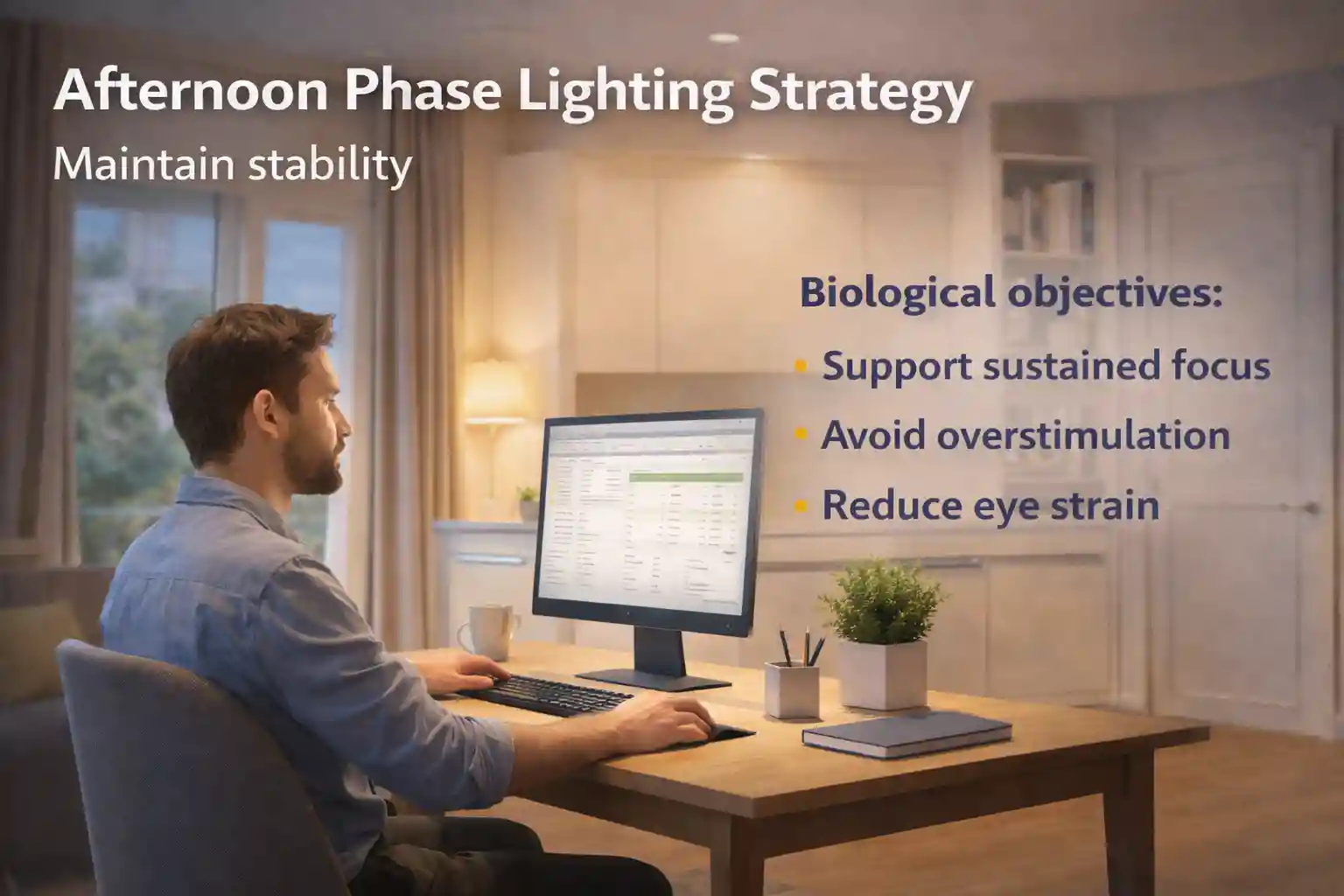
Professional working in a cozy office environment with afternoon phase lighting, using balanced illumination to maintain focus and reduce visual fatigue.
The afternoon phase is not about increasing circadian stimulation, but about preserving visual and neurological comfort.
Afternoon lighting should maintain alertness while minimizing biological stress and visual fatigue.
Biological objective
Afternoon light should:
- support sustained focus
- avoid overstimulation
- reduce eye strain
At this stage, the circadian system is already active and requires reinforcement, not escalation.
Spectrum and intensity parameters
| パラメータ | Afternoon Target |
|---|---|
| 色温度 | 3500K–4500K |
| 輝度 | 中程度 |
| Contrast | 中程度 |
| フリッカー | 最小限 |
Excessive brightness or contrast often causes fatigue rather than improved performance.
Fixture strategy
Standard fixtures perform well when balanced correctly:
- Downlights for general illumination
- E27 bulbs for ambient fill
- GU10 for localized task accents
Avoid:
- extreme brightness
- glare in the field of view
- narrow beams directed toward eyes
Visual comfort considerations
In practice, afternoon discomfort is more often caused by:
- ちらつき
- glare
- uneven luminance
rather than circadian misalignment itself.
IEEE Std 1789 confirms that flicker can affect neurological comfort.
出典: https://ieeexplore.ieee.org/document/6575776
Preparing for evening transition
Afternoon lighting should gradually prepare for evening.
Progressive reduction is more effective than sudden shifts.
Evening Phase Lighting Control
Evening is where many circadian lighting designs fail. Light remains too bright and too white for too long.
Evening lighting must reduce biological stimulation while preserving comfort and social usability.
Biological objective
Evening light should:
- allow melatonin levels to rise
- reduce alertness
- signal the body to slow down
This phase strongly influences sleep quality.
Spectrum and intensity targets
| パラメータ | Evening Target |
|---|---|
| 色温度 | 2200K–3000K |
| 輝度 | 低から中程度 |
| Blue content | Reduced |
| Direction | Indirect |
White light above 3000K works against evening biology.
Evening as a transition, not a destination
Evening lighting should be treated as a transition phase, not an endpoint.
It prepares the body for darkness but does not replace night-safe lighting.
Using standard fixtures in the evening
GU10 fixtures become important during this phase.
Effective uses include:
- warm GU10 accent lighting
- dim-to-warm GU10 for gradual transition
- E27 warm bulbs for ambient glow
Downlights should be heavily dimmed or switched off.
Placement strategy
- reduce ceiling-based illumination
- emphasize wall and perimeter lighting
- minimize direct eye exposure
Common evening mistakes
- leaving daytime lighting active
- using cool white for perceived clarity
- overusing downlights
These delay sleep onset and increase night-time alertness.
Night Phase Lighting and Sleep Protection
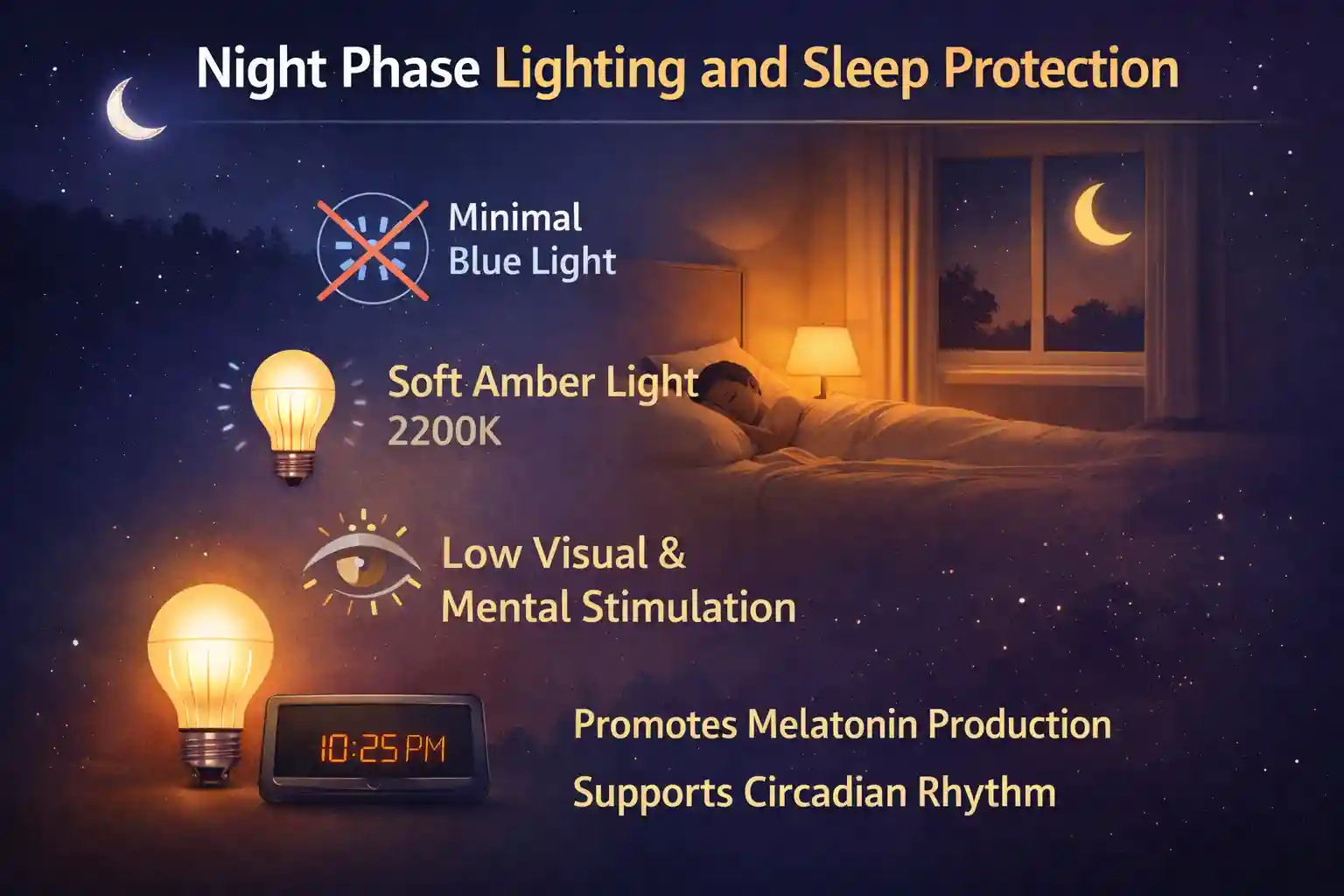
Bedroom scene at nighttime with amber light illumination, a crossed-out blue light icon, and visual cues explaining low stimulation lighting for improved sleep quality and melatonin production.
Night lighting should exist only to prevent accidents.
At night, lighting must avoid biological stimulation entirely while maintaining orientation and safety.
Biological objective
Night lighting must:
- protect melatonin
- avoid blue wavelengths
- remain extremely low
Even brief exposure matters.
Research shows melatonin suppression can occur at very low blue-light levels, even below 10 lux.
Source: Journal of Clinical Endocrinology & Metabolism
https://academic.oup.com/jcem/article/100/6/2209/2836073
Acceptable spectra at night
| Spectrum | Night Safety |
|---|---|
| 赤 | 優れている |
| Blue-free amber | 限定的 |
White light is not circadian-safe at night, even when dimmed.
Fixture strategy
GU10 is ideal for night-phase lighting.
Best applications:
- floor-level path lighting
- bathroom guidance lights
- corridor orientation
Placement rules:
- below knee height
- shielded from direct view
- minimal brightness
In hospitality and residential projects, night lighting must assume incorrect user behavior and remain safe by default.
What night lighting is not
- “Very warm white” is not night-safe
- Dimmed downlights are not circadian-safe
- User-controlled lighting is not reliable protection
Using Standard Fixtures in a Circadian System

Diagram illustrating how standard lighting fixtures adapt to circadian rhythms throughout the day, progressing from basic fixed-output lamps to smart, adaptive lighting controls.
A full-day circadian system does not require specialized luminaires. It requires clear role assignment.
Fixture role assignment
| Fixture Type | Proper Role | Common Misuse |
|---|---|---|
| Downlights | Morning and afternoon | Left on at night |
| E27 bulbs | Ambient daytime and evening | Over-bright evening use |
| GU10 | Evening transition and night guidance | Used for morning activation |
Problems occur when one fixture type attempts to serve all phases.
Control logic over complexity
Effective circadian systems do not require advanced platforms.
Simple solutions include:
- time-based switching
- separate circuits by phase
- predictable dimming schedules
Behavioral simplicity outperforms technical complexity.
A realistic bedroom example
- downlight off at night
- E27 warm lamp for evening
- GU10 red light for navigation
This is a functional circadian system—no app required.
結論
A full-day circadian lighting system can be designed using standard LED fixtures when each biological phase is supported by the correct spectrum, intensity, and placement.
Circadian effectiveness comes from clear contrast between phases, not from specialized products or complex controls.
Work With Us – Technical Support & Project Guidance
Teco manufactures GU10 LED spotlights and supports E27 and standard LED solutions for circadian-aware and human-centric lighting projects.
We operate strictly in B2B environments, focusing on systems that work within real buildings, budgets, and timelines.
Our China-based factory supports:
- warm, amber, and red GU10 solutions
- dim-to-warm development
- stable low-level dimming
- OEM and ODM customization
- compliance for Europe, Middle East, and Southeast Asia
If you are planning a circadian lighting strategy using standard fixtures:
メール: [email protected]
ウェブサイト: www.tecolite.com
Describe your space type and constraints.
We help validate circadian strategies before procurement—not after installation.