Introdução: Porque a Cintilação LED é um Risco Real de Projeto
A cintilação de LED é um dos problemas mais comuns em projetos de iluminação comercial.
Pode levar a:
- instabilidade da luz visível
- interferência com câmaras em ambientes de retalho
- desconforto em escritórios e espaços de hospitalidade
- riscos de segurança em ambientes com maquinaria em movimento
Em muitos casos, o que parece ser cintilação é na verdade uma efeito estroboscópico—um fenômeno diferente que pode distorcer a perceção de movimento.
Compreender a diferença é essencial para:
- selecionar drivers de LED compatíveis
- cumprir os padrões internacionais de conformidade
- evitar atrasos dispendiosos na comissionamento
Compreender a diferença é crucial para selecionar drivers de LED e sistemas de dimerização compatíveis. Para um entendimento mais aprofundado da compatibilidade de dimerização, consulte o nosso guia sobre sistemas de iluminação LED dimerizáveis.
Cintilação vs Efeito Estroboscópico
| Caraterística | Cintilação | Efeito Estroboscópico |
|---|---|---|
| Causa | Flutuação da intensidade luminosa | Interação com o movimento |
| Perceção | Instabilidade visível (estática) | Ilusão de movimento |
| Métricas-Chave | PF / FI / Pst LM | SVM |
| Risco | Fadiga ocular, desconforto | Perigo para a segurança |
O Que É a Cintilação de LED?
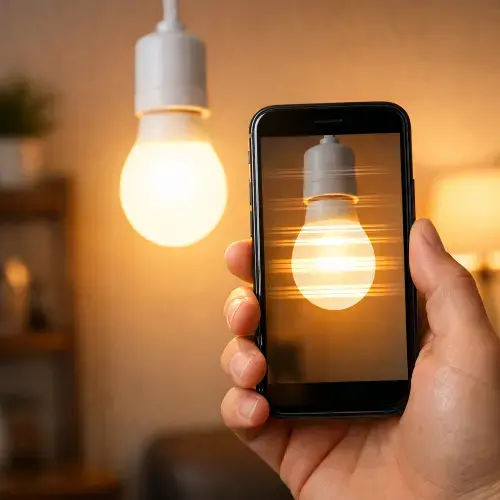
Num interior com iluminação quente, o ecrã de um smartphone reflete o brilho de uma lâmpada LED de candeeiros suspensos próximos, rodeado por plantas de interior e prateleiras de madeira.
A cintilação de LED refere-se a modulação temporal da luz, onde a produção de luz varia ao longo do tempo devido a ondulação elétrica ou instabilidade do driver.
De acordo com a IEEE, o risco de cintilação depende da frequência e da profundidade de modulação (ver IEEE 1789-2015).
Métricas-Chave de Cintilação
- Percentagem de Cintilação (PF)
- Índice de Cintilação (FI)
Percentagem de Cintilação = (L_max − L_min) / (L_max + L_min) × 100%
Recomendação IEEE:
- Baixo risco: <10% modulação (100–2000 Hz)
- Preferível: <5% em ambientes sensíveis
Visão de Engenharia
Em instalações comerciais reais de GU10, mais de 80% dos problemas de cintilação são causados por incompatibilidade entre dimmer e driver, e não pela qualidade do chip LED.
O Que É o Efeito Estroboscópico?
A efeito estroboscópico ocorre quando a luz modulada interage com objetos em movimento, criando ilusões visuais.
Exemplos:
- ventiladores rotativos a parecer estacionários
- correias transportadoras a parecer mais lentas ou invertidas
- movimento de maquinaria sendo mal interpretado
Definido pela Comissão Eletrotécnica Internacional (IEC) na IEC TR 63158:2018
(https://webstore.iec.ch/publication/29994)
Métrica Chave: SVM (Medida de Visibilidade Estroboscópica)
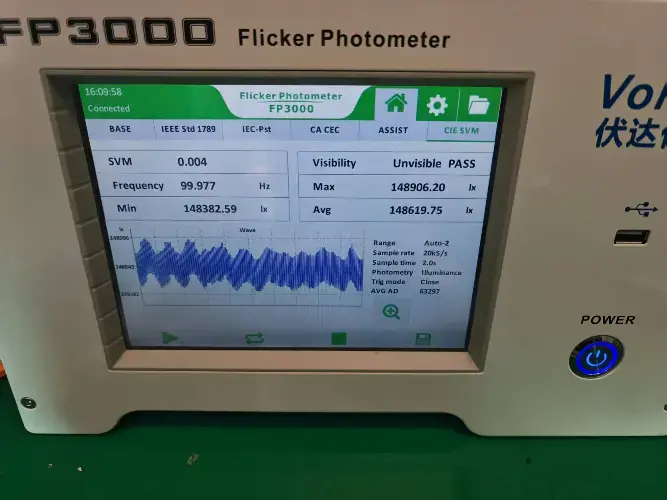
Interface do Fotómetro de Cintilação FP3000 mostrando dados de medição em tempo real, incluindo gráficos de forma de onda, faixa de frequência de 95,77 Hz a 148,60 Hz e controlos para testes de cintilação visível e invisível.
- SVM ≤ 0,4 → aceitável (requisito UE ErP)
SVM < 0,2 → nível de baixo risco recomendado
Nas regulamentações modernas da UE (Regulamento da Comissão (UE) 2019/2020),
SVM ≤ 0,4 é o limiar de conformidade chave para produtos LED.
Cintilação de Curto Prazo (Pst LM) em Sistemas LED
Além do FP e SVM, os sistemas de iluminação comercial devem considerar:
Pst LM (gravidade de cintilação de curto prazo)
Definido na IEC 61000-3-3
O que o Pst LM Mede
- Avalia impacto da flutuação de tensão na estabilidade da luz
- Reflete desempenho a nível de sistema, não apenas o design do driver
Limiar Chave
- Pst LM = 1,0 → limite de perceção
- Pst LM < 1,0 → aceitável para sistemas de iluminação pública
Por Que É Importante
Valores elevados de Pst resultam frequentemente de:
- fonte de alimentação instável
- atenuadores incompatíveis
- grande variação de carga
Recomendação de Engenharia
- Garantir Pst LM < 1,0
- Validar compatibilidade de dimerização
- Utilizar drivers com regulação de entrada estável
Por que é que as luzes LED piscam em instalações comerciais?
Em projetos reais, a cintilação é geralmente causada por incompatibilidade do sistema em vez de falha do produto.
Causas Comuns
Incompatibilidade do dimerizador
- incompatibilidade TRIAC
Corrente de ondulação do driver
- filtragem insuficiente
Instabilidade de tensão
- comum em grandes edifícios
Instabilidade de atenuação de baixo nível
- abaixo de 20–30% de brilho
Como Corrigir Problemas de Cintilação e Efeito Estroboscópico em LEDs
1. Seleção do Driver
- Utilizar drivers de corrente constante
- Corrente de ondulação <5% recomendado
- Utilize condensadores classificados ≥105°C for stability
2. Dimming System Matching
- Verify minimum load of dimmer
- Prefer trailing-edge dimmers for LED systems
3. Increase PWM Frequency
- Recommended: >20 kHz
- Eliminates visible flicker
4. System-Level Validation
- Verify Pst LM < 1,0
- Check voltage fluctuation behavior
5. Specify Compliance Metrics
- PF < 10%
- FI < 0.08
- SVM ≤ 0.4
Many flicker issues originate from incompatible dimming systems.
You can learn more in our guide on LED dimmer compatibility and common mistakes
LED Flicker Troubleshooting Checklist
- Check dimmer compatibility (TRIAC vs LED driver)
- Verify driver ripple current (<5%)
- Measure Pst LM (<1.0)
- Confirm SVM value (≤0.4 for EU compliance)
Test across full dimming range (10–100%)
This checklist helps reduce commissioning issues and field failures.
Risks in Industrial and Commercial Environments
In environments with motion:
- flicker → fatigue and discomfort
- stroboscopic effect → safety hazards
According to World Health Organization, low-frequency flicker may contribute to headaches and visual strain.
Example Risk Scenario
- 10 Hz modulation
600 RPM machinery
Can appear stationary → serious safety risk
Referenced in EU Machinery Directive 2006/42/EC
Testing Methods and Standards
Key standards include:
- IEEE 1789-2015
- IEC 61000-3-3
- IEC TR 63158
* CIE TN 006:2016
Typical Testing Methods
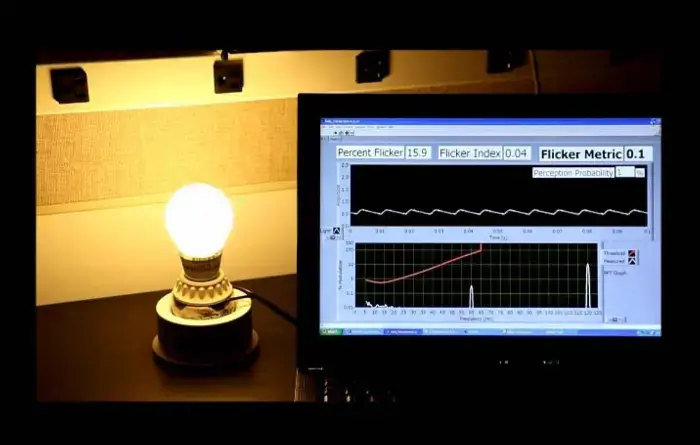
Illuminated incandescent bulb setup with an adjacent screen showing waveform graphs used to analyze light flicker index and related performance metrics in a laboratory environment.
- Oscilloscope waveform analysis
- FFT frequency analysis
- High-speed camera motion testing
Why It Matters in Retail and Hospitality
In commercial spaces:
- flicker → reduces visual comfort
- stroboscopic → disrupts perception
According to Illuminating Engineering Society (see IES RP-29-16):
lighting quality directly affects customer experience and dwell time
Cost Consideration in Commercial Projects
Flicker-free drivers may increase upfront cost by approximately 5–10%, but can significantly reduce:
- maintenance frequency
- replacement costs
- customer complaints
Quick Answers for Specifiers
Q: What is the difference between flicker and stroboscopic effect?
A: Flicker is brightness variation; stroboscopic effect is motion illusion.
Q: What is the key EU requirement?
A: SVM ≤ 0.4 (ErP regulation)
Q: What is acceptable flicker level?
A:
- PF < 10%
- FI < 0.08
- Pst LM < 1,0
Q: How to verify supplier claims?
A:
- Request third-party reports (UL / ETL)
- Verify PF / SVM / Pst LM data
Conclusion: Engineering Value
Flicker and stroboscopic effects directly impact:
- safety
- conforto
- system reliability
A properly specified system ensures:
- compliance
- stable performance
- reduced lifecycle cost
Recomendação de Engenharia B2B
For commercial lighting projects:
- verify PF / FI / SVM / Pst LM
- ensure driver-dimmer compatibility
- validate system performance before installation
Early validation helps avoid:
- commissioning delays
- warranty claims
- rework costs