
Melhor Design de Iluminação para Restaurantes: Como a Iluminação Molda o Ambiente de Jantar e a Experiência do Cliente
Introdução
Restaurant lighting is not a decorative afterthought. In commercial projects, it affects how guests read the menu, how food color appears on the table, how staff move through service areas, and how the whole venue feels during lunch, dinner, cleaning, and late-night operation. A restaurant can look attractive in a rendering and still fail on site if the lighting is selected only by fixture style or total wattage.
For restaurant operators, designers, distributors, and project contractors, lighting errors create real costs. Poor beam control can produce glare at seated eye level. Low color rendering can make meat, seafood, vegetables, wine, wood, and skin tones look dull. Poor dimming compatibility can cause flicker, buzzing, or unstable scenes during dinner service. A successful restaurant lighting design must therefore balance atmosphere, visibility, color quality, driver stability, maintenance access, and long-term consistency across the full dining area.
❌ Falso
Warm light can help create mood, but it cannot fix glare, poor table visibility, low CRI, weak accent lighting, or unstable dimming scenes.
✔ Verdadeiro
A reliable restaurant lighting plan separates ambient, task, and accent lighting so each fixture supports a clear operational and visual purpose.
Resumo Executivo
Effective restaurant lighting combines ambient, task, and accent layers to control atmosphere, visibility, food presentation, and operational workflow. For B2B projects, the lighting schedule should not stop at wattage and fixture appearance. It should define illuminance targets, color temperature, CRI or TM-30 data, beam angle, glare control, dimming method, driver compatibility, and maintenance access.
If the project follows EN 12464-1 workplace lighting guidance, restaurant and dining areas are commonly listed around 200 lux maintained illuminance, with UGR 22, uniformity 0.40, and Ra 80 as reference values.1 These figures are useful baselines, not a full design answer. Fine dining, casual dining, cafes, bars, counters, kitchens, and cleaning scenes may need different lighting levels and control scenes.
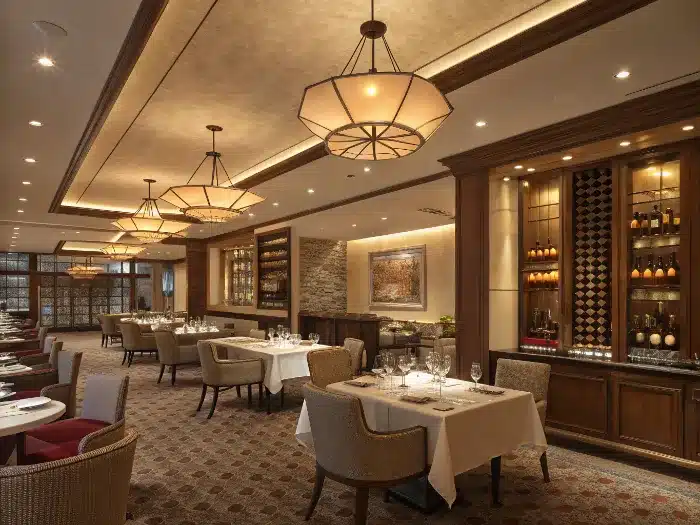
restaurant lighting design dining atmosphere commercial project
If you remember only five specification rules, keep these:
- Do not select restaurant fixtures by style and wattage alone; confirm lux target, beam angle, glare control, CRI/TM-30, and dimming behavior.
- Use warm CCT such as 2200 K-3000 K for most dining atmospheres, but verify food color and material appearance under the actual source.
- Treat CRI 80 as a general baseline; consider CRI 90+, R9, or TM-30 data for food presentation, premium dining, bars, and hospitality interiors.
- Test dimming, drivers, and control scenes before bulk order, especially for restaurants that need lunch, dinner, cleaning, and event scenes.
- Review the lighting from seated eye level, not only from the reflected ceiling plan.
| Design Item | B2B Specification Check | Por Que É Importante |
|---|---|---|
| Dining area illuminance | Around 200 lx as an EN 12464-1 reference, adjusted by concept | Supports menu reading and table visibility |
| Color quality | Ra 80 baseline; CRI 90+ / R9 / TM-30 for food-sensitive zones | Protects food, material, and skin-tone appearance |
| Controlo de brilho | Shielded optics, cutoff angle, UGR review where applicable | Reduces seated discomfort |
| Atenuação | Phase-cut, 0-10 V, DALI, or smart control compatibility | Prevents flicker, buzzing, and scene failure |
| Maintenance | Driver access, replaceable modules, circuit identification | Lowers service cost after opening |
How Lighting Influences Customer Experience in Restaurants
Realidade no Local / Comercial
Restaurant lighting changes how guests perceive comfort, privacy, food freshness, and venue quality. If the room is too bright, it can feel clinical. If it is too dim, menus become difficult to read and service staff lose visibility. If the table is bright but the walls are dark, the room can feel visually compressed. If the ceiling is bright but the food is dull, the measured lux level may look acceptable while the dining experience still feels weak.
For operators running multiple outlets, inconsistent lighting between locations also creates brand inconsistency. A chain restaurant cannot rely on "similar-looking" fixtures if one batch has different color temperature, different beam spread, or unstable dimming behavior.
Mergulho Profundo & Solução de Engenharia
Lighting influences customer experience through visibility, emotional response, and spatial hierarchy. Ambient lighting provides the luminous background. Task lighting supports table use, bill checking, ordering counters, and staff operations. Accent lighting creates focus on walls, shelves, bars, artwork, signage, plants, wine displays, and architectural textures.
Contrast ratio is important. If the table surface is too close in brightness to the background, the dining setting looks flat. If contrast is too high, faces and menus can fall into shadow. The target is controlled contrast, not simply low light.
❌ Falso
Average lux does not show glare, vertical brightness, food color quality, table focus, wall brightness, or whether the dimming scene works during real service.
✔ Verdadeiro
Real materials change glare, reflection, shadow, and perceived contrast, so final aiming should be checked under operating conditions.
| Caraterística | Balanced Layered Lighting | Single-Level General Lighting | B2B Risk If Ignored |
|---|---|---|---|
| Dining atmosphere | Controlled and differentiated | Flat and generic | Weak brand perception |
| Table visibility | Targeted and comfortable | Uneven or glary | Menu-reading complaints |
| Food presentation | Supported by color quality and focal light | Dependent on room brightness | Dull food appearance |
| Scene control | Lunch, dinner, cleaning, event modes | One compromise setting | Operational frustration |
Nota da Fábrica
In hospitality projects, the most common problem is not insufficient fixture quantity. It is poor hierarchy between the dining surface, wall background, circulation path, and decorative features. Enough wattage does not guarantee a good restaurant atmosphere.
Key Elements of Restaurant Lighting Design
Realidade no Local / Comercial
Restaurant lighting must work across different operating periods. Lunch service may need clearer visibility and higher output. Dinner service often needs lower ambient light and stronger table focus. Cleaning requires higher general brightness. Events may need flexible scenes. If the design ignores this operational reality, staff will compensate manually or request circuit changes after installation.
Mergulho Profundo & Solução de Engenharia
A restaurant lighting scheme typically depends on lighting layers, illuminance, glare control, color rendering, color temperature, beam distribution, fixture placement, and dimming control.
For dining areas, 200 lx is a useful EN 12464-1 reference point where that standard is applied.1 Fine dining may intentionally operate lower in some ambient zones if table lighting and task visibility are carefully controlled. Service counters, cashier zones, buffet areas, and cleaning scenes often need higher functional visibility. The article should therefore treat lux values as maintained design references, not fixed universal numbers.
Color rendering is critical because food contains reds, browns, greens, warm neutrals, and surface textures that can look flat under weak spectra. CRI is still widely used, and ENERGY STAR Lamps Version 2.1 required certified compact fluorescent and solid-state lamps to have Ra >= 80; for solid-state lamps, R9 had to be greater than 0.2 For restaurants that sell food quality and atmosphere, CRI 90+ and available R9 or TM-30 data are better procurement questions than "Is it warm white?"
Color temperature should support the concept. Many dining zones use warm white ranges such as 2200 K-3000 K. Cafes, breakfast areas, and daytime casual dining may use 3000 K-3500 K where a fresher, more active feel is desired. The exact choice should be tested against food, tableware, wall finishes, wood, stone, metal, and brand colors.
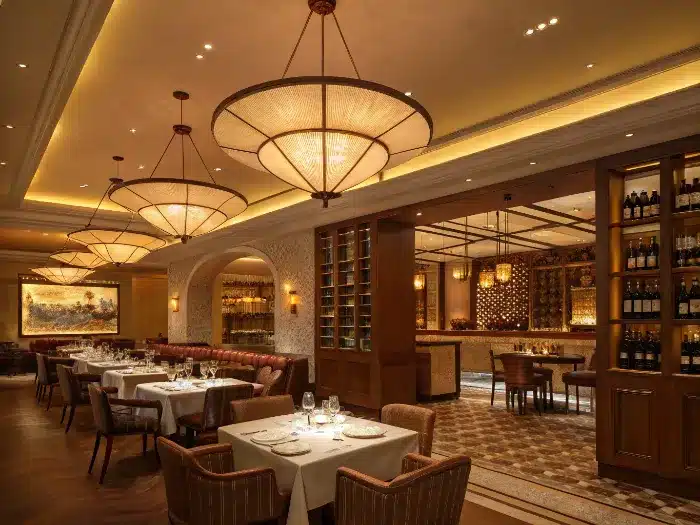
restaurant lighting design elements color rendering glare control
| Element | Practical Range or Check | B2B Specification Note |
|---|---|---|
| Dining illuminance | Around 200 lx as an EN 12464-1 reference | Adjust by concept, scene, table reflectance, and service needs |
| Temperatura da cor | 2200 K-3000 K for warm dining; 3000 K-3500 K for brighter cafe/service areas | Keep CCT consistent within each visual zone |
| Color rendering | Ra 80 baseline; consider CRI 90+, R9, or TM-30 | Important for food, wine, wood, skin tones, and premium materials |
| Glare | UGR 22 as an EN 12464-1 restaurant reference where applicable | Also check seated eye-level views |
| Beam control | Narrow/medium beams for focal tables and accents; wider optics for ambient | Match beam to table size, mounting height, and target surface |
| Atenuação | Test actual driver + control system | Prevent flicker, buzz, pop-on, drop-out, and scene mismatch |
Nota da Fábrica
Fixture specification should never be separated from optical performance. The same lumen package can perform very differently depending on diffuser material, reflector geometry, shielding angle, lens quality, and beam control. Mock-up review is more valuable than relying only on wattage or catalog photos.
Lighting Design for Dining Tables
Realidade no Local / Comercial
Dining tables are the focal point of the guest experience. If the table is underlit, guests struggle to read menus and food loses visual detail. If it is overlit, plates and glassware can create harsh reflections. In banquet layouts or tightly spaced table plans, poor beam control can spill light into adjacent tables and reduce privacy.
Once furniture positions are fixed, correcting table lighting becomes difficult without changing ceiling cut-outs, suspension points, track positions, or circuit grouping.
Mergulho Profundo & Solução de Engenharia
Dining table lighting should create a controlled visual focal area with enough horizontal light for food and menus and enough vertical light for faces. Candeeiro suspenso fixtures, narrow-to-medium beam downlights, adjustable spotlights, and decorative luminaires can all work, but fixture choice must match table size, ceiling height, seating density, and sightline.
The objective is to light the food, tabletop, and faces naturally while avoiding direct glare. For round tables, centered pendants or symmetrical beam placement often work well. For rectangular tables, linear pendants, multiple controlled beams, or track-mounted accent fixtures may be more appropriate.
Do not judge table lighting in an empty room. White plates, glossy tabletops, wine glasses, dark stone, polished metal, and menu paper all change reflected brightness. Final aiming should be checked from seated eye level and staff circulation paths.
| Table Lighting Issue | On-Site Symptom | Specification Fix |
|---|---|---|
| Beam too narrow | Hotspot in the center, dark table edges | Use wider beam or multiple lower-output sources |
| Beam too wide | Spill into adjacent tables, weak intimacy | Use controlled optics and better aiming |
| Pendant too low | Blocks sightlines and service movement | Coordinate mounting height with table and service style |
| Poor color rendering | Food appears dull or unnatural | Use high-CRI source and request R9/TM-30 data |
Nota da Fábrica
Table lighting issues often appear only after furniture and tableware are installed. Empty-room lux readings can look acceptable, but reflective plates, glassware, and dark tabletop materials change glare and shadow patterns significantly.
Restaurant Lighting Layout Planning
Realidade no Local / Comercial
Layout planning determines whether the restaurant feels coherent or fragmented. Poor fixture spacing, misaligned ceiling grids, and incorrect switching zones can create dark corners, uneven aisles, and overexposed seating clusters. These issues lead to repeated site visits, difficult re-aiming work, and conflicts between lighting, HVAC, sprinklers, ceiling services, speakers, and decorative elements.
Mergulho Profundo & Solução de Engenharia
Restaurant lighting layout should start from functional zoning, not fixture quantity. The plan should identify entrance, waiting area, dining zones, service aisles, counters, bar, decorative walls, washroom access, and circulation transitions. Each zone has a different visual requirement.
Ceiling-mounted fixtures should be coordinated with furniture plans and architectural features. Candeeiro de encastrar fixtures may align with table centers where appropriate, but not at the expense of glare control or maintenance access. Circulation areas need visual continuity so guests and staff can move safely without a sudden drop in brightness.
Switching and dimming scene planning are equally important. Restaurants rarely operate with one lighting condition. Lunch, dinner, cleaning, pre-opening setup, and private events each need different output levels. If circuits are grouped poorly, staff cannot adjust atmosphere without also affecting service visibility. For projects using external drivers or low-voltage systems, the Controlador LED should be checked together with the selected fixture and dimming method.
| Layout Decision | Correct B2B Approach | Common Failure |
|---|---|---|
| Seating zone | Coordinate table plan, beam spread, and glare view | Downlights land between tables |
| Service aisle | Maintain safe visual continuity | Staff walk through dark gaps |
| Bar/counter | Separate task light from decorative glow | Counter looks attractive but staff cannot work comfortably |
| Wall display | Use accent or wall-wash optics | Decorative wall disappears at dinner scene |
| Acesso ao driver | Plan access before ceiling closure | Maintenance requires disruptive work |
Nota da Fábrica
Layout planning should include driver access, replacement clearance, circuit labeling, and fixture aiming access from the start. Restaurants often prioritize visual finish during design review, but maintenance teams later inherit inaccessible ceiling conditions.
Choosing the Right Color Temperature for Restaurants
Realidade no Local / Comercial
Color temperature has a major effect on dining atmosphere and food presentation. If the lighting is too cool, the restaurant can feel sterile. If it is very warm but has poor color rendering, food and surfaces may look yellow, flat, or muddy. In mixed-fixture projects, inconsistent CCT between batches can become visible across open dining areas.
Correcting color temperature after installation can require lamp or fixture replacement across multiple zones, so CCT and batch consistency should be reviewed before purchase.
Mergulho Profundo & Solução de Engenharia
Color temperature should be selected according to restaurant concept, interior materials, food type, daytime/nighttime use, and target customer behavior.
Fine dining environments often use warmer tones to create intimacy. Casual restaurants may use warm to warm-neutral lighting for comfort and practical visibility. Modern cafes may use warm-neutral or neutral lighting, especially when daylight, laptop use, and daytime visual clarity are part of the concept.
Color temperature must be considered together with CRI, R9, TM-30, and surface reflectance. A warm source with weak red rendering can make meat, desserts, wood, and skin tones look poor. A neutral source with strong color rendering may present food better than a warmer but lower-quality source.
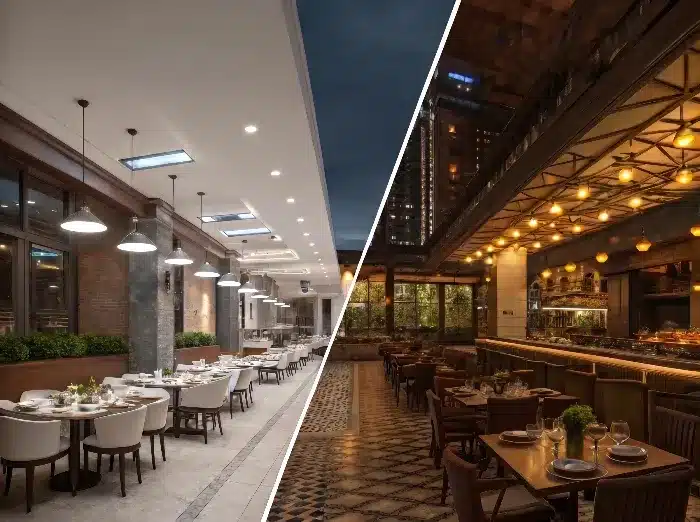
restaurant color temperature warm white dining atmosphere
| Restaurant Type | Typical CCT Direction | Specification Caution |
|---|---|---|
| Fine dining | 2200 K-2700 K | Keep glare low and confirm food color under dimmed scenes |
| Casual dining | 2700 K-3000 K | Balance atmosphere with menu and table visibility |
| Modern cafe | 3000 K-3500 K | Coordinate with daylight and brand material palette |
| Bar / lounge | 1800 K-2700 K or dim-to-warm | Avoid sacrificing staff task visibility |
| Service / cleaning scene | Often higher output, not necessarily cooler CCT | Separate scene control from guest atmosphere |
Nota da Fábrica
In multi-outlet restaurant projects, CCT consistency between production batches is as important as the nominal Kelvin value. A project may be specified at 2700 K, but visible variation between adjacent fixtures can create a patchy ceiling or inconsistent table appearance. Batch verification is critical before shipment.
Lighting Design for Different Restaurant Types
Realidade no Local / Comercial
Different restaurant formats require different lighting strategies. Applying one standard lighting template to all venues usually fails. A quick-service restaurant, a fine dining venue, and a modern cafe have different customer turnover rates, dwell times, service patterns, and visual expectations.
Mergulho Profundo & Solução de Engenharia
Casual restaurants typically need balanced lighting that supports both atmosphere and practical visibility. Customers should feel relaxed, but staff must still operate efficiently across lunch and dinner service.
Fine dining spaces require stronger control of contrast, glare, and visual focus. The table should feel intentionally highlighted while the surrounding environment remains calm. Vertical accent lighting can add depth without increasing general brightness excessively.
Modern cafes often need lighting that transitions well between daytime and evening use. These venues may rely more on daylight, laptop-friendly visibility, and social-media-conscious food presentation. Decorative luminaires can play a stronger brand role, but they should still be integrated with usable ambient and task lighting.
| Restaurant Type | Primary Lighting Priority | Recommended Layer Strategy | Product Direction |
|---|---|---|---|
| Casual dining | Comfort and clarity | Balanced ambient + task + moderate accent | Downlights, pendants, linear lights |
| Fine dining | Atmosphere and intimacy | Low ambient + focused table light + controlled accent | Dimmable spotlights, pendants, wall emphasis |
| Modern cafe | Flexibility and identity | Daylight-integrated ambient + decorative task + brand accent | Track lights, pendants, linear profiles |
| Bar / lounge | Contrast and mood | Low ambient + back-bar accent + task support | Adjustable spots, shelf lighting, dim-to-warm lamps |
| Quick-service restaurant | Speed and visibility | Brighter ambient + counter task + menu accent | Downlights, panels, counter lights |
Nota da Fábrica
The most successful hospitality schemes usually start from service pattern rather than decorative style. Lighting must support how the venue actually operates hour by hour, not only how it appears in concept presentations.
Restaurant Lighting Case Study
Realidade no Local / Comercial
A typical issue in restaurant fit-outs is that the initial design provides sufficient average lux, yet the finished venue still feels visually uncomfortable. This usually happens when ambient lighting is overused and no clear task or accent hierarchy is established. The result is a bright room without atmosphere, poor table focus, and inefficient dimming scenes.
Mergulho Profundo & Solução de Engenharia
Consider a mid-to-upscale dining project with three primary zones: entry, main dining, and decorative wall display. The initial design used a regular grid of ceiling downlights across the entire room. Measured brightness looked acceptable, but the space lacked depth and tables did not stand out.
The revised scheme reduced the dominance of general ceiling lighting, added focused table illumination, and introduced perimeter accent lighting using adjustable fittings such as Suporte de luz de calha. The result was not necessarily higher total lumen output, but better visual structure. Guests perceived the dining area as warmer and more comfortable, while staff retained sufficient service visibility.
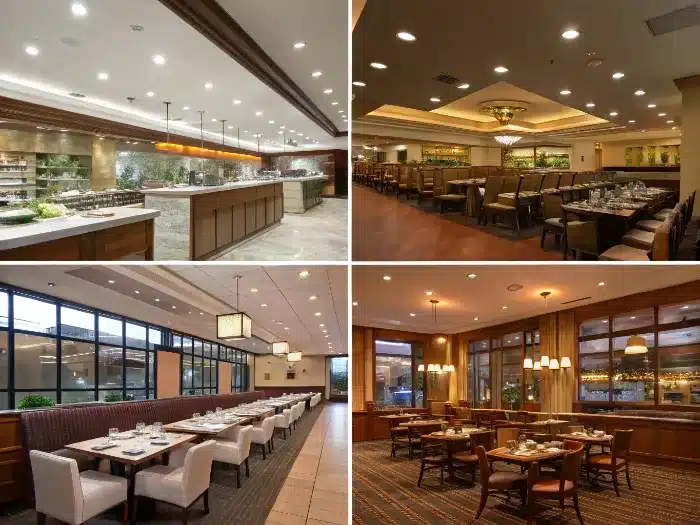
restaurant lighting case study ambient task accent balance
| Design Stage | Initial Scheme | Revised Scheme | B2B Lesson |
|---|---|---|---|
| Iluminação geral | Uniform downlight grid | Controlled ambient base | Do not let ambient light carry every function |
| Table lighting | Weak focus | Dedicated focal illumination | Table visibility drives guest perception |
| Wall/display lighting | Minimal | Integrated accent and wall emphasis | Vertical brightness adds spatial depth |
| Scene control | Limitado | Service-based dimming scenes | Operations need more than one setting |
Nota da Fábrica
Sample-room validation is essential. Photometric files are necessary, but final judgment should include real furniture, surface finishes, tableware, and intended dimming scenes before full rollout.
Common Restaurant Lighting Mistakes
Realidade no Local / Comercial
Most restaurant lighting problems are not caused by product failure. They come from planning mistakes: relying on one lighting layer, choosing the wrong beam angle, ignoring glare, using inconsistent color temperatures, placing fixtures without reference to furniture, or buying dimmable products without testing the actual control system.
Mergulho Profundo & Solução de Engenharia
Common restaurant lighting mistakes are easier to prevent when they are translated into field symptoms:
| Common Mistake | Typical Result | Engineering Correction |
|---|---|---|
| One-layer lighting | Flat atmosphere, no table focus | Add ambient, task, and accent hierarchy |
| Excessive glare | Visual discomfort from seated positions | Improve shielding, cutoff, and aiming |
| Wrong CCT | Restaurant feels sterile or overly yellow | Select by concept and verify with materials |
| Low color rendering | Food looks dull or inaccurate | Use CRI 90+ or request R9/TM-30 for food-critical zones |
| Poor dimming compatibility | Flicker, buzz, pop-on, drop-out | Test fixture, driver, and control system together |
| Misaligned fixture placement | Uneven tables and circulation | Coordinate with furniture and service paths |
❌ Falso
Decorative fixtures can support identity, but they still need correct output, shielding, beam spread, mounting height, and dimming control to perform as task lighting.
✔ Verdadeiro
Seated-eye-level review quickly reveals glare, reflection, shadow, and table-focus problems that ceiling plans and empty-room measurements often miss.
Nota da Fábrica
During commissioning, seated-eye-level review is one of the fastest ways to identify design problems that drawings miss. A fixture can appear acceptable on plan and still produce uncomfortable glare from the actual dining position.
Conclusão: Valor Comercial
Well-executed restaurant lighting design improves more than visual appeal. It supports customer comfort, strengthens brand atmosphere, helps staff operate efficiently, and reduces the risk of post-installation corrections. For commercial operators, this translates into better consistency, lower maintenance disruption, and a more reliable long-term lighting system.
A successful scheme combines ambient, task, and accent lighting in a controlled way, with proper attention to illuminance, color temperature, color rendering, optics, dimming, and layout coordination. The strongest restaurant lighting schedule does not ask only whether the fixture looks good. It asks what the fixture must do, where it will be installed, how it will be controlled, and how it will perform under real service conditions.
Recomendação de Engenharia B2B
Before mass production or bulk purchase, request the complete technical package: datasheet, IES or LDT photometric file, beam angle, CRI and available R9/TM-30 data, driver specification, dimmer compatibility list, rated ambient temperature, and installation restrictions. For large restaurant projects using GU10, MR16, Lâmpadas LED PAR, pendant fixtures, recessed fittings, or track fittings, approve samples under the actual fixture, dimmer, ceiling height, table material, and service-scene condition before confirming the final order.
Notas de rodapé
EN 12464-1:2021 lighting tables commonly list restaurants and dining areas at 200 lx maintained illuminance, UGR 22, uniformity 0.40, and Ra 80; use project-specific criteria where local standards or brand requirements differ. Source: Techlumen EN 12464-1 guide. ↩ ↩
ENERGY STAR Lamps Version 2.1 required certified compact fluorescent and solid-state lamps to have Ra >= 80; for solid-state lamps, R9 had to be greater than 0. Source: ENERGY STAR Lamps V2.1 Final Specification. ↩
 English
 French
 German
 Italian
 Spanish
 Portuguese
 Arabic
 Russian
 Japanese
 Chinese