Meilleur design d'éclairage pour restaurants : Comment l'éclairage façonne l'atmosphère de la salle à manger et l'expérience des clients
Introduction
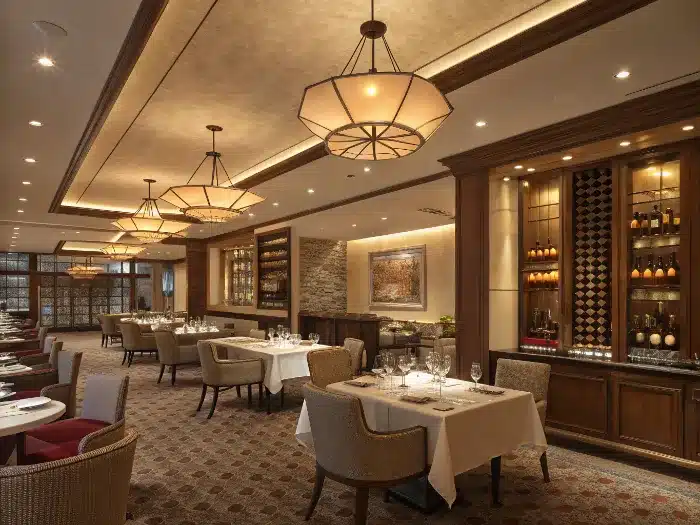
Restaurant lighting is not a decorative afterthought. In commercial projects, it affects how guests read the menu, how food color appears on the table, how staff move through service areas, and how the whole venue feels during lunch, dinner, cleaning, and late-night operation. A restaurant can look attractive in a rendering and still fail on site if the lighting is selected only by fixture style or total wattage.
For restaurant operators, designers, distributors, and project contractors, lighting errors create real costs. Poor beam control can produce glare at seated eye level. Low color rendering can make meat, seafood, vegetables, wine, wood, and skin tones look dull. Poor dimming compatibility can cause flicker, buzzing, or unstable scenes during dinner service. A successful restaurant lighting design must therefore balance atmosphere, visibility, color quality, driver stability, maintenance access, and long-term consistency across the full dining area.
❌ Faux
Warm light can help create mood, but it cannot fix glare, poor table visibility, low CRI, weak accent lighting, or unstable dimming scenes.
✔ Vrai
A reliable restaurant lighting plan separates ambient, task, and accent lighting so each fixture supports a clear operational and visual purpose.
Résumé Exécutif
Effective restaurant lighting combines ambient, task, and accent layers to control atmosphere, visibility, food presentation, and operational workflow. For B2B projects, the lighting schedule should not stop at wattage and fixture appearance. It should define illuminance targets, color temperature, CRI or TM-30 data, beam angle, glare control, dimming method, driver compatibility, and maintenance access.
If the project follows EN 12464-1 workplace lighting guidance, restaurant and dining areas are commonly listed around 200 lux maintained illuminance, with UGR 22, uniformity 0.40, and Ra 80 as reference values.1 These figures are useful baselines, not a full design answer. Fine dining, casual dining, cafes, bars, counters, kitchens, and cleaning scenes may need different lighting levels and control scenes.
restaurant lighting design dining atmosphere commercial project
If you remember only five specification rules, keep these:
- Do not select restaurant fixtures by style and wattage alone; confirm lux target, beam angle, glare control, CRI/TM-30, and dimming behavior.
- Use warm CCT such as 2200 K-3000 K for most dining atmospheres, but verify food color and material appearance under the actual source.
- Treat CRI 80 as a general baseline; consider CRI 90+, R9, or TM-30 data for food presentation, premium dining, bars, and hospitality interiors.
- Test dimming, drivers, and control scenes before bulk order, especially for restaurants that need lunch, dinner, cleaning, and event scenes.
- Review the lighting from seated eye level, not only from the reflected ceiling plan.
| Design Item | B2B Specification Check | Pourquoi c'est important |
|---|---|---|
| Dining area illuminance | Around 200 lx as an EN 12464-1 reference, adjusted by concept | Supports menu reading and table visibility |
| Color quality | Ra 80 baseline; CRI 90+ / R9 / TM-30 for food-sensitive zones | Protects food, material, and skin-tone appearance |
| Contrôle de l'éblouissement | Shielded optics, cutoff angle, UGR review where applicable | Reduces seated discomfort |
| Gradation | Phase-cut, 0-10 V, DALI, or smart control compatibility | Prevents flicker, buzzing, and scene failure |
| Maintenance | Driver access, replaceable modules, circuit identification | Lowers service cost after opening |
How Lighting Influences Customer Experience in Restaurants
Réalité sur site / commerciale
Restaurant lighting changes how guests perceive comfort, privacy, food freshness, and venue quality. If the room is too bright, it can feel clinical. If it is too dim, menus become difficult to read and service staff lose visibility. If the table is bright but the walls are dark, the room can feel visually compressed. If the ceiling is bright but the food is dull, the measured lux level may look acceptable while the dining experience still feels weak.
For operators running multiple outlets, inconsistent lighting between locations also creates brand inconsistency. A chain restaurant cannot rely on "similar-looking" fixtures if one batch has different color temperature, different beam spread, or unstable dimming behavior.
Plongée approfondie & Solution d'ingénierie
Lighting influences customer experience through visibility, emotional response, and spatial hierarchy. Ambient lighting provides the luminous background. Task lighting supports table use, bill checking, ordering counters, and staff operations. Accent lighting creates focus on walls, shelves, bars, artwork, signage, plants, wine displays, and architectural textures.
Contrast ratio is important. If the table surface is too close in brightness to the background, the dining setting looks flat. If contrast is too high, faces and menus can fall into shadow. The target is controlled contrast, not simply low light.
❌ Faux
Average lux does not show glare, vertical brightness, food color quality, table focus, wall brightness, or whether the dimming scene works during real service.
✔ Vrai
Real materials change glare, reflection, shadow, and perceived contrast, so final aiming should be checked under operating conditions.
| Fonctionnalité | Balanced Layered Lighting | Single-Level General Lighting | B2B Risk If Ignored |
|---|---|---|---|
| Ambiance de la salle à manger | Contrôlé et différencié | Plat et générique | Perception faible de la marque |
| Visibilité de la table | Ciblé et confortable | Inégal ou éblouissant | Plaintes concernant la lecture du menu |
| Présentation des plats | Soutenu par la qualité des couleurs et la lumière focale | Dépend de la luminosité de la pièce | Apparence terne des aliments |
| Contrôle de scène | Modes déjeuner, dîner, nettoyage, événement | Un réglage de compromis | Frustration opérationnelle |
Note d'Usine
Dans les projets hôteliers, le problème le plus courant n'est pas une quantité insuffisante de luminaires. C'est une mauvaise hiérarchie entre la surface de la table, l'arrière-plan mural, le chemin de circulation et les éléments décoratifs. Une puissance suffisante ne garantit pas une bonne atmosphère de restaurant.
Éléments clés de la conception de l'éclairage pour restaurants
Réalité sur site / commerciale
L'éclairage du restaurant doit fonctionner pour différentes périodes d'exploitation. Le service du déjeuner peut nécessiter une visibilité plus claire et un rendement lumineux plus élevé. Le service du dîner nécessite souvent un éclairage d'ambiance plus faible et un accent plus marqué sur les tables. Le nettoyage requiert une luminosité générale plus élevée. Les événements peuvent nécessiter des scènes flexibles. Si la conception ignore cette réalité opérationnelle, le personnel compensera manuellement ou demandera des modifications du circuit après l'installation.
Plongée approfondie & Solution d'ingénierie
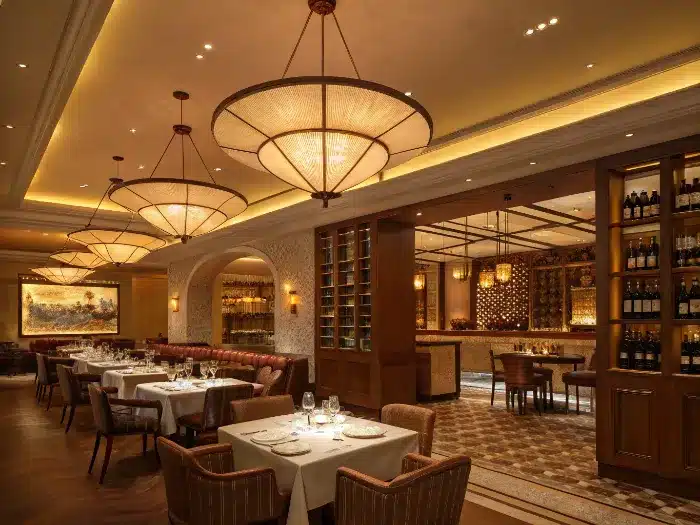
Un schéma d'éclairage de restaurant dépend généralement des couches d'éclairage, de l'éclairement, du contrôle de l'éblouissement, du rendu des couleurs, de la température de couleur, de la distribution du faisceau, du placement des luminaires et du contrôle de l'intensité.
Pour les zones de restauration, 200 lx est un point de référence utile de l'EN 12464-1 lorsque cette norme est appliquée.1 La restauration gastronomique peut fonctionner intentionnellement à un niveau plus bas dans certaines zones d'ambiance si l'éclairage des tables et la visibilité des tâches sont soigneusement contrôlés. Les comptoirs de service, les zones de caisse, les zones de buffet et les scènes de nettoyage nécessitent souvent une visibilité fonctionnelle plus élevée. L'article doit donc traiter les valeurs de lux comme des références de conception maintenues, et non comme des chiffres universels fixes.
La restitution des couleurs est essentielle car la nourriture contient des rouges, des bruns, des verts, des neutres chauds et des textures de surface qui peuvent paraître ternes sous des spectres faibles. L'IRC est encore largement utilisé, et ENERGY STAR Lamps Version 2.1 exigeait que les lampes fluorescentes compactes et les lampes à semi-conducteurs certifiées aient un Ra >= 80 ; pour les lampes à semi-conducteurs, R9 devait être supérieur à 0.2 Pour les restaurants qui vendent la qualité de la nourriture et l'ambiance, un IRC 90+ et des données R9 ou TM-30 disponibles sont de meilleurs critères d'achat que "Est-ce un blanc chaud ?"
La température de couleur doit soutenir le concept. De nombreuses zones de restauration utilisent des gammes de blanc chaud comme 2200 K-3000 K. Les cafés, espaces petit-déjeuner et restauration décontractée diurne peuvent utiliser 3000 K-3500 K pour une ambiance plus fraîche et dynamique. Le choix exact doit être testé avec la nourriture, la vaisselle, les finitions murales, le bois, la pierre, le métal et les couleurs de la marque.
éléments de conception d'éclairage de restaurant rendu des couleurs contrôle de l'éblouissement
| Élément | Plage pratique ou vérification | Note de spécification B2B |
|---|---|---|
| Éclairement pour la salle à manger | Environ 200 lx comme référence EN 12464-1 | Ajuster selon le concept, la scène, la réflectance de la table et les besoins du service |
| Température de couleur | 2200 K-3000 K pour une salle à manger chaleureuse ; 3000 K-3500 K pour les zones de café/service plus lumineuses | Maintenir la CCT cohérente dans chaque zone visuelle |
| Rendu des couleurs | Ra 80 comme base ; envisager CRI 90+, R9 ou TM-30 | Important pour la nourriture, le vin, le bois, les tons de peau et les matériaux premium |
| Éblouissement | UGR 22 comme référence EN 12464-1 pour les restaurants, le cas échéant | Vérifier également les vues à hauteur des yeux en position assise |
| Contrôle du faisceau | Faisceaux étroits/moyens pour les tables focales et les accents ; optiques plus larges pour l'ambiance | Adapter le faisceau à la taille de la table, à la hauteur de fixation et à la surface cible |
| Gradation | Tester le pilote réel + système de contrôle | Éviter les scintillements, bourdonnements, allumages brusques, coupures et incohérences de scène |
Note d'Usine
Les spécifications des luminaires ne doivent jamais être séparées des performances optiques. Le même flux lumineux peut donner des résultats très différents selon le matériau du diffuseur, la géométrie du réflecteur, l'angle de protection, la qualité de la lentille et le contrôle du faisceau. L'examen d'une maquette est plus utile que de se fier uniquement à la puissance ou aux photos du catalogue.
Conception de l'éclairage pour les tables de salle à manger
Réalité sur site / commerciale
Les tables de restaurant sont le point central de l'expérience des clients. Si la table est sous-éclairée, les clients ont du mal à lire les menus et la nourriture perd ses détails visuels. Si elle est trop éclairée, les assiettes et la verrerie peuvent créer des reflets gênants. Dans les agencements de banquet ou les plans de tables très serrés, un mauvais contrôle du faisceau peut déverser de la lumière sur les tables adjacentes et réduire l'intimité.
Une fois les positions des meubles fixées, corriger l'éclairage des tables devient difficile sans modifier les découpes au plafond, les points de suspension, les positions des rails ou le regroupement des circuits.
Plongée approfondie & Solution d'ingénierie
Dining table lighting should create a controlled visual focal area with enough horizontal light for food and menus and enough vertical light for faces. Lampe suspendue fixtures, narrow-to-medium beam downlights, adjustable spotlights, and decorative luminaires can all work, but fixture choice must match table size, ceiling height, seating density, and sightline.
The objective is to light the food, tabletop, and faces naturally while avoiding direct glare. For round tables, centered pendants or symmetrical beam placement often work well. For rectangular tables, linear pendants, multiple controlled beams, or track-mounted accent fixtures may be more appropriate.
Do not judge table lighting in an empty room. White plates, glossy tabletops, wine glasses, dark stone, polished metal, and menu paper all change reflected brightness. Final aiming should be checked from seated eye level and staff circulation paths.
| Table Lighting Issue | On-Site Symptom | Specification Fix |
|---|---|---|
| Beam too narrow | Hotspot in the center, dark table edges | Use wider beam or multiple lower-output sources |
| Beam too wide | Spill into adjacent tables, weak intimacy | Use controlled optics and better aiming |
| Pendant too low | Blocks sightlines and service movement | Coordinate mounting height with table and service style |
| Poor color rendering | Food appears dull or unnatural | Use high-CRI source and request R9/TM-30 data |
Note d'Usine
Table lighting issues often appear only after furniture and tableware are installed. Empty-room lux readings can look acceptable, but reflective plates, glassware, and dark tabletop materials change glare and shadow patterns significantly.
Restaurant Lighting Layout Planning
Réalité sur site / commerciale
Layout planning determines whether the restaurant feels coherent or fragmented. Poor fixture spacing, misaligned ceiling grids, and incorrect switching zones can create dark corners, uneven aisles, and overexposed seating clusters. These issues lead to repeated site visits, difficult re-aiming work, and conflicts between lighting, HVAC, sprinklers, ceiling services, speakers, and decorative elements.
Plongée approfondie & Solution d'ingénierie
Restaurant lighting layout should start from functional zoning, not fixture quantity. The plan should identify entrance, waiting area, dining zones, service aisles, counters, bar, decorative walls, washroom access, and circulation transitions. Each zone has a different visual requirement.
Ceiling-mounted fixtures should be coordinated with furniture plans and architectural features. Lampe encastrée fixtures may align with table centers where appropriate, but not at the expense of glare control or maintenance access. Circulation areas need visual continuity so guests and staff can move safely without a sudden drop in brightness.
Switching and dimming scene planning are equally important. Restaurants rarely operate with one lighting condition. Lunch, dinner, cleaning, pre-opening setup, and private events each need different output levels. If circuits are grouped poorly, staff cannot adjust atmosphere without also affecting service visibility. For projects using external drivers or low-voltage systems, the Pilote de LED should be checked together with the selected fixture and dimming method.
| Layout Decision | Correct B2B Approach | Common Failure |
|---|---|---|
| Seating zone | Coordinate table plan, beam spread, and glare view | Downlights land between tables |
| Service aisle | Maintain safe visual continuity | Staff walk through dark gaps |
| Bar/counter | Separate task light from decorative glow | Counter looks attractive but staff cannot work comfortably |
| Wall display | Use accent or wall-wash optics | Decorative wall disappears at dinner scene |
| Driver access | Plan access before ceiling closure | Maintenance requires disruptive work |
Note d'Usine
Layout planning should include driver access, replacement clearance, circuit labeling, and fixture aiming access from the start. Restaurants often prioritize visual finish during design review, but maintenance teams later inherit inaccessible ceiling conditions.
Choosing the Right Color Temperature for Restaurants
Réalité sur site / commerciale
Color temperature has a major effect on dining atmosphere and food presentation. If the lighting is too cool, the restaurant can feel sterile. If it is very warm but has poor color rendering, food and surfaces may look yellow, flat, or muddy. In mixed-fixture projects, inconsistent CCT between batches can become visible across open dining areas.
Correcting color temperature after installation can require lamp or fixture replacement across multiple zones, so CCT and batch consistency should be reviewed before purchase.
Plongée approfondie & Solution d'ingénierie
Color temperature should be selected according to restaurant concept, interior materials, food type, daytime/nighttime use, and target customer behavior.
Fine dining environments often use warmer tones to create intimacy. Casual restaurants may use warm to warm-neutral lighting for comfort and practical visibility. Modern cafes may use warm-neutral or neutral lighting, especially when daylight, laptop use, and daytime visual clarity are part of the concept.
Color temperature must be considered together with CRI, R9, TM-30, and surface reflectance. A warm source with weak red rendering can make meat, desserts, wood, and skin tones look poor. A neutral source with strong color rendering may present food better than a warmer but lower-quality source.
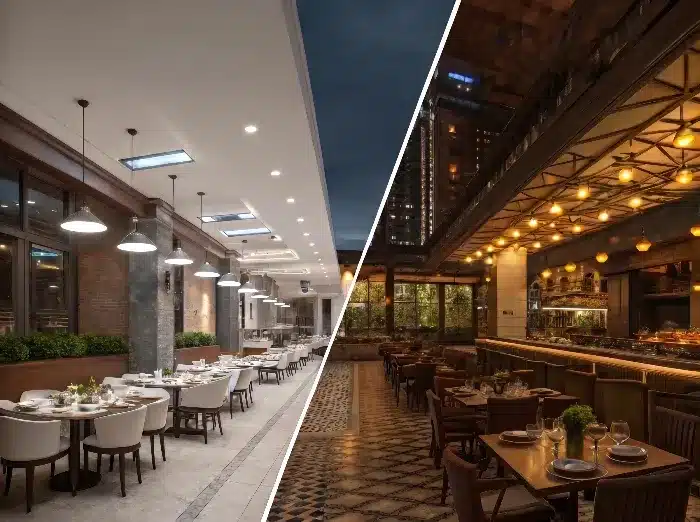
restaurant color temperature warm white dining atmosphere
| Restaurant Type | Typical CCT Direction | Specification Caution |
|---|---|---|
| Fine dining | 2200 K-2700 K | Keep glare low and confirm food color under dimmed scenes |
| Casual dining | 2700 K-3000 K | Balance atmosphere with menu and table visibility |
| Modern cafe | 3000 K-3500 K | Coordinate with daylight and brand material palette |
| Bar / lounge | 1800 K-2700 K or dim-to-warm | Avoid sacrificing staff task visibility |
| Service / cleaning scene | Often higher output, not necessarily cooler CCT | Separate scene control from guest atmosphere |
Note d'Usine
In multi-outlet restaurant projects, CCT consistency between production batches is as important as the nominal Kelvin value. A project may be specified at 2700 K, but visible variation between adjacent fixtures can create a patchy ceiling or inconsistent table appearance. Batch verification is critical before shipment.
Lighting Design for Different Restaurant Types
Réalité sur site / commerciale
Different restaurant formats require different lighting strategies. Applying one standard lighting template to all venues usually fails. A quick-service restaurant, a fine dining venue, and a modern cafe have different customer turnover rates, dwell times, service patterns, and visual expectations.
Plongée approfondie & Solution d'ingénierie
Casual restaurants typically need balanced lighting that supports both atmosphere and practical visibility. Customers should feel relaxed, but staff must still operate efficiently across lunch and dinner service.
Fine dining spaces require stronger control of contrast, glare, and visual focus. The table should feel intentionally highlighted while the surrounding environment remains calm. Vertical accent lighting can add depth without increasing general brightness excessively.
Modern cafes often need lighting that transitions well between daytime and evening use. These venues may rely more on daylight, laptop-friendly visibility, and social-media-conscious food presentation. Decorative luminaires can play a stronger brand role, but they should still be integrated with usable ambient and task lighting.
| Restaurant Type | Primary Lighting Priority | Recommended Layer Strategy | Product Direction |
|---|---|---|---|
| Casual dining | Comfort and clarity | Balanced ambient + task + moderate accent | Downlights, pendants, linear lights |
| Fine dining | Atmosphere and intimacy | Low ambient + focused table light + controlled accent | Dimmable spotlights, pendants, wall emphasis |
| Modern cafe | Flexibility and identity | Daylight-integrated ambient + decorative task + brand accent | Track lights, pendants, linear profiles |
| Bar / lounge | Contrast and mood | Low ambient + back-bar accent + task support | Adjustable spots, shelf lighting, dim-to-warm lamps |
| Quick-service restaurant | Speed and visibility | Brighter ambient + counter task + menu accent | Downlights, panels, counter lights |
Note d'Usine
The most successful hospitality schemes usually start from service pattern rather than decorative style. Lighting must support how the venue actually operates hour by hour, not only how it appears in concept presentations.
Restaurant Lighting Case Study
Réalité sur site / commerciale
A typical issue in restaurant fit-outs is that the initial design provides sufficient average lux, yet the finished venue still feels visually uncomfortable. This usually happens when ambient lighting is overused and no clear task or accent hierarchy is established. The result is a bright room without atmosphere, poor table focus, and inefficient dimming scenes.
Plongée approfondie & Solution d'ingénierie
Consider a mid-to-upscale dining project with three primary zones: entry, main dining, and decorative wall display. The initial design used a regular grid of ceiling downlights across the entire room. Measured brightness looked acceptable, but the space lacked depth and tables did not stand out.
The revised scheme reduced the dominance of general ceiling lighting, added focused table illumination, and introduced perimeter accent lighting using adjustable fittings such as Luminaire sur rail. The result was not necessarily higher total lumen output, but better visual structure. Guests perceived the dining area as warmer and more comfortable, while staff retained sufficient service visibility.
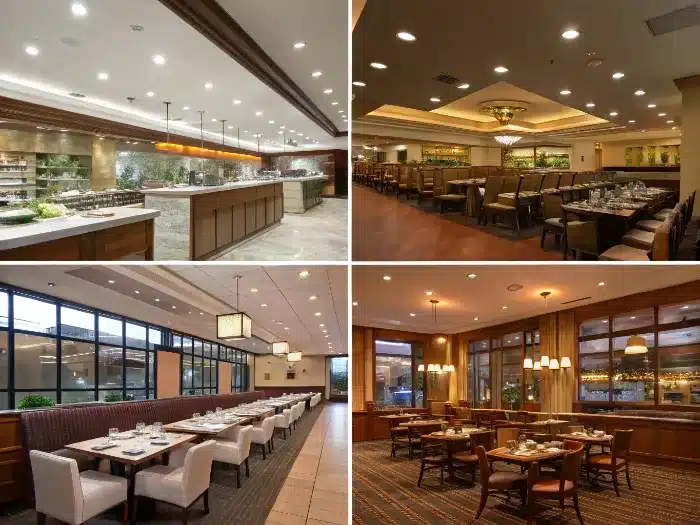
restaurant lighting case study ambient task accent balance
| Design Stage | Initial Scheme | Revised Scheme | B2B Lesson |
|---|---|---|---|
| Éclairage général | Uniform downlight grid | Controlled ambient base | Do not let ambient light carry every function |
| Table lighting | Weak focus | Dedicated focal illumination | Table visibility drives guest perception |
| Wall/display lighting | Minimal | Integrated accent and wall emphasis | Vertical brightness adds spatial depth |
| Contrôle de scène | Limitée | Service-based dimming scenes | Operations need more than one setting |
Note d'Usine
Sample-room validation is essential. Photometric files are necessary, but final judgment should include real furniture, surface finishes, tableware, and intended dimming scenes before full rollout.
Common Restaurant Lighting Mistakes
Réalité sur site / commerciale
Most restaurant lighting problems are not caused by product failure. They come from planning mistakes: relying on one lighting layer, choosing the wrong beam angle, ignoring glare, using inconsistent color temperatures, placing fixtures without reference to furniture, or buying dimmable products without testing the actual control system.
Plongée approfondie & Solution d'ingénierie
Common restaurant lighting mistakes are easier to prevent when they are translated into field symptoms:
| Common Mistake | Typical Result | Engineering Correction |
|---|---|---|
| One-layer lighting | Flat atmosphere, no table focus | Add ambient, task, and accent hierarchy |
| Excessive glare | Visual discomfort from seated positions | Improve shielding, cutoff, and aiming |
| Wrong CCT | Restaurant feels sterile or overly yellow | Select by concept and verify with materials |
| Low color rendering | Food looks dull or inaccurate | Use CRI 90+ or request R9/TM-30 for food-critical zones |
| Poor dimming compatibility | Flicker, buzz, pop-on, drop-out | Test fixture, driver, and control system together |
| Misaligned fixture placement | Uneven tables and circulation | Coordinate with furniture and service paths |
❌ Faux
Decorative fixtures can support identity, but they still need correct output, shielding, beam spread, mounting height, and dimming control to perform as task lighting.
✔ Vrai
Seated-eye-level review quickly reveals glare, reflection, shadow, and table-focus problems that ceiling plans and empty-room measurements often miss.
Note d'Usine
During commissioning, seated-eye-level review is one of the fastest ways to identify design problems that drawings miss. A fixture can appear acceptable on plan and still produce uncomfortable glare from the actual dining position.
Conclusion: Business Value
Un design d'éclairage de restaurant bien exécuté améliore plus que l'attrait visuel. Il favorise le confort des clients, renforce l'atmosphère de la marque, aide le personnel à travailler efficacement et réduit le risque de corrections après installation. Pour les opérateurs commerciaux, cela se traduit par une meilleure cohérence, moins de perturbations de maintenance et un système d'éclairage à long terme plus fiable.
Un schéma réussi combine éclairage ambiant, fonctionnel et d'accentuation de manière contrôlée, avec une attention appropriée à l'éclairement, la température de couleur, la restitution des couleurs, l'optique, le gradation et la coordination de la disposition. Le meilleur plan d'éclairage de restaurant ne se demande pas seulement si le luminaire est esthétique. Il demande ce que le luminaire doit faire, où il sera installé, comment il sera contrôlé et comment il fonctionnera dans des conditions réelles de service.
Recommandation d'ingénierie B2B
Avant la production en série ou l'achat en gros, demandez le dossier technique complet : fiche technique, fichier photométrique IES ou LDT, angle de faisceau, données CRI et R9/TM-30 disponibles, spécifications du driver, liste de compatibilité des variateurs, température ambiante nominale et restrictions d'installation. Pour les grands projets de restaurant utilisant GU10, MR16, Ampoules LED PAR, luminaires suspendus, appareils encastrés ou rails, approuvez les échantillons sous le luminaire réel, le variateur, la hauteur sous plafond, le matériau de la table et les conditions de service avant de confirmer la commande finale.
Notes de bas de page
Les tableaux d'éclairage EN 12464-1:2021 listent couramment les restaurants et zones de restauration à 200 lx d'éclairement maintenu, UGR 22, uniformité 0,40 et Ra 80 ; utilisez des critères spécifiques au projet lorsque les normes locales ou les exigences de la marque diffèrent. Source : Guide EN 12464-1 de Techlumen. ↩ ↩
ENERGY STAR Lamps Version 2.1 exigeait que les lampes fluorescentes compactes et à semi-conducteurs certifiées aient un Ra >= 80 ; pour les lampes à semi-conducteurs, R9 devait être supérieur à 0. Source : Spécification finale ENERGY STAR Lamps V2.1. ↩