
IP20 vs IP65: What IP Ratings Mean for Indoor and Outdoor LED Lighting
Introduction
In lighting projects, IP rating selection is often treated as a box-ticking exercise until failures begin appearing on site. A fixture specified with insufficient environmental protection can lead to moisture ingress, dust contamination, premature driver failure, corrosion, and repeat installation work. On commercial projects, that does not just affect product lifespan. It affects access costs, ceiling rework, project handover schedules, and the contractor’s reputation.
For importers, distributors, and project teams, IP ratings are a practical engineering specification used to judge whether an LED luminaire is suited to its real installation environment. The difference between IP20 and IP65 is not simply “indoor” versus “outdoor.” It is a decision about how much protection the fixture offers against solid particles and water exposure, and whether that level of protection matches the service conditions over time.
This is why lighting engineers evaluate IP rating together with mounting location, cleaning methods, humidity level, splash risk, and maintenance access. A product that performs well in an office ceiling may be the wrong choice for a bathroom, canopy, façade, or semi-exposed corridor.
Executive Summary
IP ratings define how well a lighting fixture resists dust and water ingress.1 IP20 is typically suitable for dry indoor areas, while IP65 is designed for dusty or water-exposed environments. Correct selection reduces failures, reinstallation work, and long-term maintenance cost.
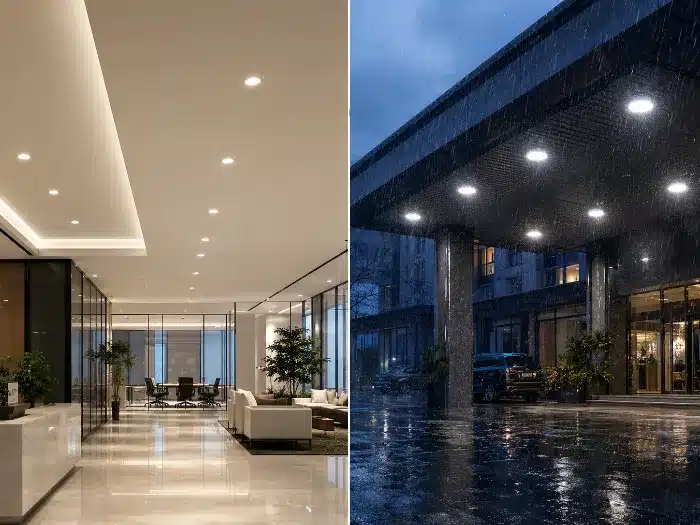
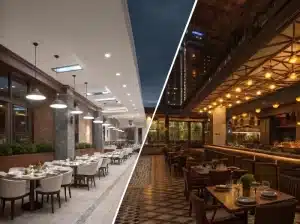
IP20 vs IP65 LED lighting protection ratings for indoor outdoor applications
What Is an IP Rating in Lighting?
On-Site / Commercial Reality
During specification and procurement, IP rating is one of the quickest ways to filter whether a luminaire is appropriate for its environment. If this is misjudged early, the problem usually appears later during commissioning or after occupancy: fogging inside the fitting, corrosion around terminals, tripping, discoloration, or complete failure of the LED module or driver.
In commercial buildings, replacing a failed fixture is rarely just a product issue. It may require night work, scaffold access, tenant coordination, ceiling opening, and repeated labor. That is why IP rating matters well before the first fixture is installed.
Deep Dive & Engineering Solution
IP stands for Ingress Protection.2 The rating is expressed as two digits, such as IP20 or IP65.
- The first digit indicates protection against solid objects or dust
- The second digit indicates protection against water
This coding system gives specifiers a practical way to compare enclosure protection levels across different products.
For LED lighting, the IP rating helps evaluate whether the housing, diffuser, gasket system, cable entry, and sealing details are suitable for the installation conditions. This is particularly important because LED fixtures are electronic systems, not just light sources. Once dust or water reaches the internal electrical components, reliability drops quickly.
A simplified comparison is shown below:
| Caraterística | IP20 | IP65 | Impact on Maintenance / ROI |
|---|---|---|---|
| Solid particle protection | Protected against fingers and larger objects | Dust-tight | Lower contamination risk in demanding environments |
| Water protection | No special water protection | Protected against water jets | Reduced moisture-related failures |
| Typical installation zone | Dry indoor areas | Wet, dusty, or exposed areas | Better fit for environment reduces rework |
| Fixture construction | Usually simpler enclosure | Sealed housing with gaskets and protected entries | Higher upfront cost, lower service risk where exposure exists |
The engineering point is straightforward: IP rating is not a performance luxury. It is an environmental suitability indicator used to reduce failure risk.
Factory Note
From a manufacturing perspective, IP performance depends on the full enclosure system, not only on the housing shape. Lens fit, gasket compression, cable gland quality, screw torque, and assembly consistency all affect whether the rated protection level is actually maintained in production.
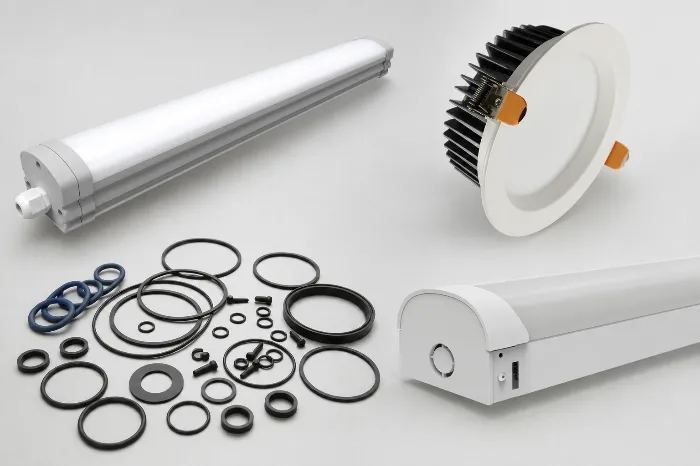
understanding IP rating in LED lighting fixtures for commercial environments
Understanding IP20: Typical Indoor Lighting Protection
On-Site / Commercial Reality
IP20 fixtures are widely used in offices, meeting rooms, retail stores, hotel guestrooms, and other dry indoor spaces. In these areas, the main environmental risks are accidental contact, ceiling dust, and normal indoor air conditions rather than direct water exposure.
For these installations, specifying IP65 would often add unnecessary cost, enclosure complexity, and sometimes thermal compromise without delivering practical value. On large-volume projects, over-specification can materially affect budget and procurement efficiency.
Deep Dive & Engineering Solution
IP20 typically means:
- First digit 2: protection against fingers or solid objects larger than 12.5 mm
- Second digit 0: no rated water protection
This makes IP20 suitable for interior spaces where the luminaire is not exposed to dripping water, washdown, spray, or heavy condensation.
Typical commercial applications include:
- Recessed downlights in office ceilings
- Track lights in retail environments
- Decorative pendants in dry public interiors
- Hotel room lighting
- Corridor lighting in enclosed, climate-controlled areas
The key engineering judgment is that “indoor” does not automatically mean IP20 is acceptable everywhere. Some indoor zones still involve elevated humidity or periodic cleaning exposure. Bathrooms, spa areas, covered loading zones, and some food service spaces may require a higher protection class depending on fixture position.
| Caraterística | Standard Dry Indoor Area | Humid or Splash-Prone Indoor Area | Impact on Maintenance / ROI |
|---|---|---|---|
| Typical IP choice | IP20 | Often IP44, IP54, or IP65 depending on zone | Correct selection avoids premature failure |
| Cost level | Lower | Higher | Over-specification raises capex; under-specification raises service cost |
| Service risk | Low in dry conditions | High if wrong fixture is used | Better environmental match improves system life |
Factory Note
In large hospitality projects, IP20 is often the correct choice for the majority of decorative and architectural indoor lighting. The problem is usually not understanding IP20 itself, but extending it into semi-wet areas simply because the space is technically indoors.
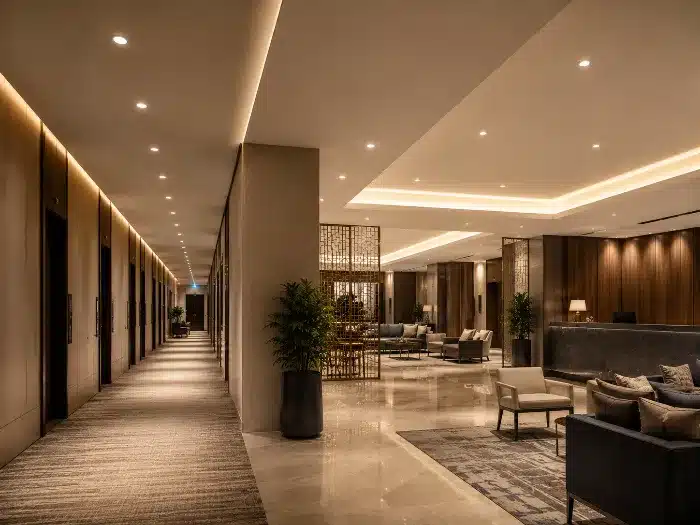
IP20 indoor LED lighting for offices retail stores and hotel interiors
Understanding IP65: Waterproof Lighting Protection
On-Site / Commercial Reality
IP65 fixtures are commonly specified where water spray, rain exposure, cleaning procedures, or airborne dust can affect the luminaire. In these environments, using a lower-rated fitting can result in visible water ingress, internal condensation residue, terminal corrosion, and driver instability.
For contractors, the risk is amplified in exterior façades, canopies, landscape lighting, parking areas, bathrooms, and back-of-house service zones because access for replacement is more difficult and maintenance windows are limited.
Deep Dive & Engineering Solution
IP65 typically means:
- First digit 6: dust-tight protection
- Second digit 5: protection against water jets from any direction
In practical terms, IP65 is used when the fixture must resist both particulate intrusion and meaningful water exposure. It does not mean the product is suitable for full submersion, but it is a strong protection level for many outdoor and wet-area applications.
Typical commercial applications include:
- Exterior wall-mounted luminaires
- Outdoor soffit or canopy lighting
- Bathroom fittings in appropriate zones
- Service corridors with washdown exposure
- Landscape and façade lighting where direct spray or rain is expected
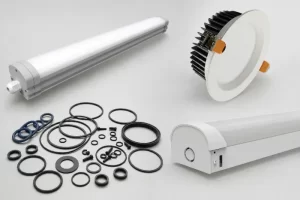
For LED products, achieving IP65 usually requires:
- Sealed lens-to-housing interface
- Reliable gasket design
- Properly rated cable glands or sealed connectors
- Controlled assembly torque
- Housing design that limits ingress pathways
| Caraterística | IP20 | IP65 | Impact on Maintenance / ROI |
|---|---|---|---|
| Dust resistance | Limited | Dust-tight | Lower internal contamination over time |
| Water exposure suitability | Dry area only | Suitable for jets and outdoor splash exposure | Fewer field failures in exposed zones |
| Typical enclosure design | Open or lightly protected | Sealed enclosure | Better reliability in harsh environments |
| Commercial use case | Offices, retail, guestrooms | Bathrooms, canopies, outdoor areas | Correct fit reduces call-backs |
Factory Note
From a manufacturing perspective, an IP65 claim should never be separated from process control. The sealing design may be correct on paper, but without batch verification, gasket consistency checks, and assembly discipline, field performance can vary significantly between production runs.
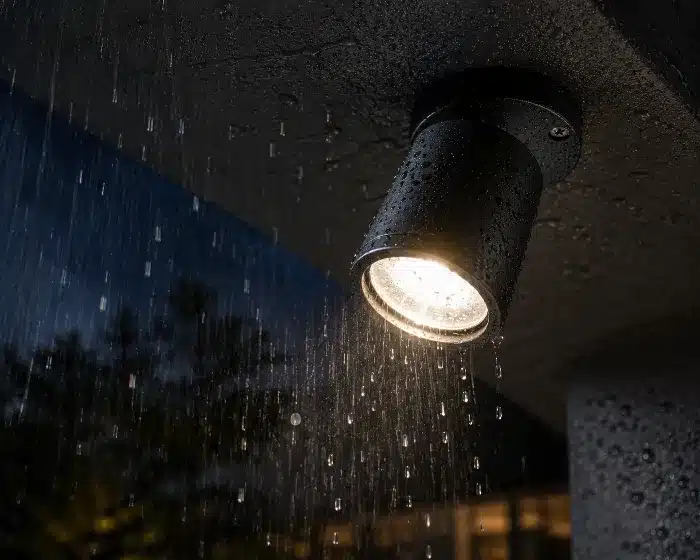
IP65 waterproof LED lighting for bathrooms outdoor commercial installations
IP20 vs IP65: Key Differences in Lighting Applications
On-Site / Commercial Reality
The practical difference between IP20 and IP65 appears when the fixture is exposed to the real building environment rather than the drawing set. An office lobby, for example, may safely use IP20 decorative fittings indoors, while the entrance canopy outside may require IP65 because of wind-driven rain and cleaning exposure.
This distinction matters during project execution because a visually similar fixture may be acceptable in one zone and a maintenance liability in another.
Deep Dive & Engineering Solution
The decision between IP20 and IP65 is driven by environmental exposure, not by appearance or general building type.
Key differences include:
| Caraterística | IP20 | IP65 | Impact on Maintenance / ROI |
|---|---|---|---|
| Protection against contact | Basic | High | Both may be acceptable depending on location |
| Protection against dust | Limited | Complete dust protection | IP65 performs better in dusty service areas |
| Protection against water | None | Water jet resistant | Critical for wet or outdoor installation |
| Utilização típica | Dry interior zones | Outdoor or wet interior/exterior zones | Environment-based selection reduces failure risk |
| Enclosure complexity | Lower | Higher | IP65 usually costs more but protects better where needed |
Commercial examples make the difference clearer:
- Office open-plan ceiling: IP20 is usually appropriate
- Retail shop interior: IP20 is commonly sufficient
- Bathroom ceiling near wet zones: often higher than IP20
- Exterior walkway: IP65 is generally preferred
- Loading area or service yard: IP65 is often necessary
- Indoor decorative chandelier in climate-controlled space: IP20 can be fully adequate
The engineering approach is to review actual installation conditions:
- Is there direct or indirect water exposure?
- Is the fixture in a dusty or dirty environment?
- Will the area be cleaned with spray equipment?
- Is condensation likely due to temperature change?
- Is fixture replacement difficult after handover?
Factory Note
During hotel commissioning, the most common mistake is assuming “under cover” means dry. Entrance soffits, open corridors, and porte-cochère ceilings may still experience wind-driven moisture and airborne contamination that exceed IP20 capability.
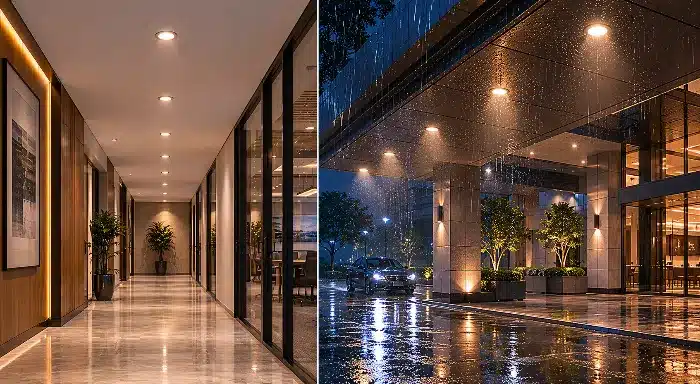
IP20 vs IP65 lighting applications for offices bathrooms and outdoor projects
How to Choose the Right IP Rating for Lighting Projects
On-Site / Commercial Reality
Choosing the wrong IP rating creates two kinds of cost. Under-specification leads to failures and replacements. Over-specification increases procurement cost unnecessarily and can limit product options. On large commercial projects, both errors scale quickly across hundreds or thousands of fixtures.
The correct decision is made by reviewing the installation environment fixture by fixture, especially in projects with mixed-use spaces.
Deep Dive & Engineering Solution
A practical selection method should consider:
-
Installation location
Determine whether the fixture is in a dry indoor zone, humid area, washdown area, covered exterior, or fully exposed outdoor position. -
Water exposure level
Check for drips, splashes, steam, cleaning spray, rain, or water jets. -
Dust and contamination level
Warehouses, service spaces, transport hubs, and exterior zones usually demand higher ingress protection. -
Maintenance difficulty
The harder the fixture is to access, the less tolerance there is for environmental mismatch. -
Long-term reliability target
Projects with high occupancy, luxury positioning, or strict maintenance windows should avoid marginal specification.
A useful rule is that lighting engineers and buyers should not choose IP rating by catalog category alone. The same building can require different protection levels across offices, washrooms, reception areas, façades, and service corridors.
At the product-selection stage, compare candidate LED lighting fixtures by IP rating, cable entry method, mounting position, material finish, and available test documentation rather than by appearance alone.
| Project Area | Typical Environmental Condition | Common IP Direction | Impact on Maintenance / ROI |
|---|---|---|---|
| Office | Dry, climate-controlled | IP20 | Economical and usually sufficient |
| Retail interior | Dry indoor use | IP20 | Good cost control in protected zones |
| Bathroom | Humidity, splash risk | Higher than IP20, often IP65 in exposed positions | Better resistance to moisture-related failures |
| Outdoor entrance | Rain, wind-driven moisture | IP65 | Reduces corrosion and ingress risk |
| Service yard / exterior corridor | Dust, spray, exposure | IP65 | Lower long-term replacement frequency |
Factory Note
From a manufacturing perspective, the most effective way to reduce project risk is to review the actual installation schedule and location list before production. The IP rating should be matched to the site condition, not assumed from the product family name.
Common Mistakes When Selecting IP Ratings
On-Site / Commercial Reality
Most IP-related failures do not come from dramatic misuse. They come from small assumptions made during specification, substitution, or procurement. Once installed, these mistakes are expensive because the fixture may physically fit and illuminate correctly at first, but fail months later under environmental stress.
Deep Dive & Engineering Solution
Common mistakes include:
-
Assuming all indoor spaces can use IP20
Bathrooms, semi-open corridors, poolside areas, and service rooms often require higher protection. -
Assuming all outdoor fixtures must be the same IP rating
Some sheltered outdoor zones may not need the same protection level as fully exposed areas, but this should be confirmed carefully. -
Focusing only on the luminaire body
Connectors, cable entries, junction interfaces, and installation workmanship also affect system-level ingress protection. -
Treating IP65 as universal waterproofing
IP65 protects against water jets, not submersion or every extreme exposure scenario. -
Ignoring maintenance access
A marginal IP decision may become very costly if the fixture is mounted high above a lobby, stairwell, or exterior façade. -
Trusting claims without verification
Rated protection should be supported by test evidence and consistent production control.
| Mistake | Result | Impact on Maintenance / ROI |
|---|---|---|
| Using IP20 in damp zones | Moisture ingress and premature failure | Increased service calls and replacement cost |
| Using IP65 everywhere without review | Unnecessary cost escalation | Lower procurement efficiency |
| Ignoring connectors and sealing points | System leakage despite rated housing | Hidden failure risk after installation |
| No validation of supplier claim | Batch inconsistency | Higher RMA exposure |
Factory Note
Conclusion: Business Value
IP20 and IP65 are not just technical labels. They are practical indicators of whether a luminaire can survive its operating environment with stable long-term performance. When the IP rating matches the installation condition, projects benefit from better reliability, fewer maintenance interventions, and lower lifetime system cost.
For distributors, contractors, and specifiers, the most effective approach is to evaluate lighting by environmental exposure zone rather than by product appearance or generic indoor/outdoor assumptions.
B2B Engineering Recommendation
For projects involving bathrooms, canopies, façades, exterior corridors, or service areas, share the fixture schedule, installation drawings, exposure conditions, cable entry method, and maintenance requirements before purchase.
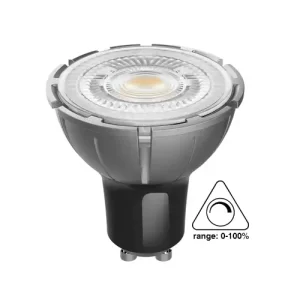
As a professional LED lighting manufacturer, Teco can review environmental suitability and help match fixture protection ratings, material selection, dimming compatibility, and installation details before mass production. OEM and project-based customization support are also available for distributors, wholesalers, contractors, and lighting brands.


 English
  French
  German
  Italian
  Spanish
  Portuguese
  Arabic
  Russian
  Japanese
  Chinese