Dimmer TRIAC para Lâmpadas LED: Compatibilidade, Riscos e Aplicações Comerciais
Introdução
Em retrofits comerciais, Dimerização por TRIAC para lâmpadas LED é uma das fontes mais comuns de atrasos na comissionamento. Muitos hotéis, corredores de escritórios e espaços comerciais tentam reutilizar reguladores de parede TRIAC antigos, originalmente concebidos para cargas incandescentes. No entanto, quando esses reguladores são emparelhados com drivers de LED modernos, o resultado é frequentemente cintilamento, ruído audível, queda em níveis baixos ou falha prematura do driver.
De acordo com o Departamento de Energia dos EUA (DOE), os sistemas de iluminação LED dependem de drivers eletrónicos com características de corrente não lineares, fundamentalmente diferentes dos filamentos incandescentes resistivos. Esta incompatibilidade elétrica é a causa principal da maioria dos Compatibilidade TRIAC LED problemas.
Compreender como funciona a regulação TRIAC — e quando é adequada — pode reduzir custos de retrabalho, proteger margens do distribuidor e melhorar a fiabilidade do sistema a longo prazo.
O que é Dimerização por TRIAC?
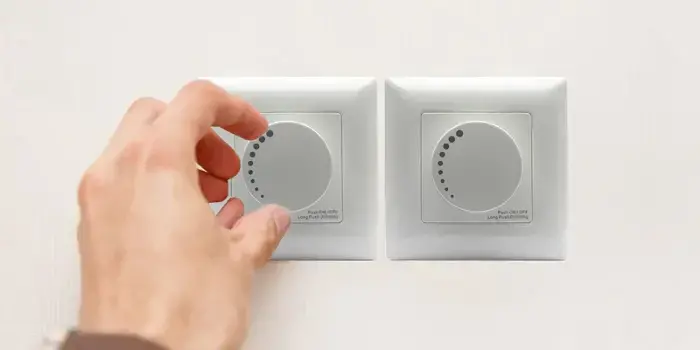
Close-up de uma mão a ajustar o botão num interruptor dimerizador branco e elegante instalado numa parede, destacando o controlo de luz intuitivo e preciso.
A dimerização por TRIAC (Triodo para Corrente Alternada) é um método de dimerização por corte de fase que reduz a saída luminosa cortando parte da forma de onda AC.
Em termos simples:
A dimerização por TRIAC reduz o brilho encurtando a forma de onda AC entregue à carga.
Existem duas formas principais:
- Borda de subida (fase direta)
- Borda de descida (fase inversa)
Princípio Elétrico da Regulação por Corte de Fase TRIAC
Num sistema incandescente, a potência segue:
Como as lâmpadas incandescentes se comportam como cargas resistivas, reduzir a tensão RMS reduz diretamente a saída luminosa de forma proporcional.
As lâmpadas LED, no entanto, não se comportam como simples resistências. Contêm fontes de alimentação comutadas (SMPS), retificadores, condensadores e frequentemente circuitos de correção do fator de potência (PFC). Estes componentes respondem de forma diferente às formas de onda com corte de fase.
Quando a regulação TRIAC é aplicada a drivers de LED:
- Picos de dv/dt elevados sobrecarregam os condensadores de entrada
- Correntes de entrada podem exceder picos de 5–10A
- A distorção harmónica total (THD) aumenta significativamente
A IEC 61000-3-2 estabelece limites de corrente harmónica para equipamentos de iluminação para proteger a estabilidade da rede1.
Porque é que o Dimmer TRIAC Causa Cintilação em LEDs
O cintilamento ocorre porque a regulação TRIAC cria ciclos de CA fragmentados. Os drivers de LED tentam reconstruir a saída DC a partir de ondas sinusoidais incompletas, levando a tensão de ondulação.
A IEEE 1789-2015 define limites seguros de cintilamento e limiares de modulação para iluminação LED2.
| Parâmetro | Carga Incandescente | Carga do Driver LED |
|---|---|---|
| Consumo Atual | Contínuo | Pulsada, não linear |
| THD Sob Regulação | <5% | 100–200% possível |
| Sensibilidade à Ondulação | Baixo | Alta |
| Risco de Cintilação | Mínima | Elevado em níveis baixos de regulação |
Condições de baixa carga (inferior a 20W por canal) são particularmente instáveis com regulação TRIAC de borda de subida.
Dimerização TRIAC de Borda Inicial vs. Borda Final
Compreender a diferença é fundamental para Dimerização por TRIAC para lâmpadas LED.
| Caraterística | TRIAC de Borda Inicial | TRIAC de Borda Final |
|---|---|---|
| Tipo de Interruptor | Semicondutor TRIAC | MOSFET / IGBT |
| Corte da Onda | Rising edge | Falling edge |
| Compatibilidade LED | Limitado | Significantly better |
| Minimum Load | 20–50W typical | 5–10W typical |
| EMI Generation | Superior | Inferior |
Trailing-edge dimming produces a smoother voltage transition (lower dv/dt), making it more compatible with capacitive LED driver inputs.
For most commercial LED retrofits, trailing-edge dimmers significantly reduce:
- Flicker complaints
- Zumbido audível
- Sobreaquecimento do acionador
Measured Causes of Audible Noise in TRIAC LED Systems
Audible hum in Dimerização por TRIAC para lâmpadas LED typically originates from:
- Magnetostriction in inductors
- High-frequency switching stress
- Harmonic current interactions
IEC 61547 addresses electromagnetic immunity for lighting equipment3.
| Noise Source | Causa | Mitigation |
|---|---|---|
| Inductor vibration | Corrente de ondulação | Use ferrite shielding |
| Capacitor stress | High crest factor | Increase ESR stability |
| Commutation spikes | TRIAC switching | Add RC snubber circuit |
Testing in acoustic chambers at 50/60Hz significantly reduces RMA rates in hospitality projects.
Compatibility Testing Standards for TRIAC LED Systems
Reliable Compatibilidade TRIAC LED requires structured testing.
Key standards include:
| Padrão | Objetivo | Key Metric |
|---|---|---|
| IEC 61000-3-2 | Harmonics control | THD limits |
| IEEE 1789 | Flicker safety | Modulation depth |
| UL 153 | Thermal safety | Temp rise <75°C |
| ENERGY STAR v2.1 | Dimming compatibility | Flicker & dropout control |
ENERGY STAR provides dimmer compatibility guidance for LED lamps.
Testing should include:
- 0–100% dimming sweep
- 1,000-hour cyclic stress test
- Voltage fluctuation simulation
- Dropout detection below 10% dim level
When Is TRIAC Dimming Still Suitable?
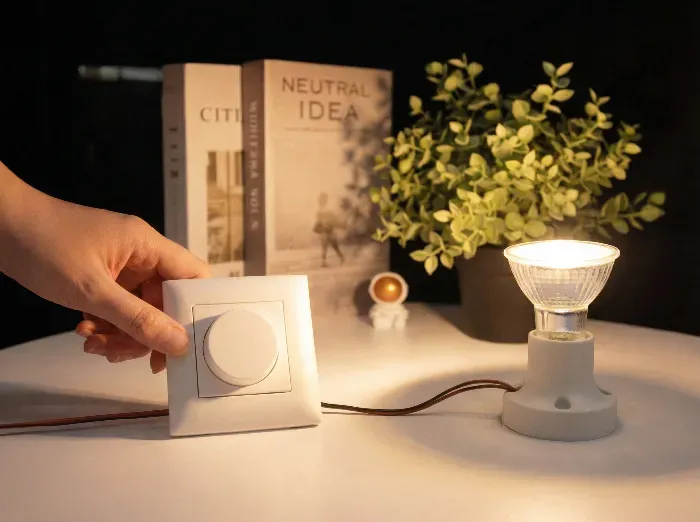
Person adjusting brightness using a rotary dimmer switch in a simple desk lamp setup, with neutral décor elements and soft ambient lighting in the background.
Despite its risks, Dimerização por TRIAC para lâmpadas LED is still viable in specific scenarios:
Suitable Applications
- Legacy hotel retrofits
- Residential-style commercial corridors
- Loads >10W per channel
- Budget-sensitive upgrades
Less Suitable Applications
- New-build smart buildings
- Large zoned commercial spaces
- Low-load distributed LED systems
- Sensitive medical environments
DOE retrofit studies show that reusing existing dimming infrastructure can reduce retrofit cost by up to 30% when compatibility is validated beforehand.
How to Specify TRIAC Dimming for LED Projects
To avoid compatibility failures, specifications should include:
| Specification Element | Recommended Requirement |
|---|---|
| Tipo de Dimerizador | Trailing-edge preferred |
| Minimum Load | ≥5W per channel |
| THD | <30% per IEC 61000-3-2 |
| Flicker Index | <0.08 per IEEE 1789 |
| Certificação | UL / ETL listed |
Example RFQ language:
“LED bulbs compatible with trailing-edge TRIAC dimming, tested per IEC 61000-3-2 and IEEE 1789 flicker limits.”
Clear specification reduces:
- Commissioning delays
- Warranty disputes
- Compatibility recalls
- Post-install labor costs
Business Impact of Poor TRIAC LED Compatibility
Failure to properly evaluate Dimerização por TRIAC para lâmpadas LED can result in:
- 15–20% rework cost overruns
- Increased maintenance visits
- Higher RMA rates
- Delayed occupancy certificates
- Reduced contractor reputation
Conversely, validated compatibility improves:
- System stability
- Lifecycle ROI
- Client satisfaction
- Repeat procurement rates
Conclusão
TRIAC dimming was designed for resistive incandescent loads—not electronic LED drivers. While Dimerização por TRIAC para lâmpadas LED can still function effectively in controlled retrofit scenarios, compatibility must be validated through proper testing, standard compliance, and dimmer-driver matching.
Trailing-edge dimmers significantly improve TRIAC LED compatibility, reducing flicker, noise, and driver stress. However, for large-scale commercial installations, alternative control systems may offer better scalability and long-term efficiency.
The key is not whether TRIAC dimming works—but whether it is properly engineered for LED systems.
If your project involves:
- Legacy TRIAC infrastructure
- Hospitality retrofits
- Mixed-load circuits
- Large-scale LED conversions
Our engineering team can simulate dimmer-driver interaction in-lab before mass production to verify Compatibilidade TRIAC LED and prevent costly site delays.
Contact us to review your load schedule and ensure your TRIAC dimming system performs reliably from day one.
Notas de rodapé
IEC 61000-3-2 – Limits for harmonic current emissions
https://webstore.iec.ch/en/publication/92799 ↩IEEE 1789-2015 – Flicker Recommendations for LED Lighting
https://standards.ieee.org/ieee/1789/4479/ ↩IEC 61547 – EMC Immunity Requirements
https://webstore.iec.ch/en/publication/67273 ↩