LED灯泡的TRIAC调光:兼容性、风险与商业应用
引言
在商业改造中,, LED灯泡的TRIAC调光 是调试延迟最常见的来源之一。许多酒店、办公室走廊和零售空间试图重复使用最初为白炽灯负载设计的传统TRIAC壁式调光器。然而,当这些调光器与现代LED驱动器配对时,结果往往是闪烁、可听噪音、低亮度时熄灭或驱动器过早失效。.
根据美国能源部(DOE)的说法,LED照明系统依赖于具有非线性电流特性的电子驱动器,这与电阻性白炽灯丝有根本区别。这种电气不匹配是大多数 TRIAC LED兼容性 问题的根本原因。.
理解TRIAC调光的工作原理及其适用场合,可以降低返工成本、保护分销商利润,并提高长期系统可靠性。.
什么是TRIAC调光?
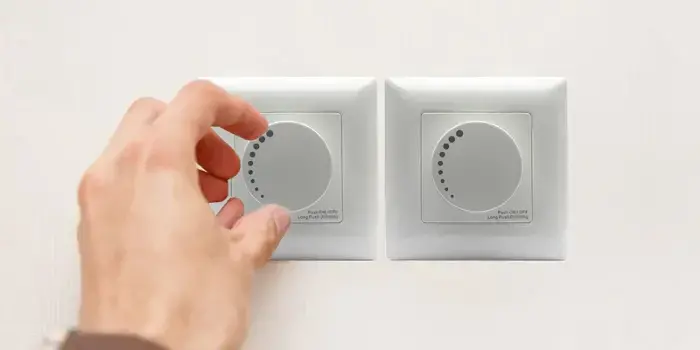
特写镜头:一只手正在调整安装在墙上的时尚白色调光开关的旋钮,突出直观且精确的光线控制。.
TRIAC调光(双向可控硅交流调光)是一种切相调光方法,通过截取交流波形的一部分来降低光输出。.
简而言之:
TRIAC调光通过缩短传递给负载的交流波形来降低亮度。.
主要有两种形式:
- 前沿(正向相位)
- 后沿(反向相位)
TRIAC切相调光的电气原理
在白炽灯系统中,功率遵循:
因为白炽灯泡表现为电阻性负载,降低RMS电压会直接按比例减少光输出。.
然而,LED灯泡并不表现为简单的电阻。它们包含开关模式电源(SMPS)、整流器、电容器,以及通常的功率因数校正(PFC)电路。这些组件对切相波形的响应方式不同。.
当TRIAC调光应用于LED驱动器时:
- 高dv/dt尖峰对输入电容器造成压力
- 浪涌电流可能超过5–10A峰值
- 总谐波失真(THD)显著增加
IEC 61000-3-2设定了照明设备的谐波电流限制,以保护电网稳定性1.
为什么TRIAC调光会导致LED闪烁
闪烁发生是因为TRIAC调光产生了不完整的交流周期。LED驱动器试图从不完整的正弦波重建直流输出,导致纹波电压。.
IEEE 1789-2015定义了LED照明的安全闪烁限制和调制阈值2.
| 参数 | 白炽灯负载 | LED驱动器负载 |
|---|---|---|
| 电流消耗 | 连续式 | 脉冲式、非线性 |
| 调光下的总谐波失真 | <5% | 可能达到100–200% |
| 纹波敏感性 | 低 | 高 |
| 闪烁风险 | 最小 | 在低调光水平下升高 |
低负载条件(每通道低于20W)在前沿TRIAC调光下尤其不稳定。.
前沿与后沿TRIAC调光
理解差异对于 LED灯泡的TRIAC调光.
| 特点 | 前沿TRIAC | 后沿TRIAC |
|---|---|---|
| 开关类型 | TRIAC半导体 | MOSFET / IGBT |
| 波形切割 | 上升沿 | 下降沿 |
| LED兼容性 | 有限 | Significantly better |
| Minimum Load | 20–50W typical | 5–10W typical |
| EMI Generation | 更高 | 降低 |
Trailing-edge dimming produces a smoother voltage transition (lower dv/dt), making it more compatible with capacitive LED driver inputs.
For most commercial LED retrofits, trailing-edge dimmers significantly reduce:
- Flicker complaints
- Audible buzzing
- Driver overheating
Measured Causes of Audible Noise in TRIAC LED Systems
Audible hum in LED灯泡的TRIAC调光 typically originates from:
- Magnetostriction in inductors
- High-frequency switching stress
- Harmonic current interactions
IEC 61547 addresses electromagnetic immunity for lighting equipment3.
| Noise Source | 原因 | Mitigation |
|---|---|---|
| Inductor vibration | 纹波电流 | Use ferrite shielding |
| Capacitor stress | High crest factor | Increase ESR stability |
| Commutation spikes | TRIAC switching | Add RC snubber circuit |
Testing in acoustic chambers at 50/60Hz significantly reduces RMA rates in hospitality projects.
Compatibility Testing Standards for TRIAC LED Systems
Reliable TRIAC LED兼容性 requires structured testing.
关键标准包括:
| Standard | 目的 | Key Metric |
|---|---|---|
| IEC 61000-3-2 | Harmonics control | THD limits |
| IEEE 1789 | Flicker safety | 调制深度 |
| UL 153 | Thermal safety | Temp rise <75°C |
| ENERGY STAR v2.1 | Dimming compatibility | Flicker & dropout control |
ENERGY STAR provides dimmer compatibility guidance for LED lamps.
Testing should include:
- 0–100% dimming sweep
- 1,000-hour cyclic stress test
- Voltage fluctuation simulation
- Dropout detection below 10% dim level
When Is TRIAC Dimming Still Suitable?
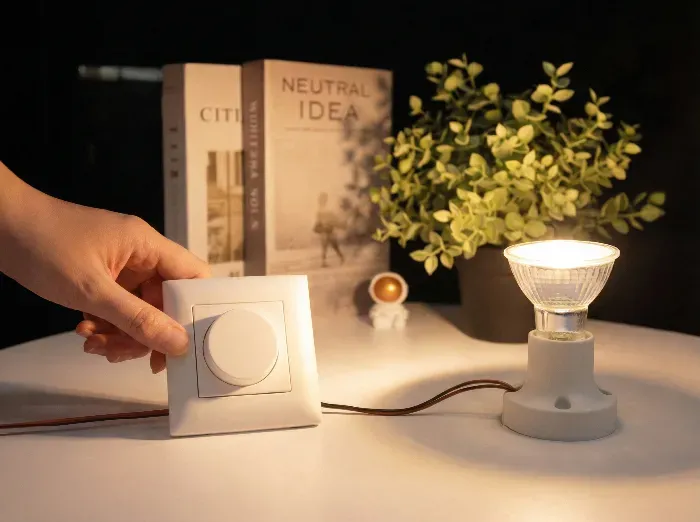
Person adjusting brightness using a rotary dimmer switch in a simple desk lamp setup, with neutral décor elements and soft ambient lighting in the background.
Despite its risks, LED灯泡的TRIAC调光 is still viable in specific scenarios:
Suitable Applications
- Legacy hotel retrofits
- Residential-style commercial corridors
- Loads >10W per channel
- Budget-sensitive upgrades
Less Suitable Applications
- New-build smart buildings
- Large zoned commercial spaces
- Low-load distributed LED systems
- Sensitive medical environments
DOE retrofit studies show that reusing existing dimming infrastructure can reduce retrofit cost by up to 30% when compatibility is validated beforehand.
How to Specify TRIAC Dimming for LED Projects
To avoid compatibility failures, specifications should include:
| Specification Element | Recommended Requirement |
|---|---|
| 调光器类型 | Trailing-edge preferred |
| Minimum Load | ≥5W per channel |
| THD | <30% per IEC 61000-3-2 |
| 频闪指数 | <0.08 per IEEE 1789 |
| 认证 | UL / ETL listed |
Example RFQ language:
“LED bulbs compatible with trailing-edge TRIAC dimming, tested per IEC 61000-3-2 and IEEE 1789 flicker limits.”
Clear specification reduces:
- Commissioning delays
- Warranty disputes
- Compatibility recalls
- Post-install labor costs
Business Impact of Poor TRIAC LED Compatibility
Failure to properly evaluate LED灯泡的TRIAC调光 can result in:
- 15–20% rework cost overruns
- Increased maintenance visits
- Higher RMA rates
- Delayed occupancy certificates
- Reduced contractor reputation
Conversely, validated compatibility improves:
- System stability
- Lifecycle ROI
- Client satisfaction
- Repeat procurement rates
结论
TRIAC dimming was designed for resistive incandescent loads—not electronic LED drivers. While LED灯泡的TRIAC调光 can still function effectively in controlled retrofit scenarios, compatibility must be validated through proper testing, standard compliance, and dimmer-driver matching.
Trailing-edge dimmers significantly improve TRIAC LED compatibility, reducing flicker, noise, and driver stress. However, for large-scale commercial installations, alternative control systems may offer better scalability and long-term efficiency.
The key is not whether TRIAC dimming works—but whether it is properly engineered for LED systems.
If your project involves:
- Legacy TRIAC infrastructure
- Hospitality retrofits
- Mixed-load circuits
- Large-scale LED conversions
Our engineering team can simulate dimmer-driver interaction in-lab before mass production to verify TRIAC LED兼容性 and prevent costly site delays.
Contact us to review your load schedule and ensure your TRIAC dimming system performs reliably from day one.
脚注
IEC 61000-3-2 – Limits for harmonic current emissions
https://webstore.iec.ch/en/publication/92799 ↩IEEE 1789-2015 – Flicker Recommendations for LED Lighting
https://standards.ieee.org/ieee/1789/4479/ ↩IEC 61547 – EMC Immunity Requirements
https://webstore.iec.ch/en/publication/67273 ↩