
Почему освещение в вашем отеле выглядит тусклым через 3 года?
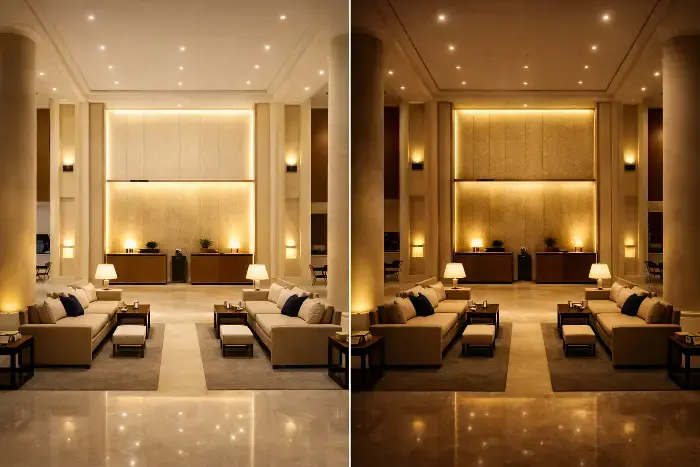
Современный вестибюль отеля показан при двух условиях освещения, контрастируя холодным дневным светом с тёплым, приветливым сиянием, чтобы подчеркнуть архитектурные детали и внутреннее убранство.
Во многих проектах освещения в сфере гостеприимства и коммерции проблема заключается не в отказе продукта — это неправильное указание срока службы.
Распространённые реальные проблемы включают:
- коридоры ниже требуемых уровней освещённости
- неравномерная яркость по зонам
- дорогая групповая замена ламп на высоких потолках
- рост затрат на обслуживание уже через 2–4 года
Основная причина часто проста:
Выбор неправильного значения L (L70, L80 или L90)
Быстрый ответ: Что выбрать?
| Сценарий | Рекомендуется | Почему |
|---|---|---|
| Отели / коридоры / высокие потолки | L70 | Самая низкая стоимость обслуживания, самый длительный срок службы |
| Рестораны / гостеприимство | L80 | Лучшая визуальная согласованность |
| Розничная торговля / люксовая витрина | L90 | Максимальная точность яркости |
Заключение:
Для более чем 80% коммерческих проектов, L70 — самый практичный выбор.
Что означают L70, L80 и L90?
Срок службы светодиодов определяется поддержание светового потока, а не отказ.
- L70 → осталось 70% яркости
- L80 → осталось 80% яркости
- L90 → оставшаяся яркость 90%
Это означает, что свет всё ещё работает, но постепенно тускнеет.
Как на самом деле выглядит поддержание светового потока с течением времени

Ключевой вывод
- L90 падает быстрее → короче номинальный срок службы
- L70 падает медленнее → дольше срок службы
Выглядит ли 70% яркости “тусклой”?
Важное понимание
Человеческий глаз воспринимает яркость логарифмически.
70% яркости НЕ выглядит на 30% темнее
Вот почему:
L70 стал мировым отраслевым стандартом
Реальная разница: L70 против L80 против L90
| Метрика | Сохранение яркости | Типичный срок службы | Влияние на стоимость |
|---|---|---|---|
| L90 | 90% | Shortest | Высокий |
| L80 | 80% | Средний | Средний |
| L70 | 70% | Longest | Lowest |
The Hidden Cost: Why L90 Is Not Always Better
Over-Specification Problem
Choosing L90 often leads to:
- higher fixture cost
- lower drive current (to reduce heat)
- more fixtures needed to meet lux levels
Lifecycle Cost Comparison (10-Year)
| Метрика | Initial Cost | Maintenance Cost | Total Cost |
|---|---|---|---|
| L90 | Высокий | Средний | Highest |
| L80 | Средний | Средний | Сбалансированный |
| L70 | Низкий | Низкий | Lowest |
Key B2B Insight
In high-ceiling projects, labor cost exceeds fixture cost.
This makes L70 the most economical choice.
3-Step Decision Tree (Fast Selection)
Step 1: Is visual perfection critical?
→ Yes → Choose L90
Step 2: Is maintenance difficult (high ceiling / large scale)?
→ Yes → Choose L70
Step 3: Need balance between cost and performance?
→ Choose L80
Why L70 Is the Industry Standard
1. Matches Real Maintenance Cycles
- hotels: 5–10 years
- offices: 3–7 years
2. Aligns with Lighting Standards
- EN / IES lux requirements
- ENERGY STAR baseline
3. More Realistic in Real Conditions
Real installations include:
- higher ambient temperatures
- enclosed fixtures
- dimming usage
LM-80 and TM-21: How Lifetime Is Calculated

Chart illustrating lumen maintenance curves for LED light output normalized to 1 at zero hours, showing how performance degrades at different operating temperatures over time.
Основная концепция
- LM-80 = measurement (real test data)
- TM-21 = projection (mathematical model)
The Rule of Six
Lifetime ≤ 6 × test duration
Пример:
- 10,000h test → max claim = 60,000h
- 6,000h test → max claim = 36,000h
Why Temperature (Ta) Matters More Than You Think

Key Rule
Every +10°C → lifetime drops ~50%
Critical Engineering Insight
All lifetime claims depend on ambient temperature (Ta).
If real installation temperature exceeds test conditions:
actual lifetime will drop significantly
Advanced Engineering Note
What Is L70B50?
- L70 = lumen level
B50 = 50% of samples meet the level
Industry standard = L70B50
Important Distinction
- LM-80 → LED package
- Real project → luminaire system
Includes:
- driver
- heatsink
- housing
Manufacturer Insight
As a manufacturer, we validate:
- LED package (LM-80)
- complete luminaire performance
- thermal + driver integration
Common Mistakes to Avoid
❌ L90 is always better
→ Not true (higher cost, shorter life)
❌ L70 means low quality
→ Not true (industry standard)
❌ Lifetime = working hours
→ Not true (it means brightness drop)
Final Selection Checklist
✔ What is the maintenance cycle?
✔ Is visual accuracy critical?
✔ What is the installation height?
✔ What is the ambient temperature (Ta)?
✔ Is dimming used?
✔ Is LM-80 ≥10,000h?
✔ Is TM-21 within 6× rule?
FAQ (Featured Snippet Ready)
What is L70 in LED lighting?
L70 means the LED produces 70% of its initial brightness and is the most common lifetime standard.
Is L90 better than L70?
Not necessarily. L90 provides higher brightness retention but shorter lifetime and higher cost.
Which LED lifetime is best for hotels?
L70 is typically the best choice for hotels due to lower maintenance and longer usable life.
Can I trust a 100,000-hour LED claim?
Only if LM-80 test data exceeds ~16,000 hours. Otherwise, it likely violates the Rule of Six.
Заключение
Choosing L70, L80, or L90 is not about selecting the highest number.
It is about selecting the right balance between performance, cost, and maintenance.
For most commercial and hospitality projects, L70 delivers the best long-term value.
For large-scale projects, we provide:
- LM-80 / TM-21 report verification
- thermal simulation
lifetime optimization recommendations
Send your project details to get a free lifetime evaluation report
 English
 French
 German
 Italian
 Spanish
 Portuguese
 Arabic
 Russian
 Japanese
 Chinese