What Is an Electronic Transformer? Working Principle, LED Compatibility & MR16 Applications
Последнее обновление: 3 марта 2026 г.
Electronic transformers are widely used in low-voltage lighting systems, especially for MR16 halogen and LED lamps. However, many installers and buyers misunderstand how they work — and more importantly, when they should or should not be used.
This guide explains:
- What an electronic transformer is
- How it works (high-frequency switching principle)
- Differences between electronic and magnetic transformers
- LED compatibility risks
- Minimum load requirements
- Dimming considerations
- Relevant safety standards
If you specify or install low-voltage lighting, understanding these factors can prevent flicker, overheating, and premature failure.
What Is an Electronic Transformer?

TECO electronic transformer housed in a white enclosure, displaying model information, a 6–30W power rating range, and multiple safety and compliance markings.
Это electronic transformer is a high-frequency power conversion device that steps down mains voltage (typically 110V or 220V AC) to low voltage (commonly 12V AC) for lighting applications.
Unlike traditional magnetic transformers, electronic transformers operate at high switching frequencies (typically 20 kHz–40 kHz), allowing them to be smaller and lighter.
According to the International Electrotechnical Commission (IEC), transformers used in lighting systems must comply with safety standards such as IEC 61558 (Safety of Transformers, Reactors, Power Supply Units)
Источник: https://webstore.iec.ch/publication/6109
How Does an Electronic Transformer Work?
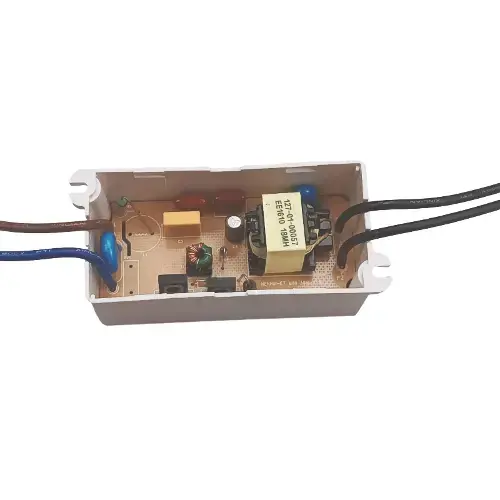
Open electronic module in a white housing, showing PCB components such as a transformer, capacitors, resistors, and wiring used for LED driver applications.
Electronic transformers use a high-frequency switching circuit instead of a heavy iron core.
Basic working steps:
- AC mains is rectified to DC.
- The DC is switched at high frequency (tens of kHz).
- A small ferrite transformer steps voltage down.
- The output delivers low-voltage AC suitable for halogen lamps.
Because they operate at high frequency, the transformer core can be significantly smaller than a traditional 50/60 Hz magnetic transformer.
Why High Frequency Matters
- Smaller size
- Lighter weight
- Higher efficiency
- Lower material usage
However, high frequency also introduces compatibility issues — especially with LED loads.
Electronic vs Magnetic Transformer: Key Differences
| Характеристика | Electronic Transformer | Magnetic Transformer |
|---|---|---|
| Рабочая частота | 20–40 kHz | 50/60 Hz |
| Size & Weight | Compact & lightweight | Larger & heavier |
| Minimum Load Requirement | Да | Usually No |
| Эффективность | Выше | Умеренный |
| Совместимость со светодиодами | Limited (depends on design) | Often more stable |
| Совместимость с регулировкой яркости | Must match dimmer type | More forgiving |
Magnetic transformers use laminated iron cores and operate directly at mains frequency. While heavier, they are often more tolerant of low-wattage LED loads.
Electronic Transformer vs LED Driver (Important Distinction)
Many people confuse electronic transformers with LED drivers.
They are NOT the same.
| Параметр | Electronic Transformer | Светодиодный драйвер |
|---|---|---|
| Output Type | 12V AC | DC (Constant Current or Constant Voltage) |
| Designed For | Halogen lamps | LEDs |
| Load Sensitivity | Высокий | Controlled |
| Flicker Risk with LED | Common | Minimal (if quality driver) |
Most electronic transformers were originally designed for halogen MR16 lamps — not LED retrofits.
For LED installations, a dedicated LED driver is generally the more stable solution.
Reference: U.S. Department of Energy – LED Driver Reliability
https://www.energy.gov/eere/ssl/led-driver-reliability
Minimum Load Requirement (Critical Issue)
One of the most common causes of flicker is the minimum load requirement.
Electronic transformers often specify a load range, for example:
20W – 60W
If the connected LED load is below the minimum threshold, the transformer may:
- Мерцание
- Shut down intermittently
- Produce audible noise
- Overheat
Halogen lamps naturally meet minimum load requirements. LED replacements often do not.
This is why replacing 50W halogen MR16 with 5W LED MR16 can cause instability when using old electronic transformers.
Why Do MR16 LEDs Flicker with Electronic Transformers?
Common causes:
- Insufficient load
- Incompatible dimmer
- High-frequency interference
- Non-stabilized output waveform
- Transformer designed for resistive load (halogen), not electronic load (LED)
IEEE Std 1789-2015 discusses flicker and modulation risks in lighting systems.
Источник: https://ieeexplore.ieee.org/document/7118618
Applications of Electronic Transformers
Electronic transformers are still widely used in:
- MR16 halogen track lighting
- Recessed low-voltage fixtures
- Display lighting
- Ландшафтное освещение
- Retail accent lighting
They are suitable when:
- Load meets minimum requirement
- Halogen lamps are used
- Compatible dimmers are installed
Совместимость с регулировкой яркости
Electronic transformers require compatible phase-cut dimmers.
Two main types:
- Leading-edge (TRIAC)
- Trailing-edge (ELV)
Using the wrong dimmer can cause:
- Buzzing
- Мерцание
- Ограниченный диапазон диммирования
Dimming compatibility must be verified at system level — transformer + lamp + dimmer.
When Should You Use an Electronic Transformer?
Use electronic transformer when:
✔ Operating halogen MR16 lamps
✔ Load meets minimum wattage
✔ Weight and size are critical
✔ Proper dimmer compatibility confirmed
Avoid electronic transformer when:
✘ Using low-wattage LED MR16 retrofits
✘ Deep dimming required
✘ Load varies frequently
✘ Stability is critical (hospitality / retail premium display)
In LED projects, constant-current or constant-voltage LED drivers are typically more reliable.
Safety & Compliance Considerations
Electronic transformers used in lighting systems should comply with:
- IEC 61558 (Transformer Safety)
- EN 61347 (Lamp Controlgear)
- Local electrical codes
Improper transformer selection can result in:
- Overheating
- Reduced lamp lifespan
- Electrical noise
- Safety risks
Часто задаваемые вопросы (FAQ)
Can I use an electronic transformer with LED MR16?
Sometimes, but only if:
- The LED load meets minimum requirement
- The LED is labeled “electronic transformer compatible”
- Dimming system is verified
Otherwise, an LED driver is safer.
What is the difference between electronic and magnetic transformers?
Electronic transformers operate at high frequency and are compact. Magnetic transformers operate at mains frequency and are heavier but often more stable with LED loads.
Why does my 12V LED flicker after replacing halogen?
Likely due to:
- Minimum load mismatch
- Dimming incompatibility
- High-frequency waveform instability
Are electronic transformers more efficient?
Generally yes, due to high-frequency operation and reduced core losses.
Заключение
Electronic transformers revolutionized low-voltage lighting by reducing size and improving efficiency. However, they were originally designed for halogen loads.
When used with modern LED retrofits, compatibility must be carefully evaluated — especially minimum load, dimming type, and waveform stability.
Understanding the difference between electronic transformers, magnetic transformers, and LED drivers is essential for reliable lighting system design.
Need Help Choosing the Right Power Solution?
If you are specifying MR16, GU10, or low-voltage LED lighting for commercial or retail projects, selecting the correct power solution is critical.
Teco supports B2B buyers with:
- MR16 compatible LED drivers
- Electronic transformer compatibility guidance
- Dimming system verification
- Engineering support before mass deployment
Tell us your load type, wattage, and dimming requirements.
We’ll help you choose a solution that works in the field — not just on paper.
Website: https://www.tecolite.com
Email: [email protected]