如何选择商业LED照明:完整分步指南
引言
选择商业LED照明不仅是挑选灯具和核对瓦数。在实际项目中,照明性能取决于整个系统:应用类型、目标照度、光束分布、色彩质量、眩光控制、调光兼容性、安装条件和供应商一致性。.
对于进口商、承包商和项目采购方而言,选择不当会直接带来商业风险。其结果往往是现场延误、重复调试、可见闪烁、调光故障、不舒适的视觉环境、客户投诉,以及灯具供应商、驱动供应商和控制供应商之间的保修纠纷。在酒店、走廊、大堂、零售空间和办公室等商业项目中,这些问题会迅速转化为返工成本和声誉损害。.
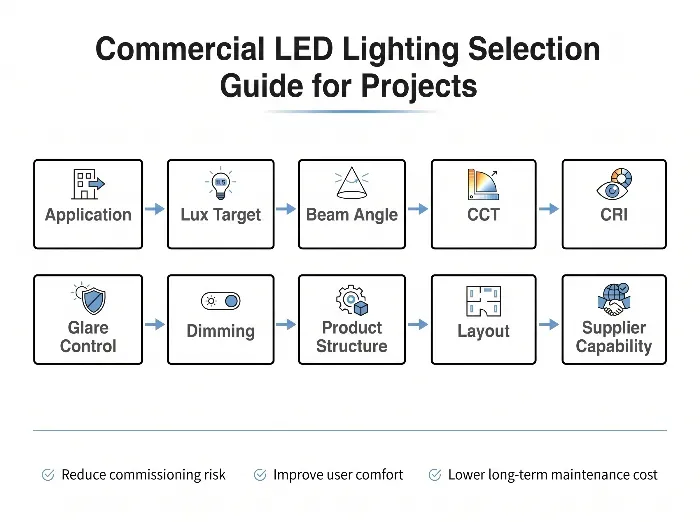
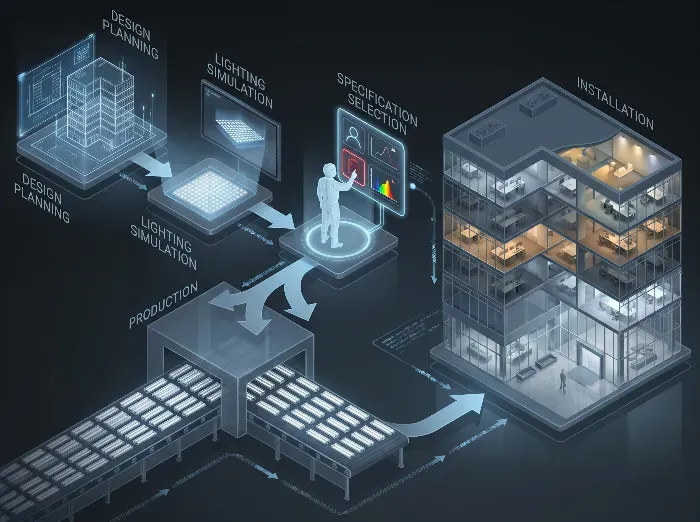
结构化的选择流程可降低这些风险。正确的路径是实用且有序的:定义应用场景、计算照明水平、选择光束角度、确认色彩性能、控制眩光、验证调光和控制功能、筛选产品、审查布局,并在购买前评估供应商的工程可靠性。.
执行摘要
商业LED照明应按顺序选择:应用场景、照度目标、光束角、色温、显色指数、眩光控制、调光性能、产品结构、布灯方案及供应商能力。此方法可降低调试风险、提升用户舒适度并减少长期维护成本。.
项目商业LED照明选型指南
1.简介
现场/商业现实
许多商业照明问题在安装前就已埋下隐患。错误的灯具常因仅基于单价或外观选择而非系统兼容性而被批准。产品到现场后,光束分布错误、眩光过高、调光不稳定或照度未达设计要求。此时修正成本高昂。.
深度解析与工程解决方案
商业LED照明决策应遵循技术工作流程,而非目录工作流程。正确的顺序是:
| 选择步骤 | 必须明确的要素 | 对维护/投资回报率的影响 |
|---|---|---|
| 应用 | 酒店、办公室、零售、走廊、大堂、餐厅 | 防止性能不足和重新设计 |
| 照明水平 | 目标照度1 按任务和空间 | 避免过度照明和能源浪费 |
| 光束角度 | 窄、中、宽配光分布 | 减少暗区与过量灯具数量 |
| 色温 / 显色指数 | 色温2 与色彩还原3 | 保障视觉舒适度与呈现品质 |
| 眩光 | 统一眩光值4 和截止控制 | 提升用户舒适度与合规性 |
| 调光性能 | 驱动器与调光器兼容性 | 减少闪烁、故障与返修需求 |
| 产品结构 | 热设计、光学系统、防护等级5 | 延长使用寿命并降低退换货率 |
| 供应商 | 批次一致性与检测规范 | 降低项目风险与售后纠纷 |
这种逐步推进的方法对处理多房间或多楼层项目的B2B买家尤为重要,微小的选择偏差会迅速放大影响。.
工厂备注
从制造角度看,最昂贵的错误通常不是某个缺陷部件,而是批准了整批产品的错误规格。交付后修正规格错误的成本,远高于提前验证照明系统。.
商业LED照明工程工作流程
2.商业LED照明为何重要
现场/商业现实
商业照明影响的不仅是可见度。它关乎宾客舒适度、零售展示效果、员工效率、安全感知与能源成本。在酒店及商业室内空间中,照明质量会被即刻感知,而照明故障则会被更快察觉。.
深度解析与工程解决方案
合格的LED解决方案必须平衡四项商业需求:
- 视觉表现
- 控制兼容性
- 安装实用性
- 全生命周期运营成本
低价产品常因仅优化初始采购价而失败。在许多项目中,这会导致频闪、调光曲线不佳、批次间色彩不一致及驱动器性能不稳定。这些问题在前台区域、宾客走廊、餐厅和会议空间中尤为明显。.
| 项目优先级 | 错误选择后果 | 商业影响 |
|---|---|---|
| 稳定调光 | Flashing, dropout, limited dimming range | Client complaints and commissioning delays |
| Low glare | Visual discomfort | Reduced occupant satisfaction |
| Color consistency | Visible mismatch between fixtures | Poor project finish quality |
| Reliable electronics | Early failures | Higher maintenance access cost |
| Correct optical distribution | Patchy lighting | More fixtures or redesign required |
工厂备注
In large hospitality projects, lighting quality is judged at the scene level, not the fixture level. Even if individual luminaires pass basic function tests, inconsistent beam quality, color shift, or dimming instability can still damage the final project result.
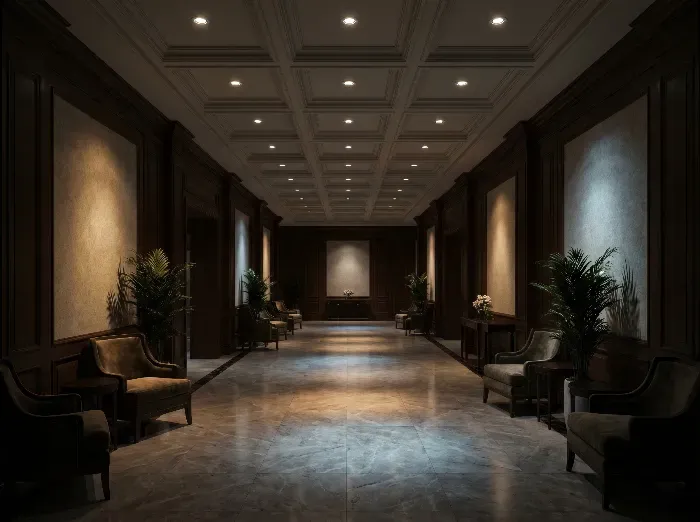
why commercial led lighting matters in hospitality and office projects
3.Step 1 – Identify Your Application
现场/商业现实
The same lamp cannot serve every commercial space effectively. A lobby, corridor, guest room, retail display, and back-of-house area each require different light distribution, glare control, color appearance, and control logic. If the application is not defined first, the rest of the selection process becomes guesswork.
深度解析与工程解决方案
Start by identifying the use case:
- 通用环境照明
- 重点照明
- 任务照明
- Decorative lighting
- Wet or semi-outdoor application
- Dimmable scene lighting
- 24/7 circulation area lighting
Typical examples:
| 应用 | Primary Requirement | Typical Selection Focus | 对维护/投资回报率的影响 |
|---|---|---|---|
| Hotel corridor | Uniformity, low glare, long operating hours | Wide beam, stable driver, dimmable if needed | Reduces maintenance frequency |
| Lobby | Layered scene effect, premium appearance | Dimming, high CRI, glare control | Improves client perception |
| Retail display | Product emphasis | Narrow beam, high CRI | Better merchandise presentation |
| 办公室 | 视觉舒适度 | UGR control, neutral CCT | Supports occupant comfort |
| Bathroom / humid area | Moisture resistance | Correct IP rating | Prevents premature failure |
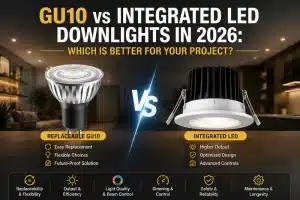
Where retrofit projects use GU10 lamps, compatibility with existing housings and dimmers must be checked early. This is particularly important when replacing halogen systems with LED alternatives.
工厂备注
During hotel commissioning, the biggest application error is treating decorative and functional lighting as the same category. They may share a cutout size, but their optical and control requirements are usually very different.
4. Step 2 – Define Lighting Levels (Lux)
现场/商业现实
If the lux target is too low, the space feels dim and underperforming. If it is too high, the project wastes energy, increases glare, and often creates an over-lit environment that feels harsh rather than premium.
深度解析与工程解决方案
Lux targets should be set according to the actual visual task and commercial environment, not by copying a generic wattage from a previous project.
Typical reference ranges:
| 空间类型 | 典型照度范围 | Selection Impact | 对维护/投资回报率的影响 |
|---|---|---|---|
| Hotel corridor | 100–150 lux | Balanced ambient lighting | Lower energy use |
| Lobby | 200–300 lux | Layered lighting recommended | Better guest experience |
| Restaurant | 150–300 lux | Often dimmable by scene | Flexible operation |
| Office work area | 300–500勒克斯 | Requires uniform distribution | Supports task visibility |
| Retail display | Depends on accent ratio | Beam angle becomes critical | Better visual merchandising |
Lux must be considered together with:
- 安装高度
- 光束角度
- Reflectance of wall and ceiling surfaces
- Fixture spacing
- Dimming strategy
A low-wattage lamp can still achieve the required lux if the beam and layout are correct. Conversely, a higher-wattage lamp can still fail if light is distributed inefficiently.
工厂备注
From a manufacturing perspective, many overpowered specifications are actually layout problems. When spacing and optics are not defined properly, buyers compensate by increasing wattage, which raises cost without solving visual quality.
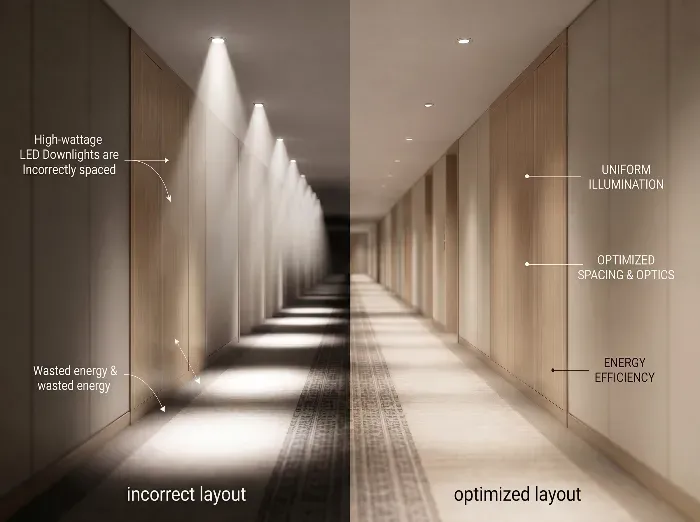
define commercial lighting lux levels correctly
5. Step 3 – Choose Beam Angle
现场/商业现实
Beam angle errors are among the most common causes of on-site dissatisfaction. A beam that is too narrow creates scalloping and hot spots. A beam that is too wide reduces emphasis and lowers useful illuminance at the target surface.
深度解析与工程解决方案
Beam angle selection should match the application, ceiling height, and spacing.
| 光束角度 | 最佳使用场景 | 限制 | 对维护/投资回报率的影响 |
|---|---|---|---|
| 15°–24° | Accent, artwork, retail highlighting | Too narrow for general lighting | Fewer fixtures for focal points |
| 36° | Mixed-use accent and ambient | Requires spacing review | Flexible for many applications |
| 60°+ | General lighting, corridors, low ceilings | Weak emphasis for displays | Better uniformity if layout is correct |
For GU10 and spotlight projects, beam quality matters as much as nominal angle. Two lamps both marked 36° may perform differently if the optic design, lens accuracy, and chip position are inconsistent.
A proper beam decision should consider:
- Target object or surface size
- Distance from luminaire to target
- Required contrast ratio
- Ceiling height and fixture spacing
- Whether the project prioritizes ambience or task visibility
For deeper explanation, this topic should be linked to the dedicated beam angle article.
工厂备注
From a manufacturing perspective, beam angle consistency is often overlooked in low-cost sourcing. On paper, the specification may match. In practice, optical variation between batches creates visible inconsistency across the ceiling.
6. Step 4 – Select CCT & CRI
现场/商业现实
Incorrect color temperature or low color rendering can make a commercial space feel uncomfortable, flat, or unnatural. This directly affects guest perception, retail presentation, and brand image.
深度解析与工程解决方案
CCT defines the visual warmth or coolness of the light. CRI indicates how accurately colors appear under that light source.
Typical guidance:
| 参数 | Typical Choice | Best Application | 对维护/投资回报率的影响 |
|---|---|---|---|
| 2700K | Warm, relaxed atmosphere | Hospitality, restaurants, guestrooms | Supports premium ambience |
| 3000K | Warm-neutral | Hotels, residential-style commercial areas | Common project standard |
| 4000K | Neutral white | Offices, retail, circulation areas | Functional and efficient |
| CRI 80 | Standard commercial use | General applications | Lower cost baseline |
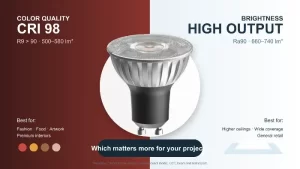
| CRI 90+ | Premium color rendering | Retail, hospitality, food presentation | Better visual quality |
Do not evaluate CCT and CRI independently. A hospitality project may prefer 2700K or 3000K, but if CRI is low, finishes and materials can still look dull. Likewise, high CRI without stable binning can lead to visible color inconsistency between luminaires.
工厂备注
In large hospitality projects, color consistency between production batches is often more important than chasing an aggressive paper specification. A stable 3000K with controlled batch variation usually performs better on site than an inconsistent premium claim.
7. Step 5 – Glare Control (UGR)
现场/商业现实
Glare complaints are common in offices, reception areas, and hospitality spaces with reflective finishes. Once glare becomes visible, it is difficult to solve without changing fixtures, accessories, or layout.
深度解析与工程解决方案
UGR is a practical indicator for visual discomfort. In commercial projects, glare is influenced by:
- Optic design
- Recess depth
- Shielding angle
- 安装高度
- Surface reflectance
- Viewing direction
A high-output fixture without proper shielding may meet the lux target but still fail the user experience.
| Glare Control Method | 益处 | 限制 | 对维护/投资回报率的影响 |
|---|---|---|---|
| Deep recessed source | Better visual comfort | May reduce output | Lower complaint risk |
| Honeycomb / louver | Reduces direct glare | Can reduce efficiency | Better occupant comfort |
| Wider fixture spacing with lower output points | More balanced field | Requires layout planning | Better overall lighting quality |
| Dedicated low-UGR optic | Strongest engineered solution | Higher product cost | Lower rework cost |
工厂备注
During hotel and office commissioning, glare is one of the most underestimated issues because it may not be obvious on the sample board. It becomes visible only after full installation, especially against polished stone, glass, or glossy finishes.
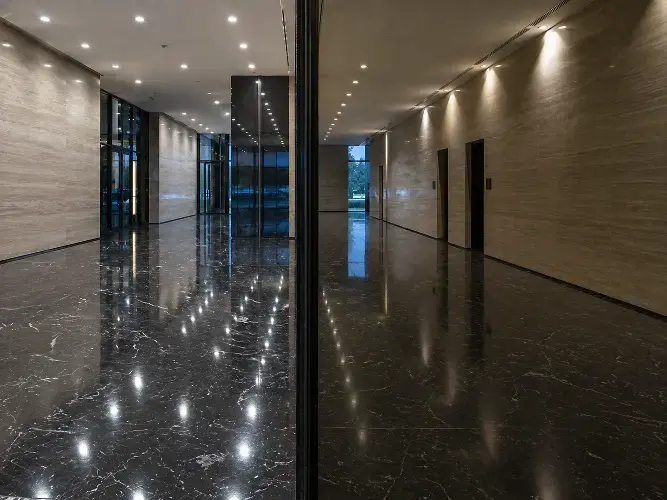
glare control ugr in commercial led lighting
8. Step 6 – Dimming & Smart Controls
现场/商业现实
Dimming is one of the highest-risk areas in LED projects. Many problems only appear after installation: lamps flashing at low level, limited dimming range, mismatch between channels, audible noise, or complete incompatibility with legacy dimmers.
深度解析与工程解决方案
LED loads behave very differently from halogen loads. Traditional dimmers were designed for higher-wattage resistive loads, while LED drivers are low-wattage and non-linear. This mismatch often causes instability unless the lamp driver and dimmer are tested as a complete system.
Common control options include:
| 控制类型 | 最佳使用场景 | Main Risk | 对维护/投资回报率的影响 |
|---|---|---|---|
| TRIAC | Retrofit, GU10 replacement, legacy systems | Compatibility varies by dimmer | Convenient if verified in advance |
| 0/1–10V | Commercial analog control | Extra wiring required | Stable in planned installations |
| DALI | Advanced scene and addressable control | Higher system complexity | Good for large projects |
| Wireless control | Retrofit and flexible zoning | Ecosystem compatibility | Lower rewiring cost |
For retrofit GU10 applications, dimming validation is essential. A lamp may dim perfectly on one dimmer and fail on another; review the dimmer compatibility troubleshooting guide before final specification.
工厂备注
From a manufacturing perspective, dimming compatibility cannot be assumed from datasheet labels alone. It must be verified through real dimmer-driver-lamp testing across the operating range, including startup, low-end dimming, and multiple units on one circuit.
9. Step 7 – Final Product Selection
现场/商业现实
At the final selection stage, buyers often compare only wattage, lumen output, and price. That is where many project problems begin. Two products with similar headline specifications can perform very differently in service life, compatibility, and visual result.
深度解析与工程解决方案
Final product selection should include the following checks:
- Correct cutout or lamp base compatibility
- Thermal design and heat dissipation
- 驱动器质量
- 频闪表现9
- Dimming validation
- Beam consistency
- CCT consistency
- Required IP rating
- Replaceability and service access
- Compliance documentation
| Product Checkpoint | 为何重要 | 对维护/投资回报率的影响 |
|---|---|---|
| Thermal structure | Protects LED and driver life | Lower failure rate |
| Low flicker design | Supports visual comfort | Fewer complaints |
| 驱动器质量 | Affects dimming and stability | Lower call-back risk |
| IP rating | Matches environment | Reduces premature failure |
| Replaceability | Easier service | 较低的人工成本 |
If the project includes bathrooms, covered outdoor areas, or humid zones, confirm the correct IP specification against the IP rating guide for LED lighting.
工厂备注
From a manufacturing perspective, early LED failures are often not caused by the LED package itself. They usually come from thermal stress, driver instability, or component variation that was not adequately screened during production verification.
10. Step 8 – Lighting Layout Basics
现场/商业现实
Even a good fixture can perform badly in a poor layout. Incorrect spacing, poor alignment, and mismatch between beam angle and ceiling height create dark zones, glare, or uneven brightness that the client notices immediately.
深度解析与工程解决方案
Basic layout review should include:
- 天花板高度
- Fixture spacing
- Distance from wall
- 光束角度
- 目标照度
- Uniformity requirement
- Accent-to-ambient ratio
A simple layout check before ordering can avoid costly on-site adjustment.
| Layout Factor | Common Error | Result | 对维护/投资回报率的影响 |
|---|---|---|---|
| Spacing too wide | Dark patches | More fixtures added later | Higher total cost |
| Spacing too tight | Over-lighting and glare | Energy waste | Poor visual comfort |
| Wrong wall offset | Uneven wall wash | Poor appearance | Rework risk |
| Same layout for all beams | Optical mismatch | Inconsistent lighting | Delayed commissioning |
工厂备注
During hotel commissioning, layout issues are often blamed on the fixture, while the real cause is spacing copied from a different beam angle or ceiling height. Layout and optics must be reviewed together.
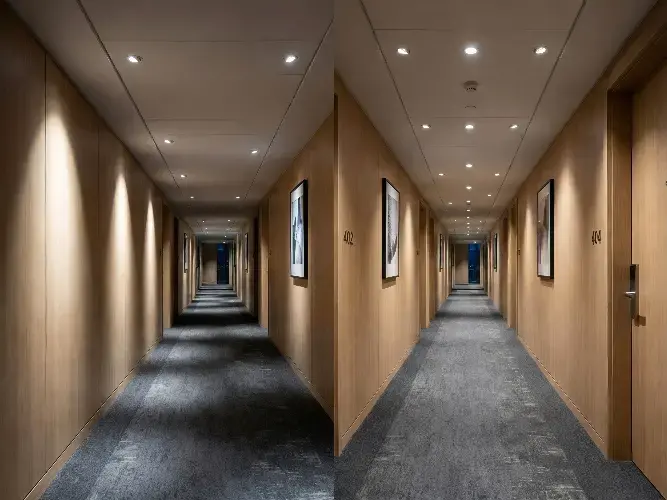
commercial lighting layout basics for led projects
11.Final Selection Checklist
现场/商业现实
Procurement teams often need a fast approval tool before placing an order. Without a checklist, key risks are missed, especially under project deadline pressure.
深度解析与工程解决方案
Use this shortlist before final approval:
| Checklist Item | Verified? | 对维护/投资回报率的影响 |
|---|---|---|
| Application defined clearly | Yes / No | Prevents wrong product category |
| Lux target confirmed | Yes / No | Avoids over- or under-lighting |
| Beam angle matched to layout | Yes / No | Reduces visual defects |
| CCT and CRI approved | Yes / No | Protects project appearance |
| Glare control reviewed | Yes / No | Improves user comfort |
| Dimming/control compatibility tested | Yes / No | Reduces commissioning failure |
| IP requirement checked | Yes / No | Avoids environmental failure |
| Flicker performance reviewed | Yes / No | Supports comfort and compliance |
| Sample approved from production-standard batch | Yes / No | Reduces batch mismatch |
| Supplier test capability reviewed | Yes / No | Lowers after-sales risk |
工厂备注
From a manufacturing perspective, the safest sample is not a hand-built engineering sample. It is a sample that represents actual production materials, driver version, and assembly process.
12. Recommended Solutions
现场/商业现实
Different project types require different product priorities. A universal recommendation is rarely reliable for B2B procurement.
深度解析与工程解决方案
Recommended direction by scenario:
| Project Type | Recommended Focus | Typical Product Direction | 对维护/投资回报率的影响 |
|---|---|---|---|
| Hotel retrofit | Dimming compatibility, warm CCT, low glare | Dimmable GU10 or retrofit downlight | Lower rewiring cost |
| New-build hospitality | Scene control, color consistency, premium finish | Dedicated dimmable downlight system | Better guest experience |
| 办公室 | UGR control, 4000K, stable driver | Low-glare downlight or panel | Better comfort and productivity |
| Retail | High CRI, controlled beam angles | Accent spotlight system | Better merchandise presentation |
| Humid areas | Correct IP grade, stable sealing | IP-rated downlight | Longer service life |
For retrofit lamp-based projects, a verified GU10 dimmable solution is often the practical path when existing infrastructure must be retained.
工厂备注
In large hospitality renovations, keeping the existing control infrastructure can save substantial cost, but only if LED lamp compatibility is tested in advance rather than assumed.
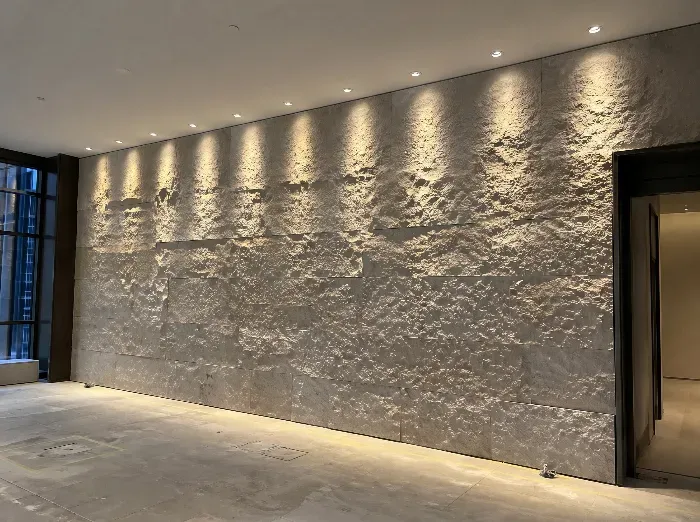
recommended commercial led lighting solutions by application
13. Common Mistakes to Avoid
现场/商业现实
Most commercial lighting failures come from predictable decision errors rather than random defects.
深度解析与工程解决方案
常见错误包括:
- Buying on wattage alone
- Ignoring beam angle
- Choosing CCT without reviewing material finishes
- Using dimmable lamps without dimmer validation
- Overlooking flicker performance
- Failing to check IP requirements
- Approving non-representative samples
- Choosing suppliers with unstable batch control
- Treating all commercial spaces with one lighting rule
| 错误 | Immediate Outcome | Longer-Term Cost Impact |
|---|---|---|
| Lowest-price sourcing only | 性能不稳定 | Higher replacement and complaint cost |
| No dimming test | Flashing or dropout | Commissioning delay |
| 错误的光束角度 | Uneven lighting | Re-layout or re-order |
| No supplier audit | Batch inconsistency | Higher RMA and reputational risk |
工厂备注
From a manufacturing perspective, the phrase “same as last time” is risky unless the BOM, driver version, LED bin, and optical parts are all controlled. Small changes in components can produce large differences on site.
14. How to Choose a Reliable Supplier
现场/商业现实
A supplier is not reliable because the sample looks good. Reliability is proven by process control, technical response speed, compatibility knowledge, and batch consistency.
深度解析与工程解决方案
A dependable commercial lighting supplier should provide:
- Production-standard samples
- Dimming compatibility guidance
- Batch consistency control
- Aging and burn-in verification
- Flicker and electrical performance data
- Clear warranty responsibility
- Stable communication during project execution
- Ability to review layout and application requirements
| Supplier Evaluation Point | What to Ask | 对维护/投资回报率的影响 |
|---|---|---|
| Batch control | How is color and driver consistency managed? | Lower mismatch risk |
| Dimming support | Which dimmers have been tested? | Fewer site issues |
| Quality verification | Is aging or burn-in done before shipment? | Lower early failure rate |
| Technical support | Can they review application and load schedule? | Better system fit |
| Complaint handling | Who takes responsibility for compatibility issues? | Faster resolution |
工厂备注
From a manufacturing perspective, the most useful supplier is the one that identifies project risk before shipment, not the one that only responds after failure occurs on site.
15. Review Your Project Requirements
现场/商业现实
Commercial lighting selection becomes difficult only when key decisions are made out of sequence. When application, lux, beam angle, color quality, glare, control method, product structure, and supplier capability are reviewed step by step, project risk drops significantly.
深度解析与工程解决方案
The most effective selection path is clear:
application → lighting level → beam angle → CCT/CRI → glare control → dimming/control system → product selection → layout review → supplier verification
This method helps reduce:
- Installation errors
- Dimming incompatibility
- Visual discomfort
- Excess energy use
- Warranty disputes
- Long-term maintenance cost
If your project involves GU10 retrofit lamps, dimming compatibility, beam angle selection, or IP-rated applications, review these related technical pages before approval:
- Dimmable GU10 LED bulb guide
- Dimmer compatibility troubleshooting guide
- Beam angle guide for LED spotlights
- IP rating guide for LED lighting
For a project-specific review, contact the Tecolite team with the application, control method, mounting conditions, and required IP rating.
工厂备注
During hotel commissioning, the projects that run smoothly are usually not the ones with the cheapest fixture. They are the ones where the system was verified before ordering.
结论:商业价值
A step-by-step commercial LED lighting selection process improves reliability, reduces commissioning issues, lowers maintenance effort, and controls lifetime system cost. For B2B buyers, the goal is not only product performance but predictable project delivery with stable batch quality and verified control compatibility.
B2B工程建议
对于有特定调光需求的大型项目,请索取负载计划表。Teco工程团队将在量产前通过实验室系统模拟验证兼容性。.
脚注
Lux is the unit of illuminance, indicating how much light falls on a surface. ↩
CCT, or correlated color temperature, describes whether light appears warm, neutral, or cool. ↩
CRI, or color rendering index, measures how accurately a light source reveals object colors compared with a reference source. ↩
UGR, or unified glare rating, is a standard method used to assess visual discomfort caused by glare. ↩
IP rating, or ingress protection rating, indicates resistance to dust and water penetration. ↩
TRIAC or phase-cut dimming reduces light output by cutting part of the AC waveform. ↩
0/1–10V dimming controls light output through a low-voltage analog signal. ↩
DALI is a digital addressable lighting control protocol used in commercial systems. ↩
Flicker is the rapid variation of light output over time, which can affect visual comfort and perceived quality. ↩