GU4与GU5.3 LED灯泡:引脚间距对比、MR11与MR16规格差异、电压兼容性及灯具适配指南
更新于:2026年9月4日
GU4和GU5.3是两种不同的两针灯座,它们不可互换。. GU4通常与较小的MR11灯一起使用,而GU5.3通常与12V MR16灯一起使用。更换前,请检查引脚间距、反射器尺寸、电压、变压器或LED驱动器兼容性、亮度要求以及可用灯具深度。.
| 基地 | 典型灯具 | 引脚间距 | 常见风险 |
|---|---|---|---|
| GU4 | MR11 | 约4毫米 | 灯具空间小且流明输出较低 |
| GU5.3 | MR16 | 约5.3毫米 | 变压器最小负载和调光稳定性 |
请勿将GU4灯强行插入GU5.3灯座,或将MR11与MR16视为相同替代品。对于B2B订单,请在样品确认前发送灯座照片、灯具标识、变压器型号及目标数量。.
在照明设计的大背景下,选择正确的低压射灯灯头似乎是一个小决定。但对于批发商、照明品牌和商业项目规划者来说,在 GU4 和 GU5.3 是一个具有实际影响的选择——影响安装兼容性、亮度水平、维护周期、采购成本,最终影响被照明空间的体验。.
虽然两者都是用于低压灯具的12伏双针灯头,, GU4 和 GU5.3 在当今照明市场中,它们服务于截然不同的目的。其机械结构、热行为、亮度能力以及典型应用之间的差异,远比许多买家所意识到的要大。由于您的目标客户依赖可靠、一致且易于长期更换和维护的照明,理解这些差异对于避免代价高昂的错误至关重要。.
本文从工厂层面提供了关于 GU4 和 GU5.3 灯具对比——从技术、商业、光学和操作层面。它还解释了每种类型设计用于何种灯具,以及照明专业人士在实际项目中应如何选择。.
理解技术定义:GU4与GU5.3对比

最基本的区别在于引脚间距:
这种间距是不可互换的。使用一种灯头的灯具无法插入为另一种设计的灯座,原因如下:
- 灯座宽度不同。.
- 灯体深度和直径不同。.
- 灯座内部的机械固定结构不同。.
在大多数情况下,通常,, GU4 灯头与紧凑的MR11(35毫米)外形规格配对,而 GU5.3 灯头最常与较大的MR16(50毫米)外形尺寸相关联。这种尺寸关系解释了几乎所有的下游差异——亮度、热管理、光学和应用领域。.
CIE关于灯和反射器定义的参考: https://cie.co.at
尺寸与外形规格:为何物理尺寸比买家预想的更重要

GU4(MR11)灯具远比GU5.3(MR16)灯具小巧轻便:
15毫米的差异看似微小,但在照明工程中却显著影响:
• 散热能力
小型灯具表面积有限,难以散热。如果结温未得到控制,LED会迅速退化。这就是为什么GU4 LED很少超过3-4瓦。.
• 光学元件可用空间
GU5.3反射器和透镜可以更精确地塑造光束,并支持更广的波束角范围。.
• 驱动电路空间
更大的灯体允许使用更强大的恒流驱动器,从而提高稳定性和使用寿命。.
• 与商业灯具的兼容性
许多建筑筒灯、轨道灯头和重点照明灯具是专门围绕MR16外形尺寸设计的。.
这是两个系统之间的第一个主要区别:
GU4用于空间受限的场合;GU5.3用于性能至关重要的场合。.
光学工程:光束角度、光分布和显色性

GU4和GU5.3灯具的光学设计因其物理几何形状而有显著差异。.
GU4(MR11)光学特性
- 更小的反射器面积 → 光束更集中
- 通常提供于 15°–35° 光束
- 更适合小型重点照明点、展示柜、珠宝照明
- 先进扩散器或防眩光结构的安装空间有限
GU5.3(MR16)光学特性
- 更大的反射器 → 容纳 窄光束、中等光束和宽光束 (15°/24°/36°/60°)
- 兼容先进TIR透镜和镀膜反射器
- 更好的中心光束强度
- 更均匀的分布,适用于一般商业照明
对于零售店或酒店走廊等商业空间,GU5.3光学元件提供的视觉舒适度和分布均匀性是GU4无法比拟的。.
电压与驱动器考量:理解12V系统行为
两者 GU4 和 GU5.3 灯具工作于 12伏低压系统, ,但买家理解变压器兼容性如何影响性能至关重要。.
现场使用的变压器类型
- 磁性变压器 (与大多数LED兼容)
- 电子卤素变压器 (通常与LED不兼容)
- LED恒压驱动器 (推荐用于现代安装)
实际项目中的常见问题
- 欠载导致的闪烁
- 高频输出引起的嗡嗡声
- 当变压器最小负载未满足时无法开启
- 因电压不稳定导致的早期LED性能下降
对于大规模安装(酒店、餐厅、商场),使用 LED专用驱动器 显著提升可靠性。.
低压照明系统的IEC标准: https://www.iec.ch
热工设计:热量决定寿命与稳定性
热管理是LED灯泡中最关键的工程挑战之一。. GU4 和 GU5.3 在此处差异显著:
GU4
- 微型散热器
- 小型灯具内气流受限
- 热量迅速积聚
- 典型功率: 1.5W–3.5W
- 随时间推移颜色偏移的风险更高
GU5.3
- 更大的铝制或复合散热器
- 在大多数灯具中更好的气流
- 支持 5W–7W 或更多
- 远更长的稳定寿命(当设计得当时)
This is why most lighting designers choose GU5.3 for general illumination in commercial spaces.
ENERGY STAR data on LED thermal performance: https://www.energystar.gov
Brightness and Efficiency: GU5.3 Is the Clear Winner

Because GU5.3 lamps support higher wattage and better thermal design, they deliver significantly higher brightness.
Typical commercial LED lumen outputs:
| 类型 | Typical Lumen Output | 效率 |
|---|---|---|
| GU4 (MR11) | 150–300 lm | 45–70 lm/W |
| GU5.3 (MR16) | 350–650 lm | 70–95 lm/W |
The difference is not minor. It determines whether a fixture can serve as:
- General illumination
- 重点照明
- High-intensity spot lighting
- Retail product highlighting
For most commercial applications, GU5.3 provides the necessary visual performance.
GU4 vs GU5.3: Comparison of Compatible Fixtures)
Different lamp bases require different fixture types. This is a critical difference often overlooked by buyers.
GU4-Compatible Fixtures
Because GU4 lamps are smaller, they are used in fixtures requiring compact design:
- 展示柜 (museum displays, jewelry stores)
- Under-cabinet lights
- Mini spotlight fixtures
- Micro track lights
- Furniture-integrated lighting
- Small showcase downlights
Characteristics of GU4 fixtures:
- Very small beam focus
- Lightweight and compact
- Limited heat dissipation space
- Usually used at eye-level or close-range illumination
- Low installation depth
GU5.3-Compatible Fixtures
GU5.3 lamps are compatible with significantly more fixture categories:
- Architectural downlights
- Office spotlights
- Hotel ceiling fixtures
- Retail track lighting
- Restaurant general illumination
- Recessed ceiling fixtures
- Landscape lighting (12V)
Characteristics of GU5.3 fixtures:
- Larger housings allow robust heat management
- Better anti-glare design (baffles, reflectors)
- Wider range of beam angles
- Designed for long operating hours
Compatible with dimming systems used in commercial lighting
Key Insight for B2B Buyers:
Fixture availability strongly favors GU5.3, making it easier to use for new construction, renovations, and large-scale commercial upgrades.
Real-World Applications: When to Choose GU4 vs GU5.3
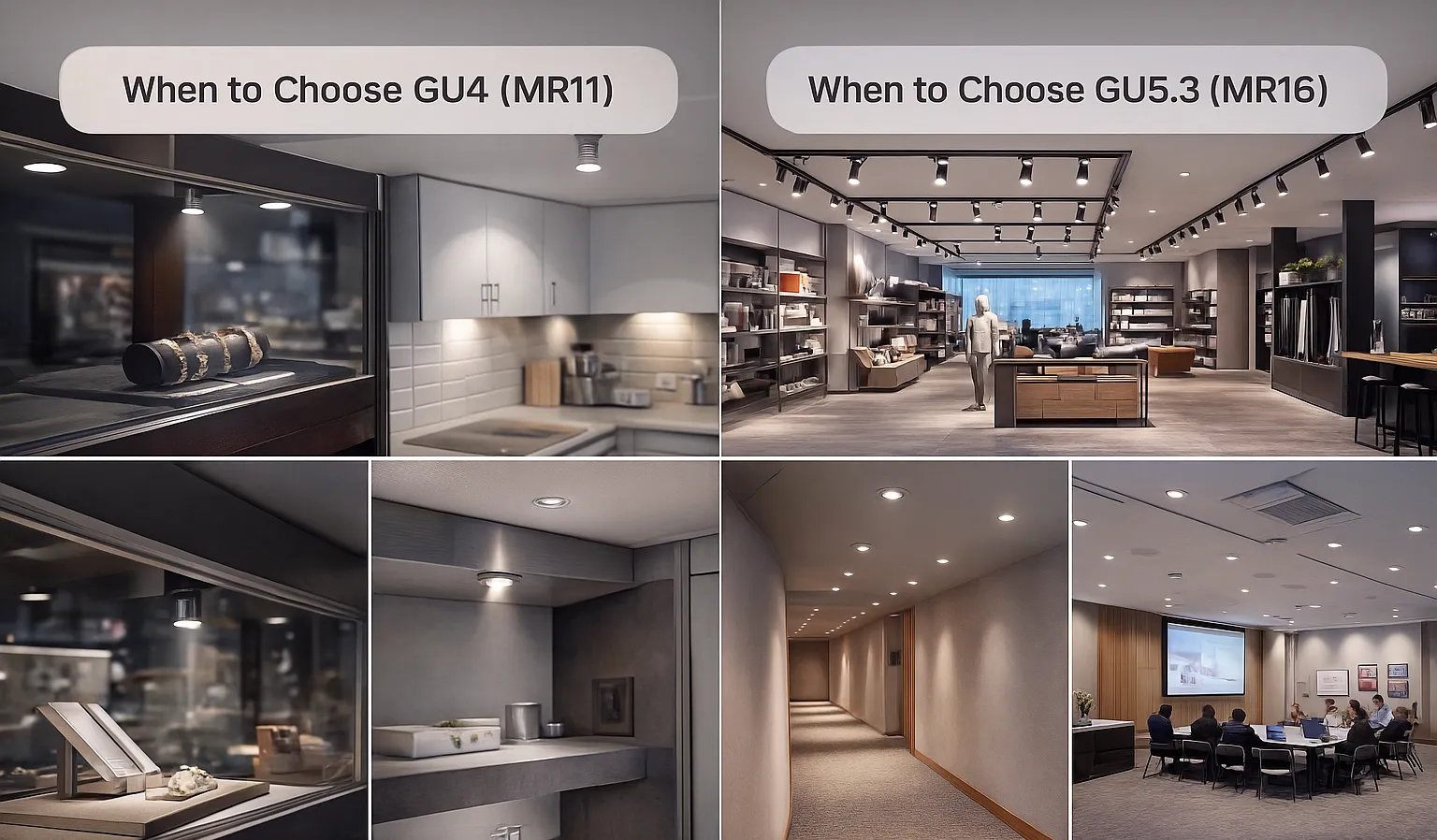
Choose GU4 when:
- Space is extremely limited
- Precision accent lighting is required
- Light must be integrated into furniture or displays
- Illumination distance is short
- Brightness requirements are modest
Choose GU5.3 when:
- The installation involves ceilings or track lights
- Light must reach medium to long distances
- Brightness is important
- Dimming performance matters
- Fixtures require heat management
- Project scale is large (hotel, retail chain, office renovation)
Commercial Buyer Considerations: Cost, Availability, and Supply Chain
Market Demand
Supply Chain Stability
- GU5.3 has more mature tooling, higher-volume chip matching, and optimized production lines.
- GU4 often requires semi-custom assembly.
Cost Factors
- GU5.3 is cheaper due to economies of scale.
- GU4 costs more per lumen and per unit due to smaller market size.
Inventory Risk
- Wholesalers stocking GU5.3 move units faster.
- GU4 sells more slowly but has steady demand in specialty markets.
Common Mistakes Buyers Make (and How to Avoid Them)
- Assuming GU4 和 GU5.3 are interchangeable
- Using halogen electronic transformers with LED replacements
- Ignoring fixture size or heat constraints
- Choosing too small a lamp (GU4) for general illumination
- Only comparing wattage rather than lumen output
- Not confirming compatibility with existing dimmers
- Buying non-branded drivers to save cost (reduces lifespan)
Practical Recommendation: Which Base Should You Choose?
对于 most commercial projects, GU5.3 is the reliable, versatile, cost-efficient choice.
对于 small-scale, precision, cabinet, or furniture lighting, GU4 is the right choice.
For wholesalers and lighting brands:
- Primary inventory → GU5.3
- Supplementary inventory → GU4 for professional/retail niche markets
For contractors and project planners:
- Always verify the original fixture type
- Ensure transformer/driver compatibility
- Choose GU5.3 when in doubt
结论
GU4 和 GU5.3 both serve important roles in modern lighting, but they are designed for entirely different environments. GU4 excels in compact, close-range accent lighting where space is limited. GU5.3 dominates commercial architectural lighting because of its superior brightness, optics, thermal stability, and compatibility with a wide range of fixtures.
Understanding these distinctions helps lighting brands plan better product assortments, helps wholesalers maintain more efficient inventory, and helps contractors avoid installation headaches that slow down projects.
If you’re looking for reliable, high-quality GU4 or GU5.3 LED solutions—custom branding, dimmable options, high-CRI models, or specialized commercial beam angles—I can help.
Contact:
[email protected]
https://www.tecolite.com
Let’s build a product lineup and supply chain that supports your business growth across every lighting application.