如何为商业及酒店项目选择可调光LED系统(避免闪烁与驱动器故障)
最后更新于 2026 年 3 月 2 日
为何可调光LED项目在安装后出现问题?
许多酒店、办公室和零售项目在启用后不久即出现LED闪烁、调光范围有限、可闻嗡嗡声甚至驱动器故障。.
在大多数情况下,LED本身并非问题所在。.
真正的问题是系统不匹配。.
可调光LED技术不仅是产品功能,更是以下要素之间的相互作用:
- LED光源
- LED驱动器
- 调光器或控制协议
- 电气负载与布线环境
当这些要素未被指定为协调系统时,不稳定性便成为可预见的结果。.
对于商业和酒店业采购者而言,理解可调光LED的兼容性比单纯选择“可调光”产品更为重要。.
本指南解释可调光LED系统的工作原理、闪烁产生的原因,以及如何指定在实际项目中表现稳定的可靠解决方案。.
什么是可调光LED技术?

可调光LED照明设置的示意图,展示LED光源连接至驱动器、调光控制器及周边电气环境。.
可调光LED技术允许照明输出平滑调节——通常从100%降至1–10%——无可见闪烁、噪音或颜色不稳定。.
与卤素灯不同,LED在电压下降时不会自然变暗。LED是电流驱动设备,意味着亮度必须通过驱动器电子控制。.
这使得驱动器质量和调光器兼容性至关重要。.
功能性可调光LED系统包含四个相互依存的组件:
| 组件 | 角色 | 不匹配的风险 |
|---|---|---|
| LED光源 | 发光 | 色偏、不稳定 |
| LED驱动器 | 调节电流 | 闪烁、熄灭、故障 |
| 调光器/控制器 | 发送控制信号 | 兼容性问题 |
| 电气环境 | 负载、布线、电压 | 噪声与不稳定 |
任一环节故障都会影响整个系统。.
TRIAC、0–10V、DALI:哪种调光方式最佳?
最常见的规格误区之一是假设所有调光方法表现相同。.
它们无法实现。.
相位切割(TRIAC)调光
- 常见于改造项目
- 利用现有交流布线
- 对低负载条件敏感
- 大多数闪烁投诉源于此处
当驱动器专门设计并测试兼容性时,TRIAC调光效果良好。然而,混用不同品牌常导致不稳定。.
后沿(ELV)调光
- 比前沿调光更LED友好
- 更低可闻噪音
- 低亮度下稳定性更佳
0–10V调光
- 常见于商业系统
- 线性稳定控制
- 需要额外控制布线
DALI(数字可寻址照明接口)
- Used in smart buildings
- Addressable, programmable control
- Higher system complexity
Internal PWM Control
High-quality drivers use high-frequency PWM (pulse-width modulation) internally to regulate output.
Drivers operating above 1 kHz significantly reduce visible flicker.
The correct dimming method depends on the application scale, wiring conditions, and project budget — not on trend or marketing claims.
High-frequency PWM dimming significantly reduces visible flicker.
Why Do Dimmable LEDs Flicker?
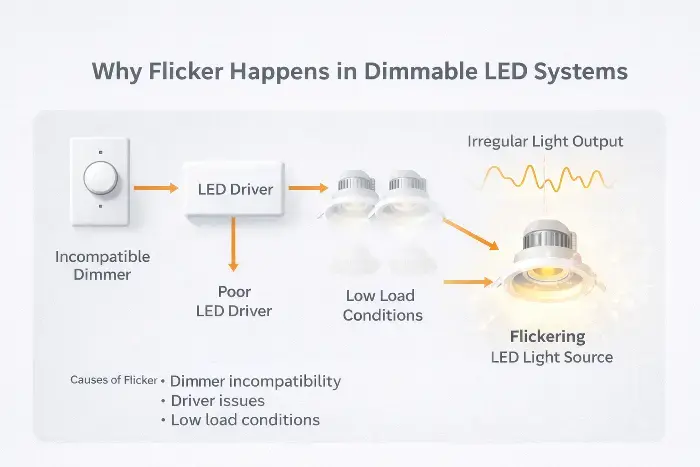
Infographic illustrating why flicker occurs in dimmable LED lighting systems, highlighting dimmer incompatibility and low-load conditions that lead to unstable light output.
Flicker is the most frequent complaint in commercial dimming installations.
According to IEEE flicker guidelines, visible modulation can cause eye strain, headaches, and reduced productivity in commercial environments.
Flicker is rarely random. It usually results from one of these conditions:
| 原因 | Why It Happens |
|---|---|
| 调光器不兼容 | Dimmer not designed for LED loads |
| Low load conditions | Too few fixtures per dimmer |
| Poor driver design | Weak current regulation |
| Missing neutral wiring | Unstable control reference |
| Electrical interference | Noise from HVAC or heavy equipment |
In retrofit hospitality projects, low load is especially common. Dimmers originally designed for 200W halogen circuits may struggle when driving only 30W of LED load.
The result is unstable dimming behavior at lower levels.
Learn more about IEEE flicker measurement standards in our LED flicker technical guide.
The LED Driver: The Most Critical Component
More than half of field failures in LED luminaires are related to driver issues rather than LED chips.
A high-quality dimmable LED driver determines:
- Minimum stable dimming level
- Smoothness of dimming curve
- 频闪表现
- Thermal stability
- Batch consistency
Key characteristics of reliable dimmable drivers include:
- 1–100% dimming capability
- High-frequency PWM control
- 热保护
- Verified dimmer compatibility lists
- Controlled component sourcing
For commercial buyers managing repeat projects, driver consistency between production batches is essential to avoid re-testing costs.
LED driver reliability plays a major role in commercial failures.
Color Stability Under Dimming: Often Overlooked
Brightness control is not the only concern.
Low-quality dimmable LEDs often show:
- Color temperature shift
- Reduced CRI performance
- Uneven output between fixtures
In hospitality environments, this directly affects guest perception.
Fixed CCT dimmable LEDs typically remain stable when paired with high-quality drivers. Tunable white systems offer greater flexibility but require more advanced control logic.
When specifying dimmable LED systems for hotels or premium retail, color behavior under low dimming levels should be verified — not assumed.
How Much Energy Do Dimmable LEDs Really Save?
Energy savings are often overstated in marketing.
In practical commercial environments, dimmable LED systems combined with occupancy or daylight sensors typically reduce lighting energy use by 20–40%.
However, the larger financial advantage often comes from:
- Reduced thermal stress
- Longer driver lifespan
- Lower maintenance frequency
- Improved user comfort
Over a 10-year lifecycle, well-specified dimmable systems often deliver lower total cost of ownership compared to non-dimmable alternatives — especially in high-usage environments like hotels and conference spaces.
Common Specification Mistakes in Commercial Projects
Many dimming issues originate during specification, not installation.
1. Asking “Is It Dimmable?” Without Defining Conditions
Dimmable for which dimmer?
At what load?
Down to what minimum level?
Without this clarity, instability is likely.
2. Ignoring Circuit Load Calculations
LED loads behave differently from halogen loads. Dimmer minimum load thresholds must be respected.
3. Allowing Driver Substitution
Uncontrolled driver changes between production batches can create inconsistent dimming behavior.
4. Over-Specifying Simple Areas
Not every space requires deep dimming or tunable white systems. Complexity increases risk if not justified.
Practical Buyer Checklist for Reliable Dimmable LED Projects
Before confirming orders, commercial buyers should verify:
- Which dimmers are used on-site?
- What is the minimum stable dimming level?
- How many fixtures per circuit?
- Has flicker been measured?
- Are drivers locked for repeat orders?
- Is documentation available for compliance?
Professional suppliers should provide test reports and compatibility lists — not generic “dimmable” claims.
Where Dimmable LED Technology Makes the Most Sense

Visual showcase of dimmable LED technology enhancing atmospheres in hotels, restaurants, event spaces, and retail environments through soft, adjustable lighting.
High-Value Applications
- Hotels and hospitality
- Restaurants and lounges
- Meeting and conference rooms
- Retail display environments
- 住宅开发项目
Lower Priority Applications
- Fixed-output corridors
- Utility rooms
- Back-of-house areas
Strategic deployment — rather than universal installation — typically delivers the strongest ROI.
Frequently Asked Questions About Dimmable LED Systems
Why do dimmable LEDs flicker at low levels?
Usually due to dimmer incompatibility or insufficient circuit load. Driver quality also plays a major role.
Are all LED bulbs compatible with TRIAC dimmers?
No. Many are labeled “dimmable” but have not been tested with specific dimmer models.
What is the minimum dimming level for commercial LEDs?
High-quality drivers typically achieve 1–10% stable dimming without flicker.
Is 0–10V better than TRIAC for commercial projects?
0–10V generally offers more stable control in new-build commercial systems, but requires separate control wiring.
How can flicker be tested?
Flicker can be measured using specialized photometric instruments or high-speed cameras to assess modulation percentage and frequency.
The Future of Dimmable LED Technology
The dimming market continues to evolve toward:
- Higher-frequency PWM drivers
- Improved thermal management in compact formats
- Standardized compatibility testing
- Deeper smart building integration
Future lighting standards increasingly evaluate flicker performance and human comfort — not just lumen output.
结论
Dimmable LED technology delivers measurable value in commercial and hospitality projects when treated as a system — not as a standalone feature.
Reliable performance depends on:
- Correct dimming method selection
- High-quality driver design
- Verified compatibility testing
- Controlled specification and sourcing
For B2B buyers, success is not determined by whether a product is labeled “dimmable,” but by how the complete dimming system is specified, tested, and implemented in the field.
When these elements are aligned, dimmable LED systems provide stable performance, improved ambience, energy savings, and long-term reliability.